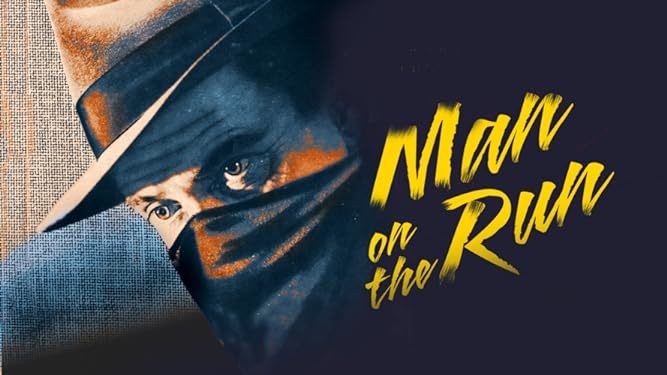
Noirvember: Man on the Run (1949)

man on the run

A man walks into a club and finds his old Army compatriot, Peter Burden (Derek Farr) working behind the bar. Peter is a deserter and as this is post-War England that’s a bad thing to be. The man tries to blackmail Peter so he flees. We see him doing a series of odd jobs throughout the country before, desperate, he walks into a pawn shop looking to sell his Army revolver. Just as he takes the gun out of his coat, but before he can say anything a couple of actual armed robbers come in and beat the proprietor senseless. Before he dies the proprietor gives a description of the only robber not wearing a mask – our hero Peter.

As the police close in on him, a desperate Peter busts into the home of a widow named Jean Adams (Joan Hopkins). He promises not to hurt her, but begs her to let him stay. She being kindly and perhaps a bit lonely allows him overnight. While there he tells her his story and she believes him.

Together they begin searching for the two real burglars who can set the police straight and set him free.

Man On the Run is a terrific little British Noir. It doesn’t do anything new or amazing with the genre, but what it does do it does really well. During my month of watching Great British Cinema, I fell in love with this type of film.

The Brits were great at making this kind of tidy, nuts-and-bolts thriller. I don’t mean to say that there isn’t artistry to this film, because there is. The sets are fantastic, as is the camera placement, and the lighting all has that wonderful noir shadowy thing going for it. It mostly takes place in bars, police stations, and houses which gives it a claustrophobic feel. But it’s a film that doesn’t wow you with that stuff, it isn’t overloaded with style. It is a really good story told really well.

The relationship between Peter and Jean does develop a little too quickly. It is difficult to believe that she’s gonna fall for this man who just busted into her home, clearly running from the police. But that’s the movies and I didn’t mind. Both actors are quite good in it and they do make their love as believable as it can be. The thriller aspects are tightly wound and make their plight quite exciting.

It is surprisingly sympathetic the Peter’s plight as a deserter, something that was quite contentious and in the minds of its British audience at the time. He’s served four years as a soldier but when he requests some additional time off due to family members being deathly ill, his request is denied. He takes them anyway and is considered a deserter. The film puts the moral wrestling over this type of thing in the background, but the fact that it is there at all, and that it lends sympathy to a man (and men like him) who technically deserted is interesting.

The whole thing may be a little too Hitchockian for some but I found it be be delightful all the way through.
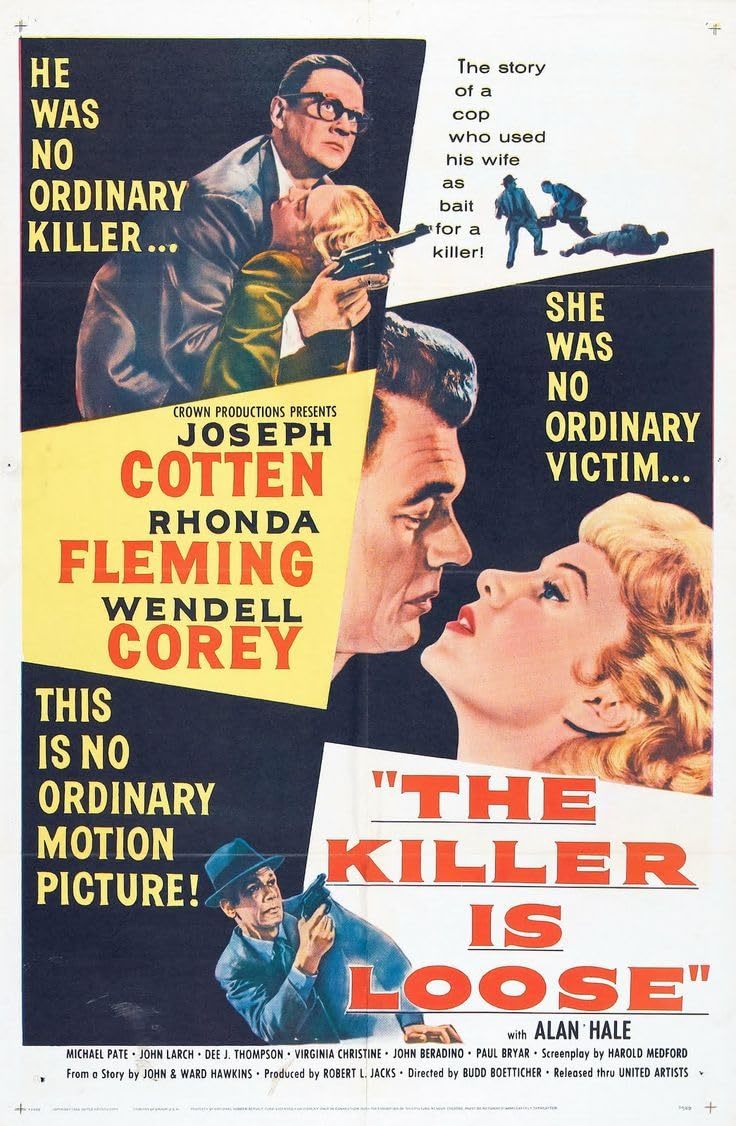
Noirvember: The Killer Is Loose (1956)

the killer is loose poster

A bank is robbed in broad daylight. Everything about it indicates there was an inside man. Lt. Sam Wagner (Joseph Cotten) is on the case. Clues lean toward bank employee Leon Poole (Wendell Corey). When they come to his apartment to speak to him Poole shouts that he’s not coming out then shoots through the door, injuring one policeman. Wagner busts in, but with the lights out he can’t see. He sees a shadow and shoots. The victim isn’t Poole but his wife, who dies instantly. Poole is convicted and vows revenge.

For two years Poole is a model prisoner and he’s sent to a work camp with less security. When he’s asked to accompany a guard to go into town to help pick up a few things he sees his opportunity. He kills the guard and escapes. But it isn’t Sam Wagner he’s after, it’s his wife Lila (Rhonda Fleming) he wants to kill. An eye for an eye, or rather a wife for a wife is his feeling.

Director Budd Boetticher filmed The Killer is Loose in 15 days. In some ways, you can feel that time (and budget) constraint on screen. It often feels like a made-for-television movie. But in all the ways that count, the film is excellent.

I’ve seen quite a few of Boetticher’s films (including all five in the Ranown Cycle he made with Randolph Scott) and I’ve enjoyed them all. He wasn’t a flashy or even stylish director, but he knew how to get the most out of his limited resources. He was a master of efficiency and that’s certainly true here.

I’m very much a fan of Joseph Cotten as well, and he falls right in step with what Boetticher was going for. His performance is perfect, not flashy. It doesn’t draw attention to itself, it’s just a good performance by an absolute pro.

But it is Wendell Corey who catches my attention. He’s not showy, either, but he plays Poole like a wounded animal. There is a scene early on at the bank where his former Sergeant (John Larch) bumps into him. It seems Poole wasn’t much of a soldier and his Sergeant made fun of him ruthlessly. Later, while holding the Sergeant’s wife (Dee J. Thompson) hostage, he tells her that everyone has always made fun of him. Except his wife. In that moment we understand what he’s doing. It isn’t that the film exempts or forgives Poole of his murderous revenge, but the script and Corey’s performance make us understand, even sympathize to some extent.

Naturally, I always want all my films to be masterpieces, but if I can’t have that then I’ll take a solidly built, professionally created film every time. This is exactly that.

Noirvember: Pitfall (1948)

pitfall

John Forbes (Dick Powell) is a regular, average guy. He’s happily married to Sue (Jane Wyatt), has a loveable son, and a decent job as an insurance investigator. He should be happy, but he’s not. He’s bored. He’d like some excitement even if he doesn’t know what that looks like, and when he gets it he doesn’t know what to do with it.

Excitement comes in the form of Lizabeth Scott who plays Mona Stevens. She’s the wife of a guy who just got sent up for embezzlement. The insurance company initially covered some of the losses from that embezzlement scheme and they are looking to get some of their money back. As it turns out the crook gave his wife several gifts with the money he embezzled and the insurance company can confiscate those things to recoupe some of their losses.

John initially sends a private detective named Mac (Raymond Burr) to take a look at the case. He immediately falls in love with Monda and tells John so. John immediately takes him off the case and goes to have a look at her himself.

He likes what he sees and they have a dalliance of sorts. When Mac finds this out he gets all tough guy on John. What’s interesting here is that John goes back to his wife. He’s seen the excitement he was hoping for and it makes him realize what he’s got.

For a time. Naturally, certain events draw him back bringing it all to a surprising conclusion.

It is interesting to place this film into context. Made in 1948 this is a depiction of America just a few years into its post-war greatness. Men like John Forbes are supposed to be the very picture of contentment. He should be happy. But he’s not. Being a cog in a large machine, living a life of utter blandness has gotten to him. And yet, an exciting life filled with sex and violence isn’t the answer either. What the film does with all this is interesting.

Pitfall is one of the definitive film noirs of its period. Yet, I could never quite get into it. Maybe that’s because it is both very similar to the classic noir plot and just different enough to throw me off-kilter. Or maybe it was something else, I don’t know exactly what didn’t excite me about it.

Dick Powell is always enjoyable and I love me some Lizabeth Scott in a film noir. It is always interesting to see Raymond Burr in these old films as the heavy when I grew up watching him as Perry Mason on the television.

So it isn’t the cast that bothers me. And it isn’t a bad film by any means, just not as good as I expected from its reputation.

Noirvember: Black Angel (1946)

black angel poster

This twisty little noir finds Marty (Dan Duryea) teaming up with Catherine (June Vincent) to solve the murder of his wife. The first twist is that Catherine’s husband has already been convicted for that crime. But she still thinks he’s innocent, and Marty doesn’t particularly care for his scheming, femme fatale wife.

He plays piano and she sings pretty good so they decide to team up as an act and get a gig performing at Marko’s club. Marty saw Marko (Peter Lorre) heading into his wife’s apartment just before the murder so they figure he might be the killer.

The proof will be if Marko has a brooch that was stolen from the victim. If he’s got it then he is the killer. There are some nice, tense scenes in which Catherine tries to sway Marko into revealing something, and then later, as she tries to break into his safe.

It is a bit too relaxed to keep the tension going (there are at least two full-on musical numbers in the middle) and a giant red herring causes it to lose a bit of focus, but it is a mostly enjoyable little noir and worth seeking out.

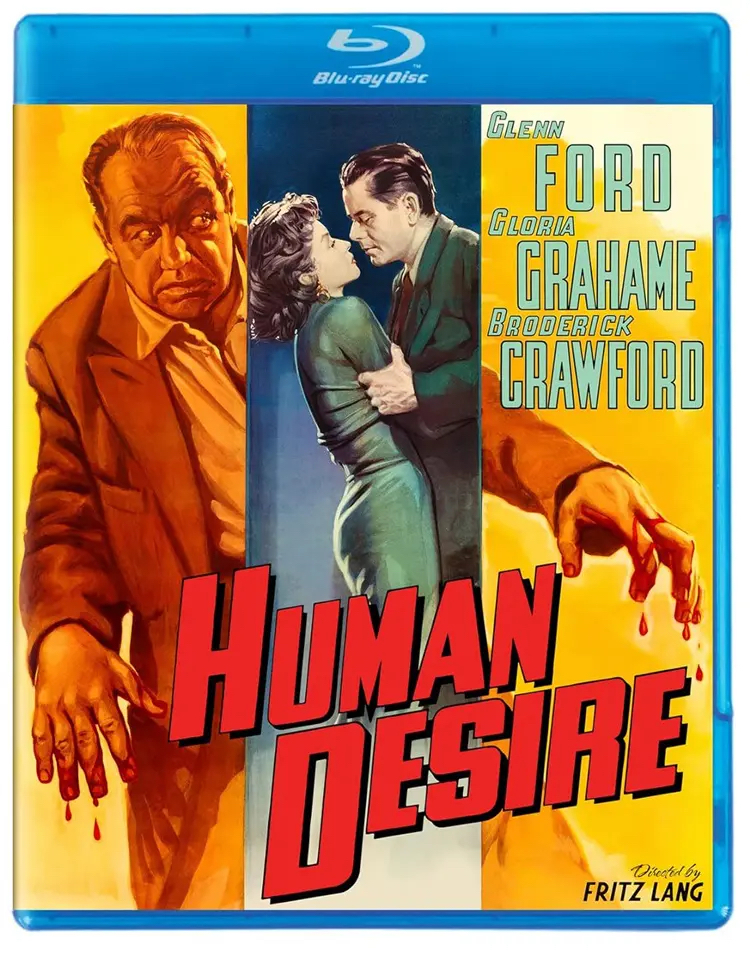
Noirvember: Human Desire (1954)

human desire

Fritz Lang made quite a few film noirs in his storied career. Some of them are some of the greatest ever made. Films like M (1931), The Big Heat (1954), and The Woman in the Window (1944) are terrific examples of the genre.

Human Desire is not the best example of film noir, nor one of Lang’s best, but it’s still pretty great. You can read my review of it over at Cinema Sentries.

Noirvember: Night and the City (1950)

night and the city

Harry Fabin (Richard Widmark) is a man constantly on the run – from gangsters, and bookkeepers, loansharks and anyone else he owes money to or has otherwise schemed. He’s always got something cooking, some way to make a fast buck, get rich, and live a life of luxury. The ironic thing is if he actually put the energy he uses on these schemes and put them to legitimate work, he’d have a comfortable life.

Night and the City begins with Harry on the run. He’s making the slip past some unknown assailants across the streets of London. He winds up at Mary Bristol’s (Gene Tierney) flat. She loves him, but she’s tired of his constant hustling. Taking none of his crap, she simply asks him how much he wants this time.

Harry has a part-time gig working for Phil Nosseross (Francis L. Sullivan) smooth-talking out-of-town businessmen into coming to Nosseross’ club, The Silver Fox. One night out looking for chumps he wanders into a wrestling match where he becomes entranced by Gregorious the Great (Stanislaus Zbyszko). He isn’t in the ring but rather is complaining loudly about how fake everything is. Turns out he’s one of the great Greco-Roman wrestlers and these days everything is more WWE than real.

Harry hatches a plan to use Gregorious to become the wrestling magnate of London. Trouble is the current magnate is also Gregorious’ son Kristo (Herbert Lom). The father is angry with the son for getting involved in what he thinks of as entertainment and not real wrestling.

Harry needs money to get everything set up and he borrows it from Mrs. Nosseross (Googie Withers) who wants to divorce Mr. Nosseross but can’t until she’s got herself set up somewhere else. So she lends money to Harry so he can get more money from Mr. Nosseross (he won’t lend Harry money until he has some money himself to put down) which she will use to start a new nightclub.

The plot gets more convoluted from there. But I was never confused. Directed by the great Jules Dassin things run smoothly and clearly. There are some great exterior scenes overlooking most of the popular London spots, but much of the action takes place underground, it dirty bars, back alleys, and run-down gyms.

There’s a terrific wrestling sequence towards the end between Gregorious and another man. It isn’t staged with any flair, it is just two men trying to beat the other one into submission, but it is brutally effective.

I wish Gene Tierney had more to do that look upset at Harry, but she does get a wonderful scene towards the end that makes it all worth while.

Night in the City is a great movie, and a fantastic example of what film noir can be.

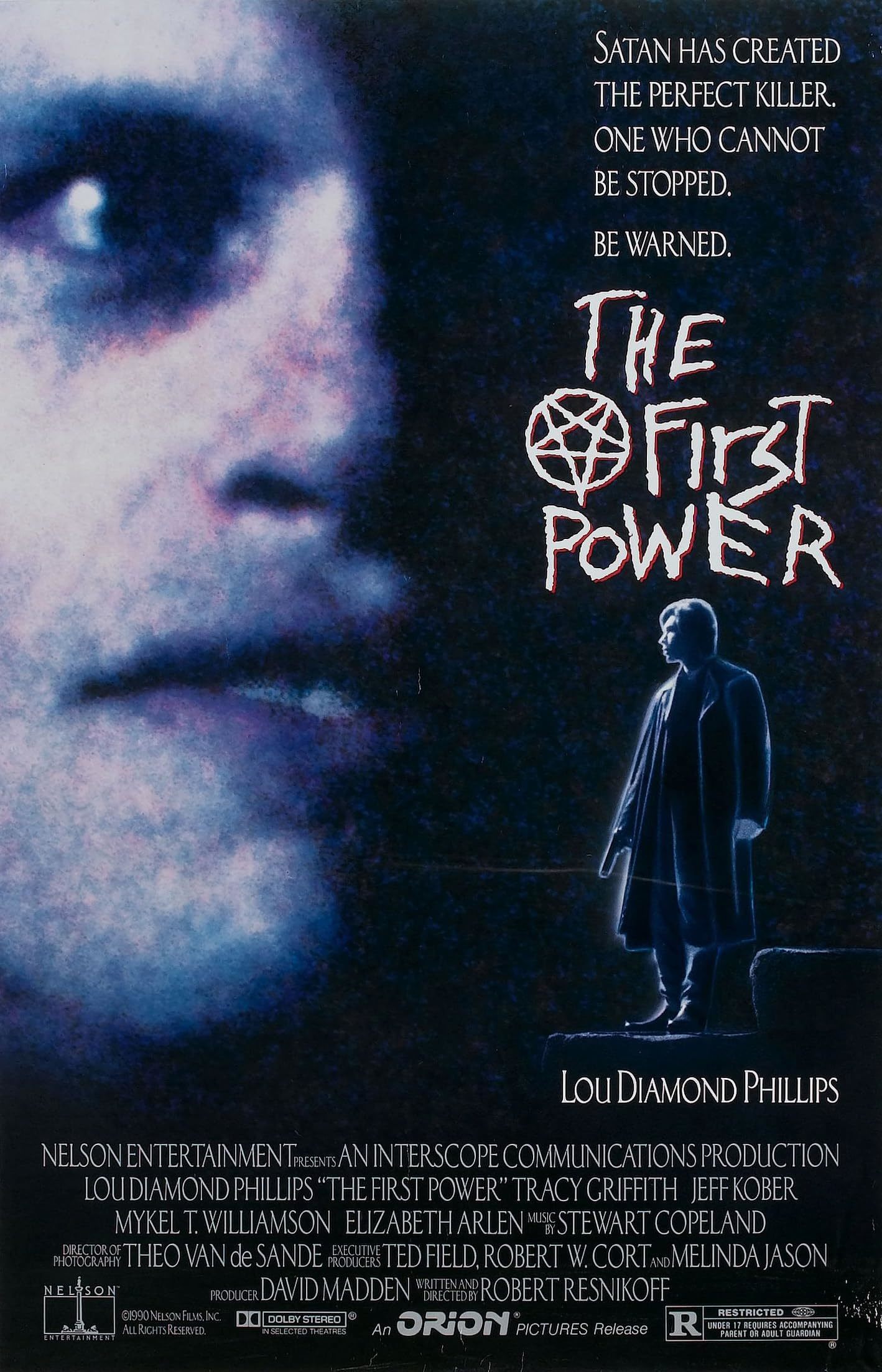
The Friday Night Horror Movie: The First Power (1990)

the first power

A crazy, satanic serial killer is on the loose in Los Angeles. Detective Russell Logan (Lou Diamond Phillips) is on the case. Or rather he’s chilling at home when a psychic (Tracy Griffith) calls him up and tells him where the killer’s next victim is going to occur. But she makes him promise that he won’t kill the killer nor will he allow him to get the death penalty.

Our hero gets the killer but he reneges on the deal to not let him get the death penalty. After he gets the gas chamber Detective Logan starts seeing horrific images and hearing the killer’s voice in his head.

The psychic shows up in person to let him know that the killer’s soul is now inhabiting the bodies of others and the killings will continue until they can stop them.

It is Noirvember and as I noted in today’s Daily Bootleg Post I’m gonna be busy watching a bunch of kung-fu movies over the next week or two. It is also Friday and I’m definitely not giving up my Friday Night Horror Movie. So, I was trying to find a way to blend those two things together.

Theoretically, that’s pretty easy to do. Film noir is hard to define and thus the definition is actually pretty flexible. Neo-noir is even more flexible. Both tend to involve crime, often murder. Sometimes serial murder. Horror films generally involve some murder and sometimes those murders are wrapped up in a murder mystery. A little Googling turned up a list of noir/horror hybrids and that’s how I discovered The First Power.

I wanna say I’ve seen this movie before but none of it rang any memory bells and I haven’t logged in on Letterboxd, so who knows. I definitely remember it coming out and wanting to see it.

It isn’t great. I love me some Lou Diamond Phillips. This film comes at the tail end of his first wave of popularity and it doesn’t work that well as a star vehicle for him. The script is pretty hokey, and it doesn’t lean hard enough on the whole satanic angle.

The killer carves pentagrams into his victims and they do bring a nun in at some point, but he’s never really involved in anything demonic. Most of it takes place in the city in broad daylight which is just weird for a horror movie about the occult. There are some scenes in dark warehouses and down in the bowels of the city’s water drainage. It does some nice things with light and shadow in those moments, but they don’t last.

The film posits that the killer’s soul is possessing various other people but it doesn’t really do much with that concept. Mostly we see him in the original body (played by Jeff Kober), but sometimes we see him in the body of whoever he’s possessing. But there are no scares involved in that. There is never any mystery of who he is possessing.

There are a few good, nut-ball moments like when a homeless woman floats in the air, or when the killer jumps off a ten-story roof and survives, or the fact that Los Angeles apparently has a giant boiling cauldron of flammable liquid in the bowels of their water drainage system, but mostly this is a by-the-numbers early 1990s horror/thriller.

Noirvember 2022

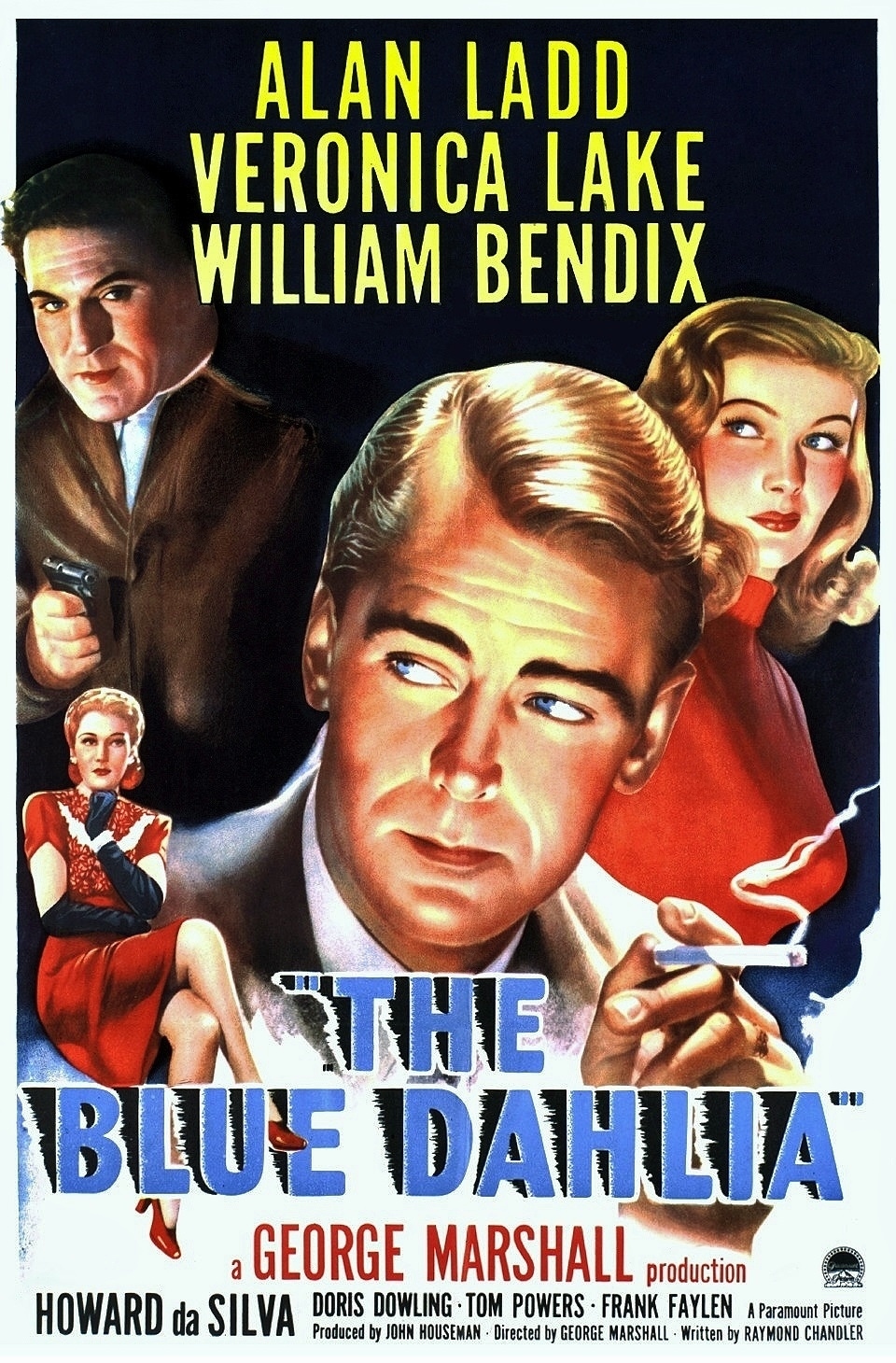
the blue dahlia

I watched 35 movies in November. 27 of those films were new to me. 22 of them were made before I was born. 18 of them could be considered noirs, two of which would be categorized as neo-noirs.

Because I was seeking out lesser-known film noirs, and thus was watching films that were less than extraordinary, I got a little burned out on the genre a little more than halfway through the month and so my watching of said genre slowed down a bit. And then I got sick and I reverted to some comfort movies to get me through.

Still, it was a good movie month overall, and I did see some very good noirs.

Anyway, here’s the list:

Le Doulos (1962) – ***1/2
The Blue Dahlia (1946) – ****1/2
Kiss of Death (1947) – ***1/2
After Dark, My Sweet (1990) – **1/2
The Killer That Stalked New York (1950) – ***
In a Lonely Place (1950) – ****1/2
Sorcerer (1977) – ****1/2
The Dark Corner (1946) – ***1/2
Beyond a Reasonable Doubt (1956) – **1/2
The Dark Mirror (1946) – ***1/2
Johnny Allegro (1949) – ***1/2
Fallen Angel (1945) – ***1/2
This Gun for Hire (1942) – ****
Reign of Terror (1949) – ****
Face the Music (1954) – ***
A Blueprint for Murder (1953) – ***
The House on Telegraph Hill (1951) – ***
The Big Clock (1948) – ****

My favorites were:

The Blue Dahlia. Written by the hard-boiled Raymond Chandler this one stars Alan Ladd as a veteran who returns home to find out that his wife has been cheating on him, when she turns up dead the cops naturally suspect he killed her. Veronica Lake is the classic femme fatale and William Bendix is the pal who has a few screws loose. It had some classic Chandler one-liners and plenty of twists and turns.

Sorcerer. William Friedkin’s fantastic remake of the classic French film Wages of Fear updates the politics a bit, and moves the setting to the jungle, but it keeps all the intense tension.

In a Lonely Place. I’d seen this one before and didn’t love it, but after reading the book I decided to give the film another chance. I’m glad I did because I loved it this time. The movie changes the story quite a bit, turning it into something of a mystery (in the book the character played by Bogart in the film is fore sure a serial killer, but in the movie he maybe, just maybe killed one girl). Bogart is terrific as is Gloria Grahame.

The Big Clock. I wrote about this one in full here.

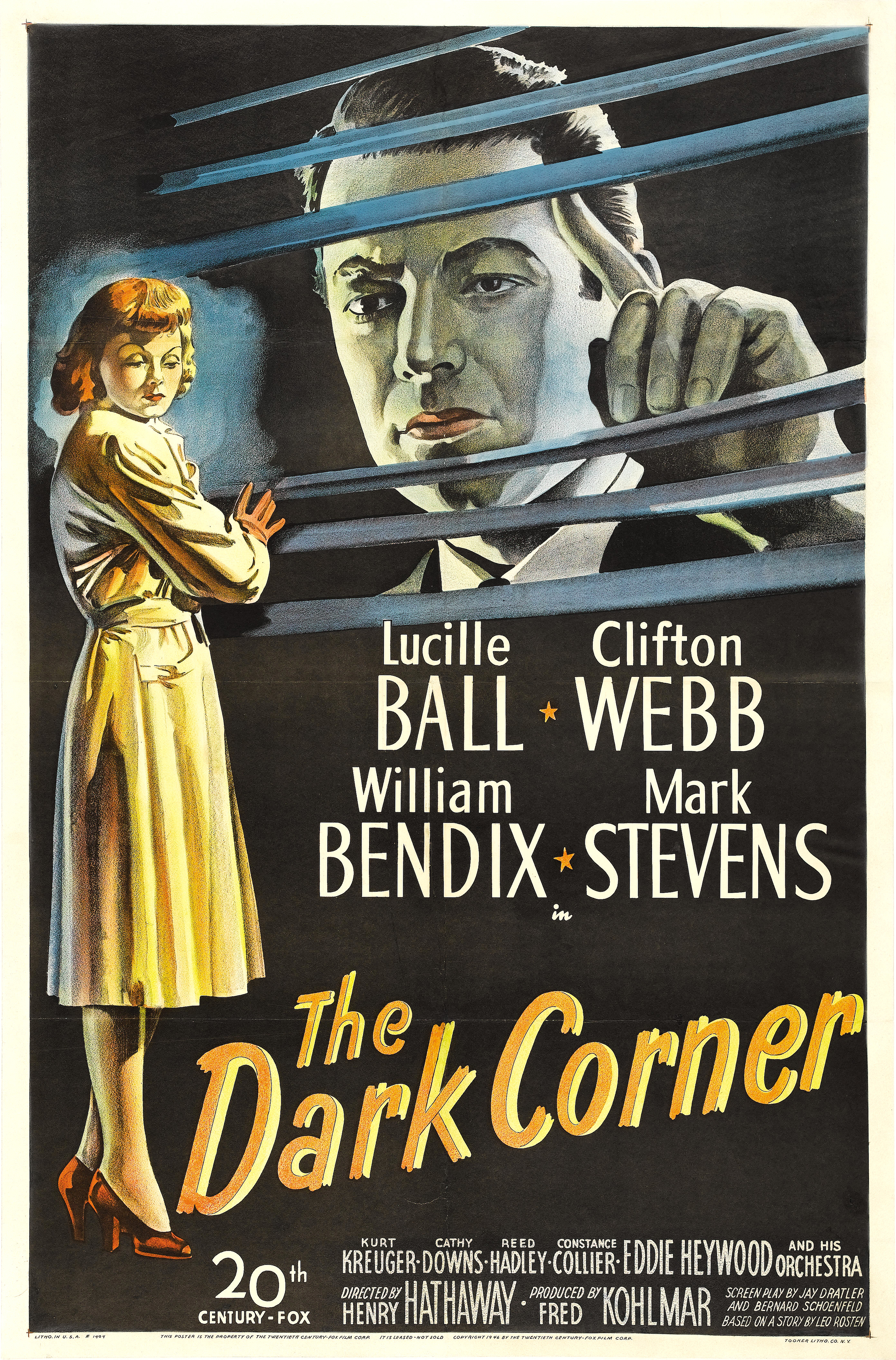
Noirvember #11: The Dark Corner (1946)

the dark corner

I love me some William Bendix. He’s one of those great character actors that you don’t necessarily notice at first but then he keeps showing up in small parts in all sorts of films and you go, “oh there’s that guy again.” And he’s always good. I probably first noticed him in The Glass Key (1942) where he played a jovial gangster who rather enjoyed beating up on Alan Ladd.

He’s a heavy in The Dark Corner as well, but he’s smarter and more crafty, but not nearly as fun to watch. He’s been hired by the film’s true villain to spy on the hero of our picture, Bradford Galt (Mark Stevens). He intentionally does a bad job of it so that Bradford will know someone’s keeping an eye on him. And then later trying to kill him.

Lucille Ball plays Galt’s secretary, but she doesn’t quite fit. Obviously, she was a gifted comedienne and a true treasure, I just wish they’d done something different with her character. They could have used her comedic talents and made something like The Thin Man where she wisecracks her way through the film. Or they could have made her the smartest person in the room. That’s what all the descriptions indicate she’ll be. I was expecting the Galt character to be rather dim-witted and she’s the smart secretary secretly solving all the crimes. Instead, she’s just a regular secretary and the love interest but is given very little of interest to do.

The story is fine, there are some good twists and it has the look of a good noir. But it never quite did it for me.

This makes yet another Noirvember film this month put into the just OK category. I fully expected this to happen as I intentionally picked relatively obscure films to watch instead of the well-known classics, but I have to admit I’m ready for something really good.

Noirvember #10: Beyond a Reasonable Doubt (1956)

beyond a reasonable doubt

I’m generally not the type of person who complains about plot holes in a movie. I’m a firm believer that cinema is much more than the plot. I can easily overlook holes in a plot or problematic bits of a story when the acting, direction, cinematography, music, etc, are doing it for me.

Fritz Lang is a fantastic director. He came up making silent films in Germany so he knows how to tell a story visually, without a lot of audible or written language. But I almost turned Beyond a Reasonable Doubt off because the story was so ridiculously dumb.

Dana Andrews plays a guy who, along with his soon-to-be father-in-law hatch a plan to expose the inadequacies of the district attorney and the death penalty. The idea is to find a murder case that the police can’t solve, then plant a bunch of evidence making it look like Dana Andrew’s character is guilty. At the same time, they’ll take some photos and stuff proving they planted it. The police will catch him, the DA will prosecute him, and the jury will convict but just before he’s executed the father-in-law will reveal the plan and all will be saved. Also, they’ll expose how easy it is to convict and execute an innocent plan.

Anyone with half a brain can see how terrible this plan is. Nobody in their right mind would intentionally get convicted of a crime they didn’t commit expecting the justice system to correct itself when proof of innocence is procured. Anybody who has ever seen a film before will know that something will inevitably go wrong leading to a panic that our hero will actually face the gas chamber. Everyone will guess he gets saved at the last minute.

What I’m saying is this movie is dumb. Dana Andrews does his best to carry the plot on his shoulders. Fritz Lang does a decent job of adding what tension he can to the story. But I could not get past how stupid it all is.

Did I mention that the two men decide not to tell Andrews’s character’s fiance about this stupid, stupid, plan because they don’t want to worry her? Because apparently letting her believe her fiance is going to be wrongfully executed is no big deal. That’s how dumb this plot is.