The Great Pumpkin

pumpkin party
It is a tradition that Amy and I throw a pumpkin carving party around Halloween. It started as a party of two, me and her carving our own pumpkins. In time roommates joined the festivities, and eventually, we decided to have real parties.

It has become quite an annual event with lots of people, food, drinks, and prizes given for the best pumpkin.

After a year off, via Strasbourg, we were very excited to host a new party this year. It was different this year for a few reasons. For the first time since dating, we are both living in an apartment instead of a house. This keeps the carving located in smaller areas inside our living quarters. Our previous home had a very large covered porch in which all types of participants could go wild.

pumpkin carving This was also the first time I’ve invited anyone from my work. For years I’ve kept my business life apart from my personal one. But for varying reasons, mainly the lack of any friends in the outside work world, I decided to invite a few folks I work with to the festivities.

Inviting people from work is harder than it appears. I don’t have the space, or inclination to invite everyone I work with. As a supervisor, I can’t show favoritism to anyone while working, and this has the potential to spill over into my personal life. So I had to carefully choose a few kind folks, and then secretly invite them.

Amy invited a few folks from the French department making it a unique mix of French, French-Canadians, intellectuals, and the working stiff.

It’s always funny to me that Amy and I spend a large quantity of cash buying food and prizes, hours of our time cleaning the house, preparing food, and making the proper musical arrangements, all for what amounts to a couple of hours of fun.

The party started at six and by five we had already had a few callouts. Surprise visits by grandparents, deaths in the family, and horribly late veterinarians all were keeping folks away from our party.

Around seven we had enough people to call it a party. We munched and drank and mingled. We then spread out the plastic coverings and got down to business. Amazingly, several people confessed to having never carved a single pumpkin.

An easy victory, I would have thought had it not been for the appearance of Travis, my arch-enemy in pumpkin carving. Travis has been carving pumpkins for as long as he’s been able to hold a miniature blade and usually beats the pants off of everyone.

Patterns were chosen, stems cut out, and pumpkin guts were strewn into bowls all over the flat. Some chose to trace their patterns with marker, others tapes the patterns on and cut through them, and still others used the poke tiny holes method.

pumpkin Half-way through I realized my legs had fallen asleep while sitting on the floor. I have rather poor blood circulation and my appendages have a tendency to go numb if I sit still for too long.

Standing up, I realized I could feel neither leg as my right foot literally bent all the way over to the ankle. Trying to rebalance myself I felt the world turn as I fell towards it. Like an old man, I crashed against our big CD shelf and prayed that neither it nor the clock on top would come crashing down.

With a good thump, I landed on the floor. Embarrassed and with the entire house looking at me with shock, I managed to yelp out and “I’m Ok” and get back on my feet.

With that excitement over we all finished our pumpkins and were ready for the judging. Through secret ballot, we all voted on our favorite carvings. Travis did a marvelous hanging bat that got a whirlwind of oohs and ahs. I must admit though he was my nemesis, I voted for him.

carved pumpkins

I, myself, went for a complicated scary tree, that Amy dubbed Treebeard. I was a little hesitant as I cut him out, worrying that my year off had atrophied my ability to carve something more than a smiling face.

But with a candle inside, Treebeard won me the victory! First prize in my own home! Being the host I let Travis, the second prize winner, have his choice between the prizes: The 10th-anniversary edition of Toy Story, and the complete works of Curious George.

It was a great night.

pumpkin party

The Simpsons One Step Beyond Forever: A Complete Guide to Our Favorite Family…Continued Yet Again

the simpsons one step beyond forever I am, what the kids call, a Simpsons fan. It easily falls into my All Time Top 5 Television Shows ever list. It has a rotating slot with Cheers for the Number 1 spot on that list.

When The Simpsons moved from its Sunday night slot to Thursday night, throwing the gauntlet at The Cosby Show in a no-holds-bar grudge match, it split my family apart. Mom and Dad stayed in the living room in front of the main TV with the Huxtables, while my brother and I huddled together in the back bedroom watching the Homer, Marge, Bart, Lisa, and Maggie.

I’ve been taping The Simpsons for as long as they’ve been on. I’ve got a shelf dedicated to VHS recordings of the show. New episodes, syndicated reruns, with commercials, commercial-free, and several dubbed in French from the time my wife spent in Montreal. It was with great pleasure that I met the news that FOX was releasing each season on DVD.

When we spent 10 months in Strasbourg, France, and were without television, we spent our lunches, suppers, and free time watching DVDs on the laptop computer. Only the first four seasons were out at that time and we wore them out. Having already spent the last 10 years+ watching these episodes, we continued to watch the Simpson shenanigans on an almost daily basis.

I must admit that after about 6 months of those episodes, we did get a little tired of them. At about two dozen viewings of each episode though, that’s not a bad track record for a TV show.

For any fan of the show, the Complete Guides to Our Favorite Family series is indispensable. Each book has covered several seasons of The Simpsons in the minutest of details.

The Simpsons One Step Beyond Forever: A Complete Guide to Our Favorite Family…Continued Yet Again covers seasons 13 and 14. It is the best companion piece you’ll ever find to the series, and nearly as good as having every episode, uncut and restored on DVD.

The layout is similar to the previous books. Every episode for these two seasons is fully covered giving plot synopsis and the best quotes. All of the movie/music/TV/literary references, both obvious and obscure, are listed as well as a section dedicated to “the stuff you might have missed.”

The Simpsons are what creator Matt Groening calls the first VCR television show. There are so many quick sight gags in each episode – be it a church marquee reading “If you were pastor you’d be home right now” to the Simpsons staying at the Second Best Western hotel – you have to rewind and pause the VCR, er DVR to catch them all. That is, unless you have this book that captures every gag in every episode.

Along with episode guides, there is a complete listing of every uttering of Homer’s “D’oh” or “Mmmmm” (mmmmm…unexplained bacon), couch gags, song lyrics, and virtually anything you’d ever want to know about the show.

Sure, seasons 13 and 14 do not contain the best episodes ever. They even generated an influx of jumping-the-shark accusations. I certainly yelped out a few groans over less-than-stellar episodes. However, there are still a good number of classic episodes in these seasons (The Blunder Years where, under hypnosis, Homer regresses back to his 12th year and winds up screaming like a child – for hours; or How I Spent My Summer Vacation with Homer going to Rock n Roll camp – Mick Jagger: “Homer, its only rock n roll camp” Homer “But I like it” – immediately come to mind.

One Step Beyond Forever continues the excellent tradition of documenting every nuance of one of the greatest shows to hit television…ever.

On Chat, Lead Poisoning, and FBI Raids

chat pile

Ok, I have several stories that I want to tell involving a job I had several years ago. The problem is, that to make any sense of those stories you have to have some information concerning the job and what I did. So the first half of this post may be a little tedious, but it is completed with a grand tale of intrigue. Tell me you like it and I’ll fill some later posts with crazy, mad tales from the same time.

Between the years 1999-2000, I worked in NE Oklahoma, a desolate, desperate, depressed area. For the better part of the last century, this section of the country was mined for various metals, including lead. The lead mining in this community was so enormous they say there are enough underground tunnels that if you laid them all out in a straight line you would drive halfway across the country.

The displaced soil from these tunnels, what the locals call chat, and which consists mainly of small bits of rock and lead, has been piled up forming great mountain-like piles. There are large sections of the area that look a lot like the parts of Arizona and Utah that you can see in old John Wayne movies. It was really quite beautiful and spooky.

Loads of chat from these “mountains” was used throughout the community to fill in driveways, and roads, and to smooth out yards. This added to the already high levels of lead contamination in the soil, causing extensive health problems for the community.

We’ve all heard about the dangers of lead poisoning from old water pipes, paint, and even dishes. Well, this community not only had lead in all of those places, but in the very ground they walked upon, and the air that they breathed. Children are especially susceptible to lead contamination, and in fact, there was a high rate of related health problems in the area.

chat piles

The EPA (that’s Environmental Protection Agency to you non-Yanks) moved in and decided they needed to do something about it. Through the US Army Corps of Engineers, they hired the company I worked for to do the cleanup. We went to each property, tested the soil and if the soil was contaminated we removed it and backfilled it with clean soil.

My job was insurance. I came to the property before any work was done and documented any pre-existing damage to the homes inside, outside, and underneath. I took digital photos, shot videos, and filled out a long checklist documenting any damage that existed to the houses, land, and anything sitting on the land. So, if a homeowner decided to sue my company because we caused some damage to their home, we would have proof that it was damaged long before we go there.

And believe me, there was often plenty of pre-existing damage. As I said this was a very depressed area. The mining companies had long since left, leaving the few members of the community who wanted to remain with very few means of surviving.

old house

Even though we were doing about $30000 worth of work to these properties and charging the homeowners absolutely nothing (it was a superfund site meaning the $$ didn’t come from tax dollars either, but rather from donations to the EPA and from fines they had levied upon various companies) some of the homeowners hated us. To them, we were big government coming in to take over their lives. Or to a few others here was big money government whom they could sue and get rich off of. After a few months with the local paper writing semi-weekly articles on how we were causing water damage to the houses we worked on (in my inspecting I found that more than half of the homes I visited had inches of water standing under their crawlspace) the complaints from homeowners became more frequent. I once literally had to take a complaint from a lady who said there was water in her yard that morning….it had poured some 4 inches of rain that very morning!)

At any rate, tensions were pretty high between the townspeople, my company, and the federal government.

One day, while out on assignment, I heard over the walkie-talkies we used to communicate a call to one of the foremen that he needed to head back to the office. A few minutes later a similar call came to the other foremen. Then one of the Army Corps of Engineers was called back to the office.

I felt all this was peculiar, but I was a small fry in the company and continued with my work. I needed to head back to the office a bit later and did so with no worries. I imagined there was some kind of onsite accident that needed the attention of the bigger wigs.

chat pile

Since it was construction work, our onsite offices were nothing but a group of trailers. As I drove back to the office I noticed a large number of cars lining the sides of the street. This, too was a bit unusual, but not that rare. A funeral home was located nearby and periodically the streets would be lined down the road for a funeral. There were a number of people also standing by the side of the road, and though unusual, I didn’t see anything completely askew at this point.

I slowed down to make the turn into my office complex. Just as I was turning I noticed one very large man walking across the street towards my building. On the back of his jacket, in bright white letters read:

FBI

Holy crap! What is that guy doing here? I wondered.

I parked and headed to my friend Sandy’s trailer, expecting she would know something. I walked into her office only to find that Sandy was not there, instead two more, very large men with even larger pistols strapped to their sides were searching through the office.

One of them turned to me as I entered and asked very abruptly, what I wanted. I timidly said I was looking for my friend and U-turned it straight out.

When I entered my building, which was the main trailer on site I was greeted by Sandy, the project Engineer, my boss, and various other office workers. They were all lined against a wall, sitting on the floor.

Moving like ants whose hill has just been stomped on, a variety of FBI, IRS, and Federal Marshalls were zipping throughout the building. One, enormous male, stopped long enough to tell me to join the others against the wall. They were digging through all of our files, and collecting them for removal. They were even downloading everything off of our computers and confiscating the hard drives. No one would tell us precisely what they were looking for.

We were told we could not leave the premises until the search was complete.

Outside the line of cars I had seen previously, grew. Large masses of people stood across the street, staring at this circus. Media from Joplin, Missouri, and Tulsa came up with their video cameras.

At around 7 that evening the officers finally let us all go home, still not willing to tell us just what they were looking for. They had essentially stripped all of our offices of every piece of data we had used over the last couple of years.

It was several months later when I found out that one of the top folks from my company had been bilking the government out of huge sums of money. Apparently, this guy filled out work orders for things never completed. Added fake names to work lists, etc.

I believe they finally gave up on the cleanup and simply paid for everyone in the community to move. (Editors note: a few years after I wrote this a tornado ripped through town destroying just about everything.  It is now almost completely deserted).

Suicide Club (2001)

suicide club poster

Fifty-four Japanese schoolgirls stand on a train platform, holding hands, singing, and laughing. As the train approaches they clasp their hands tighter, and in sing-song fashion start to count. As the train arrives, the counting stops, and all 54 of them jump in front of the train. Buckets of blood and guts spray the train, the passengers, and the people passing by.

Later, another group of teenagers sits on the roof of a school building during their lunch break. They are eating and laughing and looking like happy schoolchildren. Conversations turn to the 54 and how cool it would be to form their own suicide circle. Amongst much joking and a good time having, a crew decides to end their lives then and there. Standing on the edge of the rooftop they hold hands and plunge their way to the bottom. Buckets of blood and guts spray all over the school grounds, teachers and students.

Amongst the bloodletting are some scenes about a pop group whose Britney Spearesesque pop wailings are irresistible to every teen. Adults everywhere do their best to quash any talk about the deaths being a part of a suicide club movement.  A theme develops about society’s herd mentality.

Call it Japanese horror with a message.

The cops have to rule all of these deaths as accidents for there seems to be no foul play involved. That is until a bag filled with little rectangles of skin sewn together shows up. Then the suicides become a matter of detective work.

The detectives begin getting calls from a cyber-savvy woman who seems to know more than she lets on, calling herself the Bat. She leads the detectives to an internet site keeping a count of the suicides before they actually happen. One of the detective’s kids finds another site with some peculiar type clues.

Call it a Japanese horror, detective thriller with a message.

Through all this shocking, blood-splattering suicidal carnage continues to occur.

The detectives find a suspect who acts like a cross between Ziggy Stardust and Graham Norton. He’s definitely a bad fellow, what with the squishing of animals, kidnapping, and the random sexing with girls wrapped in pillowcases lying in a bowling alley. But he may not be behind all the suicides.

Call it a Japanese horror, detective thriller by way of Asian MTV, with a message.

In the end, we’re left with nary an explanation of the suicides, but that’s not really the point anyway. There is lots of gory violence if you like that kind of thing. And let’s be honest if you are taking the time to search out a copy of a relatively obscure Japanese horror film called Suicide Club, you probably do. There are gobs of creepy, moody suspense, with some very dark humor thrown in. All mixed in with some pretty in-your-face, and spot-on social commentary.

What’s not to love?

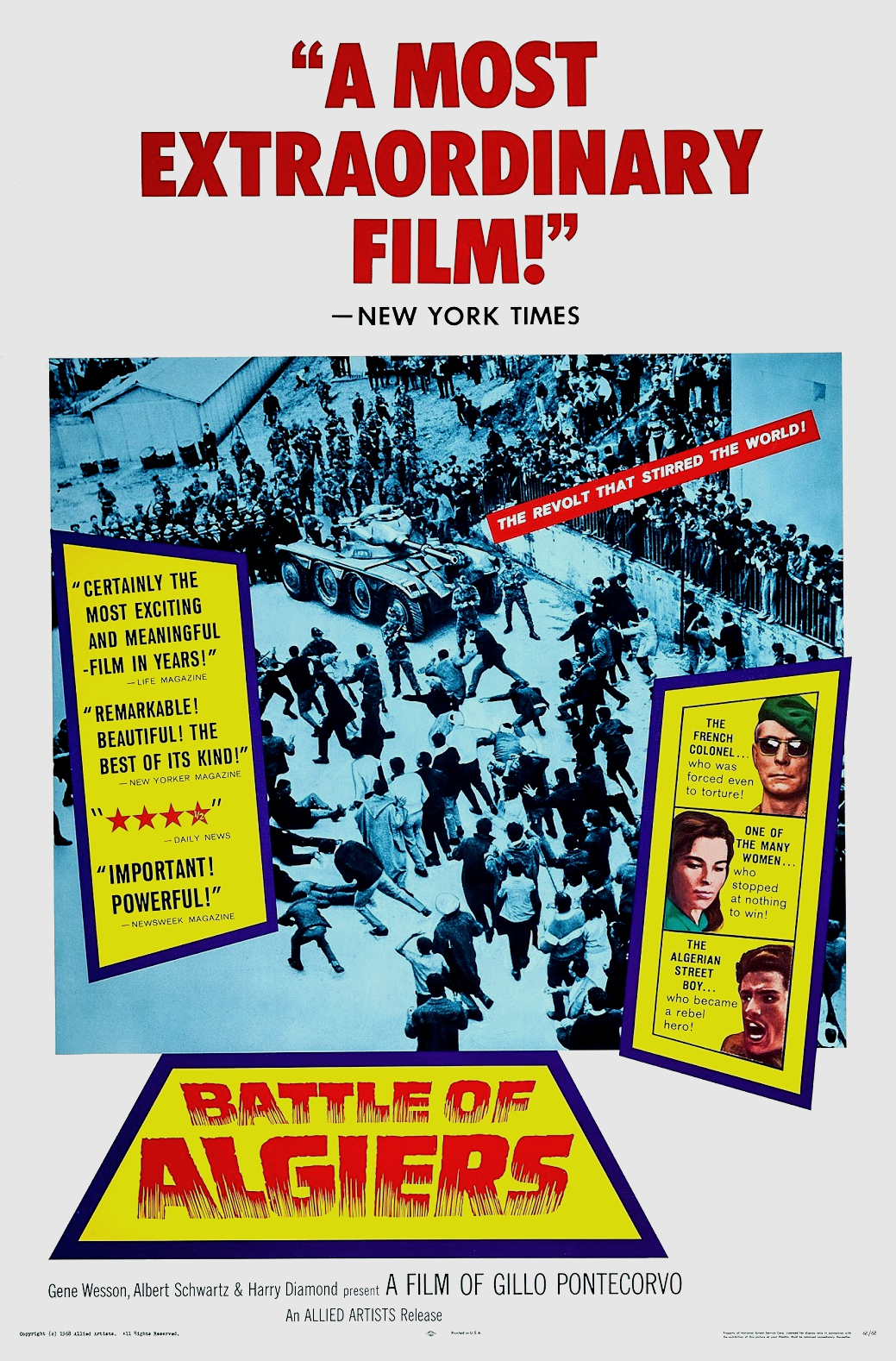
The Battle of Algiers (1966)

the battle of algiers poster

A man has electrodes attached to his ears and is shocked until he names names, and gives vital information about the revolution. A band of children shouts at an old man “drunkard” as they beat him and send him tumbling down a flight of stairs. A bomb explodes in a café, killing women and children. These are just a few of the horrific images seen in The Battle of Algiers, the 1965 film concerning the Algerian revolution against French colonization. From the start, we are told that no documentary footage was used in the making of the film and that it is all staged. It is an important piece of information, for it looks and feels all too real. The filmmakers used newsreel film stock, existing light, and actual locations to make the movie. This succeeds in sucking the viewer straight into the trenches. We feel as if we were there, plotting with the revolutionaries, struggling with the French army.

While watching this film in 2005 it is easy to think about the war in Iraq. There are many similarities including a large nation occupying a smaller, Muslim country; small bands of revolutionaries who have created an underground network of revolt. Even the methodology of the Iraqi insurgents is similar to the violent acts of the Algerian revolutionaries.

It is a disservice to the power of the film, though, to allow it to only serve our current political landscape. It is, in fact, important to realize that a film about an Algerian revolt against French oppression over 40 years ago, can serve as a springboard to a discussion about US involvement in Iraq. It is a film, that is specifically located, and time capsuled and yet its message is so universal that it can be applied to any war, insurgency, or revolution.

Though the filmmaker’s sympathies clearly lie with the Algerians, no side comes off as humane. The revolutionaries think nothing of bombing innocent people, some of them their own, to further their cause. There are multiple shots of the Algerians shooting policemen at point-blank range.

The French fight dirty as well. In a particularly grueling montage, we see them hideously torture the Algerians to get information. The French leader, Col. Mathieu (Jean Martin), at one point, mentions that the only way to fight off this type of revolution is by using such brutal tactics.

Ultimately, the film left me not with a feeling of rightness for either the French occupation, or the Algerian revolution, but rather despair over the horrendous acts we are capable of as humans.

It is a moving, often gut-wrenching picture, but an undeniably important one. Gillo Pontecorvo has made a film that needs to be watched. Not only to understand the Algerian revolution but to get a better understanding of any form of violence and revolt.

U2 – Wide Awake in America

u2 wide awake in america

I first bought this EP, in tape form, from a used record shop for about $3.00. I wore the sucker out playing it on my way to and from high school.

It is really more of a CD single than any real album. Though the sticker price would have you wish for more. It has two live cuts and a couple of B-side singles.

The first track, a live cut of “Bad”, from the newly released (back in 1985) album, The Unforgettable Fire, is tremendous. It has a real laid-back feel to it, with a nice groove running throughout. Adam Clayton’s bass moves the song along while Bono is at his best as a frontman.

Bono sings the song like a preacher at the apocalypse. You can almost see him standing on the edge of the stage, thousands of fans reaching out to him in front, while fires ablaze from behind.

Another live track comes next, A Sort of Homecoming. It doesn’t have quite the same magical feel of “Bad”, but is still played quite well, and is actually quite fun. What with the bouncy chorus, sing-along chanting, you actually forget the darkness of the lyrics.

The final two cuts, Three Sunrises, and Love Comes Tumbling are studio offerings that didn’t make the cut for The Unforgettable Fire. It is easy to see why. They are slower ballads, with little passion in the delivery.

But if you can find the album in the bargain bin, the live version of “Bad” is more than worth a listen.

To read an essay I wrote on U2 featuring some stories culled from this album click here.

Steve Kimock Band – Eudemonic

steve kimock eudemonic

The first time I saw Steve Kimock play was during the summer of 1998. He was one of two guitarists (the other being Mark Karan) filling the big gap left by Jerry Garcia in the Grateful Dead reincarnation The Other Ones.

Kimock’s stage presence was slight. Sitting on a stool, guitar in his lap, head bent down he looked more like some Buddhist monk contemplating the mysteries of the universe on a lonely mountain than a rock star.

In fact, many Deadheads were complaining about his lack of presence during this tour. This always seemed ironic to me considering that Garcia had spent the last decade of his life, standing motionless on stage, with his chin resting on his chest.

While others complained about how Kimock looked on stage, I was awed by his chops as a guitarist. His playing was both fluid and tight. Technical and yet full of emotion. Much like Garcia himself, in his better days.

Soon after The Other Ones show, I did some tape trading for a live KVHW show. This was a short-lived band Kimock formed with Babby Vega, Alen Hertz, and Ray White. Again I was knocked out by Kimock’s virtuosity on guitar.

For whatever reason, though Kimock’s name was often batted about in musical conversations amongst online groups, I never gained another piece of his music. Various albums, live tapes, and concerts landed on my list of things to get but never managed to materialize into reality.

So, it was with great anticipation that I found myself with the Steve Kimock Band’s newest release, Eudemonic. The dictionary says the title means “producing happiness and well-being.” That’s a lot to ask for in 66 minutes of music. I definitely had a few moments of happiness brought to me by the music on this album, but I’ll leave my well-being to a higher authority.

I have to admit right upfront here, that I’m not a fan of instrumental music, especially instrumental rock music. Sure, I’ve got some classical music, your Beethoven some Mozart, and whatnot. But I generally regulate this to background music; something to play when I’m a little sad, or to back me up during a romantic dinner. But with the music coming out of my car stereo, or pulsating through my home, my music life consists of some lyrics, some singing.

Don’t get me wrong I can totally dig a 10-minute improvised jam in the middle of a song, but in the end, I want it to come back to a melody, a hook, a chorus. Walking down the road, I need a lyric to sing.

Eudemonic, in fact, feels like the middle jams to some really great songs. I just keep waiting for them to go somewhere, to have a crescendo and soar back down to a rousing final verse or a sing-a-long chorus.

The instrumentation is admittedly quite good. I still hear the passion and performance behind the Kimock guitar, and the rest of the band plays extremely well. Alphonso Johnson especially proves his ability to hit the right groove on bass.

The standout songs are the retro groove opening track, “Eudemon, the moe. inspired “Ice Cream”, and the bouncy “Bouncer”. The songs are often lengthy, averaging about 6 minutes per song. There is plenty of grooves laid down in all the songs, I just wish there was either consistency throughout the entire album or a bigger hook-to-song ratio.

Fans of instrumental guitar rock will have a lot to dig into with Eudemonic. The jams are flowing, and Kimock is a fine guitar player. It is, in fact, my predilection for turning instrumental music into background fodder that gets me in trouble here. There is just too much going on here, musically, to allow it to stay in the background. A person needs to really listen to the interplay between musicians on this album. Because of this, I’m afraid Eudemonic is something that will probably not get a lot of play around my house. But for those of you willing to take the time to dig into a piece of music, there are many treasures to be found.

2 Days in the Valley Soundtrack

2 days in the valle

Once in a while, I’ll leave the movie theatre and head straight to the music shop, knowing I simply must purchase the soundtrack album. I leave thinking the music was just so perfect, so wonderful, that it would simply be a shame to not have it in my collection.

Usually, the soundtracks turn out to be absolutely friggin’ brilliant. To this day I play the Swingers soundtrack and dig nearly every swinging note. When I’m jonesing for some classic 90’s grunge I always turn to the soundtrack to Cameron Crowe’s less-than-stellar film, Singles.

But sometimes, as it turns out, the music on a soundtrack turns out to be better suited for the cinema. The songs fit the scene perfectly but taken outside of the Hollywood lights, the sounds fail to perform. Somehow the mix of images, lights, and sounds gelled, but when left alone, the music falls flat.

The soundtrack to 2 Days in the Valley is one of these disks. I literally walked straight out of the movie theatre and into the record shop and picked up the soundtrack. While watching the film all I could think about is how great the music is.

Truth be told, some of the songs are fantastic. Wilson Picket’s “Hello Sunshine and Otis Redding’s “Down in the Valley kick out the R and B jams like only they could. One of Lyle Lovett’s greatest and saddest songs “Nobody Knows Me is included in the package.

Both Taj Mahal’s “Rolling on the Sea, and Erin O’Hara’s “Down in the Valley” are very listenable, but fail to be enough to make me want to dig out the album to listen to just them. Other songs, such as Morphines “Gone For Good, seemed wonderful in the cinema. That song fit the scene perfectly, and brought home the loneliness of the moment, but left playing in my car, or the home stereo, and it just seems rather sappy, kind of silly.

The few bits of the score included failed to gain any interest. And songs like Scott Reeder’s “Gold” are barely palatable. They are the type of songs that go unnoticed in a movie, playing in the background, but get quite annoying when played on their own.

Ultimately I have the Lyle Lovett song on his own album and the two remaining standouts aren’t enough to make me shuffle through the rest to play this album often.

Neil Young – Silver and Gold

neil young silver and gold

Neil Young’s first acoustic album in seven years, Silver and Gold sounds shamefully thrown together. His last acoustic effort (not counting the MTV Unplugged release) Harvest Moon is one of my all-time favorite albums. There is some lovely songwriting in there, with some nice backup singing by the likes of James Taylor and Linda Ronstadt. It was a throwback to Young’s most successful album, Harvest. And it sounded marvelous.

In the time between Harvest Moon and Silver and Gold, he released some seven albums. He paid tribute to Kurt Cobain, rocked live with Crazy Horse, recorded with Pearl Jam, and wrote the soundtrack to a Jim Jarmusch film, all of which were pretty ragged, electric, and very loud.

I was very excited to get some more acoustic Young, but find myself disappointed with this release. That’s not to say it is a bad album, for there are several really good tunes here. The opening track, “Good to See You is a fun, jaunty little thing. His ode to his first band, “Buffalo Springfield Again is a great deal of fun, and makes me wish that band really would get back together, though I’ve never been much of a fan.

It is when Young decides to sing a ballad that things get difficult here. Eight of the ten tracks on the album are slower numbers. With the exception of “Silver and Gold (a song I included in my wedding reception music) and “Razor Love, the slow songs are boring. There is nothing to set them apart musically, and the lyrics don’t say anything particularly moving.

It is an album worth buying for the standout tracks. But you would be better off importing those tracks onto a mix tape, or your iPod and then selling back the album to someone else.

The Postman Always Rings Twice

the postman always rings twice posters

Unlike the other classic masters of crime fiction (Hammett, Chandler, and even Christie if you must) James M Cain wrote not from the perspective of the cop, or the detective, but from the side of the criminal. He wasn’t really interested in the methods of detection, but in the methods and reasons crimes were committed.

There is no Phillip Marlowe or Hercule Poirot out to solve the case in Cain’s fiction. The righteous bringers of justice are regulated to a secondhand role in his stories and are often as slimy and unrighteous as the criminals.

In his first novel, The Postman Always Rings Twice, Cain weaves a complicated plot in a very simple manner. This was never meant as anything more than a pulp novel, its aim was to titillate, shock, and most important of all, sell gobs of books.

Though told in the first person by a main character, the book is all action. There is some internal dialog, but it sheds very little light on who the characters are, and what motivates them.

It is in fact, perfect for a screen adaptation. This is probably why it is credited as the story at least 5 times on the Internet Movie Database. The lack of complicated internal thought processes, and the predilection for talking and doing, make it the ideal movie. That, and great lumps of sex and violence.

The two most famous screen adaptations are the 1946 Lana Turner/John Garfield version and the steamier Jack Nicholson/Jessica Lange released in 1981. Everyone refers to that one as a remake of the 1946 version which gets me riled up for some reason. To me, it is simply another version of the novel, rather than a remake of the old film. There are about 8 million versions of Hamlet out there, but no one refers to the next one as a remake of an earlier film. It’s simply another version of the play. But perhaps this is because I’m a fan of the novel, and I probably shouldn’t make too big a deal out of it.

The plot takes on several turns but is essentially about lust and violence. Drifter Frank Chambers lands a job at a roadside diner owned by Nick Papadakis (Smith in the 1946 version). Chambers falls immediately in lust with Nick’s unhappy wife, Cora. They cook up a plot to kill Nick making it look like an accident. Complications ensue.

The biggest difference between the two pictures is that the 1981 version has got more sex. The book is loaded with sex, or should I say simulated sex or rather off-screen (or off-page) sex. Due to the prevailing censorship at the time the novel was written the sex had to be hinted at, double entendre’d, and written in such a way as to let everyone know what they were doing and not get banned from bookshelves. Even with that, it was still quite controversial at its time.

The 1946 version hints at all the deep-seated passion going on without actually showing us anything more than a few kisses. (Though on a side piece of trivia, audiences were shocked that Garfield obviously used his tongue in one of the kisses) By 1981 Hollywood was no longer under the strenuous Production Code and morals had loosened up more than a bit through the 60s and 70s and the new version of Postman all the sex was brought out front.

The kissing gets more passionate, there is touching, rubbing, and a good deal of nakedness. The steamy sexuality of the characters now scorches off the screen. They even added a new sex scene that wasn’t in the book, just for kicks.

But even with all the nakedness and sexing, this newer version doesn’t have all the lust of the original. Though Cain was unable to fill in all the sexy details of their affairs, the raw sexuality burns through each page. The characters are led by their passions and you can feel it in every word and deed. In the same way, though nary a thigh is even shown in the 1946 version, the passions full of lust are ignited on screen. Turner and Garfield exude sensuality without any sex that far surpasses what Nicholson and Lange can manage with a movie filled with on-camera love scenes.

The violence remains pretty much the same in both versions. As a culture, we Americans have always seemed to have less of a problem with violent deeds than with any amount of sexuality. Neither film is particularly graphic in its violence, though murder and attempted murder appear throughout both plots.

My biggest problem with the 1981 version is that first-time screenwriter, David Mamet, tries to fill out the characters and give more story to the story. In the book, Nick is not a bad man, and we are given no real reason why Cora would be unhappy enough in the marriage to kill. Mamet offers a few small scenes to try to show the darker side of Nick, not enough for the audience to truly hate him, but enough to give some justification for his murder.

Likewise, Frank is a pretty worthless drifter in the novel but is given a more tender side through the pen of Mamet. Both of these additions serve to lessen the story, not give it greater depth. Cain wrote characters full of selfish lust. Frank and Cora’s passion for each other moves them to do horrible deeds, not out of any love for each other, but for reasons all their own. While it seems admirable that Mamet would attempt to bring human reasons for the character’s actions, it only serves to muddle the story. The local news and true crime shelves are filled with real-life atrocities committed for no real reason at all.

The 1941 version sticks very close to the novel’s plot. There are a few minor changes, I’m sure, and some things left out due to the time restraints of the film. But mostly it sticks closely to the book.

Sadly the great ending of the novel is removed from the 1981 version. This makes the end a little more sad, but the great irony of Cain’s closing is all but lost.

I wrote a more detailed review of the 1981 version when a new Blu-ray of it was released, for Cinema Sentries which you can read here.