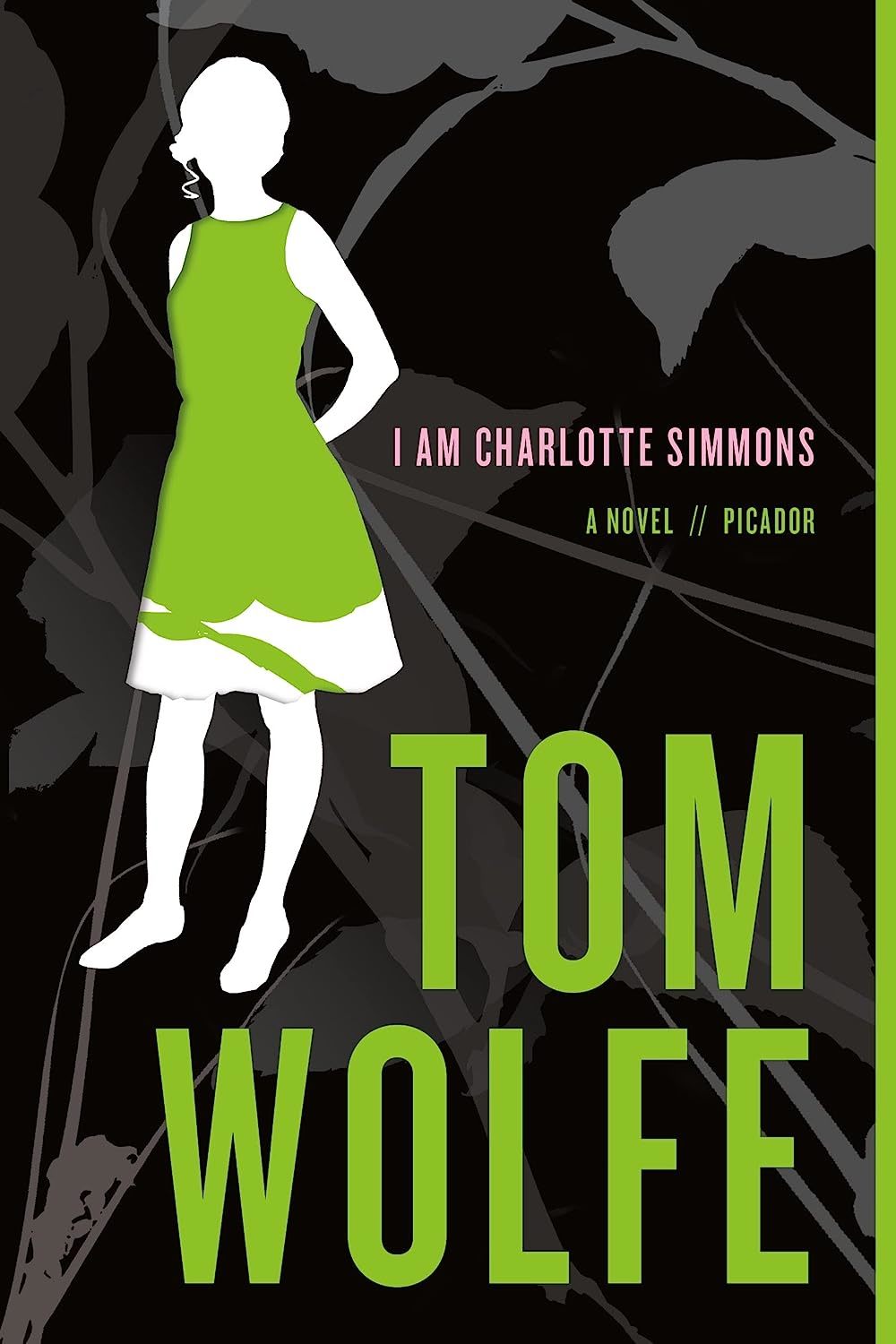
I Am Charlotte Simmons by Tom Wolfe

i am charlotte simmons
Every few years or so, Tom Wolfe creates a massive tome documenting sections of American society. In 1988, he detailed New York City during the Wall Street boom in Bonfire of the Vanities. In 2001 he turned his satiric eye to the capital of the South, Atlanta, GA, with A Man in Full. In 2004 he deconstructed another part of American culture, that of the university.

I Am Charlotte Simmons is set at the fictional Dupont University. It is a setting of higher learning as prestigious in its intelligentsia as Harvard or Princeton, with an athletic department as fearsome as the University of Texas, or Stanford. Like New York and Atlanta, it is full of a great many sub-cultures with their own social statuses. Wolfe again skewers them with a journalist’s eye for details.

Within Dupont University there are several classes of society. There are fraternities and sororities filled with alcoholic, sex-obsessed frat boys and their counterpart sorority girls, who are perfectly dressed, coiffed, manicured, and accessorized. There are “student-athletes” who are set apart from all other students on campus with private dorms, dumbed-down classes (taught by professors who understand the needs for the “program”), and of course, plenty of lavish gifts bestowed upon them. Then, there are the students daring to come to the university to actually get an education. These students are at the lower end of the social totem pole. Nerds and geeks who want to use the university for its intended purpose. But these poor lads are not complete social outcasts. For this, Wolfe gives characters with no other purpose than to be losers. There are groups of girls who line the dormitory hallways blocking the paths of others only to grasp a little of their coolness and gossip about anyone with something resembling a life.

Charlotte Simmons enters Dupont from the mountains of North Carolina. She is a beautiful, intelligent prodigy from the sticks. She comes to this bastion of the social milieu, naïve, morally pure, and with Southern good cheer. The nearly 700 pages within this novel detail her freshman year trying to find her place in all of this.

Wolfe again writes from the perspective of different characters. When chronicling one character, the reader understands their thoughts and perspectives. Here, he gives us insight into several characters. There is JoJo Johanssen, a star basketball player being outplayed by an incoming freshman. Next, there is Hoyt Thrope, the coolest of cool frat boys, who is rich, suave, and completely one-dimensional. We also understand the perspective of Adam, a poor, intellectual, and radical member of the school newspaper. Of course, much of the novel is written from Charlotte Simmon’s perspective. An interesting turn of perspectives occurs when two or more of these characters interact with each other. Suddenly we see one of the characters from another point of view.

The novel does a great job of giving details to the nuances of the fictional university. Wolfe is the reporter chronicling American college life. Yet, he is also the constant satirist drilling into the ultimate contradiction of a university doing everything but educating. There are several beautiful passages detailing the state of the once grand and beautiful fraternity houses. The large, ornate tables have long since been stained and chipped by countless beer games. The antique, gorgeous library now houses pizza boxes, beer cans, and a lone television, without a book to be found.

At its heart, this is a coming-of-age story. Charlotte Simmons must become an adult woman. Wolfe lets us know that she is an intellectual prodigy. He writes her with the ability to become an intellectual giant. She is also a pure, naïve country girl. When the novel begins, she is a virginal, teetotaling young lady who is shocked, SHOCKED at the foul language coming from the mouths of her peers. Also from the beginning, we know that within the pages of the novel Charlotte will lose her innocence. Intuitively, we understand that Wolfe must crush her under the pressure of her peers. We hope she will be able to put herself together, into a stronger self, before the last page.

A large part of the novel focuses on Charlotte’s desire to find a boyfriend. There are three boys vying for her attention. Hoyt is the good-looking, incredibly popular forerunner. He is suave and incredibly charming and quickly goes after Charlotte’s affections. Adam brings with him a stunning intellect that wows Charlotte and gives her the intellectual challenges she came to Dupont for in the first place. JoJo is a sweet, kind-hearted basketball star who cannot be overlooked.

Who she winds up with at the end of the novel, I found to be a large fault. It is almost as if Wolfe wants to surprise the reader with the least acceptable candidate. Throughout the novel, Charlotte belittles and is annoyed with this character. In order to end the novel, we are found with Charlotte throwing away so much of what she had worked for. Some of this had been destroyed by bad decisions, but we do not see where it is destroyed so much that she will accept where she is by the novel’s end.

It is discouraging, and yet believable that Charlotte is so enveloped with the need to be popular. Certainly, the need to fit in, to find kinship with our fellow people, is a universal need. Yet Charlotte concentrates so deeply on this need, it is disappointing to see. She notes that in high school she was able to be above the worldly throng, yet almost immediately she is going against her own beliefs merely to fit in.

Out of place in this novel is the lack of God. Charlotte is from the rural mountains of North Carolina, practically the buckle in the Bible Belt. Her morals abound from Christian ideology. She mentions that her mother is from the Church of Christ Evangelical denomination. Yet, rarely is there mention of God or faith. The first mention of the divine comes from Charlotte fearing the wrath of her momma’s God. The way the passage reads we understand she fears the wrath of her momma over the wrath of that God. Later, when Charlotte has all but been destroyed, she prays to God over and over again to take her away from this earthly plain. Yet, by the novel’s end, Charlotte ruminates over her disbelief in an eternal soul. It is not difficult to believe that even a rural North Carolina intellectual could pull away from her mother’s belief in God. But, to have the character seem unscarred by this belief (or unbelief), seems more from the writer’s own intellectualism, than one based on the character.

Tom Wolfe has again created a masterful work of satire. His journalistic eye gathers enormous details about the structure of American collegiate life. He seems to be trying to shock his audience where there is none left. There have been far too many MTV Spring Break specials to find any shock in college students drinking and indulging in casual sex. However, he gives a bravado performance detailing their escapades. In the same manner, he fails at bringing perfect insight into the nature of someone like the titular character. He glances over any religious turmoil that would certainly be central to her character. Even with these flaws, I Am Charlotte Simmons is a beautiful read. There is much that is spot-on correct in the current university scene, and there is much to enjoy while reading.

No Water No Cry

Once again this morning our water was turned off, that makes it six times since we’ve been here, I believe. I have no idea why they need to turn it off so often. We were awakened by some insistent hammering, and drilling this morning, that must be a part of it. Unfortunately, the hammering didn’t come early enough. The water was turned off at 8:30 and we had forgotten about the notice we received yesterday, so we slept right through. Ugh, no water is miserable. No shower, no drinks, no washing of the dishes from the previous night, no flushing the toilet. The notice said it would be back on at 12:30. We decided to sit down and watch American Beauty to pass the time. It finished right on the 12:30 nose. “Ahhhh,” we said, looking ever so forward to a long shower.

“It’s not working!” cried Amy from the bath. Indeed, she was correct, our water was still not working. Hoping it would only be off for a few more minutes we began straightening the place up. Ten minutes later and it was still off. I settled in to read a book, and Amy checked her e-mail. Thirty minutes of this and no water in sight. Amy moved to the couch to stare at the side of my head, while I picked up my French homework.

Two o’clock came and we were still as greasy as ever. Amy had to be at work at 3, in desperation, we called our friend Elizabeth. Thankfully, she was home and allowed us to jaunt over and clean up. It felt like everybody in France was out on the street gawking at the greasy Americans as we walked over.

It is now just past three o’clock, and we still do not have any water, but at least I’m clean.

Boring Details About My Day

It has been absolutely gorgeous here again for the last several days. My now daily walks to the park are gaining me a red face and a slimmer belly. There are few things better than being able to pull your belt a notch tighter.

Along with my park walks, I have nabbed what I feel, are some very good photographs.

It looks like we’ll be taking a bit of a tour of France next week. Amy has a two-week vacation from school so we thought we’d go visit the other regions in France. We hope to hit Lille, Normandy, and a few castles in the middle of the country. More details will come when we have them.

Astute observers will notice I have fewer links on my blog these days. There are several reasons for this. They are a pain in the butt to install, and I figure you guys can go to Google and search for that stuff on your own if you like. I had originally planned to have interesting and well-researched links, but that takes far too much time than I care to give to the project. Also, Google search rankings go down whenever you link to a site that doesn’t link back to you.

Speaking of Google, my blog counter gives me information on how people get to my blog. This includes linking here, or what web search they came from. Two of my favorites are searches for a popular ice cream chain “Brusters,” except the searchers misspell the name to read “Brewsters.” The other searches involve a picture I took at a German Mcdonald’s.  The picture consists of a window advertising a bar located in the Mcdonald’s and has the naked silhouette of dancing girls, the kind normally seen on truck flaps (you can view the picture here). The funniest of these searches involved Yahoo, where someone searched for “naked silhouette” and came to my site. From there I got several links from Yahoo mail. Presumably, the anonymous searcher found the picture so interesting he had to e-mail it to his buddies.

My little stint on blogcritics.org is going quite well. They are getting upwards of 40,000 visitors a day and so my reviews/essays are being read by a lot more people than I ever generate on this little piece of cyberspace. That’s a bit exciting and rather daunting.

Well, my friends, I believe that is the boredom for today.

The Little Sister by Raymond Chandler

the little sister

Raymond Chandler once wrote that Dashiell Hammett “Gave murder back to the kind of people that commit it for reasons, not just to provide a corpse.” In his essay “The Simple Art of Murder,” he continues to praise Hammett while berating Agatha Christie types who set murders at tea parties and ended them by bringing all the suspects into one room while the detective ran over all the clues before them, causing the killer to jump out and confess. Chandler set out to write Fiction, with a capital “ART”, that it happened to involve pimps, drug fiends, mobsters, and lots of murders is secondary.

It is difficult to review a single work of Chandlers, they all kind of fuse into a sort-of biography for his singular detective, Phillip Marlowe. His novels are very similar, in that they involve the seedier aspects of the city, are all told in the first person by Marlowe, always include various crimes, usually murder, and are filled with an assortment of double-crossing, corrupt folks. But, novels are not the same in the way novels by the likes of Dean Koontz or Mary Higgins Clark are the same. Where they seem to have a dozen storylines and can simply fill in different character names and settings. No, though Chandler’s stories are similar in many ways, they differ in the means by which they are told. Like the way snowflakes look the same in one drift, but upon observation are each different. Or the way in which dollar bills are the same aesthetically, but are spent in a million different ways. Chandler’s writing sparkles amidst the slums and degenerates he writes about. His dialogue sparkles as Marlowe’s sarcasm cracks your lips into a smile.

The Little Sister starts with a little nebbish girl, from nowhere-Kansas who asks Marlowe to help her find her brother. From there the plot involves Cincinnati mobsters, Hollywood agents, starlets, and a few ice picks sticking out of a few necks. As always, Chandler’s plot gets very complicated very fast. The joy of the novel is not in trying to figure out who is who, and who did what, but in the way Chandler lets the mystery unfold. The murders are always at the center of the story, but there is something else hanging near, something more akin to great literature, than dirty detective stories.

By the time he wrote The Little Sister, Chandler had written several screenplays for Hollywood pictures. He seemed to not like the experience one bit. There is plenty of cynicism directed toward Tinseltown here. The agents are like kings who will sell souls faster than Doctor Faustus and the starlets are empty, callous girls who sell sex like McDonalds sells French fries.

Reading The Little Sister was a little sad for me since it is the last Chandler novel that I had not read. There are still his short story collections to look forward to. It feels like the end of an era. His novels still swarm around in my head, and give me hope as a writer. Here is someone who wrote stories, not just to entertain, but to try to find something more-Literature or Art- and maybe, in doing so helped us to understand what it means to be a writer.

Band of Brothers (2001)

Band of Brothers

HBO’s ten-part mini-series on the “Easy” Company’s tribulations during the German invasion of World War II is a grand spectacle, filled with numerous moments of perfection, and begs one simple question. Why can’t the rest of television look like this?

Based on the book by Stephen Ambrose, and produced by Tom Hanks and Stephen Spielberg, the series gives a realistic, gut-wrenching portrayal of Easy Company’s activities from the final stages of their paratrooper training, to D-day, through their major battles up until the end of the war. It spans 10-hour-long episodes (the series opener “Currahee” clocks in at 1 hour, 30 minutes), with each episode focusing on a particular battlefront, and often specific characters. It gives a good portrait of what war must be like to those who actually fight it. It does not shy away from the brutal, ugly reality of combat. It is not just the Saving Private Ryan-like battlefield violence (though there is plenty of that here) but the cold-blooded murder of German prisoners, and the cowardice of boys trying to be soldiers. This is not John Wayne standing gruff and courageous against fascism. Band of Brothers does well to show that not all soldiers were courageous; all were scared, some so much to be rendered useless.

Each episode spotlights one or more of the men. In doing so it gives the audience a chance to view the soldiers on a more personal level, and not just their heroics. While doing so, the episodes also spotlight the types of struggles the soldiers dealt with day to day. While mainly this technique worked, there were a few missteps. Instead of using an entire episode to highlight the medics, I would have preferred those moments to be seen throughout the series. Medics were in constant need while on the battlefront, and to see this in detail, intertwined into every episode, would have served the purpose better. Instead, I would rather have seen another soldier highlighted (Nixon comes to mind.)

Likewise, the Normandy invasion seemed underwhelming. Easy company was part of a paratrooper division that flew over the beaches and fought their way back. Following the company, we miss much of what was the D-day invasion. Instead, we find the soldiers taking out a few machine gun nests. Though this may be historically accurate, it seems disappointing not to see more of what is one of the most significant battles of the 20th century. I suppose I’ll have to watch Saving Private Ryan for that.

These are minor complaints in what is ultimate, an excellent series. It is a joy to see such an excellent production come out of a television series. HBO proves once again that it is at the top of the television game. The networks need to take a long, hard look at their cable competitors and see how they can produce quality productions.

A Disgusting Display

I have mentioned the French predilection for Public Displays of Affection (or PDAs as we called them in Junior High) before. There is, of course, the bissous, or cheek kiss given to friends as a greeting. But, the French seem to great admirers of showing their affections for each other without the slightest thought given to who else may be within eyesight. Often, there are lovers holding each other close, or even locked in an embrace on the street, in restaurants, bus stops, and even while riding on the tram. It has always bewildered me to see a couple locked in heavy embraces while riding the tram. The trams are generally crowded, are usually musty and cramped, and the stop and go motions create difficulties even maintaining your balance, must less a complicated lip lock. The other day I say the most gruesome PDA I have ever witnessed.

It was around 11 pm and Amy and I were returning from watching a movie at Pamela’s. We entered a relatively full tram for the return home. The tram was full enough that we were unable to find a seat, and had to stand against a wall. Standing near the sliding door was a couple still within their teen years. She was clad in the usual assortment of tight, acid washed, blue jeans and form fitting blouse. He was fitted in a white t-shirt, light jacket and blue basketball shorts so popular amongst his type in the US. They were a happy couple who felt it necessary to make the most obnoxious kissing noises. He had to bend downwards, because his height was a good foot above her own stature. Repeatedly he did so, making a game of it. Flamboyantly, he would grab the young girl by her shoulders, lean down and proceed with the loud SMACK! Then release, only to start all over again in a moment.

This game was interrupted by tram stops. They were very near the doorway and so had to unlock their embrace to allow other on and off. This was but a temporary lull in their love making. For as soon as the tram started again, he was leaning back down to make the noises. Soon, he was not the only one to blame for this sickening display. For, she started to grab ahold of the young man, and pull him downwards. It wasn’t long before the quick smack of the lips became a longer, more sensual open mouth embrace, but always punctuated by an ending SMACK! This went on for several more stops. The couple locked in a long, putrid embrace. Then would have to stop and sheepishly move out of the way of the entrance only to move back to the lip smacking as soon as the tram got underway.

It was difficult not to stare openly. Looking about me, I could see all the other passengers doing their best to nonchalantly NOT look at the couple. My poor wife, red faced, was staring out the window. A tram ride is a rather boring thing, and the sight of a peep show in front of me was too much not too look at.

Soon, even long, lingering kisses were not enough. The boy began stooping down to the girls level so that he could bring her body close to his. Pelvis’ began to girate and grind. Now they were making good use of the swaying of the tram as it sped up and slowed down to a stop. The stop before we were to get out, I caught the ladies hand being lowered to places a hand should never be while standing in a tram. Luckily a stop was made before that could go very far. Passengers left and the couple took a seat in another car. At the next stop Amy and I left the tram, as I glanced back into the car I saw the couple deeply locked into an embrace as the tram sped away.

I will never understand the enticements of a dirty, crowded tramway.

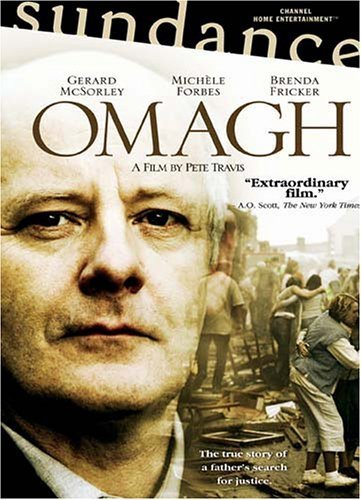
Omagh (2004)

omagh movie poster

On August 15, 1998, a car bomb exploded in Omagh, Northern Ireland killing 29 people and injuring some 220 others. It was the single worst incident in Northern Ireland in over 30 years. In 2004 director Pete Travis filmed a movie about the atrocity and the subsequent investigation. It is a relentless, brutal film that never allows the viewer an emotional sigh of fresh air. What strikes me most about the film, now, is not the quality of the film, which is quite good actually, but that I had never before heard of this event.

Admittedly, I am not the most knowledgeable lad when it comes to current events. When I had a television I would catch one of the morning news shows, and maybe a few minutes of CNN or Fox News just before bed. While in the car I tune into NPR, I receive e-mails from the Washington Post, and generally spend a few moments checking the various news websites. I’m not obsessive about the news, I try to stay mildly informed, but I certainly don’t spend every waking moment turning my thoughts to the state of the world. Yet, here was a huge terrorist attack, followed by a scandalous investigation with a potential cover-up behind it, and I’ve never heard a word about it.

I am sure the news channels mentioned something about it shortly after the bombing. It was probably a short little blurb with a death count. It’s got all the elements they love: terrorists, explosions, murder, and scandal. But, it didn’t happen in America, and European drama doesn’t have the ratings pull as say something stateside, say Michael Jackson’s latest shenanigans. Especially when these events happened in some obscure country like Northern Ireland. Who knew the North of Ireland was a separate country anyway?

In the US we have cable networks that run 24 hours a day, 7 days a week, 365 days a year. There is CNN, Fox News, MSNBC, not to mention specialty networks like CourtTV, and of course, nonnews-specific networks that still employ daily news shows. Yet with all of these outlets, American audiences are still inundated with the same stories over and over again.

It is a big world, with a lot of important events happening, but instead of covering these events, they rehash the current scandal of the week and trial of the century. How did Bill Clinton’s hummer overshadow the murder of 29 people? How did Mark McGuire’s record-breaking homerun sprint become more important than terrorist activity? Certainly, the network news shows give us what we want. Had we received a 3-hour special report on the Omagh bombing I’m sure many of us would have clicked over to Seinfeld reruns. In the end, I’m not scholar enough, nor have the time, to lay out why virtually no one I know has heard of Omagh before. This is a movie review after all. Yet, as I think about the film I can’t help but feel the sting of guilt. When I hear the chattering other others complaining that Americans are full of ego, and don’t have the slightest idea about the world, I must hold my head low and sigh.

The film itself is shot like a documentary, Dogme95 style. It uses handheld cameras, utilizes only natural lighting and there is nary a digital effect to be seen. For 106 minutes it never lets go of its punishing, merciless hold on your emotions. There is no comic relief, no juncture in which to catch your breath and get away from it all. The film brings you in close, lets you feel the tension, and suffocate in the terror. It doesn’t want you to enjoy what you see. This is not a film that allows the audience to distance themselves from the actions on the screen or their very lives. It is a film that cries out, carrying the voices of all humanity that suffers, and that feels injustice.

Though it takes a few moments to adjust to its visual style, the handheld camera work becomes an effective means to bring the audience right into the emotional impact of the film. It loses a little steam in the second half when the main character, Michael Gallagher (Gerard McSorley), a father of one of the victims, begins to lose his way in bringing the terrorist to justice. However, though some headway is lost, the film continues to pack a hard emotional punch.

I am glad that films like Omagh are being made. Though it is a film that will never see a theatre screen in America, it may find its way onto a shelf in the local movie rental house. It is here, that countless Americans may go looking for something a little different, something that they haven’t seen. And it is here that they might learn a little about the world around them.

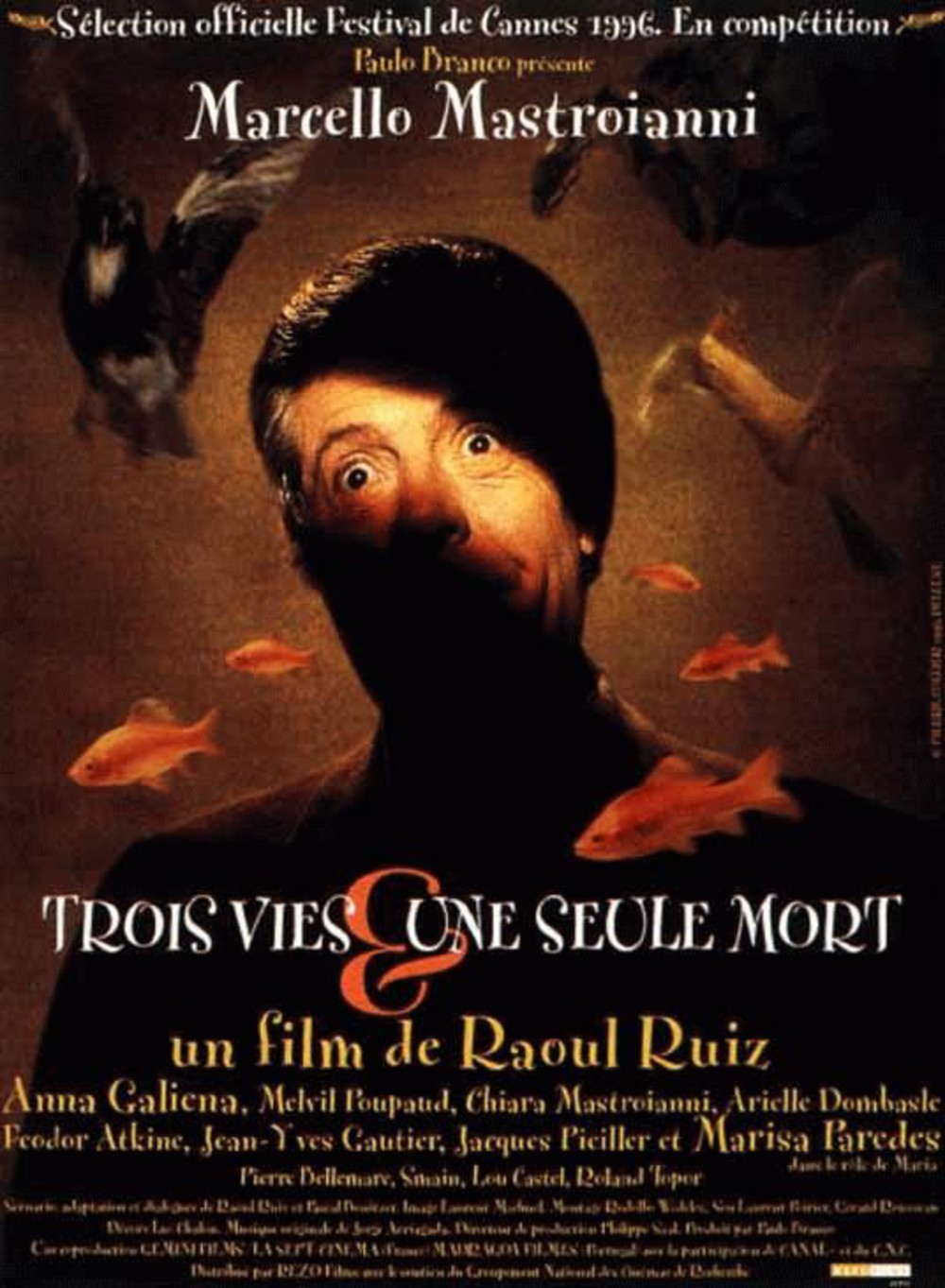
Three Lives and Only One Death (1996)

three lives and only one death poster

Chilean director Raul Ruiz created a weird, wild, fantastic world with Three Lives and Only One Death. Marcello Mastroianni plays four different characters in as many different stories that at first seem completely separate, but by the film’s end are wholly intertwined. It is beautifully, almost mystically shot, effectively using shadows, light, and computer imagery to create painted-like images. It is a bit confusing, but a wholly satisfying film.

In the first story, Mastroianni plays a salesman who walked out on his wife (Marisa Paredes) twenty years ago. The wife has since found another husband (Feodor Atkine) and is living a seemingly happy life. For reasons left unexplained Mastroianni suddenly decides he wants his old life back. He catches the new husband, at a Tabac and offers to pay him 1,000 francs for an hour of his time.

What proceeds is an imaginative, fantastic tale of why Mastroianni has been gone for twenty years. It is far too complicated to explain here, but let’s say it involves a room with moving walls and tiny fairies who prefer to eat franc bills, but will settle for newspaper. The end of the story finds Mastroianni wanting to leave the second husband in the fantastic room, while he moves back in with his wife.

In the second story, Mastroianni plays a successful professor who, for reasons that are all his own, becomes a beggar, and a rather successful one at that. He befriends a prostitute (Anna Galiena), who he later finds out isn’t all she pretends to be, and whose husband (Jacques Pieiller)is something of a psychopath.

In the third story, a young couple (Chiara Mastroianni and Melvil Poupaud) find themselves being mysteriously supported by an unnamed friend. After months of finding 1,000 francs in their mailbox each week, they learn this mysterious stranger has died and left them his mansion. The catch is they must keep on a peculiar butler (Mastroianni of course) or lose everything.

The fourth story is really a means to tie all three stories together, and yes, it is weird. There is a lot is going on throughout the film. It is visually stunning, complex in story and a delight throughout. It is the type of film that really deserves a second, and third viewing to allow thoughtful absorption of the many details. In what was his second to last film before his death, Mastroianni does a masterful job playing these varied, and interesting characters.

It is a film not meant for everyone. The story is as weird and complex as anything put out by David Lynch. But for the lover of cinema, there is much to appease the appetite. It is a beautiful, layered, surreal film that is a true pleasure to watch.

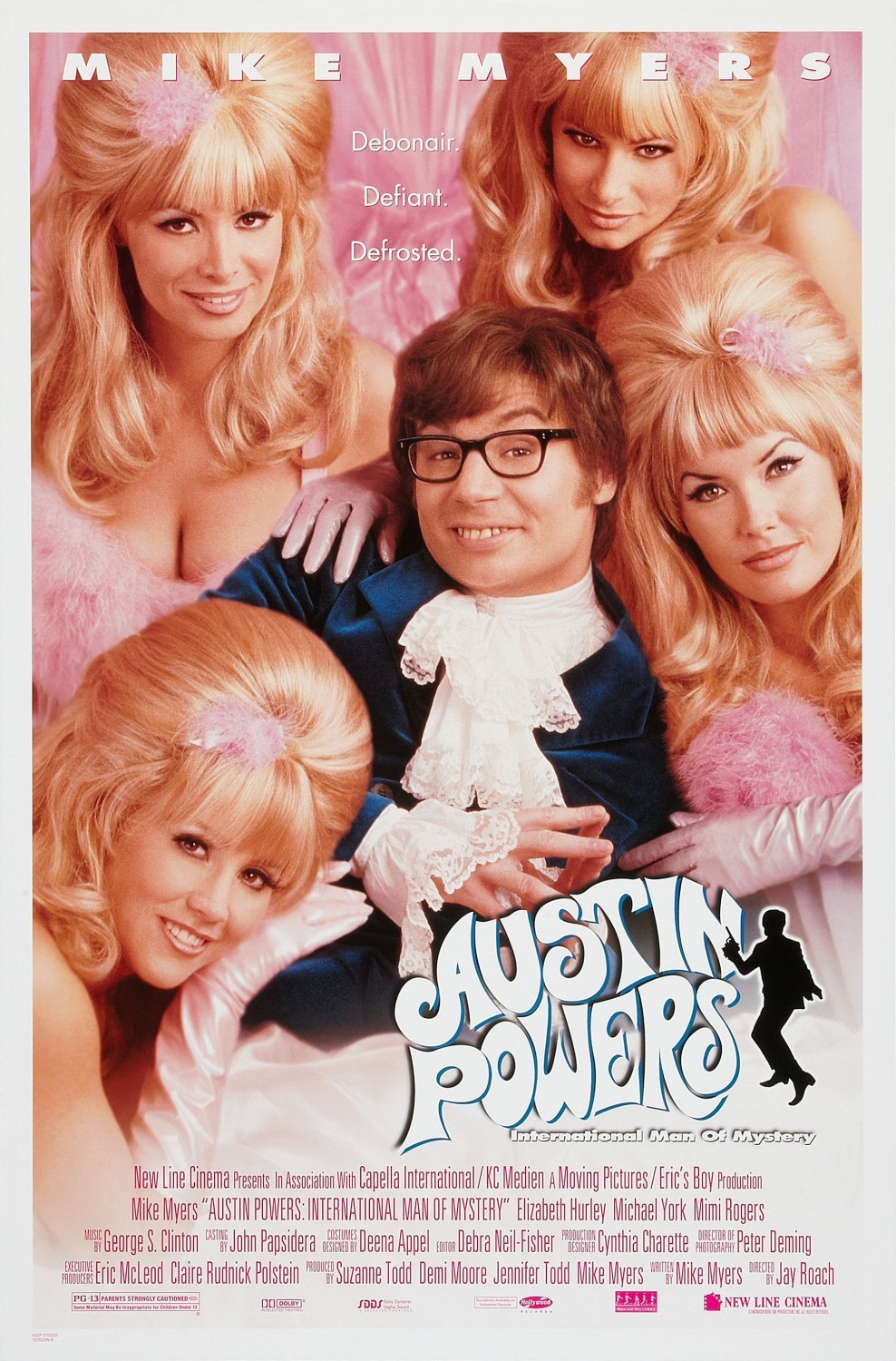
Austin Powers: International Man of Mystery (1997)

<austin powers poster

It’s hard to believe it has been 8 years since Austin Powers was unleashed on the world. A couple of sequels and far too many “Yeah Babys” later, and seemingly we’ve all had enough. I sat down and watched International Man of Mystery for the first time in a year, a few nights ago. What I found is a pretty solid comedy, which still manages to hold up, even after being parodied to death.

The jokes are no longer wet yourself funny. They are more oh-I-remember-when-this-was-hilarious cute. I did laugh out loud on a few occasions, but mostly I felt a kind sense of nostalgia, for jokes that were nostalgic in themselves. The scenes I remember most, still hold up rather well. The dancing credit sequence and the bits where we almost see nudity are beautifully done. Classics of cinema really.

Mike Myers created a very lovely character in Austin Powers. He is truly charming, funny, and a great send-up of all the classic spy characters. Jay Roach does a very nice job of bringing the manic energy of Myers’s creation to the screen while maintaining the feel of all the 60’s spy films.

Elizabeth Hurley proves once again that she has a pretty face, and looks great in a short, tight, silver skirt, but whose acting skills are less than desirable. Her character’s straight (wo)man to Power’s swinger is the weakest aspect of the film. She is way too boring playing it as a 1990s gal trying to make it as an Agent on her abilities alone. Yet, her transition into a groovy chic is unbelievable and rather insipid.

While watching, I kept forgetting which bits were in this one, and which ones actually belong in the sequels. Here there is no Mini-Me, no Heather Graham, and no references to genitalia when referring to a rocket. Too bad, too, because those are great sources of humor and I don’t have the strength to watch any of the sequels just yet.

Austin Powers: International Man of Mystery is a great film to throw in while having a party. There is no need to see and hear everything clearly. There is nothing, really to analyze. It works well as background filler to supply some hearty laughs when there is a lull in the conversations.