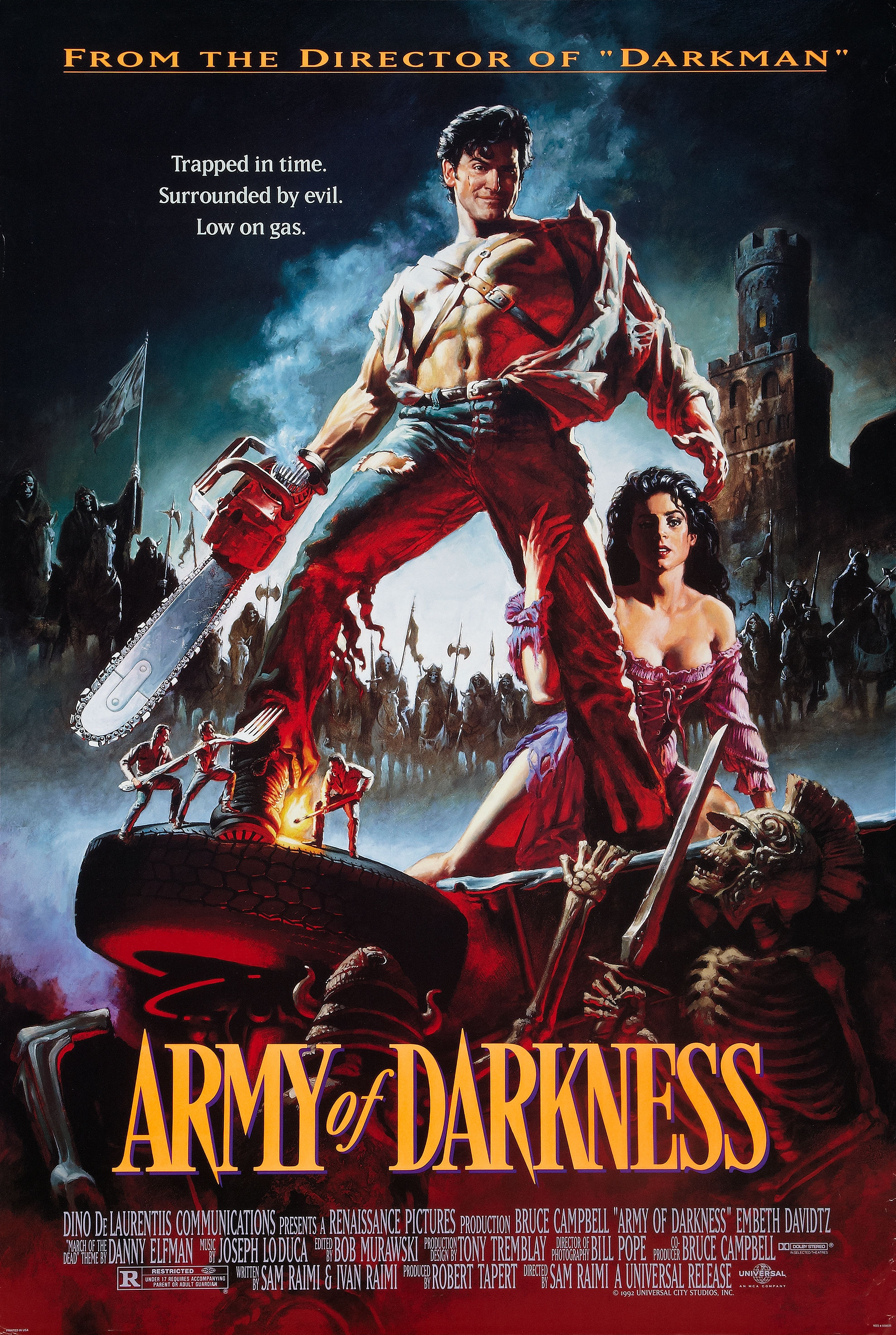
Army of Darkness (1992)

army of darkness poster

Those of you looking closely at my list of DVDs will notice there are a couple of movies before Army of Darkness. But on a Sunday night, you watch what your wife wants to watch. Especially when it’s part of the Evil Dead series and not a silly romantic comedy.

Army of Darkness is the third (and so far final) movie in the Evil Dead Series. Before director Sam Raimi went legits with a series of critically acclaimed dramas and the Spiderman Trilogy, he was a low-budget horror genius. Army of Darkness begins right where Evil Dead II ended, with Bruce Campbell trapped in medieval times to battle the deadites once again.

The trilogy began with  Evil Dead as a pretty straight horror movie. A group of people discover a book of the dead and unleash gore-filled horror upon themselves in a remote cabin. Evil Dead II basically re-tells the same story with a different cast (except for the ever-present Bruce Campbell), a bigger budget, and plenty of slapstick. The second movie is by far my favorite in the series. It keeps the ghoulish gore while adding hilarious physical comedy and some classic one-liners. Army of Darkness furthers this tradition by adding even more slap-stick and one-liners while removing almost all of the gore.

What little plot there is goes something like this: Stranded in the middle ages Bruce Campbell is at first captured by a small army, is mistaken for a member of a rival army. Bruce quickly uses his “boomstick” to gain clout with his captors and is sent on a quest to recover the Necronomicon which will both send Bruce back to his own time and save the army from evil. Bruce being Bruce he gets the book and unleashes an army of the dead. There are two endings released for this movie. One happier ending was released in US theatres and another sequel set up unhappy ending seen in a theatrical cut in the UK and on many US DVD versions.

Raimi once again does a nice job creating a mix of horror movie homages (which range from Jason and the Argonauts to Gulliver’s Travels) with the slapstick of the Three Stooges. Unfortunately, the comic elements seem to take over this picture leaving the horror end of it as more of a backdrop. It feels more like a Zucker brother’s movie more than a horror film. Most of the evil dead are formed as skeletons that crumble when destroyed rather than burst into a mess of blood and guts as they did in the first two movies. This may seem to be an absurd complaint, but as a fan of gory movies, I felt disappointed with that choice.

The cinematography is actually quite well done throughout most of the picture. My DVD copy is quite beautiful in scenes. Especially the exterior shots around the windmill. The use of color and lighting is well above par for most horror films. The pre-CGI special effects affect the quality of the print in several areas, but they still hold up as goofy Raimi effects. I kept thinking the picture was too pretty for what was actually taking place on screen.

Bruce Campbell once again does a nice job of making Ash come to life. He delivers his lines with the comic timing of a comedian while still delivering enough pain to make his albeit over-the-top beatings believable. The rest of the cast is hardly memorable as characters or for their acting.

Army of Darkness still makes a nice end to the trilogy. In a way it makes a nice bookend to Evil Dead’s pure gore horror with the single middle book being a mix between bloody gore and slapstick comedy.

Top 5 Things I Miss While Living In France

1. Money: I hate to start off with such a materialistic beginning to this list, but I can’t help it. I hate being poor. Amy and I are doing ok here, we’ve got a good budget and manage to have a nice place to stay and eat good meals every day. But man, I miss being able to buy movies, music, and books and being able to go out to dinner more than once a month. We were far from rich in Indiana, but we were able to splurge a little without having to worry about paying the bills.

2. Hamburgers: Once in a while we buy some red meat and I make my own burgers. Other than that and the occasional overpriced McDonalds/Quick pit stop that’s the only time I get a burger. There is nothing like stopping by your favorite greasy joint and tasting a big, fat, juicy burger.

3. My car: I drive a little 1996 Saturn. It’s nothing fancy, or fast, but it’s a solid car and rides well. I love to drive. If it is not overseas or our honeymoon Amy and I drive to where we’re going. I love to have control of a vehicle maneuvering in and out of traffic or taking it fast down a deserted highway. Strasbourg is a nice city to walk around in, and the tram/bus system is top-notch. But I miss the whir of sliding my car through traffic.

4. TV: I hate to put this on this list. As a card-carrying member of the “blow up your TV” club I’ll be dismembered for missing television, but darned if I don’t. Most of what’s on TV stinks. We had a satellite in Indiana and I generally just watched the news, the History Channel, and old movies on TCM. Even with all the crap I still miss being able to sit mindlessly for a little while and flip. I really like the unexpectedness of it. I never subscribe to any kind of TV guide so it’s generally a mystery to me what is on at any given moment. That was a certain joy in flipping channels to find an old favorite movie on or a great episode of Cheers.

5. Convenience: A car might help this out by making trips to anywhere quicker, but even with faster transportation Strasbourg would still be very inconvenient. There isn’t a store with everything in it. If you want aspirin or antacid you go to a pharmacie. If you want good bread you go to a boulangerie. Good desserts you go to a patisserie. You need to buy the groceries for the week you have to go to three different supermarches, and that’s if you don’t want really fresh fruit, otherwise, it is another trip to a street market. Do you want lights? Go to one store. A shade for the light, that’s another store altogether. Heaven forbid you should need any of this on a Sunday or Monday or after 8 pm on any day. Nothing is open 24/7 here. Maybe that’s a good thing. Maybe we’ve gone crazy in the US where everything is open all the time and you can get everything you need in one store. But it is extremely annoying to be used to that kind of convenience your whole life only to have it lost in France.

Blue Velvet (1986)

blue velvet poster

Blue Velvet comes from my collection of Chinese bootlegs. My sister Bethany and her husband Brian are teaching English in China. Apparently, you can purchase a wide assortment of DVDs there very cheaply. So I supply them with big lists of movies I’d like and when they come home they bring me a big stack. There are never any special features on the DVDs, but the picture is usually good and for $1 a piece, that’s all I need.

Blue Velvet is dark, scary, freaky, and really good. Which is how you could describe most of David Lynch’s films. His films are often filled with symbolism and it is easy to finish one of his films and have no real idea of what actually happened. They usually take two or three viewings, and a little research to get a good idea of what the movie is actually trying to convey.

Blue Velvet has a simple plot that can generally be understood at a basic level upon first viewing, but there is plenty of symbolism and deeper meaning to make it “enjoyable” for further viewing. I put enjoyable in quotation marks because for many watching it is not an enjoyable experience. It is a movie deep-seated in horror, with scenes that make you crawl under the covers and lock the doors. For the cinephile, it is a pleasure to watch a lurid piece of cinema with enough depth to require multiple viewings. For the weekend movie watcher, it is probably too much to stomach.

The film starts with an idyllic, picturesque small town. It’s a town where every day has blue skies, manicured lawns, pretty flowers, and quiet, simple people. Lynch fills the screen with gorgeous pictures straight out of fifties television shows. But this is a David Lynch movie and the pretty pictures don’t last long. Soon enough a nice old man who is watering his lawn falls down near death. The camera pans down past the convulsing man and deep into the grass. Digging into the earth until the camera is dark with freshly wet dirt and grotesque bugs. The idyllic town is only pretty on the surface. Underneath the top layer of goodness lies a darker, seedier town hidden from the eyes of most of its citizens.

The plot of the film revolves around Kyle MacLachlan and Laura Dern delving deeper and deeper into the darker side of the small town. MacLachlan finds a dismembered ear on his walk home from the hospital one afternoon. Finding such a macabre item in his hometown sparks a quest to discover whose head the ear could belong to and why it was removed. He involves the good girl Laura Dern in his quest and they sink into darker waters. To tell more of the plot is to give away too much. I’ll just say that it is not for the weak of heart.

Dennis Hopper plays one of cinema’s creepiest villains to date. His psychosis is even more terrifying in that it is so real. Here is no Freddy Krueger, or even a Hannibal Lector. This is not some crazed psychopath lurking in the corner. Sure he is psychotic and maniacal, but versions of him can be found almost nightly in any major city newspaper. He is not a homicidal maniac, but a violent, evil man made even more so by his addiction to unnamed drugs.

Isabella Rossellini plays Dorothy Valens with such beauty and sadness it breaks your heart as it squirms your stomach. Her character has taken such horrible abuse over her life she has come to like and enjoy it. Mixed with heavy amounts of masochism her performance is remarkable.

There were several times while watching this with my wife, Amy that she said she couldn’t keep watching it. After the credits rolled she said she would never watch it again. I suspect this is the sentiments of many viewers after watching Blue Velvet. But if you can stomach the violence, masochism, and overall creepiness there is a lot of pure cinema to study.

A Non Movie Review Post

Sorry that it seems all I have been doing is reviewing movies lately. I've gotten into a nice groove of watching/reviewing and my real life hasn't been that exciting.

I've been a bad boy this week. Monday I was supposed to have a French lesson with Ann at 5 pm. The lessons are normally at six and I totally forgot about the time change. At 5 I was making supper (tuna patties, which were surpisingly delicious) and thinking about the supposed lesson at 6. At a quarter after 5 Amy came home and said Elizabeth had invited us to dinner. The selling point was we were going at happy hour when tarte flambee's sold for 2.80! In my excitement I put away the tuna, rushed out the door, and totally forgot about the lesson. It was midway through the second flambee that I suddenly remembered the lesson. I ran out the door and flew to Subway. Alas, no Ann. Which was actually good since I was really late, but she has waited for me a long time before. I felt even worse when I got home and realized that not only was I late for my 6 lesson, but it was actually at 5!

Tuesday we went out to dinner with Daniel and Tammy. We went to a little Italian joint downtown. I had a delicious lasagna, Amy had a pizza. The waiter was very rude. He quickly took our order, delivered our food, and took the check. No smiling, no chatter, no extra stops. We decided it was because were were obviously American and spoke English. Afterwards we headed to the movie theatre, but Amy developed a headache and we decided to go home.

In a few moments I am going to deliver a couch. A friend of Jean Claude's is giving him a couch so Daniel and I are picking it up and then lugging it up 7 floors to Jean Claude's place. Oh what fun I have in France.

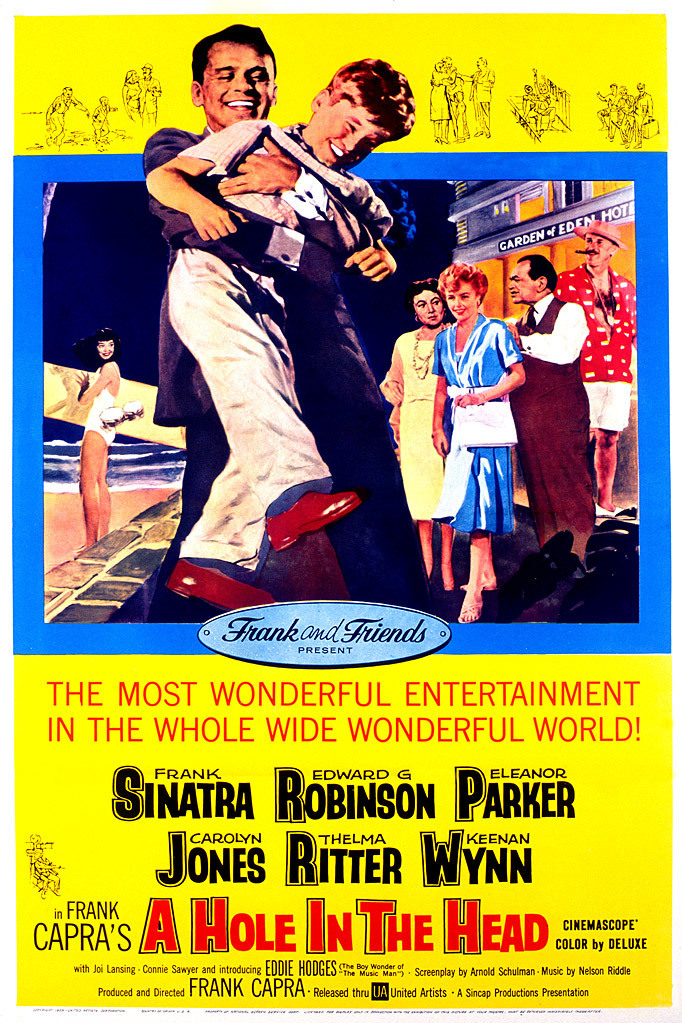
A Hole in the Head (1959)

a hole in the head poster

I received A Hole in the Head for my birthday in a Frank Sinatra double pack with the original Manchurian Candidate. I had put off watching it because it did not seem like a movie I would particularly enjoy. But in my quest to watch and review all of my movies, I had no choice but to put it in the player. Of course, the fact that my wife wanted to watch it prompted me a little further even to the point of watching it out of alphabetical order.

Frank Capra is the great godfather of sentimental movies. Many of these are deservedly hailed by fans and critics. From Mr. Smith Goes to Washington to It’s a Wonderful Life and Arsenic and Old Lace Capra made movies about the little guys fighting the system and coming out on top. These movies are sentimental enough to be dubbed “Capracorn” by critics but are handled with masterful hands that rise above the schmaltz created by so many others. Besides little guys, he also flooded his movies with eccentric characters standing out in a world full of normal folk.  Sadly, A Hole in the Head tries to mix both of these Capra types and fails on both accounts.

The film is the second to last picture ever made by Capra and was the beginning of an attempted comeback, as he’d taken a break from making Hollywood pictures. But instead of a comeback, this film serves only to remind us of what Capra used to be. Frank Sinatra plays a down-on-his-luck big dreamer who is about to be evicted from his hotel business in Miami, Florida. He calls up his brother, Edward G Robinson, and sister-in-law Thelma Ritter for help pretending his son is sick. Robinson and his wife quickly head down from New York to see what’s going on. Hilarity and sentimentality ensue. Swinging Sinatra butts heads with button-down Robinson until a quick ending and easy solution is found.

The performances of the stars are fine. At this point in their careers, Sinatra and Robinson are essentially playing themselves. Although Sinatra is more up and coming to the declining Robinson. There are some good jokes and the simple story is fair enough as it is. Capra fills Sinatra’s hotel with an odd collection of eccentrics that seem to have no other purpose but to fill up some time and tell a few jokes. The ending of the movie seems tied on and creates changes to some characters without any real provocation. The cheese factor is high even for a Capra film and it’s not subdued by any superb performances. The drama is not elevated above the schlock you would see in a made-for-TV movie.

The stand out of the film is Sinatra and his son singing the classic “High Hopes”. Being a fan of Sinatra more as a singer than an actor this amusing break in the middle of the picture helped keep my hopes up for a decent picture. Those hopes were not shattered, nor were they completely fulfilled. For beginners of “Capracorn” you should pick out some of his earlier, superior films. But for a lonely night in need of some corny sentiment, this is some fluffy candy that just might fill.

About Schmidt (2002)

about schmidt movie poster

Alexander Payne’s 2002 film, About Schmidt, is just as much the transformation of its star Jack Nicholson as it is the transformation of the character Jack plays “Warren Schmidt.” Here Nicholson is no longer the swaggering, smart-alecked, tough guy we have seen throughout his long, illustrious career but a quiet, shell of a nice guy trying to understand his life after retirement. Nicholson does such an amazing job portraying this loser of a character one wonders why he hasn’t been playing this type all along.

The movie begins with the retirement of Warren Schmidt. He is a typical Midwestern “good guy” who is retiring as an executive from an insurance company. Schmidt is an everyman schlub. He has worked hard to have a “normal” life. He has a good job, a good wife, and a nice daughter. Yet upon retiring, the death of a loved one, and his daughter’s imminent marriage Schmidt must take a harder look at his life. In doing so he comes to realize there isn’t much to it, really. The bulk of the movie centers on Schmidt traveling to Colorado to try to stop his daughter from marrying a redneck boob.

There are numerous perfect spoofs of Midwestern living. From Schmidt’s life to his retirement plans of living in a trailer, the details of a typical Midwestern life are just about perfect. While on the road, Schmidt stops at numerous Interstate museums that are so banal it is hilarious. Once he arrives in Colorado the characterizations of the fiancee and his family are both hilarious and frighteningly real.

Dermot Mulroney plays the mullet-wearing, salesman fiancee, and Kathy Bates plays the still living in the 60’s time of free love soon-to-be mother-in-law. The family dinner before the wedding is reminiscent of real life, mixing hilarity and sadness with the eye of an artist. The actual wedding is so dead on perfect that I believe I have actually attended that very ceremony. From the off-key singing of the schmaltzy “Longer” to the self-written vows (I will love you every day, and when I say day I mean all 24 hours, and when I say hours I mean…) the ceremony is hilarious in its real-life cheeseball hokeyness and yet manages to remain as sweet.

This is what makes the film so memorable. While it pokes fun and satirizes everyday Midwestern life it is full of rich glowing love for that very life. Schmidt is a normal schmuck who has lived his life by the rules. While at the end of his life he begins to regret that simple life, I don’t believe the film is suggesting that this type of life is meaningless. Just the opposite, in fact, I believe it is showing all of us, every day schmucks, that living a normal life can be glorious in its own way when we help those around us.

Fete des Rois

image host

January 6 is a European (?) holiday called Fete des Rois. It’s mainly for the kids, but Elizabeth had a party for us kids at heart. For the holiday you buy these yummy cakes that have a little toy inside them. Someone cuts the cake into equal pieces. Then the youngest of the group sits under a table. Another person takes a slice of cake and asks the person under the table who gets that slice. This repeats until all the cake is accounted for. The youngest then comes out from under the table and everybody eats their cake (very carefully so as to not swallow or crack a tooth on the toy). Whoever gets the toy is then King or Queen for the day and gets to wear a little crown. This year both Amy and Elizabeth got the toys and became our reigning Queens.

Editor’s Note, June 2023: I was clearly clueless as to my Christian Holidays back then (I’m not exactly an expert now either) because January 6 is Epiphany when many Christians celebrate the gifts of the Magi.

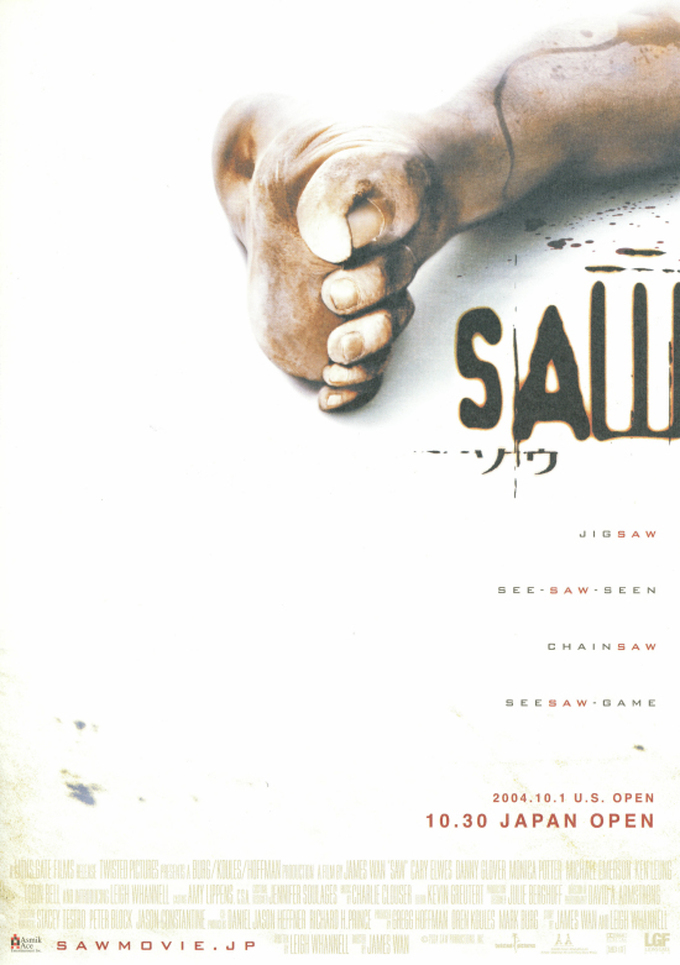
Saw (2004)

saw movie poster

I knew very little about Saw before I watched it yesterday. It came out during the time I was too busy moving out of my house and preparing to leave for France to pay much attention to upcoming movies. In France, I heard a little buzz on the internet about it being a very captivating and scary thriller. I tried not to pay much more attention than that because there is nothing worse than learning too much about a scary movie before you go see it.

Yesterday, while Amy (who doesn’t like horror movies)was out all day in class, I took my chance and sat down to watch it. Upon first viewing, I thought it was a really top-notch piece of horror (well all except that ending.) First-time director James Wan does an excellent job creating a dark, creepy mood. The set pieces are continually dirty and slimy looking, which is perfect for the setting. The story is intriguing enough to keep you from paying too much attention to the subpar acting and the numerous plot holes. It’s the kind of movie that kept me still for an hour after seeing it and thinking it over. And there lies the problem. After putting some thought into what I had just seen the movie crumbled.

But first, a little more on what is right about the film. The opening sequence is one of the more imaginatively openings I have seen in a long time. The movie opens in a rat hole of a bathroom buried deep in some long deserted public building. The two main characters, Cary Elwes and Leigh Whannel are on opposite sides of the room shackled by the ankles with a short chain connected to rusty pipes. They have no recollection of how they got there, or why. Oh, and there is a dead guy with his head blown off laying in the middle of the floor. I won’t give any other plot details away than this, but the remainder of the film centers on those two characters trying to find a way to get out of the room while playing a vicious game with a mad serial killer.

The design of the killer is also done quite imaginatively. Throughout the movie, we get brief glimpses into several other victims and the games they had to play. The killer’s design and the games he creates are quite frightening and original. Unfortunately, they are also quite implausible. There is no conceivable way that the killer could create his deadly games in the places he does without being noticed and eventually caught. I’m all for suspension of disbelief, but I believe a portion of the horror in this film is meant to be that this kind of sick killer could be quite real. He is not Jason, Freddy, or Mike Myers, but a more realistic psychopath. As such his killings are so complicated as to make them absurd.

There are several similarities to the superior piece of cinema Seven (1995). Both films are set in the seedier areas of a large city. The cinematography is both dark and moody. And both feature a moralistic serial killer who creates inventive and complicated murders. Yet where Seven succeeded in making a classic thriller all the way through, Saw fails about 3/4ths of the way in. The easier part of a horror/thriller is devising an original killer. Where the plot gets difficult is finding a resolution of why he is killing and how he is caught. Saw tries to be original by first giving the viewer a cliche fake ending, only to give a real surprise ending later. I wasn’t amused.

In order to fill out the plot and, I suppose, take up some time. The filmmakers create some characters that have no use. Danny Glover’s subplot adds to the ‘whodunnit’ aspects to a movie that doesn’t need to be a ‘whodunnit.’ Detective mysteries, cop shows, and murder plots create tension by giving various clues to who the villain could be. In a horror/thrill such as Saw, there is no need for the audience to figure out who it could be. We only need to be thrilled by the murderer and grasp with the victims for escape.

You never expect the acting to be brilliant in a small-budget horror film, and this film won’t surprise you in that area. Cary Elwes was a surpise to see in such a film. Though I know he has done similar fare I will always remember him for his role in The Princess Bride (1987). He doesn’t add much to the film in acting. He is also almost too pretty for the role. It seems as if the filmmakers recognized this because as the movie rolled on his makeup got more and more dirty and grotesque.

Overall Saw creates an unusual situation that is thrilling enough in the first viewing. However, after a truly good beginning the movie sinks into implausible and isn’t smart enough to figure out how to end itself.

A Fine How Do You Do

Seems I’ve been reviewing a lot of stuff lately, but not giving any details on my life in France. We’ve had a fine week back from Paris. The weather has been nice at least. It was still 70 percent cloudy and overcast, but it remained rather warm for January. We even had a couple of bright sunny days (like today).

I’ve been mistreating my French tutor. Last Monday I was playing a game and forgot about my session. Luckily her previous student had a cell phone and called me. Today I completely forgot about it. Amy came home from school and said we were invited for tarte flambes in a few minutes. My stomach got the best of my memory and out the door we went. It was into our second flambe that I suddenly remembered and flew out the door and ran to Subway, our meeting place. She had already left by that time. I came home to an e-mail wondering where I was. It’s amazing that I only have about two things to do a week around here and I still can’t remember to do them.

Tomorrow we’re going out with Daniel and Tammy. We’ll bring laundry over and then go to dinner and a movie. A double date it is.

Frida (2002) and Seven Brides For Seven Brothers (1954)

movie posters

We recently borrowed Seven Brides for Seven Brothers and Frida from some friends. While completely different movies I don’t have enough on either of them for full reviews so I’m bunching them up in the same post.

Seven Brides for Seven Brothers is a pretty by-the-books MGM musical. It is based on a book entitled The Sobbin’ Women which is in turn based on a Roman story titled The Rape of the Sabine Women. Which, like the title implies is about the kidnapping and rape of several young women who eventually come to ‘love’ their captors. How someone decided to make a musical out of this one wonders.

The movie is very sexist. The oldest brother, Adam (Howard Keel), sets out at the beginning of the movie to find a wife. He doesn’t do this because he is lonesome, or loveless, or in need of company. No, he seeks a wife because he lives in the mountains with six brothers and they need someone to cook for them and clean up after them. Even his method of finding a wife is pretty awful. He comes to town to shop for various goods and reckons to add a wife to that list. The remainder of the story focuses on the wife he finds, named Millie (Jane Powell), and how she manages to turn the brothers into refined gentlemen. The original story figures in with a kidnapping plot designed to win the hearts of potential brides for the remaining single brothers.

Sexist plot aside Seven Brides really does sparkle as a gem in the musical hat of MGM. This can be mainly attributed to some fine songs by Johnny Mercer (including the hillbilly charm of “Bless Your Beautiful Hide”) and some incredible choreography by Michael Kid. The ‘Barn Raising’ scene is worth the price of the ticket alone. Add to that the subtle beauty of ‘Lonesome Polecat’ and you have a winner.

I have personal memories of this film being watched in a dormitory lobby in college. Some bubbly friends of mine insisted that we had to watch it immediately after finding I had never seen it. They proceeded to quote most of the lines, sing every song, and practically dance along with every scene. They did so with such energy that I was swept along as well, hardly paying attention to the jokes or the plot. Upon viewing it again I couldn’t help but remember that enthusiasm, but this time I was unable to miss the bothersome plot. In the end, one must realize the time and place this movie came from without overlooking what is a pretty disturbing bit of plotting. The songs and the movements will most assuredly win most of the skeptics over though.

When Frida was released into theatres I had absolutely no desire to see it. I’m not a fan of Salma Hayek, biopics in general, and biopics about artists especially. Add to that my zero knowledge about the artist Frida herself and the movie’s fate was sealed into never being seen by the likes of me. However, my general lack of new movies here in France and being able to borrow them from a friend for free helped me to reconsider watching it. When I realized it was directed by Julie Taymor who also directed a marvelously beautiful version of Titus then I was actually excited by it (almost).

Like Titus, Frida is an amazingly visual movie. Taymor, who is known mainly for her Broadway adaptation of the Lion King, has an artist’s eye for visual flair. She has found a way to take something as static as a painting and made it alive. Throughout the film, she recreates several of Frida’s works and makes them a part of the action. It’s impossible to explain on paper (or cyberspace) but what she creates is something pure magic.

I can’t say how accurately Frida is portrayed in this movie. The picture we get is of a rather flawed woman who lived with a great deal of suffering. Her suffering comes in both physical ways (stemming from an accident early in life) and emotionally (from a cheating husband and her own mistakes). Yet it is this suffering that creates such remarkable art. Taymor manages to create an interesting and moving story within her excellent images.

Both Salma Hayek and Alfred Molina pull out excellent performances. I was especially impressed with Molina portraying the very flawed and yet sympathetic Diego. I had pretty much written this actor off after playing Doc Oc in the highly overrated Spider-man 2. But here he shows a real sensitivity to his character. Don’t be fooled by the billing of this film. The cover of the DVD would have you believe that Ed Norton, Antonio Banderas, Ashley Judd, and Geoffrey Rush all star in it. In fact, with the exception of Geoffrey Rush, all of them have, what amounts to cameos in the picture. Rush is in the movie a bit more, but I wouldn’t call even that a starring role.

Though neither Seven Brides or Frida are perfect films. Both of them win you over with sheer energy and charm.