Sci-Fi In July: Alien Vs. Predator (2004)

alien v predator poster

Alien (1979) is one of the greatest science fiction/horror movies ever made. Predator (1987) is, well, it isn’t the greatest anything, but it is a ridiculous bit of 1980s sci-fi action elevated by some fine direction by John McTiernan and some charismatic performances by its stacked cast (including Arnold Schwarzenegger, Carl Weathers, Jesse Ventura, and Bill Duke).

Dark Horse Comics obtained the rights to both franchises and began releasing separate stories from them. In 1989, some genius decided to combine them and created the first Alien Versus Predator mashup. There are a lot of comics, and I’ve not read any of them, so I can’t comment intelligently. My understanding is that the Predators, at some point, found some Alien eggs and have been breeding them ever since. With the intent of periodically releasing them so that they can be hunted.

A quick primer if you’ve never seen any of the films. A Predator is a technologically advanced alien species that flies to various planets and hunts the native species for sport. The Aliens are Xenomorphs, incredibly dangerous, but not particularly advanced, creatures with acid for blood.

There are numerous films in both franchises, and two crossover movies. The crossovers got terrible reviews and are generally considered some of the worst films in either franchise, which is why I’ve avoided watching them for so long. I found a cool DVD boxed set at Goodwill the other day that contains the first four Alien films, two Predator movies, and both of the crossovers. And here we are.

For the first thirty minutes, Alien vs Predator creates a promising setup. Wealthy industrialist Charles Weyland (Lance Henriksen) (the Weyland-Yutani corporation features heavily in the Alien franchise) discovers a massive pyramid structure buried some 2,000 feet below the surface of a tiny island off the coast of Antarctica.

Weyland gathers a bunch of smart people, and they investigate. I love a good story where a group of specialists investigates something mysterious and discovers monsters, or ghosts, or aliens. I can completely get behind that in a film.

The difficulty of an Alien/Predator mashup is that they are both aliens. Big, scary monsters. The Xenomorphs are basically killer animals that can’t communicate in any real way. The Predators canonically speak a non-human language that is never translated (at least not in the films). Making an interesting story with just these two creatures would be difficult. One likes to be able to relate to at least one character in a story.

I really wish they’d make that film, though. They always add humans into the mix, and humans just muck up your Alien/Predator mash-up. They don’t get developed well, and for the most part, they just become cannon fodder for the monsters. I think you could make a really good AVP film without any humans at all.

Here’s where things get stupid. Our heroes (such as they are) come to the Antarctic island only to discover someone or something has already drilled a hole down to the pyramid. Naturally, it is the Predators who drilled the hole. Apparently, the pyramid is theirs. They keep a bunch of frozen Xenomorphs down there, and every hundred years, they come to Earth, unfreeze them, let them feed on humans to grow big and strong, then hunt them for fun.

We spend a little time watching the humans muck about in the pyramid. Then they unwittingly unleash some Facehuggers, and quick as you like, they burst out of their chests and become full-fledged Xenomorphs.

A few Predators, who have apparently been hanging out in Earth’s orbit waiting for this to happen, fly down for some (finally) Predator on Alien action. Most of the humans are dispatched pretty quickly, though a couple last a while, and there is at least one survivor (because, of course, there is).

It was directed by Paul W.S. Anderson, who helmed films like Mortal Kombat, Event Horizon, and several of the Resident Evil films. And like those films, his direction isn’t terrible, he’s not incompetent, but neither is it particularly memorable. He’s just good enough to keep you watching, but bad enough you wish you hadn’t.

That pretty much sums up my feelings on this film. It is better than I expected to be, but my expectations were incredibly low. I still think you can make a good Alien Vs. Predator movie, but this is definitely not it.

Now Watching: Breaking News (2004)

image host

Breaking News (2004)
Directed by Johnnie To
Starring: Richie Jen, Kelly Chen, and Nick Cheung
Synopsis: After a disastrous failure to stop a robber gang, the police attempt to redeem themselves through a series of publicity stunts and shootouts.
Rating: 7/10

I’m quite behind on these. They are easy to write and I always mean to write them right after I watch, but then something comes up and I forget. I watched this one five days ago. I’ll try to play catch-up this weekend.

Johnnie is a Hong Kong director whose name gets tossed around quite a bit in my circles, but I’d never seen one of his films until now. The Criterion Channel is running a whole bunch of them, and I chose this one pretty much at random. It was good enough to make me watch another one the very next day and then a third a couple of days later.

It begins with an incredible 7-minute-long one-take shot. It follows a man into a building (the camera cranes to a top floor and into a building, then back out again), followed by a shootout with the cops. This goes poorly for the cops, and they decide they need to put on a “show” for the media. Basically, they start using their own PR department to create videos to send to the news to indicate how awesome they are.

The action scenes (and there are quite a lot of them) are all staged really well. The media stuff feels very dated and has not aged particularly well. But as I said, there is enough to love here that I immediately watched another film from To.

Awesome ’80s in April: The Killer (1989)

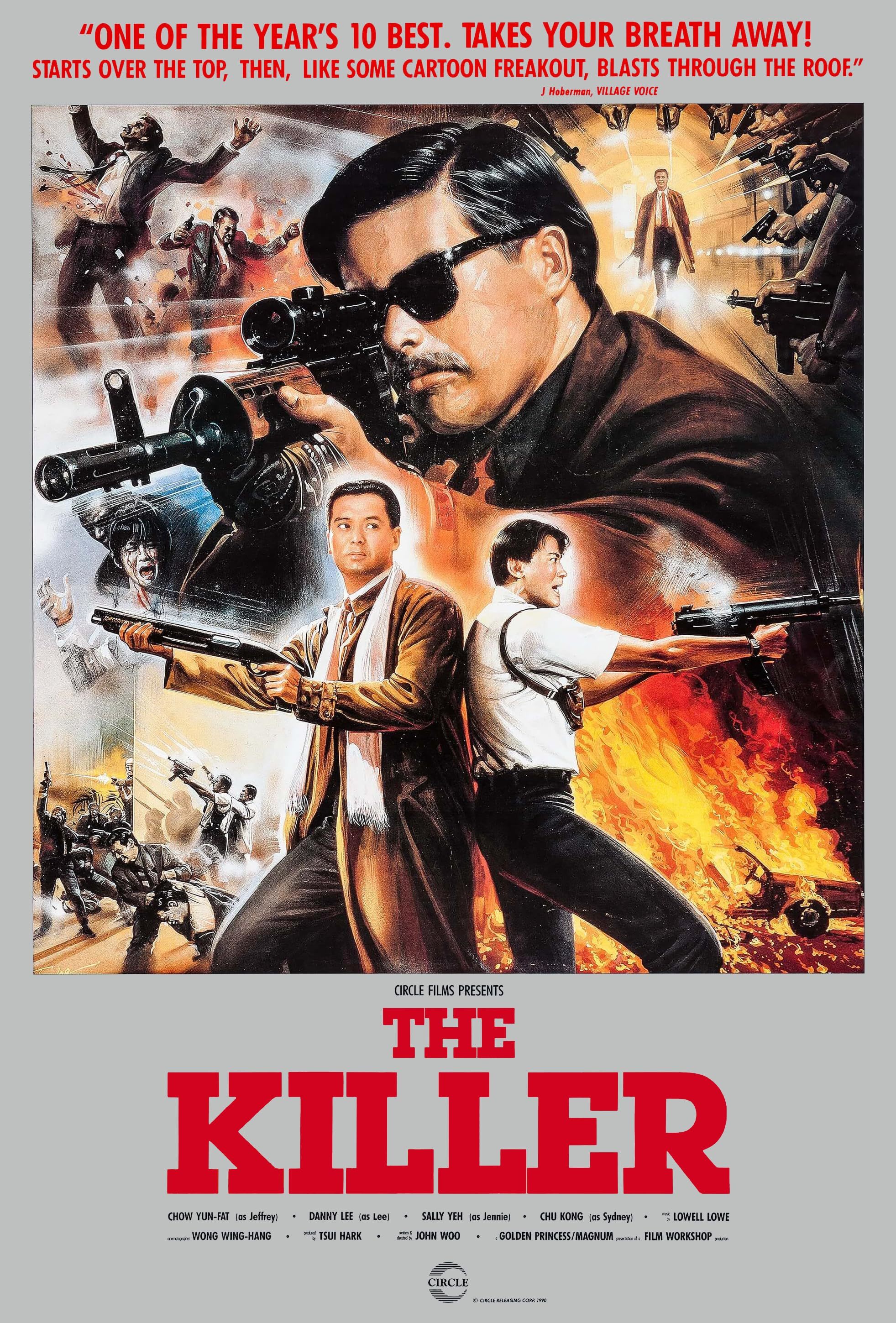
cover

I naturally think of action movies when I think about 1980s movies. Action films along with slasher horror and romantic comedies defined the genres of 1980s cinema. When I think of 1980s action films I think of Arnold Schwarzenegger, Sylvester Stallone, and Chuck Norris. I think about big explosions, increasingly bigger guns, and witty one-liners.

Big, bigger, and biggest defined American action films in the 1980s. But in Hong Kong, they were making a different kind of action film. Led by director John Woo, Hong Kong action films were much more stylized and interesting than their American counterparts. Woo’s action films were operatic in tone. They utilized slow motion and close-up gunfire. They also relied more heavily on telling a compelling story with thought paid attention to developing its characters. The explosions weren’t always big, but the emotions were.

I’m not extremely well versed in Hong Kong cinema, and I’ve only seen a few John Woo films, but watching The Killer reminded me that I need to dig further into them.

The Killer stars Chow Yun-fat as Ah Jong a hitman. Paid to assassinate a Triad leader he accidentally injures a nightclub singer named Jennie (Sally Yeh), leaving her partially blind. Ridden with guilt he begins visiting her secretly and eventually, the two become friends, without her ever knowing who he really is.

Hot on his trail are the gangsters who paid him to kill the Triad leader (his face was seen during that hit which may lead others to know who ordered the murder in the first place) and Detective Yi Ling (Danny Lee).

Ah John and Detective Ling develop a respect for one another as they both have a moral code and are both quite good at what they do. I was reminded quite a bit of Heat while watching this as the games they play with each other are reminiscent of Al Pacino and Robert DeNiro in that film.

The action sequences in this film are incredible. I’ve watched several other 1980s action films this month and most of those big action sequences pale in comparison. American films tended to rely on the bigger is better principle. As long as things were constantly blowing up they called it a day. But Woo injects his film with a real sense of style. His action sequences are exciting.

And beautiful. All those close-up shots done in slow motion with operatic music playing really give those sequences a delicate beauty. There are a few scenes located in an old church filled candles that are stunningly gorgeous.

The story itself is fine. I can’t say I’m really moved by any of it, but I appreciate that the film is making an effort with it. It is definitely better than what they were doing with Rambo III.

But nobody watches action films for the story and what Woo and company provide us with those action sequences is more than enough to make The Killer highly recommended.

Awesome ’80s in April: The Rambo Trilogy

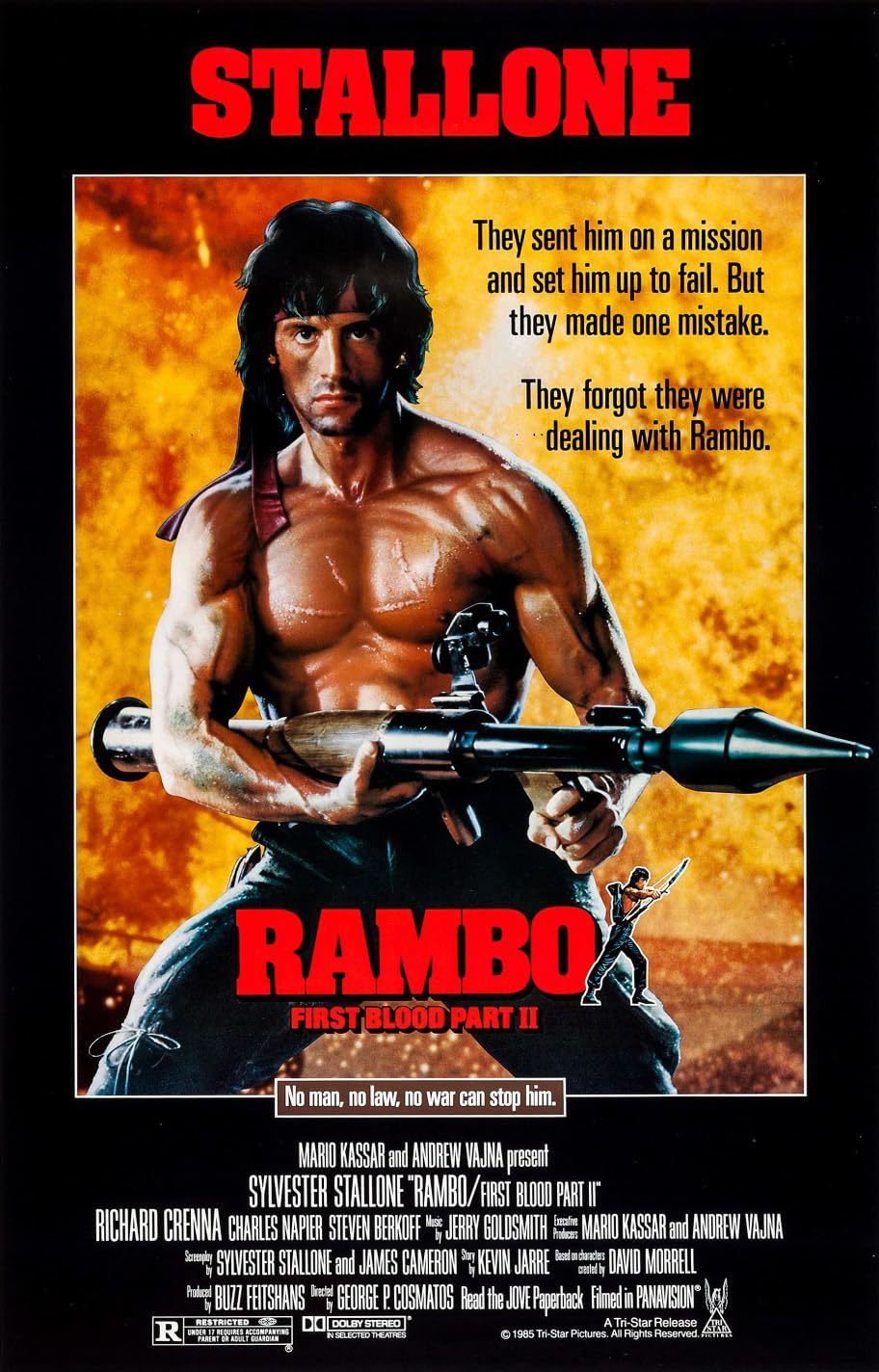
rambo ii

After years of getting bit parts and going nowhere, Sylvester Stallone sold his script to Rocky and somehow talked the right people into letting him star. It became a huge success and launched his career. In 1982 he starred in First Blood, the first Rambo movie. That film launched him into superstardom and made him one of the biggest actors of the 1980s.

What I didn’t realize until just now is that in the time between when he made Rocky in 1976 and First Blood in 1982 he made six other films including two Rocky sequels. Other than the Rocky sequels, most of them were only moderately successful. He is credited as a writer or co-writer on most of them. He also directed the first two Rocky sequels, Paradise Alley in 1978 and Staying Alive, the Saturday Night Fever sequel. It is interesting to look at his career at this stage and realize he seemed to think of himself as something of a Renaissance man.

But this isn’t about Sylvester Stallone, it is about John Rambo, the quintessential 1980s action hero. The Rambo films became something of a template for action films in the 1980s. You are probably picturing Stallone right now as Rambo, muscles bulging, a bandana wrapped around his long hair, sweat dripping down his brow as he fires a massive machine gun at countless bad guys.

Truth is the subsequent films became exactly that, but that first film, First Blood, actually attempts some real drama and a social message. It is more of a character study than an explosive shoot-em-up. For the first two acts anyway.

John Rambo is a Vietnam vet. He returns home to find his country not only isn’t proud of his service but angry at it. His fellow soldiers are spat upon when they return. He heads to the mountains to find his old friend. But when he gets there he finds his friend has died. It was cancer they wrote on his death certificate but his wife thinks it was Agent Orange from the war that really got him.

Disheartened he walks into town looking for a bit to eat before he moves on. He’s immediately picked up by Sheriff Will Teasle (Brian Dennehy). The Sheriff basically tells Rambo they don’t want his kind – dirty drifters who need a shower and a haircut – in his town and drops him off past the bridge. Rambo is having none of that and turns right back around.

He’s arrested then and essentially tortured by the local cops. Rambo, flashing back to his time in ‘Nam, when he was captured by the Vietcong and tortured, flips out and escapes. The chase is on and once again the police go too far, shooting at Rambo when he’s done nothing to deserve being killed. At this point, the film turns into an action film. Rambo’s former CO (Richard Crenna) shows up and lets the local yocals know they are facing the best damn Green Beret he’s ever seen and it’s best to give up.

The action is tight and well-composed all the way up until about the last fifteen minutes at which point it gets ratcheted up to ridiculous levels.

It is those levels that will serve as the inspiration for the following two sequels. In Rambo: First Blood Part II he’s offered a pardon from prison (for he did get sent to prison for killing all those cops in the first film) if he’ll go back to Vietnam. The mission is to infiltrate an old prison camp and see if there are still any POWs there. Naturally, there are and once again Rambo gets to kill a lot of people.

First Blood made a big deal about how the authorities were the villains. The cops hassled and tortured him just for existing, the military more or less turned their backs on him. That’s an interesting point of view for a 1980s action flick. Rambo II contains a little of that, with Rambo basically being used as an expendable pawn who is sent to Vietnam to basically prove that there aren’t any POWs left and everybody can be happy now that the war is over. But mostly it is a chance to let Rambo fight in the jungle.

With Rambo III our hero gets to fight in Afghanistan. His old CO is captured there and Rambo has to get him out. This time any pretext of a real plot of subtext is thrown out of the window in order to allow for more shooting, more explosions, and more dumb fun. Let’s just say there is a scene in which Rambo jumps inside a tank and fights off an attack helicopter and leave it at that.

There have been two subsequent Rambo sequels made – one in 2008 and another in 2019. I haven’t seen them. Those first three feel like enough.

Awesome ’80s in April: The Presidio (1988)

the presidio poster

It is funny what you remember from your childhood. Until this week I’d never seen The Presidio, but I remember that my cousin Clifton has. I remember him telling me how awesome it was and that James Bond beat a guy up using just his thumb. That was enough to make me want to watch it, but I wasn’t even a teenager in 1988 and my mother was much more strict about what she let us watch than Aunt Sandi was for Clifton. When I was old enough to watch it I had already moved on to other movies. But I still remember wondering how a guy could beat another guy up with just a thumb.

That guy is Colonel Alan Caldwell (Sean Connery) the provost marshall of the Presidio Army Base in San Francisco, California. He’s a hard-nosed guy who doesn’t take too kindly when Jay Austin (Mark Harmon), a police detective shows up at his door trying to solve two murders. One murder was committed on the base, but another, seemingly by the same criminal, was committed in the city. That means it is SFPD jurisdiction.

Turns out Austin used to be an Army man, stationed at the Presidio, under the command of Caldwell. They didn’t get along too well, but are forced to team up to solve these murders. This sets up our buddy cop film with one tough, old, by-the-books officer and a younger do whatever-it-takes to get the job done detective.

It is all pretty standard 1980s cop flick fare. Connery is great and the mystery is pretty good. The action is mostly average although I did enjoy one scene inside a warehouse full of giant water bottles that get shot up pretty good. Meg Ryan plays the love interest who is also Caldwell’s daughter. She’s basically a Meg Ryan type but not given much to do.

All in all a pretty good way to spend a Saturday afternoon at the movies.

Oh and that scene where Connery takes down a dude with his thumb? That’s worth the price of admission all on its own.

I almost forgot to mention, there is a scene in which Mark Harmon’s character meets a woman with a bunch of Grateful Dead posters on her office wall. He needs something from her so they have a hilarious chat about the Dead and which shows they’ve seen. It ends with him promising to send her a Dylan bootleg.

Awesome ’80s in April: RoboCop (1987)

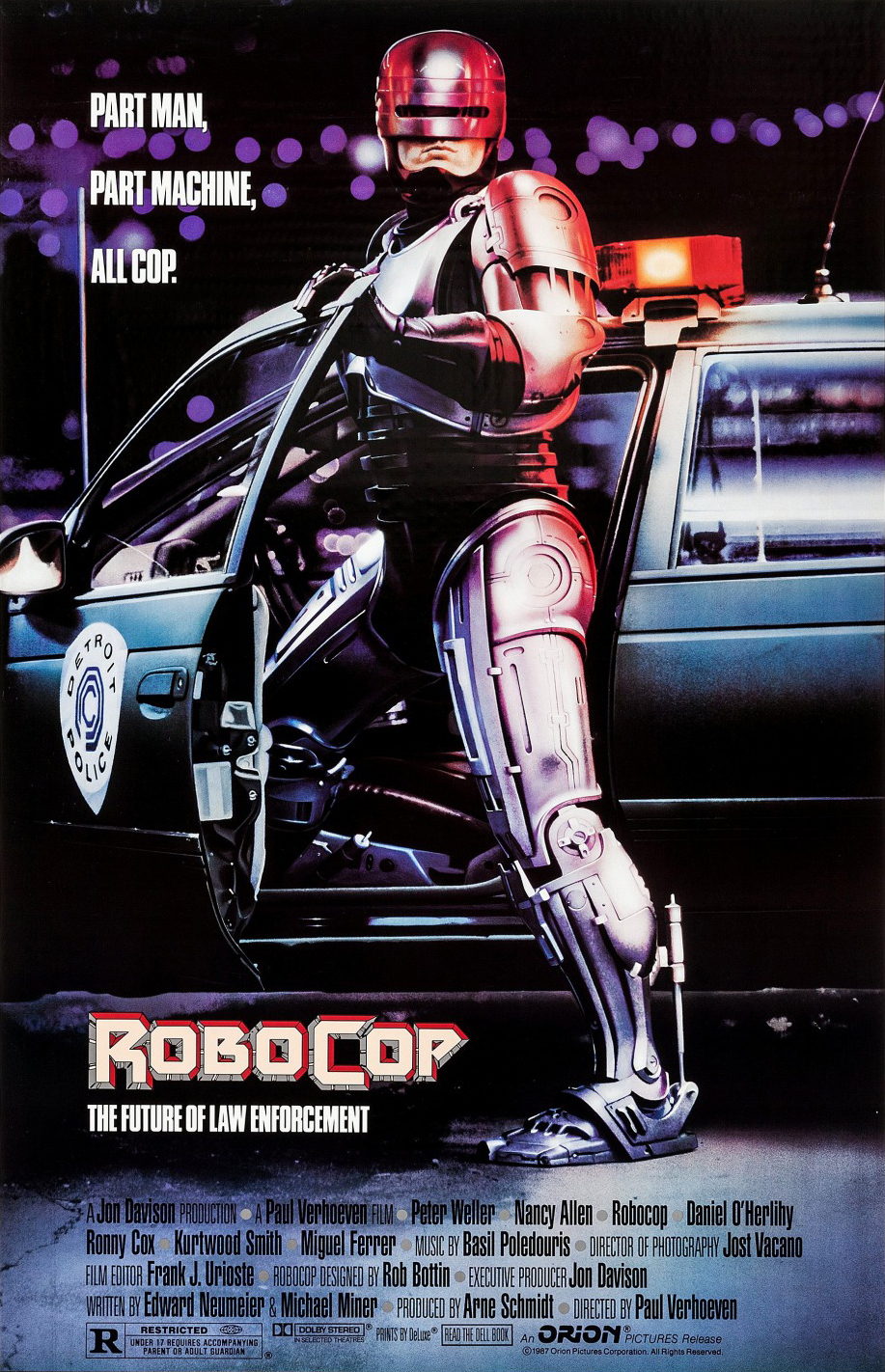
robocop poster

I sometimes say that I grew up in the 1980s but came of age in the 1990s. What I mean is that I was 13 when the ’80s became the ’90s, so my teenage years were really spent in the early ’90s. The music, movies, books – the art – that really shaped me into the man that I would come are mostly from the early 1990s. That isn’t to say the movies from the ’80s aren’t important to me – they are, absolutely. It is just a different kind of important.

I remember laying on the floor in my bedroom with my stereo speakers pointed at my ears with The Smashing Pumpkins “Gish” surrounding me. That music had a hold on me, it touched something deep inside of myself. Silence of the Lambs (1991) and Terminator 2: Judgment Day (1991) might not be the most intellectual, or emotionally deep films, but they are great movies and they had a profound effect on the way I appreciate cinema.

Movies from the 1980s, or at least movies I watched during the 1980s affected me in much different ways. As a kid, as a young teenager, I mainly looked for thrill rides or things that made me laugh, things that excited me. The movies that did those things in abundance have stayed with me all of these years. Indiana Jones and the Temple of Doom (1984) and Gremlins (1984) still flood my memory banks with nostalgic joy. But they don’t necessarily inform my understanding of Art.

I’m getting way into the weeds for what should be a review of RoboCop. But I think this type of discussion is important for me to talk about as I’m delving back into the cinema of the 1980s.

RoboCop came out in 1987. I did not see it in the theaters. My parents would have never taken me to it. But I did watch it on VHS sometime later. I don’t remember when. My guess would be sometime around when the sequel came out in 1990, but I really don’t know. One of the things I love about the ’80s is how I did get to watch so many movies at home that my parents would never have allowed me to watch in the theater. Sometimes I’d watch these types of movies at a friend’s house, sometimes my father would rent them when mom was away for the weekend. Or sometimes I just wore them down with my asking (it helped if I could convince them that the movie was rated R over violence and maybe some cussing instead of sex and nudity.)

Whenever I watched RoboCop I loved it. I thought a supercop cyborg was the coolest thing ever. I loved his multiple-round firing pistol. I loved that he had such great aim he could shoot through a lady’s dress and hit the guy who was attacking her in the crotch. I loved the big robot villain that could shoot freaking missiles. I definitely loved the guns that could blow up cars and the explosive finale.

Watching it now, I’m less impressed with the bountiful action scenes and Robocop as a character. I am interested in the satire that director Paul Verhoeven fills the film with (stuff that flew straight over my head as a kid). The movie is clearly making fun of the militarization of our police forces and military. It mocks consumer culture (the inserted commercials are terrific – especially the goofy car commercial and the placement of said car into the hands of most of the film’s characters.) It ponders a future in which we privatize the forces that are supposed to protect us and how for-profit businesses might handle such things.

Truthfully, I don’t think it does these things particularly well. Verhoeven has never been particularly subtle with his messaging. So what I’m left with is an action flick with some big messages that doesn’t handle either aspect well. It is a fun watch, but not one I can say I’m interested in seeing again anytime soon.

Lady Vengeance (2005)

lady vengeance poster

Forget Kill Bill.

Screw Quentin Tarantino.

There is one filmatic revenge series to obsess over and it doesn’t come from the mighty shores of California. Chan-wook Park’s final installment to his vengeance trilogy, Lady Vengeance, has just been released on US DVD and it is an awesome way to end the series, indeed.

Where Tarantino gave us two films full of exquisite style and very little substance, Park finds time to explore the meaning between the bloodletting.

Where Tarantino created an amazing genre-bending exploitation masterpiece, Park has made a violent, stylish trilogy that is more than just eye candy.

That’s all the Kill Bill references I’ll make, I promise.

Lady Vengeance (which was forever named Sympathy for Lady Vengeance, until the good people at Tartan decided it needed a little spiffing) is a tad slower, and less action-oriented than the other two in the trilogy, but it is the final in the series and like Kill Bill Vol. 2 (darn it, ok I swear that was the last one, for real this time) the series needs a little grounding.

Lee Geum-Ja (Yeong-ae Lee) is sent to prison at the age of 19 for the abduction and murder of a small child. Truth in fact she did not murder or abduct the boy (she merely helped keep him) but takes the blame for her accomplice, Mr. Baek (Min-sik Choi) because he threatens her own child with violent harm if she does not.

She spends 13 years in prison for those crimes and while there she makes good with everybody. She is the perfect inmate – she finds religion, helps out, cares for an elderly inmate, and even donates an organ – all the while she meticulously plots her revenge.

Upon release, she uses her former cellmates to help get her revenge and extols it in true Chan-wook Park fashion.

Although served deathly cold, the revenge is not so sweet. In fact it is quite bitter and does not relieve Geum-Ja of guilt like she thought it would. Like all of the films in the trilogy, Lady Vengeance delves deep into the consequence of being wronged and how finding vengeance reaps more than it sows.

The film is astonishingly beautiful. Bathed in gorgeous color and light that makes even the most blood-soaked scenes look as delectable as the desirous confections Geum-Ja is so good at making.

With only four films under his belt, Park has proven he is an artist of the finest measure.

As mentioned, the film is slightly more subdued than the others. There are no liver donations as performed by hoodlums, no ironic circle jerks, and certainly no massive fist-fights as performed in small hallways, but what it lacks in extremism it finds in emotional gravitas.

Yeong-ae Lee is to Chan-wook Park as Uma Thruman is to Quentin Tarantino (oh forget it, you can’t review Lady Vengeance without referencing Kill Bill, at least not in this house.) Gawd just looking in her eyes would make a cold stone weep. She plays the role of Geum-ja with an intensity of a thousand suns, yet manages to keep an eternal sadness just below the surface. It is a performance worthy of honor.

For once Park has ended a vengeance film with something resembling a happy ending. No, the vengeance isn’t really vindicated, nor is Geum-ja satisfied, but unlike the preceding films, the violence, and vengeance seem to stop here. And that seems to be enough.

It may not be as gut-wrenchingly satisfying an ending as we get in Sympathy For Mr. Vengeance or Oldboy, but it is one that rings the finality to the trilogy, one that serves as an answer to the questions brought up by all three films.