The Top Five Film Noirs Starring Humphrey Bogart

I meant to write and post this back during Noirvember, but I got distracted, and then I forgot.

Humphrey Bogart is my favorite actor. He made some incredible films in his storied career (including my all-time favorite, Casablanca), and more than a few of them were film noirs. More than just about any actor of the classic period, his name is (arguably) the one most associated with noir. So I thought it would be fun to do a Top Five favorite noirs starring Bogart.

high sierra movie poster

5.  High Sierra (1941)

Bogart wasn’t always the big star we know him as today. He spent the better part of a decade as a supporting player, often billed as a gangster or heavy. High Sierra changed that. He was lucky to get that role, as both Paul Muni and George Raft had been offered it first, and director Raoul Walsh didn’t think he was leading man material.  But writer John Huston thought Bogart was perfect for the role, and eventually Walsh relented. Huston would, that very same year, cast Bogart in his film The Maltese Falcon (more on that in a minute).

With this film he hasn’t quite left the gangster mold; he plays Roy Earle, a guy who’s just gotten out of prison and is already set for his next score. He’s holed up in a cabin in the mountains with three other guys and a girl, just waiting for the right time to rob a ritzy hotel. The girl (played by the always great Ida Lupino) will lead to trouble. Bogart is still perfecting his world-weary, cynical, but ultimately sentimental character, but he’s still terrific as Earle.  Lupino is great too, and Walsh’s direction is quite wonderful. 

the maltese falcon poster

4. The Maltese Falcon (1941)

If High Sierra made Bogart a star, then The Maltese Falcon solidified it. Based on the novel of the same name by Dashiell Hammett, this film is often considered the first truly great film noir. Bogart plays Sam Spade, a tough, cynical private eye who is hired by a woman (Mary Astor) who may not be who she claims to be and may not actually want what she claims to want. 

What she really wants is the titular object, which is a mythical, jewel-crusted statue of a bird that was supposedly gifted to the Holy Roman Emperor hundreds of years ago but has been lost to time. While trying to find the bird, Spade will run across a number of eclectic and strange people, including ones played by Peter Lorre and Sydney Greenstreet. 

The plot is complicated, the cast is perfect, and John Huston’s direction (it was his directorial debut) is fantastic.

in a lonely plac eposter

3. In a Lonely Place (1950)

This is probably the least noirish film on the list and quite possibly Bogart’s best performance. Based on the excellent novel by Dorothy B. Hughes, Bogart plays a troubled screenwriter with a penchant for violence who hasn’t written a hit movie in years. One night he takes a girl home with him, then changes his mind and kicks her out.  The next morning she finds herself dead, and he finds himself a suspect. Through this he’ll meet his neighbor Laura (a magnificent Gloria Grahame), and they’ll fall in love, but she’ll never quite be sure he didn’t kill that girl.

Bogart’s performance is heartbreaking. The script is full of great lines like, “I was born when she kissed me, I died when she left me, and I lived a few weeks while she loved me.” Just a magnificent movie.

key largo poster

02. Key Largo (1948)

Bogart and Lauren Bacall met on the set of To Have and Have Not (1944) and fell in love and stayed together until he died in 1957. They made four films together (three of them are absolute bangers, and the fourth one isn’t bad – one of the others almost made it to this list, and the other is #1).

Directed by John Huston (his second film on this list), Key Largo includes an incredible cast (including Thomas Gomez, Lionel Barrymore, and Edward G. Robinson).  Bogart plays Frank McCloud, a former soldier who stops by Key Largo to visit with his dead comrade’s father (Barrymore) and widow (Bacall) but gets stuck when a hurricane rolls in. Also stuck with them are a few gangsters awaiting a car full of cash that they’ll trade for counterfeit bills.  

The hurricane and the gangsters make for a pot of dangerous soup that’s ready to boil. This boasts a classic Bogart performance. He’s smart and tough, witty and sensitive. He and Bacall work magic together, and Barrymore is great as the father who doesn’t take any crap. But it is Robinson who steals the show. He gets one of the all-time great introductory scenes and remains awesome throughout.

the big sleep poster

01. The Big Sleep (1946)

I think this was the first film noir I ever watched. Based on the fantastic book by Raymond Chandler, Bogart plays Phillip Marlowe, a private eye hired by an old man over some blackmail scheme involving his youngest daughter (Martha Vickers in a small but oh-so-memorable role). Quickly things turn complicated, convoluted, and murderous (director Howard Hawks famously phoned Raymond Chandler over who killed a certain chauffeur, and Chandler didn’t actually know the answer). But the plot isn’t really the point. 

The Big Sleep is all about its mood, its characters, and the way it makes you feel. Bacall is the older daughter and potential love interest. It is a blast watching her flirt with Bogart and become the femme fatale. Everyone flirts with Bogart in this movie. The two sisters, the cab driver, the bookstore clerk—hell, I’d flirt with him if I were in this movie. It is the perfect noir and an absolute blast to watch.

Well, there you have it, my favorite Humphrey Bogart film noirs. Do you have a favorite? Do you disagree with my picks? Honestly, if I wrote this tomorrow I’d probably have different picks. But this was fun.  I’ll try to do more of these when I can.

Mysteries in May: Night Has a Thousand Eyes (1948)

image host

There is this thing that certain movies do where a character will have a vision or be foretold the future in some way. The future is usually bad for them; they’ll die or someone close to them will be murdered. The visions will include several very specific, yet strange details. The characters will spend the rest of the movie trying to stop the inevitable. At first, they will probably not believe in the visions, but as those specific, yet strange details all come true, there will be a mad rush to stop the horrific thing from becoming reality.

I don’t know if Night Has a Thousand Eyes was the first film to do this thing, probably it wasn’t. But I believe it is the earliest version of it that I’ve seen (or maybe not, I’m sure I’ll remember an earlier one once I hit Post.

Truth be told, I’m not a huge fan of this trope, probably because it is a trope. Whenever this sort of thing happens, you know the prophecy (or whatever) will come true. A prophecy that doesn’t come true in a movie (or is narrowly averted) would be boring.

John Triton (Edward G. Robinson) used to be a charlatan. He had an act where he pretended he was psychic. He was good at it, too. Then one day, he discovered he really could see the future. But the things he could see were always terrible events, mostly people getting killed. The thing he pretended to do for money has now become a curse.

The film begins with Jean Courtland (Gail Russell), an heiress, attempting to kill herself by jumping in front of a train. Her boyfriend, Elliott Carson (John Lund), saves her in the nick of time. When she asks him how he knew where she was, he takes her to a bar where Triton is waiting for them.

Lund is skeptical of Triton’s psychic abilities, but Jean is a firm believer. Triton then tells the whole sordid deal of how he came to know Jean and how she found herself about to commit suicide. We see this in flashbacks.

Basically, Triton had a vision that Jean’s father was going to die in a plane crash. He tries to warn her, but is unsuccessful in saving him. They begin to talk, and Triton has another vision, foreseeing Jean’s death under the stars, in a few days.

Jean can’t take the pressure and decides it isn’t worth living, knowing she’ll be dead soon anyway. But after Lund rescues her, she decides to try for life. Lund calls the cops, and a whole bunch of people try to make sure the prophecy doesn’t come true. The prophesy has some of those pesky details I was telling you about and as they come true everybody is freaking out.

I won’t spoil it all for you, but you can probably guess most of it. I will say it does something at the end that’s pretty interesting, but most of it is rather pat.

Edward G. Robinson is great, though. He’s always great, and he plays the tormented psychic pretty well.

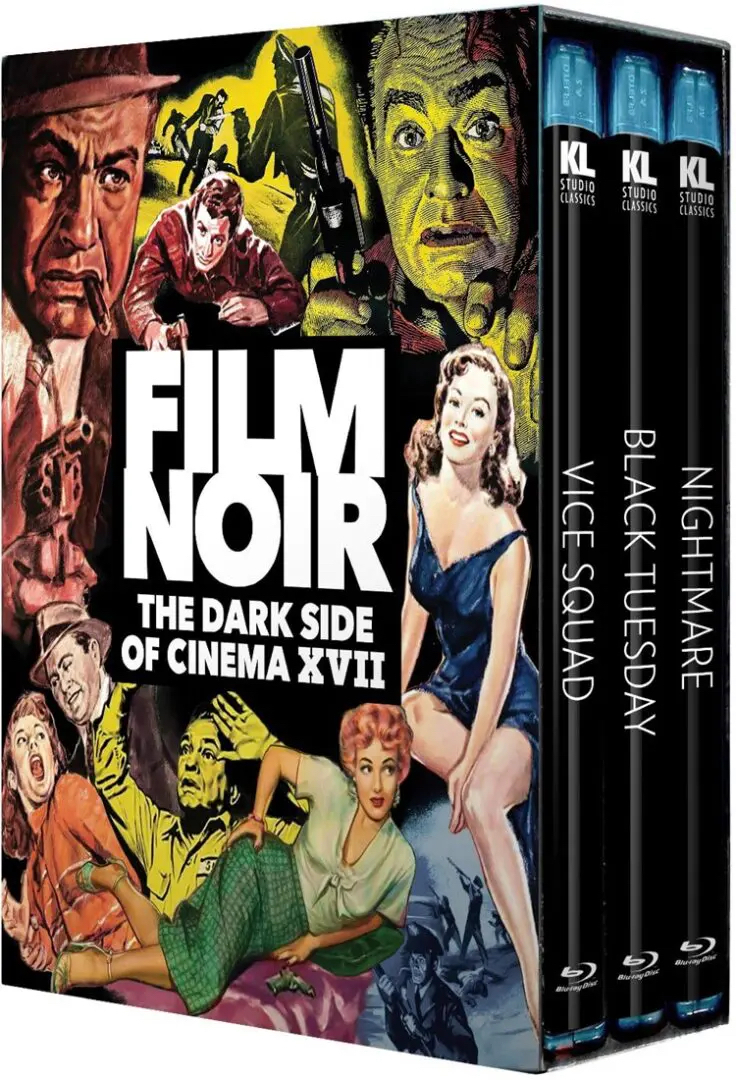
Film Noir: The Dark Side of Cinema XVII

Edward G. Robinson is one of my favorite actors. He became famous for portraying snarling, and deadly gangsters, and he’s great in that type of role in films like Little Ceasar and Key Largo (1948). But he made all types of other films from film noirs to comedies to heartfelt dramas. One of my favorite roles of his was his very last, the bookish best friend of Charlton Heston in Soylent Green (1973).

This edition of Kino Lorber’s long-running noir series stars Robinson during a dark period of his career. He’d been blacklisted by HUAC and could only find jobs with poverty row studios in low-budget b-pictures. These are certainly not his best films, but I just love that they are getting the Blu-ray treatment. You can read my full review here.

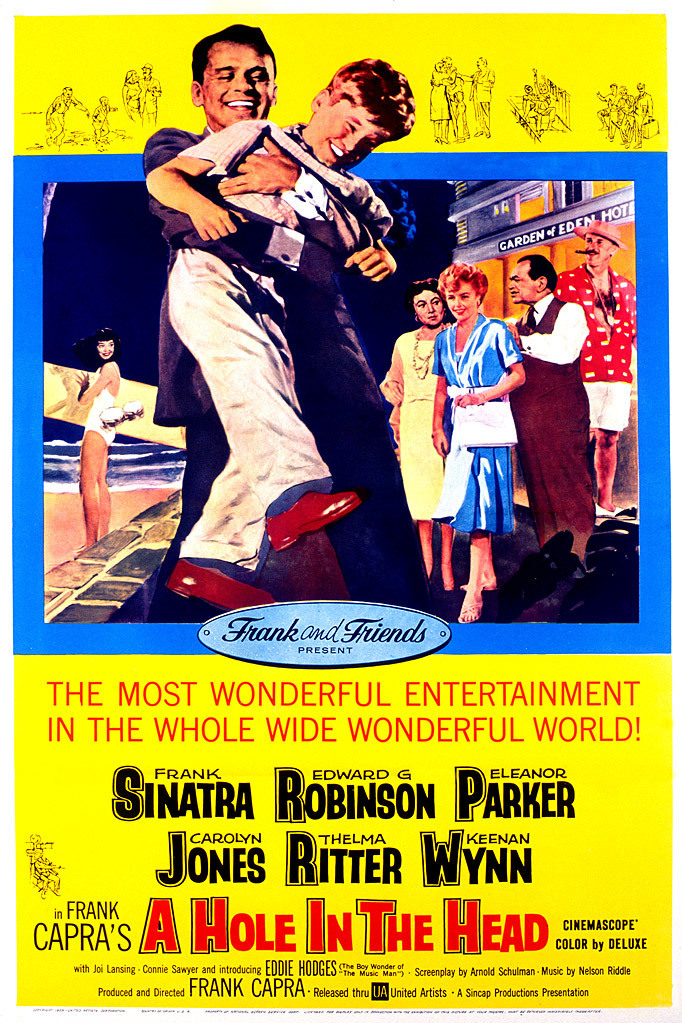
A Hole in the Head (1959)

a hole in the head poster

I received A Hole in the Head for my birthday in a Frank Sinatra double pack with the original Manchurian Candidate. I had put off watching it because it did not seem like a movie I would particularly enjoy. But in my quest to watch and review all of my movies, I had no choice but to put it in the player. Of course, the fact that my wife wanted to watch it prompted me a little further even to the point of watching it out of alphabetical order.

Frank Capra is the great godfather of sentimental movies. Many of these are deservedly hailed by fans and critics. From Mr. Smith Goes to Washington to It’s a Wonderful Life and Arsenic and Old Lace Capra made movies about the little guys fighting the system and coming out on top. These movies are sentimental enough to be dubbed “Capracorn” by critics but are handled with masterful hands that rise above the schmaltz created by so many others. Besides little guys, he also flooded his movies with eccentric characters standing out in a world full of normal folk.  Sadly, A Hole in the Head tries to mix both of these Capra types and fails on both accounts.

The film is the second to last picture ever made by Capra and was the beginning of an attempted comeback, as he’d taken a break from making Hollywood pictures. But instead of a comeback, this film serves only to remind us of what Capra used to be. Frank Sinatra plays a down-on-his-luck big dreamer who is about to be evicted from his hotel business in Miami, Florida. He calls up his brother, Edward G Robinson, and sister-in-law Thelma Ritter for help pretending his son is sick. Robinson and his wife quickly head down from New York to see what’s going on. Hilarity and sentimentality ensue. Swinging Sinatra butts heads with button-down Robinson until a quick ending and easy solution is found.

The performances of the stars are fine. At this point in their careers, Sinatra and Robinson are essentially playing themselves. Although Sinatra is more up and coming to the declining Robinson. There are some good jokes and the simple story is fair enough as it is. Capra fills Sinatra’s hotel with an odd collection of eccentrics that seem to have no other purpose but to fill up some time and tell a few jokes. The ending of the movie seems tied on and creates changes to some characters without any real provocation. The cheese factor is high even for a Capra film and it’s not subdued by any superb performances. The drama is not elevated above the schlock you would see in a made-for-TV movie.

The stand out of the film is Sinatra and his son singing the classic “High Hopes”. Being a fan of Sinatra more as a singer than an actor this amusing break in the middle of the picture helped keep my hopes up for a decent picture. Those hopes were not shattered, nor were they completely fulfilled. For beginners of “Capracorn” you should pick out some of his earlier, superior films. But for a lonely night in need of some corny sentiment, this is some fluffy candy that just might fill.