The Friday Night Horror Movie: Deep Red (1975)

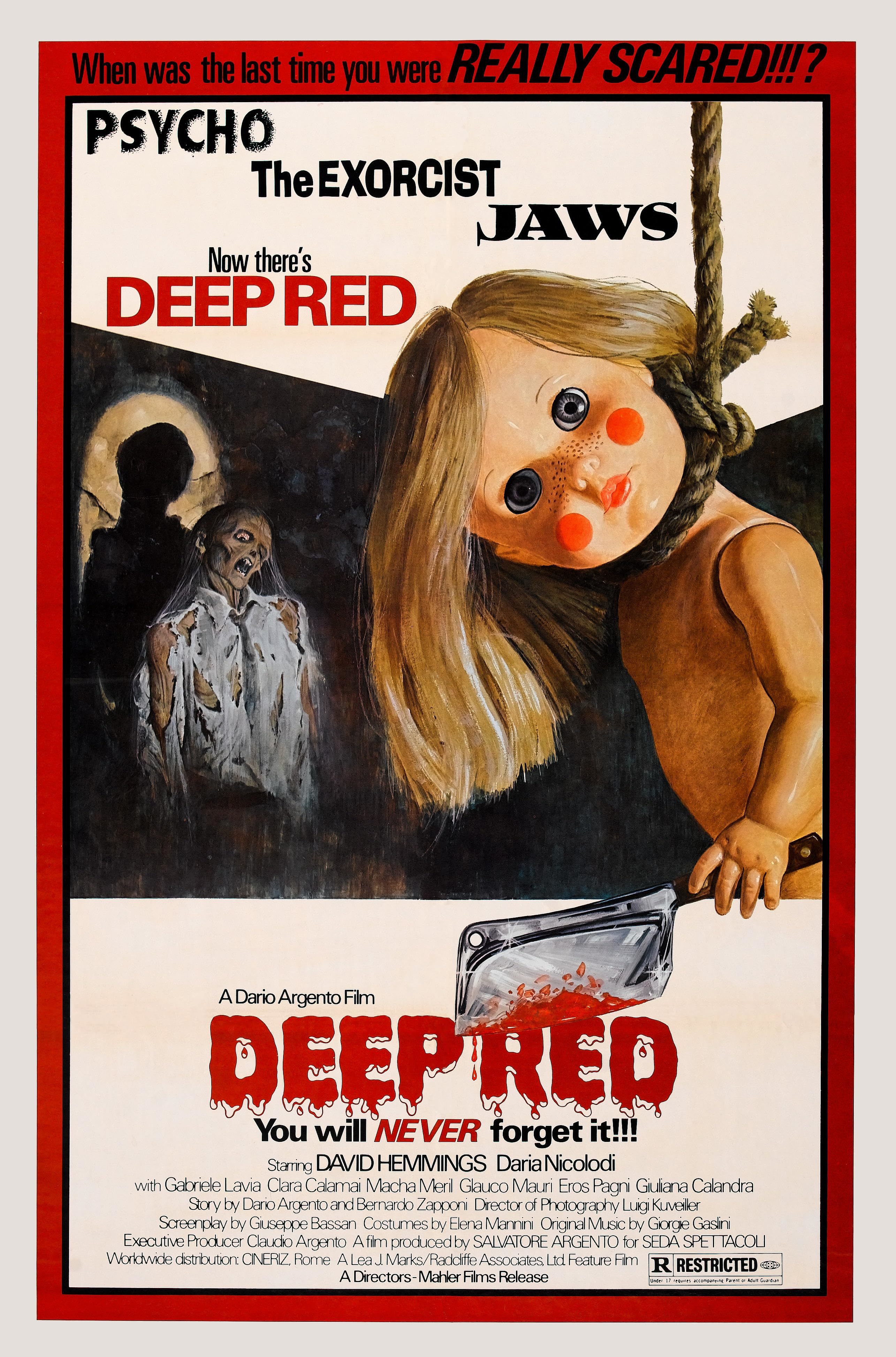
deep red poster

I’ve mentioned Dario Argento several times before on this blog. He’s one of my favorite directors – certainly my favorite horror director. He didn’t invent the Giallo, but he definitely popularized it and perfected it. Deep Red is one of, it not my actual favorite films of his and possibly the best Giallo ever made.

The plot is deceptively simple – it is a relatively straightforward murder mystery – and yet also a convoluted mess. David Hemmings stars as a jazz pianist who witnesses his downstairs neighbor get brutally murdered. He teams up with a journalist played by Daria Nicolodi and tries to figure out what happened.

I’ve seen this film at least five different times, and I’m still not sure I understand everything that happens in the film or the real motivation of the killer.

And I don’t care in the least that I don’t.

Argento was a master of style and it is on full display here. It is full of dark, bold colors (especially red) and disturbing imagery. The camera moves and slides across corridors, it is filled with extreme closeups and wondrously stylized violence.

There is a scene about halfway through the film in which a character sits in his office. The camera and the music let us know that something scary is about to happen. That the killer is there. The character knows it. We hear the killer whisper. Then something happens, I won’t spoil it here, but it is one of the most surprising and terrifying things I’ve ever witnessed at the cinema.

When my heart slows down I realize that this moment makes absolutely no logical sense, especially given who the killer turns out to be, but again I just don’t care.

The score by progressive rock band Goblin is kinetic, percussive, and heart-pounding. They wrote the scores for several other Argento films and they are all terrific. The director uses the music to great effect – stopping and starting it at crucial moments creating small, but effective adrenaline rushes.

If you are a horror fan I absolutely recommend Deep Red to you.

Like a lot of Italian productions at the time the film was shot without sync sound. All of the dialog was dubbed in post-production in both English and Italian. In previous watches I was always confused because periodically some characters would start speaking Italian without warning and then a moment later they would switch back to English. Bilingual people can, and often do this in real life, but there didn’t seem to be any rhyme or reason to it in this film.

Pulling out my Arrow Vidoe Blu-ray tonight I discovered why. They edited out several scenes (and snippets of scenes) for the exported cut of the film (which presumably means the copies sent to English-speaking countries) and thus they did not record English language tracks for those scenes. Or if they did the English tracks were lost at some point. Those scenes have since been added back into the English language version of the film but there are no English language audio for the new scenes. In some ways this adds to the already disjointedness of the film.

31 Days of Horror: Murder Rock: Dancing Death (1984)

murder rock

Lucio Fulci is often called The Godfather of Gore, and it is true, he did make a lot of horror films with copious amounts of violence, buckets of blood, and tons of gore. But he worked in many other genres throughout his long career including westerns, sword and sandal epics, and even comedy. What one would not expect from him is a musical, which is exactly (well, more or less) what he made with Murder Rock: Dancing Death.

It isn’t technically a musical since the characters don’t actually sing, but there is a lot of music (which was written by Keith Emerson) and a whole lot of dancing. But it is really a horror movie. Actually, it is the best-looking Giallo Fulci ever made.

It takes place at a New York City dance studio where one by one the female dancers are being stabbed through the heart with a long, needle-like hairpin by a black gloved killed. The studio is so hardcore that after the first girl is killed, the instructor basically tells the other dancers to stop whining and get back to work.

Meanwhile, Candice (Olga Karlatos) begins having dreams of being murdered by a man she’s never seen before. When she sees the dream man’s face on a billboard she tracks him down only to discover he’s a disheveled drunk. Instead of shrugging it off or running away in terror, she decides to sleep with him.

The film is filled with red herrings and a cop (Cosimo Cinieri) who is both lackadaisical about the whole thing and rather sadistic. It is all a bit complicated and rather silly, but I really kind of loved it. I mean most Giallos are complicated and silly, but this one pushes it to the edge and then some.

But it is stunningly gorgeous to look at. Fulci and his cinematographer have lit the heck out of it and filled it with beautiful, colorful images. The music and dancing give it an unusual energy and it’s just a lot of fun to watch.

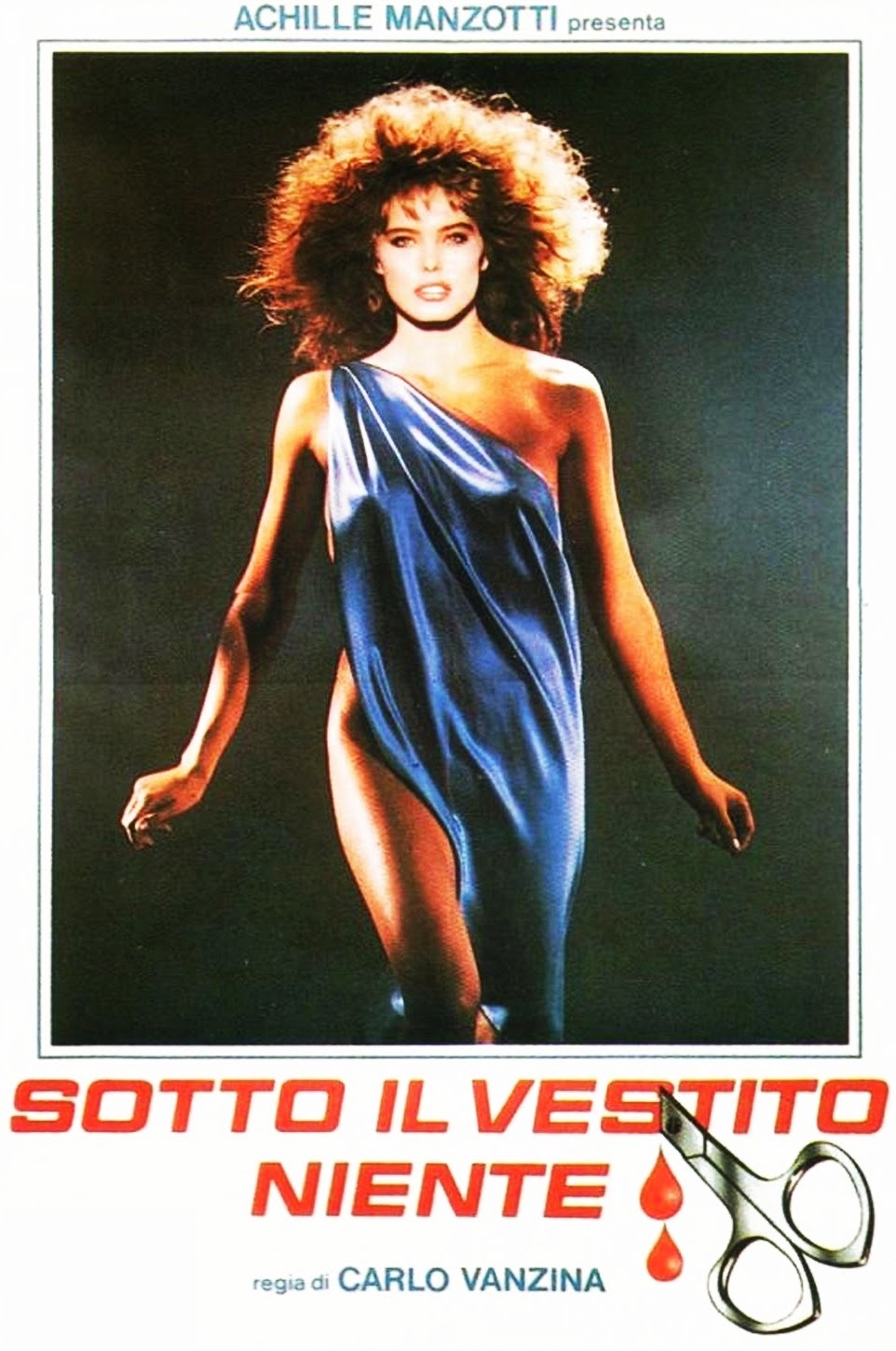
31 Days of Horror: Nothing Underneath (1985)

nothing underneath

Much like film noir, the Italian giallo is a genre without a clear-cut definition. There is a specific time period in which they flourished (the 1940s-1950s for noir and the late 1960s to the early 1980s for giallo) and certain stylistic certainties in which they operate, but there are so many outliers within each genre that pinning down an actual definition is nearly impossible. The later a film is made within their respective time periods the more fuzzy they tend to exist within the genres.

Nothing Underneath came out in the very late period of gialli, you might even call it post-giallo (although Dario Argento made Opera in 1987 and it is one of the very best gialli ever made, so go figure.) Even within the very fuzzy confines of giallo definitions, it remains a very fuzzy example of the genre.

It begins in the most unlikely of places for a giallo – Yellowstone National Park where we find our hero Bob (Tom Schanley) a ranger. He has a psychic connection to his sister, Jessica (Nicola Perring) who is a fashion model in London. While walking amongst the mountains and the trees he has a vision that Jessica is being murdered by a black-gloved killer with a pair of scissors.

Bob immediately flies to London and attempts to warn his sister of her impending doom but she’s gone missing. There is no evidence of murder, but nobody seems to know anything about where she might have gone. His investigations find that she was at a party hosted by fashion designer Giorgio Zanoni (Cyrus Elias) where he bribed several models (including Jessica) to play a game of Russian Roulette for a cache of diamonds.

Soon enough some of the women at that party start getting murdered with a pair of scissors just like in the vision. Bob teams up with Inspector Danesi (Donald Pleasence sporting a terrible Italian accent) to solve the case.

The black-gloved killer, the fashion models (providing ample excuses for casual nudity), and the killer’s point-of-view shots are all classic gialli tropes. It actually reminded me quite a bit of Brian DePalma’s work in the 1980s, but of course, he was highly influenced by the giallo genre. It lacks his formal command and the genre’s sense of style. It definitely feels like giallo-lite, or that it has outgrown the genre in some way. Or, more than likely, it just isn’t very well made.

If you are a fan of the genre and have seen all the classics then this one is worth watching. All others need not apply.

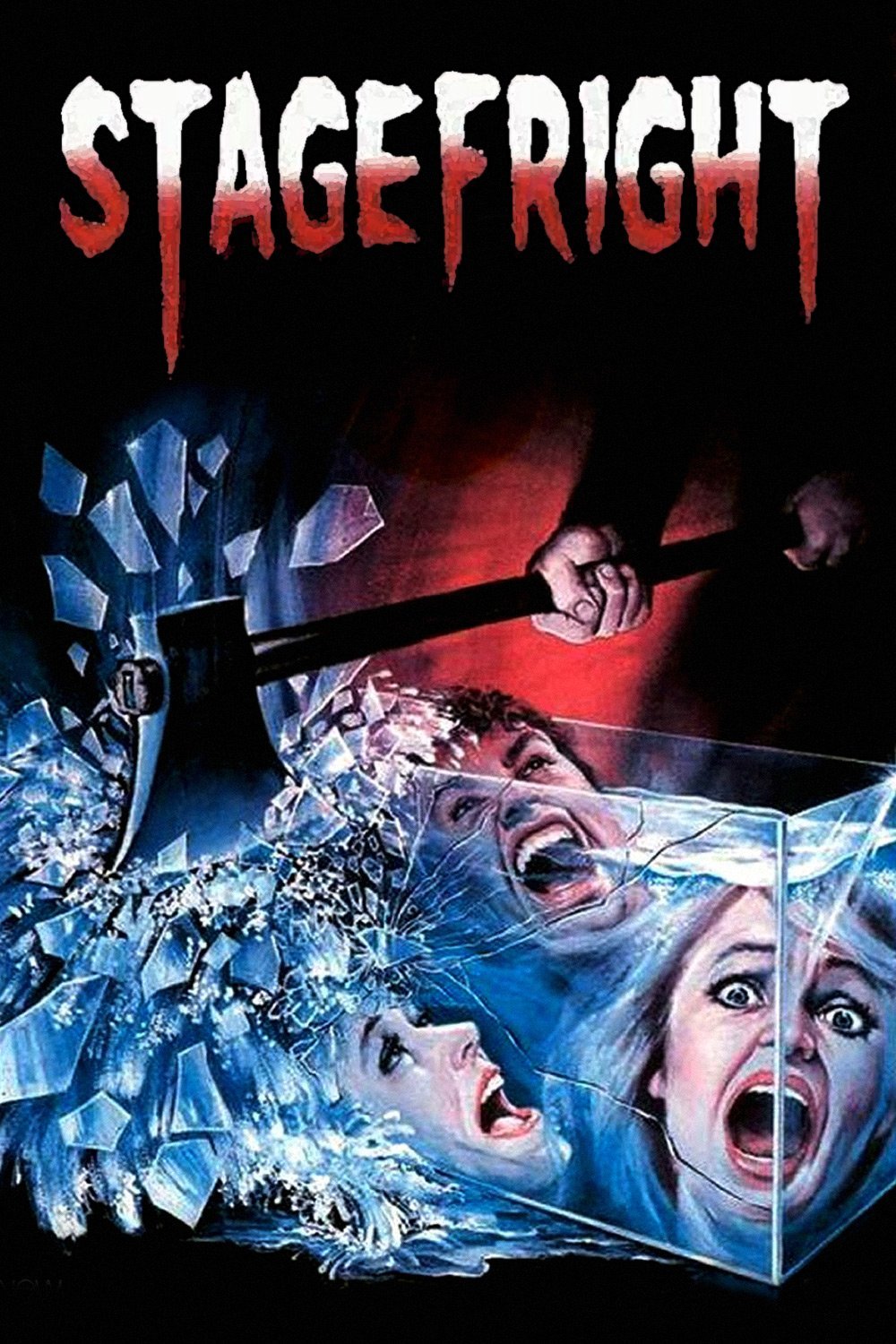
The Friday Night Horror Movie: Stage Fright (1987)

stage fright poster

I did work study for the theater department for most of my years at college. I had an amazing time. For each show, we’d spend weeks in rehearsals working several hours every night and building the sets on the weekends. Then we’d put the show on for three weekends in a row. It was a small theater department so we often had folks from outside the school performing and working. It was much more like community theater than your typical university theater.

Everybody working a show from the actors to the director and the stagehands became a small family for a few months. And because it was a community theater often the same people would come back and work the next show, and the next. I made some great, lifelong friends at that theater.

Because of this, I love a movie about theater life. Stage Fright is a pretty terrific slasher film from director Michele Soavi that takes place almost entirely in a theater.

A small theater troupe is rehearsing a show about a serial killer who wears a big owl head while he attacks young women on the city street. It is set to open in just a few days, but the maniacal director Peter (David Brandon) doesn’t think it is ready. He locks all the doors, hides the key, and demands everybody stay all night to perfect the show.

Two actresses, Alicia (Barbara Capisti) and Betty (Ulrike Schwerk) find a way to sneak out because Alicia has sprang her ankle and needs medical attention. The closest doctor is at a psych hospital and naturally, a psycho-killer escapes while they are there and sneaks into their car.

You can guess what happens next. It takes a while for the bodies to start piling up. There is some enjoyable behind-the-scenes at the theater stuff. Some of it is on point, but some of it seems completely ludicrous. All of the cast is hungry, they need the job, they need the money, and they desire the fame. When the first girl dies the police are called and the press shows up. The director immediately tries to use it as a means of drumming up publicity.

But three days before opening night, he also fires one of his lead actresses, rewrites entire scenes, and makes big changes no director in his right mind would do that close to opening.

Not that any of this matters. This is a slasher film, not a theatrical documentary, but this nerd noticed.

Soavi has a great eye. In some ways the film is more Giallo than your typical slasher, which makes sense since he studied under Dario Argento. There is a great visual sense throughout the film, but especially in the last act. There is a scene in which the stage has been set in a most theatrically macabre way and then a fan clicks on and blows feathers all over and it is so strangely beautiful.

The killer wears that giant owl head for the entirety of the film and it is just terrifying. Once the kills do begin they come fast and furious. About halfway through I was mentally writing this review and I thought to myself that there wasn’t much gore for a slasher film. I was oh-so-wrong. Not long after that things get very bloody. The kills are good as the kids say.

The best slashers are typically no more than dumb fun. Stagefright is that, but it has more style, more of that special something that elevates far above most films in the genre. It comes highly recommended by me. Perhaps even more so if you’ve ever done any theater.

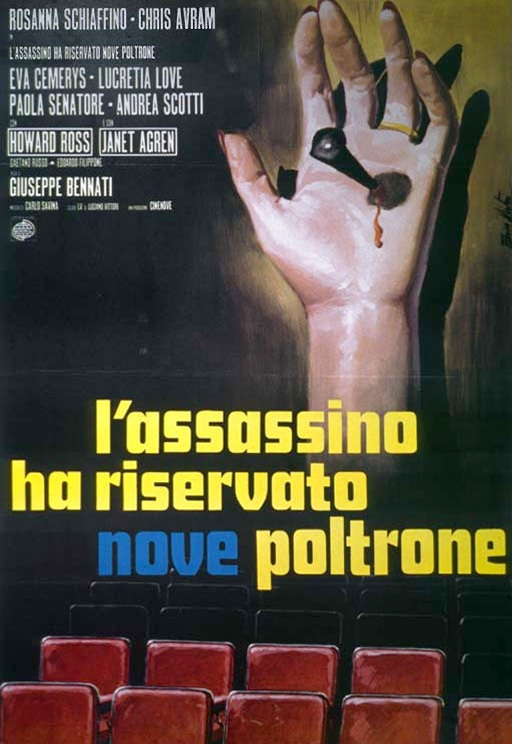
31 Days of Horror: The Killer Reserved Nine Seats (1974)

the killer reserved nine seats

A rich man, Patrick Davenant (Chris Avram) invites a group of friends to an old abandoned theater that he owns. Once there they get locked inside and someone starts killing them one by one. Who is the killer? Why is he or she killing these nine people?

The Killer Reserved Nine Seats is an Italian Giallo by way of Agatha Christie.

All of the guests are financially connected to Davenant, in that he mostly supports them through various means. His death will benefit them all in various ways. It is his life that is almost taken first. I say almost because he is saved at the last minute. A large beam is cut free from its holding rope and it drops down on top of him, but just seconds before someone calls the man’s name, he moves and is saved.

Others are not so lucky. As the bodies pile up so do the accusations as to who could be the killer.

But first, there is a lot of silliness. Because this is a 1970s Italian Giallo and not some actual Christie adaptation by the BBC or some old 1940s movie, the characters spend a lot of their time taking off their clothes and getting horny with one another. What I love about that stuff is they are getting naked with one another even after the bodies start piling up.

There is one scene in which one of the women is attacked by the killer (he’s in a mask so she can’t tell who it is). She screams and shouts for help. A man comes in and fights off the killer. The woman escapes and runs to the others. None of them believe her. They say she is hysterical and hallucinating. When they return to the room where she was attacked and find the man who helped her dead by hanging. They decide he was the real killer and guilt drove him to suicide.

I couldn’t help but watch this scene and think of the #metoo movement. About all the statistics showing that when women cry for help, when they report harassment and sexual assault they all so often aren’t believed. I have no idea if the filmmakers were thinking about such things when they created this scene, but it feels very modern.

The script is mostly nonsense. At least the parts I could understand. There were several moments in which the characters inexplicably started speaking Italian and there were no subtitles. Italian films from this era often had the actors speak in whatever language was native to them, and then they would dub in the proper languages in post-production. Presumably, these sections were moments when the English dub has been lost.

What works in the film is its vibe. The theater setting gives us several different locations with different feels. The stage has working sets for the characters to play with. Curtains rise and fall. The auditorium and lobby are beautiful and ornate. The backstage area is filled with props and costumes. Upstairs the attic is dusty and filled with cobwebs. There is even an old crypt filled with candles downstairs. All of this gives the film atmosphere. The women are dressed in fabulous gowns, and the men are in nice suits. The camera moves about, and the lighting is filled with shadows.

I love that stuff. I can put up with all sorts of bewildering things in a script if the filmmaking is interesting.

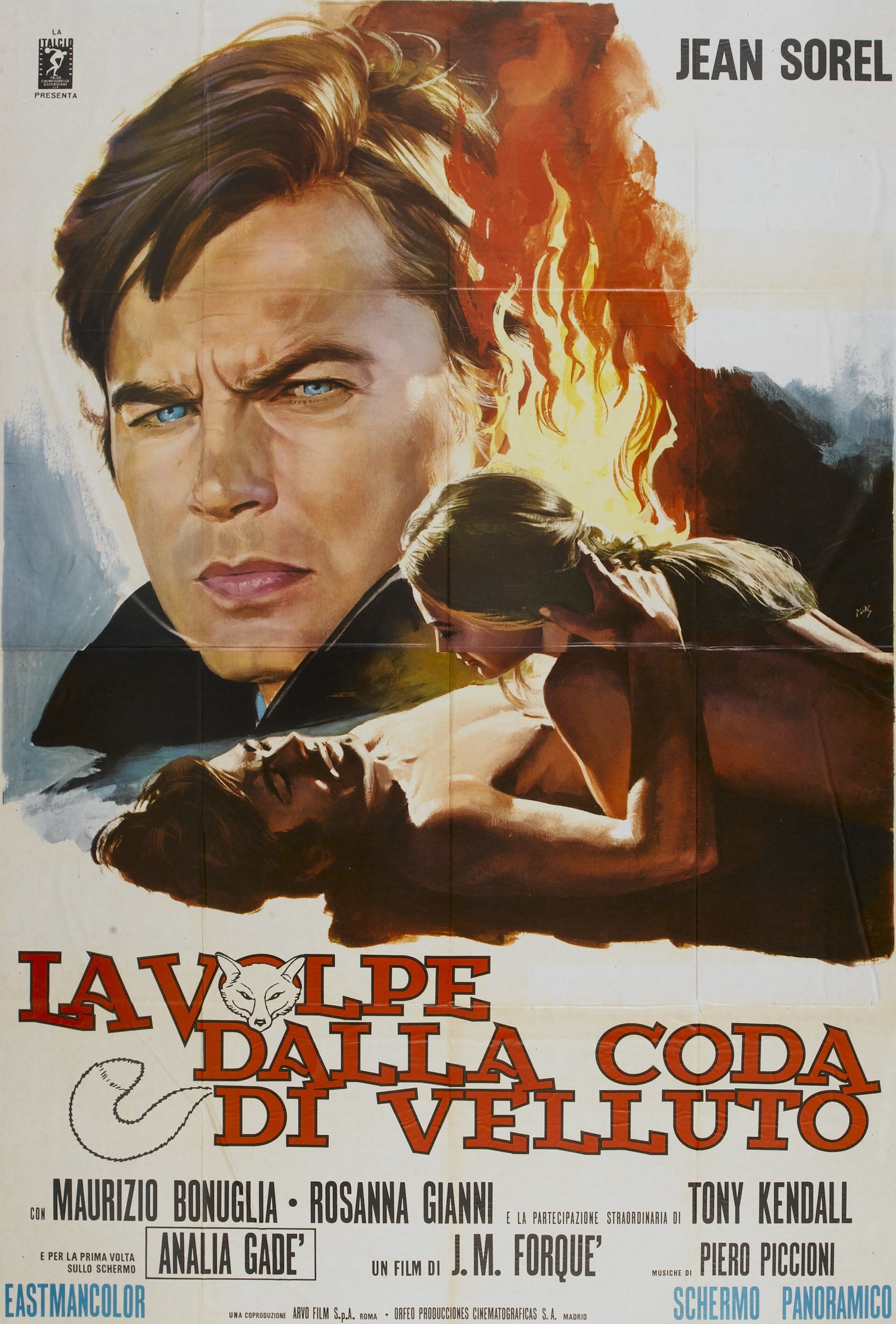
The Friday Night Horror Movie: The Fox With the Velvet Tail (1971)

the fox with the velvet tail

Once again I’m letting you know the title of the Friday Night Horror Movie before I actually watched it. With luck, I’ll actually write something about it tomorrow.

I am a very big fan of the horror subgenre called Giallo. That’s an Italian genre that was very popular in the 1970s. It usually involves a black-gloved killer who murders beautiful people with a knife or some other sharp object. They are usually very stylish with brilliant use of colors and interesting camera placement and movement.

This film is apparently better known as In the Eye of the Hurricane, but The Fox With the Velvet Tail is a much better title in my opinion (and it is much more of a Giallo title) so I’m going with that. I don’t actually know anything about the film other than it is a Giallo and I’m trying to watch everything I can within that genre. I’m about half an hour in and so far it is very stylish but also rather dull.

I will try to update you later, once I’ve finished it.

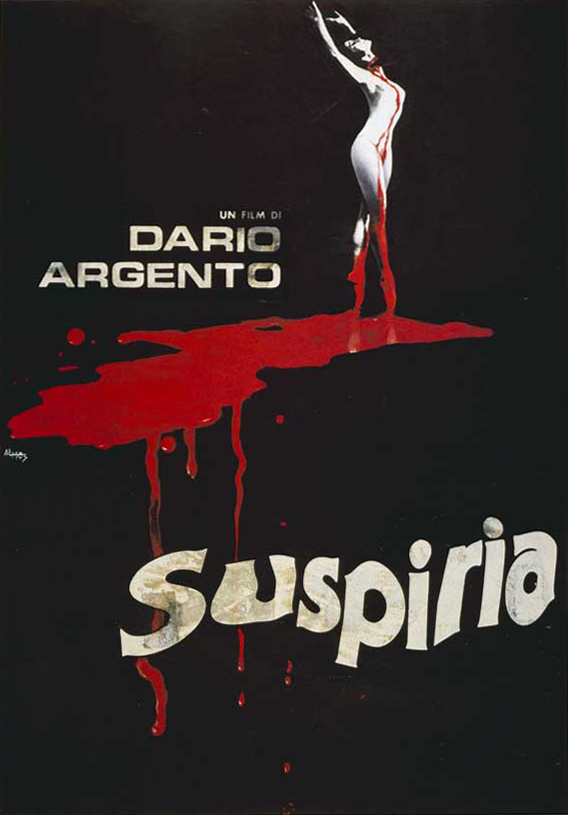
Suspiria (1977)

suspiria poster

Editors Note: I feel it necessary that I originally wrote this in April of 2007. That was nearly 16 years ago. I have seen Suspiria many times since then and my opinion of it has only grown.  I mostly stand by this review, though the writing makes me cringe a little (and I don’t think the acting in most of Argento’s films are bad, don’t know where that thought came from).  But I haven’t changed a word.

Petit and pretty Suzy Banyon flies from New York to Germany to attend a prestigious dance school. The night is dark, mysterious, and lonely, and it is storming with great torrents of rain. Upon arriving at the school, she finds the door locked, and the woman on the intercom refuses to let her inside.

Soon another woman comes to the door, not to allow entrance, but to flee. She looks greatly frightened, and shouts something to unknown persons behind the door, then runs out into the night and rain.

Shortly thereafter, we see a brutal, bloody, completely awesome murder at the school, complete with a knife stabbing directly into a heart, via an open chest, and the coolest hanging this side of The Good, the Bad, and the Ugly.

When Suzy returns the next day she finds everyone distraught over the murder, but much more welcoming than the previous night. She meets the rest of the dancers, and things begin to settle into normalcy. For a moment anyway.

On her first day of class, Suzy falls ill and is forced to become nearly bedridden and given a very special diet. Strange footsteps are heard outside her door every night, maggots fall from the ceiling, bats fly in through the window and more murders pile up. Is there a mass murderer on the loose, or is it something more sinister, more mystical?

The film is beautifully shot, with the lighting causing all sorts of creepy shadows while being bathed in primary colors. Mostly red.

Lots and lots of red.

The score, by the group Goblin, is full of creep and circumstance and sets an eerie mood throughout.

Unlike a lot of Dario Argento films, the acting here is pretty good. All of the leads do a fine job of conveying the right amounts of suspense and dread, or menace and evil, depending on what their characters call for. The plot is pretty thin, as it jumps about quite a bit. Despite what the tagline says, the last 12 minutes veer well into the ludicrous instead of terrifying, but for what the film lacks in these details it absolutely nails in terms of setting a mood and atmosphere.