The Rapacious Jailbreaker (1974) Blu-ray Review

rapacious jailbreaker

This Japanese drama is loosely based on a real guy who kept breaking out of jail only to be sent back shortly after (then he’d break out again.) In the film this becomes his entire identity. He cannot live in the hell that is prison, yet when he escapes he doesn’t know what to do with himself so he always gets caught and finds himself back in prison.

It is more of a character study than any type of thriller, but it is a good one. You can read my full review here.

Sci-Fi In July: Evangelion: 1.0 You Are (Not) Alone (2009)

image host

My daughter has gotten into Manga and Anime in a big way, so I try to watch some of that with her. We’d both heard of the Evangelion series, but neither of us really knew anything about it. It is a confusing franchise as there are numerous series and movies, with reboots and rebuilds thrown into the mix.

We more or less randomly decided to start with this film, which is essentially a retelling of the original Neon Genesis Evangelion TV series. That series isn’t available on our streaming services, but this film is on Crunchyroll, and since it basically retells the original story, we figured it was as good a place as any to start with.

Having now seen the film, I’m not so sure that was true. I found much of the story quite confusing, and it very much feels like I’m missing a large part of the lore.

The film drops you right into the middle of it, without explanation. Best I can figure is that sometime in the past, these giant Kaiju creatures known as Angels came to Earth, nearly destroying it. Humans have now built Mech-Warrior-type robots, called Evangelions, to fight back.

For reasons that are never really explained, the head leader dude taps his estranged 14-year-old son to pilot one of the Evangelion robot thingies. Though he is very young and has had zero training, they pop him into it and ask him to fight an incoming Angel.

He fumbles at first, nearly destroying the machine and killing himself, but miraculously, he recovers and destroys the angel. After some unspecified amount of time, another Angel arrives, and basically the same thing happens. Shinji is placed back into the Evangelion; he has no idea what he’s doing, but after taking some losses, he somehow finds a way to destroy the angel. Rinse, repeat.

In between these battles, he talks with his guardian Misato and becomes friends with Rei, another Evangelion pilot who was previously injured. Shinji only pilots his machine reluctantly, being essentially forced to do it, but Rei willingly takes it on with a sense of duty and honor.

It ends with a cliffhanger and some weirdness.

I seriously don’t know what to make of this film. I understood the basic plotlines, but so much of it was left unexplained. It felt very much like I was supposed to have watched the original series, even though this seems like it was designed as a straight retelling of it with updated animation.

There is a lot of mythology built into it that I simply don’t understand. I kind of hated it, but I also want to watch more. There is something about it that is truly interesting and I’d like to dig into that, but I’m not sure whether to watch the next movie or go back to the original series.

V-Cinema Essentials: Bullets & Betrayals

image host

I grew up in the late 1980s/early 1990s and I have many, many fond memories of going to the video rental store looking for something interesting to watch. I went enough that I had generally seen all the big new releases so I often went digging through the old stuff. I loved finding weird, low-budget genre films full of sex, and violence, and goofy action.

In Japan these straight-to-video releases were called V-Cinema and Arrow Video has just put out a cool little boxed set full of them. You can read my full review at Cinema Sentries.

Foreign Film February – Mothra Vs Godzilla (1964)

image host

When I was a kid, all those old Godzilla movies were on television regularly. I’m guessing they were Saturday night movies on one of the local UHF stations, but I don’t really remember. What I do remember is how much I loved them. My favorite was Godzilla vs. Mechagodzilla. Not because I thought the film was superior to the others but because in that boyhood way of arguing who could beat who in a fight, I thought Mechagodzilla was best equipped to defeat regular Godzilla. T my young mind a robot Godzilla was the coolest. My friends would choose King Ghidorah, or Rodan, or one of the other monsters and we’d endlessly argue over who would win in a fight.

I more or less forgot about Godzilla once I became a teenager. I had no interest in the 1998 film starring Matthew Broderick or the 2014 film with Aaron Taylor Johnson. And then the Criterion Collection released the original Godzilla.

The original Godzilla was released in 1954. It was a huge success in Japan and in 1956 the rights were sold for an American release. The Americans dubbed it into English, cut most of the political allegory out of it, and did a bunch of inserts starring Raymond Burr. I’m sure it was that version I watched growing up. The Criterion release included the Japanese version of the film and that got a lot of press. I bought that disc and loved the film.

Later Criterion released an incredible boxed set featuring all of the so-called Showa Films. I bought that set (it sits proudly next to my Ingmar Bergman boxed set from Criterion making it look like Godzilla is touching Liv Ullmann’s face.)

image host

I’m slowly working my way through all the Godzilla films and I recently sat down with Mothra vs Godzilla. Like a lot of Godzilla films from this era, there is a lot of buildup before we even get to Godzilla much less his battle with another monster.

A beach is wrecked by a typhoon. Afterward, a giant blueish egg washes ashore. Some greedy businessmen purchase the egg from the fishermen who have rights to everything inside the cove. They immediately start building a theme park around the egg dreaming of the millions they will make off of it.

They are visited by a couple of twin fairies who say the egg was laid by Mothra a giant moth-shaped god that protects their island. They beg the businessmen to return the egg to Mothra, but instead, the men try to capture the fairies.

After I watched the film I learned there was a previous film entitled Mothra that deepens the legend behind the moth-god. The fairies befriend some kindly reporters before returning home.

Enter Godzilla. Once again he wreaks havoc upon the Japanese island. The reporters beg the fairies to help them destroy Godzilla. Mothra agrees only when Godzilla makes eyes for the giant egg.

Before you think that a moth, no matter how giant, could do anything against an enormous radioactive dinosaur, let me just tell you that Mothra’s wings are so powerful they essentially cause a hurricane whenever she flies. She’s also got some badass powder that hurts Godzilla in some way.

Godzilla ultimately defeats Mothra with his radioactive breath. But it is the egg that saves the day. When it hatches it releases some killer caterpillars with monster choppers and an ability to spray weblike stuff from their hind quarters.

Godzilla movies are inherently silly. And awesome. You can spend all sorts of time trying to point out their various themes and trying to suss out some deeper meaning. Or you can just enjoy a giant lizard fighting an enormous moth.

The Legend of Hei (2019)

image host

My daughter has gotten into anime in a big way. She watches a lot of the series and some of the movies. She’s started reading the mangas and her art is often based around those characters (not to mention her cosplaying). She tries to get me into some of it. Sometimes it takes, but often she’s enjoying it at a much faster pace than I can tolerate.

I don’t think she’s seen this film, as I wrote my review of it in 2021 which I think was before her obsessions with the format began, but I’ll have to show it to her as I remember it being quite good.

Foreign Film February: Hokuriku Proxy War (1977)

image host

I continue to sing Radiance Films praises. They are carving out a nice little niche market in the larger Boutique Blu-ray landscape. Their focus seems to be on foreign language arthouse films that are lesser known. The type of film that would be skipped by Criterion but are generally still quite good.

Hokuriku Proxy War is a fun little Japanese Crime Drama that is a bit confusing in the story department but more than makes up for it in its action. You can read my full review here.

Foreign Film February: The Third Murder (2017)

image host

Our second film in this year’s Foreign Film February is a Japanese legal thriller that starts out strong but quickly gets muddled and ultimately wound up kind of boring me.

In the opening scene, we see a man bludgeon another man to death and then set him on fire. Then the film moves forward in time with the killer, Misumi Takashi (Kōji Yakusho) under arrest and being questioned by his defense attorneys.

He fully admits to killing the man but his story regularly changes in regards to what actually happened and why he did it. His attorneys argue over the best way to defend their client and keep him from being executed.

The devil, they say, is in the details, and while there are a lot of details in this film, I had a difficult time caring about them. This is a film that makes quite a to-do over whether he should be charged with Robbery-Murder or Murder-Robbery. The difference being in his intentions. If his intentions were robbery and the murder came after then his motive is greed, but if he murdered him for some other emotional reason (such as anger over being fired – for the dead man was his boss) and robbed him afterward then the jury might be more sympathetic.

That’s an important legal distinction, I guess, but not one that makes for compelling cinema.

It is well-acted and well made and some of the revelations are interesting, but overall I found myself ready for it to be over long before it actually was.

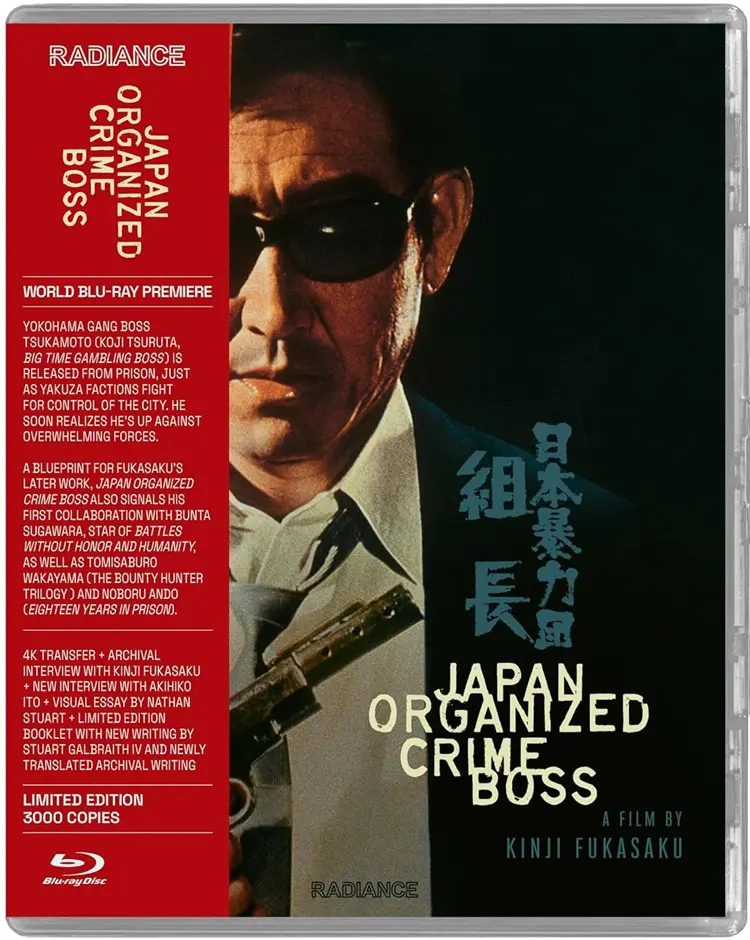
Japan Organized Crime Boss (1969)

japan organied crime boss

Kenji Fukasaku’s Japan Organized Crime Boss is a film about a man lost in time. He’s an old Yakuza who still lives by a code. But he’s been in prison for a while and that has made him want to live a quiet life. But like Michael Corleone the people all around him keep dragging him back in. But those people don’t have a code. The world is changing and it’s left him behind.

This is a good film, but a more thoughtful film than you might imagine with that title. It is shot like a documentary and is building a mythology around the Yakuza that probably never existed. You can read my full review over at Cinema Sentries.

Noirvember: Rusty Knife (1958)

rusty knife poster

I’ve mostly been watching American noir this Noirvember, but I wanted to get into something Japanese before the month was over. Rusty Knife is one of the films in Criterion’s Nikkatsu Noir set. Nikkatsu is one of Japan’s oldest, and most popular film studios. But by 1958 their popularity had waned due to the influx of Hollywood movies in Japan. To compete they started putting out American style crime stories.

It is set in Udaka, a new city made incredibly prosperous incredibly fast in Japan’s post-war industrial boom. With economic growth comes a criminal element ready to take advantage of both the city’s prosperity and its still-developing political machinery. The film follows Yukihiko Tachibana (Yūjirō Ishihara) an ex-convict just released from prison who wants to make a go of straight life.

Tachibana was in prison for murdering a man he thought had raped his wife which caused her to commit suicide. But as the film progresses he’ll learn it was much more complicated than just one man doing something heinous for his own pleasure.

To make things even more complicated before he went to prison Tachibana and two other guys, while out committing a burglary, witnessed the murder of a politician. It was gangsters that did it, making it look like a suicide. When they realize Tachibana and his friends saw the whole thing the head gangster, Katsumata (Noaki Sugiura) pays them off for their silence.

The police have been trying to put Katsumata in prison for years. When they learn that Tachibana and his friends witnessed the politician’s murder they pressure them to become witnesses.

At first, Tachibana refuses. He might be going straight but he’s no snitch. But as he learns more about his wife’s assault and Katsumata’s hand in it things become more complicated.

I liked Rusty Knife pretty well, but there was nothing to really distinguish it from the many other similar crime films I’ve watched in my lifetime. It says some things about Japan in the years that followed World War II, but again I’m not sure it says it any better than numerous other films from the era.
It is worth watching if you are a fan of this type of cinema as it does everything well. It just isn’t the best at what it does.

The Boy and the Heron (2024)

image host

Hayao Miyazaki came out of retirement and made one of his best films. The Boy and the Heron is everything you want a Studio Ghibli film to be – exciting, adventurous, weird, funny, and ultimately moving. I love it. You can read my review of the 4K UHD disc over at Cinema Sentries.