The Friday Night Horror Movie: Ju-On: The Grudge 2 (2003)

ju on the grudge 2 poster

The Criterion Channel is featuring a plethora of horror movies this month. They have at least three different horror themes going on, one of which is Japanese Horror. Naturally, I’ve seen almost all of them, but I’d never watched this sequel. I try to watch the originals again before I watch the sequel which is why you were treated to my thoughts on Ju-On: The Grudge yesterday.

This sequel is basically the same film with different characters. Once again it acts like a series of vignettes in which a bunch of people are haunted, terrified, and murdered by some evil spirits. The same evil spirits that haunted the house in the first movie (er, the third movie as there were two films before Ju-On: The Grudge). There is the creepy kid and the freaky girl who can twist her body in extreme ways.

This one does have more of a semblance of a plot and there is a bit of a through line, but it still jumbles up the chronology. It, more or less, follows horror film actress “Horror Queen” Kyoko Harase (Noriko Sakai) who is given a role in a paranormal television show. They “investigate” haunted houses and the like. For this episode, they visit the house from the last film.

Naturally, things do not go well. Nearly everyone involved in the shoot is haunted by the curse and killed. The kills remain quite effective and creepy. I might even give the ones in this film a slight edge over the last one.

There is an excellent sequence in which a woman keeps hearing a banging on her apartment wall at a certain time at night. The reasons behind it are quite clever and scary.

The way this film moves back and forth in time is much more effective than the previous one. I was often confused during the previous film, but here they will show a snippet of the same scene, albeit from a different character’s point of view, before moving on to something we haven’t seen before. Those connecting points allowed me to understand what was happening at all times. That worked for me much better than in the previous film.

But really, much like the other film, the plot in this one is just an excuse to move us from one creepy scene to another. And again this worked completely for me.

31 Days of Horror: Ju-On: The Grudge (2002)

ju on the grudge poster

A title card tells us that a Ju-On is a curse that is born when a person dies in a deep and powerful rage. The film will then spend the next 90 minutes showing us exactly what it means.

Ju-On: The Grudge was part of a cycle of Japanese horror films (collectively known as J-Horror) that came out in the late 1990s and early 2000s. Unlike their American counterparts (which were mostly self-aware slashers and other schlocky, gore-inflicted films) J-Horror tended to focus more on mood, and the psychology of fear, with plots that revolved around Japanese folklore. The violence was usually off-screen and not very graphic (though there were exceptions – I’m looking at you, Takashi Miike).

For a few years, J-horror became quite popular in America and several of them were remade by Hollywood. Someday I may do a theme where I review the Japanese horror films alongside their American remakes, but for now, we’re just talking about this one.

Ju-On: The Grudge was actually the third film in the Ju-On franchise (the previous two were straight-to-video releases) but it was the first one most of us watched (I’ve only seen this one and the first American remake).

The film is really a series of vignettes, each focusing on a different character, most of which are set in the same house located in Nerima, Tokyo.

I’ll be honest here, I just watched the film but if you paid me $1,000 to explain who each character was and what their relationship to each other is, I’d still be broke. Each vignette is so short, and each character is given so little to distinguish each other from each other I’m at a loss to tell you who is who.

They all do seem to be related to one another either by family or friendship or work. It begins with Rika (Megumi Okina) a social worker volunteer being tasked by her boss to visit an old lady at the cursed house (though neither of them realizes it is cursed at this point.) She enters to find the old lady in a daze, lying in bed. She picks her up to find that she has soiled herself.

After cleaning her up and doing a little housekeeping she hears a noise upstairs. In the bedroom, she finds a closet that has been taped over and she hears a cat meowing inside. Opening it she sees the cat and then a small, pale boy. She goes downstairs to call her boss and witnesses a black fog kill the old lady. Rika then passes out.

Others come to the house and most find themselves infected by the curse. They’ll become haunted by the boy, the cat, and the boy’s parents. Sometimes they’ll be killed inside the house, other times they’ll take the curse with them infecting their homes.

The film jumps around in time, making it a bit disorienting.

We will learn more about the boy and his family, and why they are haunting this house, but it really doesn’t matter. The plot isn’t really the point. Scaring the bejeebus out of us is the point and this film does that really well.

There are jump scares aplenty, and all sorts of creepy noises and visuals. These evil spirits appear out of nowhere – sometimes they attack, sometimes they just scare the characters, and sometimes they aren’t even seen by the character but by the audience giving us a jolt of fear. This happens so often that you’ll find yourself tensing up in anticipation, looking in corners and backgrounds half-expecting to see a ghost.

Quite a few of these sequences have become iconic for horror fans. The girl walking on all fours, contorting herself in unusual ways, the hand in the shower, the girl under the covers, etc. have all become part of our communal horror fabric.

I can’t say that Ju-On: The Grudge is a great film in any sort of artistic, cinematic sense, but it is a great one to put on late at night when you are all alone and scare yourself silly.

Animation in August: Princess Mononoke (1997)

cover

Like most kids, I suppose I grew up watching animation. I loved Disney films and the movies of Don Bluth. Every afternoon and Saturday morning I watched television series like G.I. Joe, Thundercats, The Smurfs, and Muppet Babies. Later I fell in love with the films from Pixar.

While these types of films told different stories and used somewhat different animation styles, they all held a certain familiarity. They were all distinctly American.

Princess Mononoke was the first Studio Ghibli film I’d ever seen. This was the late 1990s, maybe or possibly early 2000. I was just becoming a true cinephile. I’d heard rumblings about Studio Ghibli for a while but I think this was the first big breakout it had in the States. Or maybe just in my orbit. It definitely got a big American release because the English dub included folks like Billy Crudup, Billy Bob Thornton, Claire Danes, and Gillian Anderson.

Anyway, I sat down with Princess Mononoke with high hopes. All the critics loved it. Honestly, I was a little disappointed. No, disappointed isn’t really the right word. I just didn’t know what to make of it. It was like no movie I’d ever seen before.

The animation was strange. In the opening scene, a demon attacks a village. But it doesn’t look like any demon I’d ever seen before. It wasn’t full of fire and horns. It was an enormous boar covered in slithering black worms. Later we meet tree spirits with human bodies and rattle-like heads, and a Great Forest Spirit with a deer-like body and an almost human face.

The story wasn’t like typical American animation with clear-cut good and bad guys. The characters were murkier. Our hero sometimes brutally murdered his enemies. The villain, if you can even call her that, rescued young women from a life of prostitution.

I think on that first viewing I just didn’t know how to process what I was watching. It was so different than anything else I’d ever seen, I wasn’t sure of what to make of it.

I’ve seen it several more times since then (and many more Studio Ghibli films) and now I just love it. What was so strange on that first viewing is endearing to me now. I love that it is different from most animated films.

So, quickly, the story involves Ashitaka (Crudup) the last prince of a small village (the one that gets attacked by that demon). He kills the demon and in the process, his arm is infected by it. This gives him super strength, but also seems to possess him at times and ultimately will kill him. When he learns that an iron ball lodged inside its body is what turned the Boar God into a demon he sets off to find out how it got lodged there.

The iron ball was actually a bullet from the newly invented gun (the film is set vaguely in the time before modern warfare) and it came from Iron Town, which is run by Lady Iboshi (Minnie Driver). She’s ostensibly the villain. But she’s also the one I was talking about earlier who has rescued women from a life of prostitution and given them a certain amount of autonomy. She also uses old men, warn down by disease and injury in her town. In many ways, she’s a good person. But she also has no problem destroying nature (and the gods that protect it) to enrich herself.

Ashitaka is ostensibly our hero, and yet we see him cut the heads off of numerous soldiers (accidentally, sort of – his demon-possessed arm gives him super strength which does most of the brutal damage but he’s still out to kill them.)

It is a movie filled with morally ambiguous characters, people who aren’t fully good or fully evil. They are complex, just like real people. And those gods? They have no problem with destruction either. The Great Forest Spirit indiscriminately kills.

The titular Princess (Claire Danes) is a human girl, raised by a wolf goddess and she hates humans. She wants to destroy them.

I love that. It is a complex, beautifully drawn story. The animation, while strange to my American eyes at first is beautiful as well.

Hayao Miyazaki who founded Studio Ghibli, and wrote/directed this film is one of the greatest animators of all time. I won’t say Princess Mononoke is his greatest achievement, but I won’t deny it either.

Animation in August: Suzume (2022)

poster

Japan has a thriving animation industry. At a guess, I’d say it is much larger and more successful than American animation. Yet in the States, Japan’s output is mostly a cult phenomenon. That does seem to be changing. The comic book section at my local Barnes & Noble has almost been overcome by Mangas, and streaming services like Crunchyroll, which specializes in Japanese animation have become very popular. My daughter is a big fan.

I mostly know Japanese animation from Studio Ghibli. Oh, I’ve watched the odd film or series with my daughter, and I have fond memories of watching Robotech: The Macross Saga as a kid, but I’ve not really dug deep into the Anime waters.

I’m trying to change that and Suzume was a good start. Like a lot of Japanese animation (I think, again I haven’t seen that much) Suzume mixes intimate human drama with the fantastic.

In a small Japanese town, Suzume (voiced by Nanoka Hara in Japanese and Nichole Sakura in English) a 17-year-old girl lives a quiet life with her aunt. Her mother passed away when she was quite young.

On her way to school, she crosses paths with Souta (voiced by Hokuto Matsumura in Japanese, and Josh Keaton in English) a handsome young man who asks her if she knows of any abandoned towns nearby. He’s looking for a door, he says. She points him in the direction of a small spa resort that was destroyed in bad weather.

He thanks her and she continues on her way to school. But when a friend notices her face is flush from the encounter, she thinks twice and runs to that abandoned resort, hoping to find him. Instead, she finds a strange door standing all by itself. She opens it and sees a field full of stars. But when she passes through the door nothing happens. That magical land is seemingly off-limits to her. On one of her passings, she notices a stone cat statue on the ground. When she picks it up it turns into a real cat and runs away.

With nothing more to see she goes back to school. Later that day she noticed a huge column of smoke emanating from where the resort was. Strangely, none of her classmates can see it.

Once again she runs to the resort to find the smoke billowing out of that door. This time Souta is there and is desperately trying to close the door. With her help he does and with a magical key, he locks it.

He tells her that he is a Closer, and his job is to find these magical doors scattered across Japan in abandoned places and keep them shut. That black smoke he calls a worm and if it escapes it will cause massive Earthquakes.

That cat is a Keystone and they must get it to return to one of the doors to keep the worm in place forever. But the cat is mischievous and is enjoying its newfound freedom. It sets to scurrying around Japan. Also, it turns Souta into a three-legged chair.

Suzume and Souta then spend the rest of the film chasing after the cat and closing all the doors before the worm can cause too much damage.

The basics of that plot do nothing to explain just how wonderful this film is. The animation is simply gorgeous. The backgrounds reminded me of the less fantastical Ghibli films in that it is detailed and layered with just enough artistic flourishes to make them fantastical. The characters are drawn realistically and well. There are some wonderful shots where the camera pulls back to show the scope of the worm and the cities it is about to destroy that are just awesome. And the magical world beyond the doors is exquisite.

There is a lightness to its execution and a playfulness. When Souta becomes a chair it is joyful and very funny. But there is a soulfulness too. I believed in their developments, and in their plight.

It is perhaps just slightly too long, and there are a few moments that drag just a little bit. But mostly this is a wonderful film.

The Friday Night Horror Movie: Vampire Hunter D: Bloodlust (2000)

poster

Talk about a case of a sequel being better than the original. I watched Vampire Hunter D a few weeks ago and thought it was awful. There were interesting story ideas, cool characters, and deep mythology hidden within a terribly written and animated film. This sequel, made some fifteen years later improves upon everything in every way.

The basics of the story are essentially the same. This one opens up the mythology a little bit and adds some characters, but it is still Vampire Hunter D trying to rescue a beautiful maiden from a vampire.

In this version, set in the far future, vampires have essentially ruled the world for centuries, but they are slowly dying out. Or rather they are slowly being killed by vampire hunters. Most of these are humans, mercenaries looking for big paydays and a bit of danger. But D is a dhampir – half human half vampire.

The girl, Charlotte (Wendy Lee) is taken from her home by Meier Link (John Rafter Lee) a vampire of nobility. Her family pays D (Andy Philpot) a hefty downpayment (with promises of much more if he succeeds) for rescuing her.

They’ve also paid The Marcus Brothers, a motley crew of hunters to do the same. They mostly consist of the same type of characters you get in any film with mercenaries – rough-and-tumble dudes who are good with specific weapons and get smart-assed with their dialogue. There is one lady Leila (Pamela Segal) and a bedridden psychic who can psychically leave his body and do severe damage to his enemies with his mind.

Leila gets the most screen time and she is the most interesting. The rest of her crew immediately take a disliking to D as they see him as competition. But Leila forms a friendship of sorts with him. He rescues her then she rescues him and they form a bond.

There are monsters, including a shapeshifter and a werewolf, they must battle but those scenes are short, and the fights are finished fairly quickly. It is as if the film understands that the monsters might be fun to watch for a minute, but it is the characters that are going to create fans.

The story is mostly good, though it borrows heavily from other stories and periodically drags. It is still lightyears above what they did in the first film.

The animation is gorgeous. The film wanders from a desolate desert to a great forest and we spend the third act in an enormous gothic castle. All of it is rendered beautifully. The characters are well-drawn and the action flows like the best live-action movies do.

It is astonishing how much better this film is than the original. Highly recommended.

The Friday Night Horror Movie: Demon City Shinjuku (1988)

poster

One of the things I love about doing these monthly movie themes is that it not only allows me to watch movies I might not otherwise watch, but it gives me a greater understanding of the history of cinema. I learn things I might not otherwise come to know.

For example for Animation in August I’ve watched several Japanese animated movies and this has brought to my knowledge banks the term OVA or Original Video Animation. That’s basically a Japanese version of straight-to-video applied specifically to animation.

Like straight-to-video releases OVAs had more freedom than their cinematic or televised productions had in terms of length and mature content. An OVA could be as long as it needed to be and they were allowed more freedom in the amount of violence, adult language, and sex/nudity they could use.

Demon City Shinjuku is an OVA adapted from a novel of the same name. It follows a reluctant hero’s journey into the heart of Tokyo which has been overrun by demons.

It has more than a passing similarity to Star Wars, with some terrific animation, and some pretty cool demon designs. But it suffers from some terrible writing (or possibly a very bad translation).

In a prologue, we learn that an evil dude called Rebi Ra has allowed himself to become possessed so that he can wreak evil havoc upon the world. A good dude called Genichirou tries to stop him but is killed in the process. A giant earthquake happens during their battle wrecking the Shinjuku part of Tokyo. Demons quickly take over this area.

Ten years later Genichirou’s son, Kyoya Izayoi is tasked with going into the city and destroying Rebi Ra. He is accompanied by Sayaka Rama the daughter of the World President who has just been kidnapped by Rebi Ra. If they fail Rebi Ra will unleash all the demons and conquer the world.

Along the way, they obtain help from a short rollerblader who is just out for himself but ultimately finds his soul and a Dracula-esque mysterious goth dude. There is also Aguni Rai an ancient mystic who periodically offers advice.

They come across several demons before ultimately fighting Rebi Ra. There is a crab-like creature with a human head and a giant mouth full of teeth in its torso and a sexy redhead with tentacle arms.

All of this is pretty good. I enjoyed it. But the dialogue is rotten. Generally speaking, I watch foreign language films in their original language. I much prefer hearing the original actors’ voices even if I don’t actually understand what they are saying. With animation, I am a little more lenient since there is a realization that all actors are dubbing in their lines (it helps that most of the foreign language animated films I’ve seen are dubbed by really good English-speaking actors).

I started watching this film in the original Japanese with English subtitles, but something was wrong with the audio causing none of the film’s score or non-verbal noises to be heard. So I had to switch to the English language dub. It was…not good. And strange at times. The male characters were all very horny and they dropped F-bombs on a regular basis. I’m not necessarily opposed to either of those things but they often seemed out of place in this film.

For example, one night Kyoya Izayoi and Sayaka Rama find themselves in the same bedroom for the night. After Syaka goes to sleep Kyoya begins to look at her longingly. The camera slowly pans down her body so clearly some of this is in the original script, but in English, he goes on and on about how he wants to sleep with her.

And his dialogue is loaded with F-bombs in the oddest of places. He’ll throw one in the middle of an otherwise innocuous sentence. So much of it felt like some American scriptwriter trying to make the script more edgy.

It was bad enough that I turned on the subtitles just to compare. Gone was the hard-core cursing, but also quite a bit of the dialogue was tweaked to give it different meanings. It wasn’t the case of just some minor word changes, but entire sentences would be different. I think the gist was still there but it was clear the dialogue was translated with some different intentions than the subtitles. I also noticed there were times when the character’s mouth wasn’t moving, the subtitles weren’t indicating anything was being said, but the voice actors were talking. At first, I thought it was an internal monologue but now I think it was just the English language track adding in additional dialogue. There is a scene at the end where our two heroes are looking at each other longingly and then they kiss. His mouth doesn’t move, and there is no subtitle, but the English track has him thinking something really cheesy about how beautiful she is.

That’s far too many paragraphs of me discussing this film’s audio track. I don’t know what it all means. I just found it weird and distracting.

So, I recommend the film, but definitely try and find the original Japanese audio.

Sci-Fi In July: Paprika (2006)

cover

I rarely remember my dreams. Sometimes I remember them for just a few seconds as I’m walking downstairs in the middle of the night to use the toilet (for I am of the age where I walk downstairs in the middle of every night to use the toilet) but by the time I get there the dream has been forgotten. Like mist, it fades away no matter how hard I try to capture it.

I’m not one to put much stock into dreams and their significance. Once in a while, I’ll remember a dream and it will seem to have some deeper meaning. During my brief tenure in graduate school, I had a dream about my grandmother, some hot air balloons, and a bunch of turkeys which guided me through a major decision, but mostly I think dreams are just your brain playing Etch-A-Sketch while you’re sleeping.

Paprika is a Japanese animated film from the mind of Satoshi Kon (who also made Perfect Blue). It is a strange, beautiful film that is all about dreams, reality, and our relationship to movies and pop culture.

Taking place in the near future scientists have invented a machine that allows others to view (and even record) people’s dreams. It was built as a psychiatric tool, but it has been stolen by a terrorist. The devices, called DC-Minis, are prototypes and lack restrictions, thus anyone (including terrorists) can enter anyone else using the machine’s dreams.

Our hero is Doctor Atsuko Chiba, the head of the psychiatric department developing the DC-Minis. She’s secretly been using the machine to help people outside the purview of the research facility. When she does this she uses the alias “Paprika.”

One of the people she’s been helping is Detective Toshimi Konakawa who has been having recurring dreams about a murder case he has been unable to solve.

Together (along with Doctor Toratarō Shima the chief of staff for the institute and Doctor Kōsaku Tokita, the childlike inventor of the DC-Mini) they try to solve the mystery of who stole the device.

I think. Honestly, the plot of this film was beyond my grasp. Like a lot of films that deal with dreams, Paprika embodies dream logic to tell its story. Things are constantly changing, morphing before our eyes. Characters jump into painting and movies on a whim.

There are a lot of movie references within the film. Not to specific movies (at least none that I caught) but to genres like mysteries and romances. In doing so the film seems to be toying with the idea of reality versus fiction and how movies and books and stories sometimes seem more real than reality.

Or something. Seriously, I’m not sure what I just watched, but I sure as heck enjoyed watching. The animation is simply gorgeous. And weird. And wild. And trippy.

Go see it.

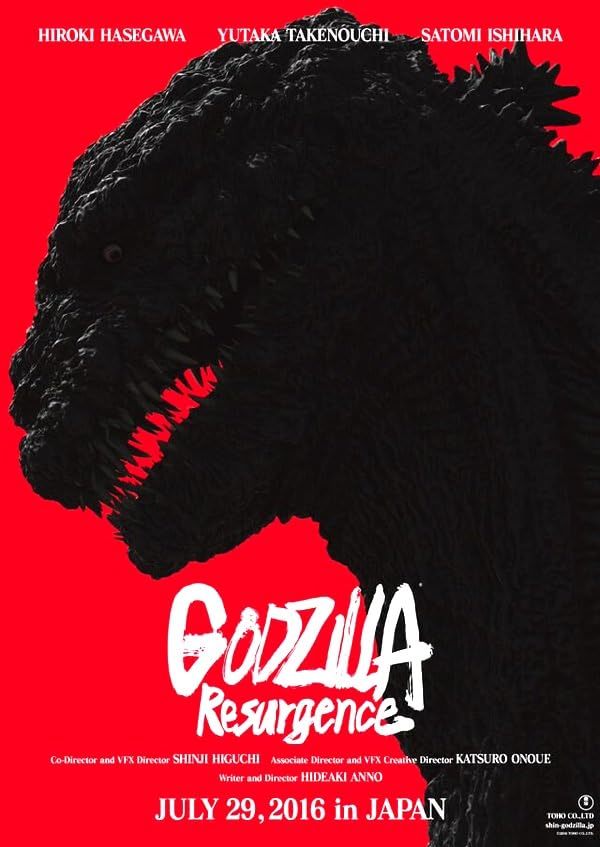
The Friday Night Horror Movie: Shin Godzilla (2016)

shin godzilla
My daughter has started to get into Japanese culture, including Anime so I got her a subscription to the Crunchyroll streaming service. I noticed that Shin Godzilla was included in that service so I gave it go. I’d say I am a fan of the Godzilla movies, but I’m not hardcore about it. I’d been meaning to watch this one since it came out, and the reviews for the new one – Godzilla Minus One have been really good, so today seemed like a good day to watch a lizard monster attacking Japan. Godzilla Minus One isn’t a true sequel of Shin Godzilla but I still wanted to watch it before Godzilla Minus One.

Crunchyroll had two audio options. I could watch it in the original Japanese with English subtitles or I could watch an English dub. In general, I prefer to watch movies in their original language and so I chose that option. Unfortunately, the sync was off which meant I got the subtitles appearing on my screen about three seconds before the characters actually said them. This was especially true during the more frantic action sequences in which the dialogue is rapid-fire. It was very confusing so after about an hour I switched to the English dub. It was a very bad dub, but somehow I survived.

Made in 1954 the original Godzilla served as a metaphor for Japan’s post-war fears of another nuclear holocaust. Shin Godzilla is at least partially concerned with the ways in which bureaucracy stalls decisive government action in a time of crisis. Making it a metaphor for the Japanese government’s response to the Fukushima nuclear disaster.

Just off the coast of Japan, an eruption of some kind occurs in Tokyo Bay. The water begins to boil and an underground tunnel ruptures sending water flooding into traffic. The government meets to discuss the issue, they call in top scientists to figure out what is causing the eruption, but they do nothing.

Soon a tail emerges then a large lizard thing (with hilarious googly eyes. But not to worry, the scientists say, it probably can’t come on land. It’s legs are too small. Then it does come on land and mutates into something more Godzilla-like. More government discussion, but little action. They have to have meetings, you see, and decide what the laws say they can and cannot do during this crisis that no one in the history of the world is prepared for.

Some low-level agents form a secret board of folks willing to actually do something, and they (eventually) save the day. But not before Godzilla destroys most of the city with his super-awesome fire breath and lasers that shoot out of his scales and tail.

It is a curious mix of dudes in offices arguing over the correct procedures, other dudes in other offices actually trying to find a real solution, and some crazy Godzilla action.

Honestly, I was mostly bored during the office scenes. I got what it was trying to do within the first ten minutes or so and after that, it just felt redundant. But the Godzilla attacks stuff is pretty great.

The Friday Night Horror Movie: House (1977)

house poster

Steven Spielberg’s Jaws was a massive worldwide hit in 1975. Naturally, studios from all over tried to find ways to replicate that success. The Japanese studio Toho was no exception and they hired Nobuhiko Obayashi to write something Jaws-like. What he came up with was one of the strangest, incomprehensible films I’ve ever seen.

The basic plot, if you want to call it that, is actually pretty simple. A teenaged girl nick-named Gorgeous (Kimiko Ikegami) (most of the characters in this film have goofy names like Kung Fu, Fantasy, and Sweet) invites several of her friends to spend summer vacation at her Aunt’s (Yōko Minamida) house. Strange things begin happening almost immediately once they arrive. It seems the house is haunted.

But any type of plot outline will do nothing to explain just how completely nuts this film is. Criterion describes it by saying that it’s like if an episode of Scooby Doo were directed by Mario Bava. I’d add that it’s a psychedelic cartoon turned into a live-action nightmare.

There is a floating head that bites one girl in the butt checks, a piano that eats people, an evil cat, a murderous futon, and so much more. The sets’ backdrops are gorgeous and intentionally designed to call attention to their fakeness. Obayashi uses fisheye lenses, superimposed images, freeze-frames, matte paintings, periodical animation, and every other cinematic trick at his disposal.

It feels both thrown together and tightly scripted. It is more comedic than horrifying, and more bizarre than thematically satisfying, but it truly is a film worth watching.

It is one of those films I’ve been hearing about for ages. The Criterion Collection got ahold of it a few years back and it’s been talked about ever since. But for one reason or another, I kept putting off watching it. I like weird films but I feel like I need to be in the mood for them, and I rarely feel like I’m really in the mood. But I needed a foreign language horror film and was struggling to find something so I put it on.

I’m so glad I did.

Foreign Film February: Re/Member (2022)

rememberposter

By now we all know the Groundhog Day Drill. Someone for some reason gets stuck in a time loop. The same day is played out for them over and over again. To stop it they must do something – make a life change, find a killer, stop a war, etc. whatever. There were time loop films before Groundhog Day, but that film perfected the concept and countless films have tried to repeat its success in various ways.

Re/Memory takes the basic concept and mixes it with a slasher horror film (something that has become something of a sub-sub-genre in itself) and a Japanese high school melodrama. Results are very mixed.

One of the many strange things the film does is that it kind of pushes many of the time loop elements to the side in order to focus on the relationship of its characters.

Set in a typical Japanese high school six students find themselves reliving the same day over and over. Eventually, they realize their task is to find the mutilated body parts of a young girl who was murdered many years ago. The ghost of the girl haunts them every day at midnight, stalking them until they are all dead, and the day resets. 

But it only happens after midnight. The day begins in the morning and they each go about their regular day – attending school, having lunch, playing sports, etc. Then at midnight, they are transported to the chapel inside the school where they must find those body parts before getting killed. Apparently, the various arms and legs aren’t available during the day.

It is so strange to see them acting like normal high school kids with all of their romances and social clicks only to find them at night running for their lives. The film never deals with the fact that being murdered every night and watching your friends get killed would be incredibly traumatic for these kids.

These six kids are all lonely in one way or another. Our main protagonist, Asuka (Kanna Hashimoto) is considered a loner. No one at school talks to her and they act like she’s some sort of freak. Some of the others are outcasts as well, but some seem to be popular kids. They have friends, but deep down they are just as lonely.

Through battling a vengeful ghost every night they become a tight group of friends. It is like The Breakfast Club, but with a vengeful, murderous ghost. This is handled fairly poorly. For the first two days, all the other kids still shun Asuka, but suddenly on the third morning, they treat her like a bestie. And she’s suddenly no longer this super shy kid, but outgoing and friendly.

The horror aspects aren’t handled any better. The film tends to skip over the hunting for the body parts scenes. The kids do eventually learn to handle the hunt systematically, but there is very little actual searching for anything. In the same way, it skips over most of the real terror of the situation. There are maybe one or two moments where the kids are hiding from the monster, hoping to escape its clutches, but mostly the film focuses on the capture. There is plenty of violence and (poorly rendered) CGI gore.

I was more interested in the daytime scenes, but I’ve always been a sucker for high school movies. If you are looking for a horror take on the classic Ground Hog Day scenario there are many other better choices. I recommend Happy Death Day.