Mysteries In May: Twin Peaks – Fire Walk With Me (1992)

image host

I never watched Twin Peaks when it originally aired. As I noted in my Five Cool Things column, I do remember seeing some magazine spread that talked about the show, detailed what we knew (at that time) about the central mystery, and gave some details on the various characters inside the fictional town of Twin Peaks, Washington.

The series was massively popular at the time, and the question of Who Killed Laura Palmer? was a cultural phenomenon. But then the popularity waned, and it was cancelled after two seasons.

My assumption was that they did not solve the mystery in those two seasons, which is why they made a movie, Twin Peaks: Fire Walk With Me.

Many years after the original airing, my wife and I borrowed the series on VHS tape from the local library. They only lent it out one tape at a time. I think we watched the first two tapes, but it could have been three or even four. We definitely did not finish the first season. But then the next tape was not available, and we got distracted and never returned. I thought about it often, but Twin Peaks is the sort of series you really want to watch straight through, and eventually, enough time had passed that we knew we needed to start it all over again.

Weirdly, my wife at some point watched Fire Walk With Me. Again, my assumption was that the movie solved the murder mystery, and since I hadn’t finished the series, I did not partake.

Recently, we finished the original series, and I finally caught up with the movie.

For those of you who know nothing about Twin Peaks, I think I can say, without really spoiling anything, that they do solve the murder of Laura Palmer somewhere in the middle of Season Two.

For those of you who know even less about the series, Twin Peaks is a television series created by David Lynch and Mark Frost, which ran on ABC for two seasons in 1990-1991.

The fictional town of Twin Peaks is an idyllic small American town with picturesque views of the Rocky Mountains. As the series begins, Laura Palmer, the beautiful Homecoming Queen and apparent darling of the town, is found brutally murdered, lying naked in the river.

FBI Agent Dale Cooper (Kyle MacLachlan) is sent to investigate. While the town is seemingly as American as Apple Pie and as idyllic as those snow-covered mountains, Agent Cooper will soon discover a dark underbelly to Twin Peaks. And Laura Palmer likewise is found to harbor dark secrets, including drug use and promiscuity.

The series is relatively light-hearted, treating most of the characters as quirky and mysterious rather than lecherous monsters. It is very much an entertaining small-town murder mystery, albeit one with periodic turns into surreal horror.

The series doesn’t judge Laura Palmer’s darker side; it doesn’t blame her murder on her various indiscretions. But it doesn’t absolve her of them either. It seems very much a part of Lynch’s obsession with revealing the darkness behind bucolic settings (see Blue Velvet for more).

And now, we finally arrive at Fire Walk With Me. If Twin Peaks: The Original Series was all about answering the question “Who Killed Laura Palmer?”, then Twin Peaks: Fire Walk With Me attempted to answer “Who Was Laura Palmer?” Which makes it not really a mystery, but as it does answer some of the lingering questions of the series (though not nearly all of them) I’m allowing into my Mysteries in May series.

Since she is dead before the original series begins, we only know her through the memories of others and the clues Agent Cooper finds. Her friends and family members remember her fondly, with rose colored glasses. She was the homecoming queen, a good girl, a saint. But then her drug use and promiscuity are revealed. She’s shown to have worked at a cat house and sold cocaine. The assumption is that she was just a stereotypical “bad” girl, rebelling against her white picket fence home life.

Fire Walk With Me plunges us into who she really was.

But first, there is some business about another murder. The film begins with two FBI agents (portrayed by Keifer Sutherland and Chris Isaak) investigating a murder very similar to that of Laura Palmer, which occurred sometime before Laura’s death. But just as we’re starting to get invested in that case, one of the agents disappears.

Back at FBI headquarters, several agents (including Agent Cooper) are discussing the matter when Agent Jeffries (David Bowie), who had been missing for many years, suddenly enters and tells them a wild tale involving spirits and a Red Lodge (something that would feature prominently in the original series). And then he disappears.

We then move on to the last days of Laura Palmer, and that initial mystery is just left hanging. Apparently, David Lynch shot a lot more footage dealing with that first mystery, plus hours of footage around Laura Palmer, but cut it for the final movie. He has since gone back and compiled many of the cut pieces into something of its own, semi-coherent movie entitled Twin Peaks: The Missing Pieces. I have yet to watch that, but it is on my Criterion Collection Blu-ray.

In the original series, Laura Palmer was a mystery to be solved. We learn about her, but she’s never anything more than a murdered corpse. Fire Walk With Me lets us know her as a living, breathing person.

In the series, she was a “bad girl” who pretended to be good. But in the film, she’s a tragic figure. We learn that she endured years of abuse and trauma. The drugs, the sex weren’t a good girl acting out, but a young woman who has systematically been abused trying to cope.

Obviously, we know Laura Palmer is going to be murdered, but the character seems to know she’s living out her final day as well. It is a staggering, heartbreaking performance by Sheryl Lee.

It is a difficult movie. Lynch infuses it with his surrealistic, nightmarish horror. Add to that the very real trauma Laura is experiencing, and it is a tough watch at times. But also beautiful, powerful, and brilliant.

I highly recommend it, but only after you’ve seen the original series and are braced for this to be something completely different.
Awesome ’80s in April: Dune (1984)

duen movie poster

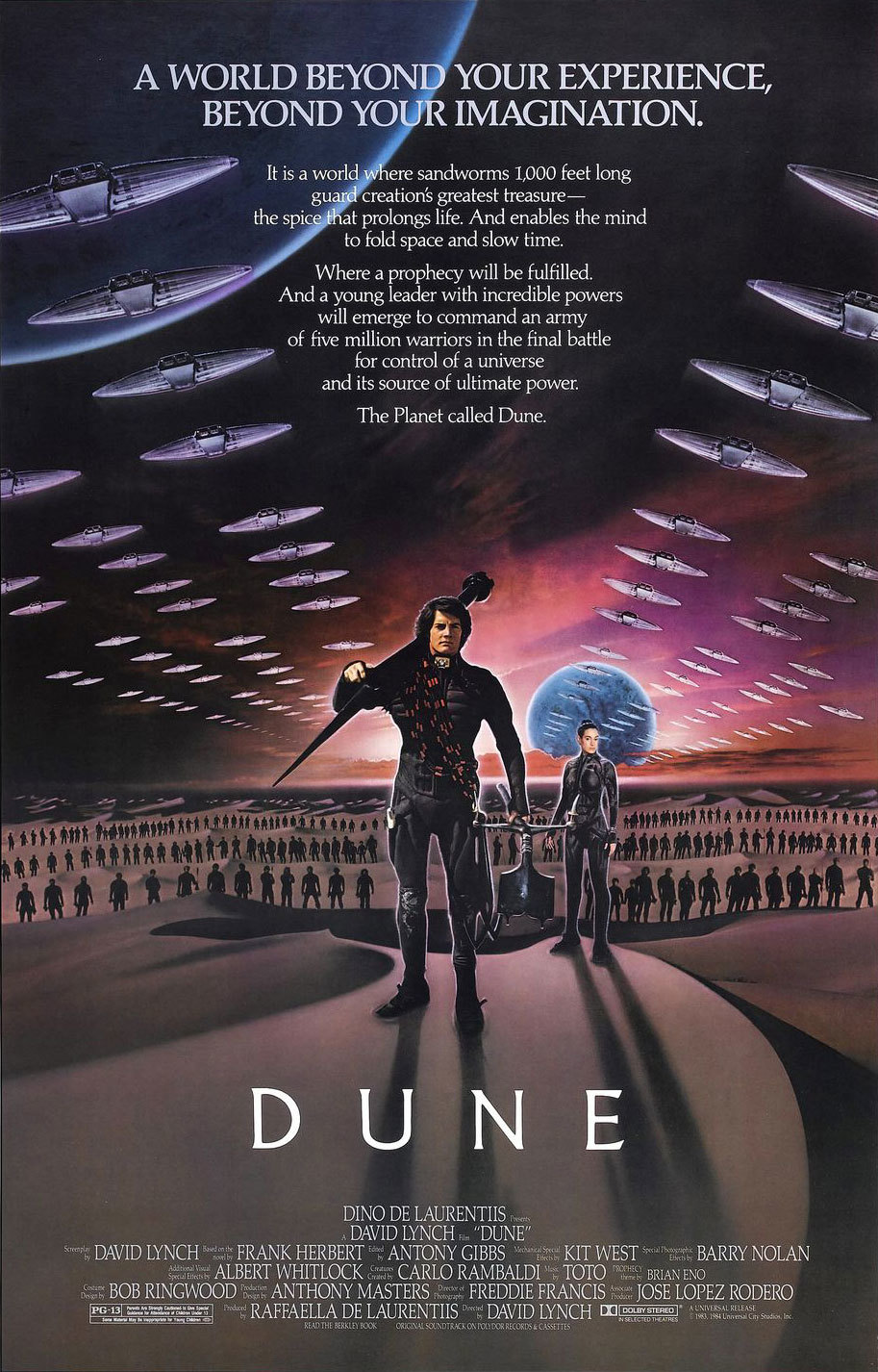
I’ve had a copy of Dune, the Frank Herbert novel, on my bookshelves for years. I’ve never managed to read it. I’ve tried a couple of times but I can’t get past the first few paragraphs. It is so dense, so full of new words that I feel immediately lost and that it isn’t worth my time to dig in.

I’ve had a DVD copy of Dune, the movie directed by David Lynch on my shelves for years as well. Until recently I had never managed to watch it. I tried once, many months ago, but didn’t get past the first few minutes. It was so full of exposition and new ideas that I was almost immediately lost and it didn’t feel worth my time to try and dig in.

Last year I did watch Dune, the movie directed by Denis Villeneuve and quite liked it. I’m a big fan of his films in general, and he somehow made this dense world full of numerous people and clans and ideas seem understandable and manageable. So, I figured now was the time to give Lynch’s adaptation another shot.

It was a notoriously expensive bomb. Lynch’s original cut ran about four hours and the studio made him cut it down to just over two. Critics hated it, audiences mostly stayed away, and Lynch has since disavowed it and refuses to speak of it in interviews.

It continues to be reevaluated by new audiences, and the general consensus of it is an ambitious failure.

It was David Lych’s third film. His first was Eraserhead (1977), a really weird, surrealistic body horror flick that became a cult hit. Mel Brooks of all people loved it and hired Lynch to direct his next film, The Elephant Man. That was a much more straightforward film, and it became a big hit and an award-winner. This is how Lynch came to direct Dune, a big-budget sci-fi epic.

I love it. With caveats. The plot is near incomprehensible even with multiple characters explaining what they are doing and with our ability to hear their thoughts.

Most of it takes place on a desert planet, the only place where the people of this universe can get something called spice. Which is a mind-altering drug, it can extend a person’s life and it allows people to bend space so they can travel across the universe in seconds. Or something. There are various warring clans who all are fighting over this planet. But it all seems to be covert. Outwardly the Emperor of the Universe has given control of the planet to one family. Their son is named Paul (Kyle MacLachlan) and he’s apparently some kind of messiah figure.

Everyone has weird hairstyles, one guy can float, and Sting spends a lot of the time practicing fighting with his shirt off. There are cool electronic shields of some kind, people have to wear these weird nose pieces on the spice planet and, oh yea, the planet is full of giant sandworms.

There is so much going on in this film that it is impossible to explain and even more impossible to understand. But it looks really cool. And it is populated by loads of great actors including Patrick Stewart, Brad Dourif, Linda Hunt, José Ferrer, Dean Stockwell, Max Von Sydow, and Sean Young.

The style and look of the film are completely Lynchian. So even while I wasn’t always sure as to what was happening on screen, I sure enjoyed watching it.

Confess, Fletch (2022)

confess fletch

I’m weird when it comes to comedies. With some exceptions, I don’t really like straight-up comedies. I find movies and TV shows that throw a million jokes at the wall hoping something will stick rather boring. I want a good story with good characters doing interesting things. I want the comedy to come naturally out of those characters and stories. Make me laugh, but do it without sacrificing your story.

I absolutely loved Fletch (1985) when I was in high school. It does technically have a story, but it is often sacrificed to Chevy Chase’s antics. Those antics won me over, as did a whole lot of very funny dialogue. Truth be told some of that love really came from a youth minister from Arkansas. He loved Fletch more than just about anything and he was constantly quoting it. I thought he was one of the coolest guys in the world and so his love of the film translated into me loving it.

I’ve not actually seen Fletch in many years, probably decades. So I have no idea if I would still find it funny. The movie is based on a book by Gregory MacDonald. I’ve read that plus a couple more in the Fletch series, and quite liked them. But it has been quite a few years since I cracked those pages, too.

That is a long build-up to say I absolutely loved Confess, Fletch. It was and is and forever shall be right up my alley.

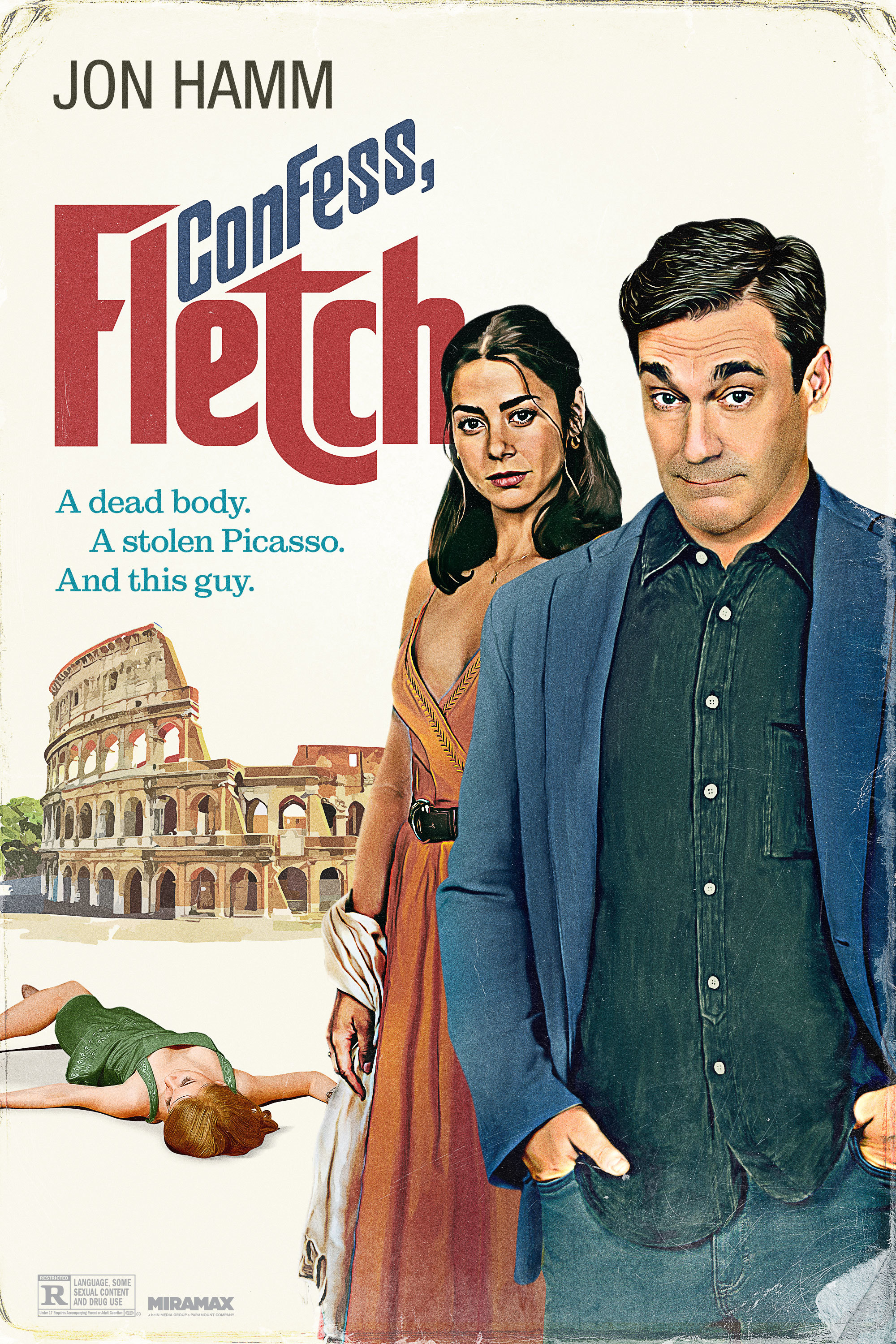
Jon Hamm is perfect as IM Fletcher a former investigative reporter “of some repute” who now writes fluff pieces for travel magazines. He returns to Boston after spending several years in Europe to find a dead woman in the living room of the house he’s renting. He spends the rest of the film trying to solve the murder much to the chagrin of the two actual police detectives assigned to the case (Ron Wood, Jr. and Ayden Mayeri).

Along the way, he runs into a cavalcade of interesting characters (played by an incredible cast of actors including Kyle MacLachlan, John Slattery, and Marcia Gay Harden).

Though it involves a murder the stakes are quite low, the suspense light. It feels like a hangout movie where Fletch keeps running into people, says funny things, and tries to solve a murder. Hamm is so good. I was a big fan of Mad Men and it is absolutely astonishing to me that the actor who was so deadly serious in that, is so goofy here (and in many other roles since that show ended.)

Everything about this movie worked for me. It is a delight. It is very silly and full of jokes, but they don’t get in the way of the story. They feel natural to the character of Fletch and everything that is happening. It isn’t really realistic, but it works within the story the film is telling.

The worst part of the film is that the studio that funded it did absolutely nothing to support it. The film opened in theaters with basically no advertisements and now it has been unceremoniously dropped onto Showtime’s streaming service. I won’t say that it would have been a huge hit had it gotten a little support but it would have at least been seen by a few people. As it is I suspect most of you reading this have never even heard of it.

Blue Velvet (1986)

blue velvet poster

Blue Velvet comes from my collection of Chinese bootlegs. My sister Bethany and her husband Brian are teaching English in China. Apparently, you can purchase a wide assortment of DVDs there very cheaply. So I supply them with big lists of movies I’d like and when they come home they bring me a big stack. There are never any special features on the DVDs, but the picture is usually good and for $1 a piece, that’s all I need.

Blue Velvet is dark, scary, freaky, and really good. Which is how you could describe most of David Lynch’s films. His films are often filled with symbolism and it is easy to finish one of his films and have no real idea of what actually happened. They usually take two or three viewings, and a little research to get a good idea of what the movie is actually trying to convey.

Blue Velvet has a simple plot that can generally be understood at a basic level upon first viewing, but there is plenty of symbolism and deeper meaning to make it “enjoyable” for further viewing. I put enjoyable in quotation marks because for many watching it is not an enjoyable experience. It is a movie deep-seated in horror, with scenes that make you crawl under the covers and lock the doors. For the cinephile, it is a pleasure to watch a lurid piece of cinema with enough depth to require multiple viewings. For the weekend movie watcher, it is probably too much to stomach.

The film starts with an idyllic, picturesque small town. It’s a town where every day has blue skies, manicured lawns, pretty flowers, and quiet, simple people. Lynch fills the screen with gorgeous pictures straight out of fifties television shows. But this is a David Lynch movie and the pretty pictures don’t last long. Soon enough a nice old man who is watering his lawn falls down near death. The camera pans down past the convulsing man and deep into the grass. Digging into the earth until the camera is dark with freshly wet dirt and grotesque bugs. The idyllic town is only pretty on the surface. Underneath the top layer of goodness lies a darker, seedier town hidden from the eyes of most of its citizens.

The plot of the film revolves around Kyle MacLachlan and Laura Dern delving deeper and deeper into the darker side of the small town. MacLachlan finds a dismembered ear on his walk home from the hospital one afternoon. Finding such a macabre item in his hometown sparks a quest to discover whose head the ear could belong to and why it was removed. He involves the good girl Laura Dern in his quest and they sink into darker waters. To tell more of the plot is to give away too much. I’ll just say that it is not for the weak of heart.

Dennis Hopper plays one of cinema’s creepiest villains to date. His psychosis is even more terrifying in that it is so real. Here is no Freddy Krueger, or even a Hannibal Lector. This is not some crazed psychopath lurking in the corner. Sure he is psychotic and maniacal, but versions of him can be found almost nightly in any major city newspaper. He is not a homicidal maniac, but a violent, evil man made even more so by his addiction to unnamed drugs.

Isabella Rossellini plays Dorothy Valens with such beauty and sadness it breaks your heart as it squirms your stomach. Her character has taken such horrible abuse over her life she has come to like and enjoy it. Mixed with heavy amounts of masochism her performance is remarkable.

There were several times while watching this with my wife, Amy that she said she couldn’t keep watching it. After the credits rolled she said she would never watch it again. I suspect this is the sentiments of many viewers after watching Blue Velvet. But if you can stomach the violence, masochism, and overall creepiness there is a lot of pure cinema to study.