The Friday Night Horror Movie: Dracula (1979)

image host

Though I’ve seen probably a dozen Dracula movies, I’ve never actually read the book by Bram Stoker. Everything I know about the story, the characters, and the most famous vampire of all comes from the movies. I have no idea how accurate any of them are. They all change the narrative to suit their cinematic needs. But I figure between them all, I’ve probably gotten all of the details in there somewhere.

This version of the story was based on a stage play (the same one the Bela Lugosi film was based on). It doesn’t do anything particularly new with the story, though it does lean more into the seductive side of Dracula than the violent, destructive side. But it is a very good adaptation, if not exactly a necessary one.

It skips the beginning of the story with solicitor Jonathan Harker (Trevor Eve) visiting Count Dracula (Frank Langella) at his home. Instead, it begins with the arrival of Dracula on the Demeter. The ship crashes near the home of Dr. Jack Seward (Donald Pleasence), and Dracula is rescued by his daughter, Lucy Seward (Kate Nelligan).

At first, Dracula is friendly with everybody and dines that evening with the Seward’s and their friend Minda Van Helsing (Jan Francis). But that evening he’s sucking Minda’s blood and seducing Lucy.

Minda’s death brings Professor Van Helsing (Laurence Olivier) back from his journeys and…well, if you’ve seen other adaptations of the story, you more or less know what comes next.

Like I said, it doesn’t do anything particularly new with the story, but I quite liked it anyway. The sets look amazing, and cinematographer Gilbert Taylor, along with director John Badham, create some stunning imagery.

Olivier is great as Van Helsing, and Pleasence is enjoyable as Dr. Seward, whose home also happens to be situated on the grounds of an insane asylum, providing the film with some of its most memorable set pieces. Tony Haygarth gives a fine, if all too brief, performance as the deranged Renfield.

The entire cast is quite good, save for Frank Langella as Dracula. His performance lacks the menace or sensuality the role requires. He plays it like he’s an old gentleman, beset by loneliness who periodically has to suck people blood to survive. There are flashes of something special hidden in there, but mostly I found it a very odd performance.

But overall this is a very good version of the old story.

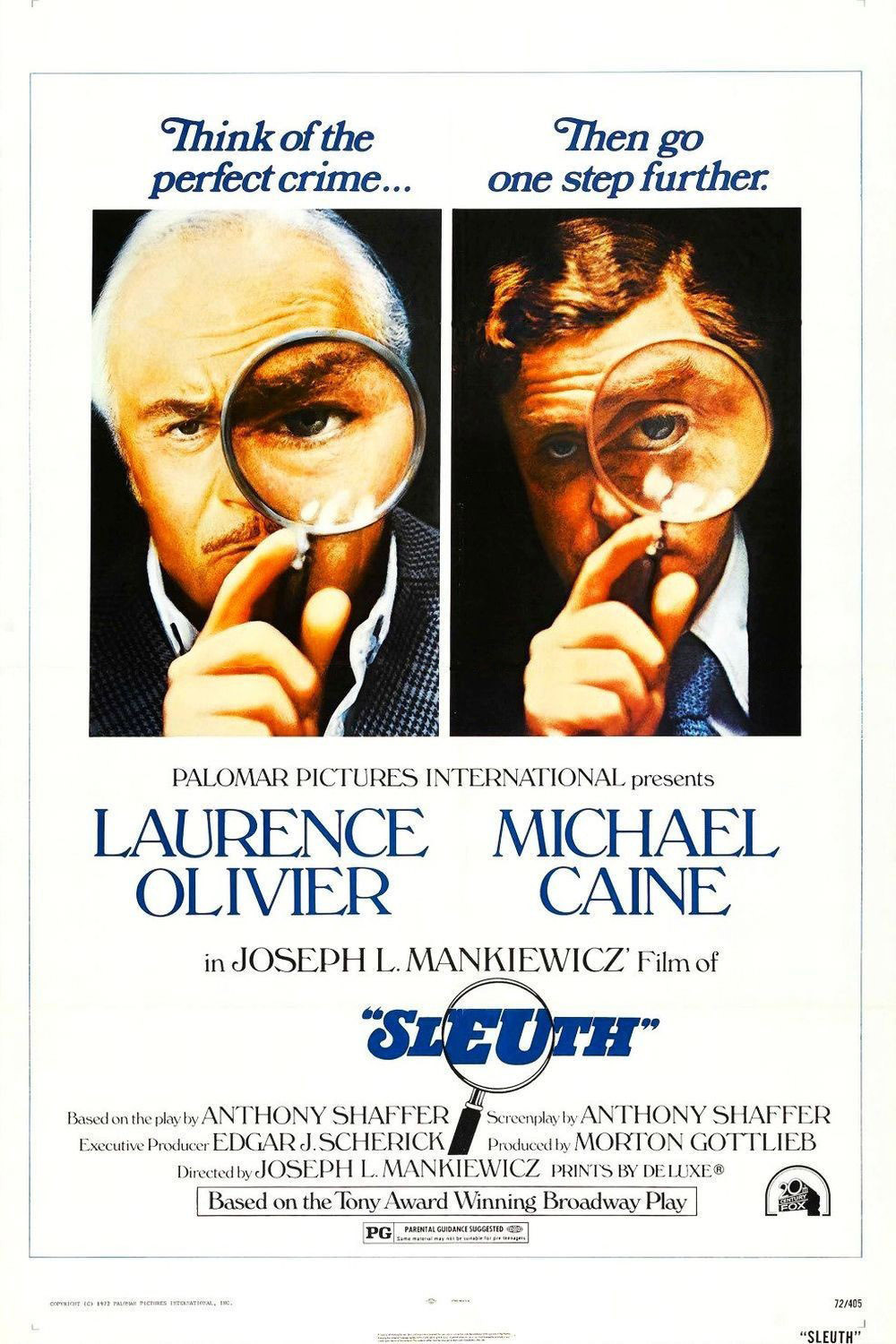
Sleuth (1972)

sleuth movie poster

This was originally written and posted on March 1, 2006.

A delightful plot-twisting mystery starring Michael Caine, Laurence Olivier, and nothing but Michael Cain and Laurence Olivier – albeit in two roles for Michael Caine. It is essentially a showcase for both actors, and it is quite a show they put on.

The plot gets complicated, but essentially Olivier plays a mystery writer in the vein of Agatha Christie. Michael Caine has been having an affair with Olivier’s wife. The two meet at Olivier’s house to discuss the state of things. Fiendish plot point after another and things get sinister and fun very quickly. There isn’t much more to say, for letting the twists and turns come as they are is half the fun.

Director Joseph L Mankeiwicz manages to adapt what was originally a successful stage play into the cinema very well. He uses his set pieces as supporting actors. There are dozens of games lying about Olivier’s house, and nearly all of them play some part of the plot.

Though the DVD seems to be out of print, Sleuth is well worth tracking down at the local library or video club.

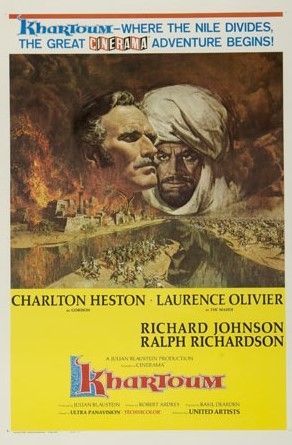
Khartoum (1966)

khartoumt

One of the fun things about going to the library is that you never know what you are going to get. They have a wide selection of DVDs, but very few are available at any given time. I was surprised this last time when I actually had a choice to pick from. Albeit it was a choice between 2 films (the few others available were either foreign films translated into French or straight French films). The choice was between the Gary Cooper version of A Farewell to Arms and an unheard-of by me Charlton Heston/Laurence Olivier adventure called Khartoum. Not in the mood for Hemingway, I decided a Heston/Olivier picture might be a treat.

To say this is a Laurence Olivier picture is to say too much. Though he gets top billing, and his character plays an important part in the picture, his actual screen time is minimal. He plays a part known only as The Mahdi, who is a Muslim that rose out of the desert to claim his place as the chosen one. I believe Olivier is an African Muslim like I believe Heston is a Mexican cop. But we suspend our disbelief and all that for the sake of the story.

As it is the story is a grand one. Based on historical events, of which, sadly, I’ve never heard a lick of until this film, where the Mahdi attempts to take control of British ran Sudan. The mysterious General Gordan (Charlton Heston) is sent down to help things along. A standoff evolves and it is wit against wit.

It is not a bad film, but neither is it a great one. There are some truly beautiful shots of the scenery. Heston plays Gordan without as much conflict as the character requires, but with enough gusto to make it believable. Olivier is, as always, near perfect. With simple facial expressions, he carries the convictions of a man who believes himself a prophet. The scenes between Olivier and Heston, though historically inaccurate, add a much-needed emotional punch. The direction is a bit plodding, nothing particularly bad, but nothing exceptional either.

When watching historical films such as Khartoum, having some connection with the actual events helps bring meaning to the picture. Films based on the holocaust are often forgiven some of their cinematic sins due to the weight of the history behind the story. Yet, historical films that are not as well known can also entrance the viewer through the weight of their story. Knowing that the events actually happened often stir the viewer to greater emotional depths than a depiction of completely fictional events. It is here that Khartoum failed for me. As I said there was nothing particularly wrong with the production, but it never really captured my emotions. Admittedly I know very little about British history or the struggles of the Mid East beyond the years of my own life. This is a fault of my own, yet a film should be universal in its undertaking. If it fails to move an audience unfamiliar with its history then it will likely fall into obscurity. For those familiar with this particular history, the film may bring more to you than it did me. As for me, it was a mostly entertaining, and an interesting couple of hours in my life, it will be one that will largely be forgotten in time.