Apocalypse Now (1979)

poster

Apocalypse Now is one of, if not the greatest war movies ever made. I can’t remember when I first watched it. I was probably in high school or maybe college. I do remember watching it again off an old VHS tape. I had taped it off TCM or HBO or some such cable channel.

It is weird to think about that now when streaming video is so prevalent. When you can watch nearly anything you want at any time you want. But back then you watched whatever TV wanted you to watch when they wanted you to watch it. You could record live TV and watch the program later, but that wasn’t the norm. People like me used to collect VHS tapes and record movies. I developed a pretty good library that way.

Whenever there wasn’t anything interesting on television I’d pull out a VHS tape and watch a movie. It took a long time to build a collection back then. I think I started collecting tapes in high school but didn’t get serious about it until college. With a small collection, I found myself watching a lot of the same movies over and over again. My favorite movies I’d watch three or four times a year. As my collection grew those viewings became a little more spaced out.

I have this vague memory of putting on Apocalypse Now one Saturday afternoon. It was an old tape and not that great of quality. I always thought it was a great film, but I seldom watched it. I’d say I’d only seen it two, maybe three times before this weekend. It is long, and meditative so I probably never felt in the mood.

In 2001 Coppola re-edited the film, adding some 49 minutes to its already long run-time. He called this version Redux. That’s what I watched this weekend.

What I found striking is how easily I was able to instinctively know what new scenes were added in. It wasn’t that the quality of those scenes was bad. There aren’t any visual clues that those moments were new. Sometimes when an old scene is added to a movie you can tell because the quality of the image is bad. But not here. It all looks amazing.

I just knew. Intuitively. Even though I hadn’t seen the film in two decades I somehow understood I hadn’t seen those moments before. This film is just part of my cinematic knowledge. It helps that nearly every scene in the movie is utterly iconic. Even if you’ve never watched the film, you probably know about large chunks of it.

There are two major scenes added in – an additional one with the Playboy Bunnies and another long one on a French plantation. In my opinion neither really adds that much to the movie. Both of them slow things down, disturbing the flow of the film. The French plantation scene is interesting, the things they discuss are worth watching, but again it slows things down just as things are heating up.

The scene with the Playmates is not particularly interesting at all. Apparently, Coppola wasn’t originally able to shoot all of that scene that he wanted due to bad weather, but he was able to edit enough of it together to put it in this recut.

I’m sure there are small moments added to already existing scenes that I didn’t notice were new, but I find it fascinating that I automatically knew those long scenes were new to me.

Coppola had originally wanted to adapt Joseph Conrad’s novel, Heart of Darkness, into a Vietnam parable as far back as 1967. He hired John Milius to write a script and wanted George Lucas of all people to direct. But no studio was willing to fund a Vietnam movie while the war was still raging and the movie was scrapped.

Coppola then made The Godfather and The Godfather II both of which were huge critical and financial successes. This offered him the clout and money to make his Vietnam movie.

It was a famously troubled shoot. Coppola wound up putting most of his own money into the film. The filming shooting schedule ballooned from several weeks to well over 200 days. Actor Harvey Keitel, who was set to play the lead role, Captain Willard, was fired after the first week of shooting. The man who replaced him, Martin Sheen, had a heart attack in the middle of making the film and nearly died. Storms destroyed sets. The Philippines government, with whom Coppola had made a deal with the overuse of some helicopters were constantly interfering. And Marlon Brando, who was paid 3 Million dollars for three weeks worth of work showed up overweight and unprepared.

Eleanor Coppola shot documentary footage through the entire process which was later turned into the film Hearts of Darkness: A Filmmaker’s Apocalypse. I watched that this weekend as well. It isn’t as great as I was hoping. The main problem is that I’ve heard most of the stories before so it doesn’t present anything new. It is fascinating to see all of the behind-the-scenes footage.

Despite all those troubles Apocalypse Now still stands as a towering achievement. I’ve never been a soldier. I’ve never gone to war. But if anything is capable of showing us the truth behind the line “War is Hell” Apocalypse Now is it.

I realize I’ve just written some 900 words on a movie and said nary a word about the actual plot.

The plot involves Captain Captain Williard who is tasked with sneaking into Cambodia to find Colonel Kurtz (Brando) a well-respected and decorated officer who has gone completely insane, and terminate him with “extreme prejudice.”

He takes several other soldiers on a small boat up the Nùng River through Vietnam into Cambodia and the heart of darkness. Along the way, he runs into a wild variety of people. This includes a helicopter assault unit led by Lieutenant Colonel Bill Kilgore (Robert Duvall) who blasts “Ride of the Valkyries” through loudspeakers when he assaults a village, goes surfing even when the enemy is still attacking, and just loves the smell of napalm in the morning.

There are a couple of outposts with no commanding officer. The remaining soldiers keep on fighting, though haphazardly. One group continues to rebuild a bridge even though it is destroyed every other day. Playmates entertain a group of soldiers and are almost immediately overrun and mawed by the men, causing them to flee by helicopter. They are attacked by a tiger, children carrying hand grenades, and natives armed with nothing but spears and arrows.

And then they arrive at Kurtz compound. It is literally littered with the bodies of his enemies. He has created an army out of local soldiers, natives, and his own company, all of whom consider him to be a god. Dennis Hopper plays a spaced-out photojournalist who decides Willard should be the man to explain the majesty of who Kurtz has become.

Willard’s missing is to kill Kurtz because he’s become insane, but what he comes to realize, is that this war has made everyone stark raving mad.

All of this is put together by an amazing cast, top-tier directing by Coppola, and award-winning cinematography by Vittorio Storaro. Though the film is full of incredible action it is meditative, philosophical and one of the most beautiful films of all time.
The Cassandra Crossing (1976)

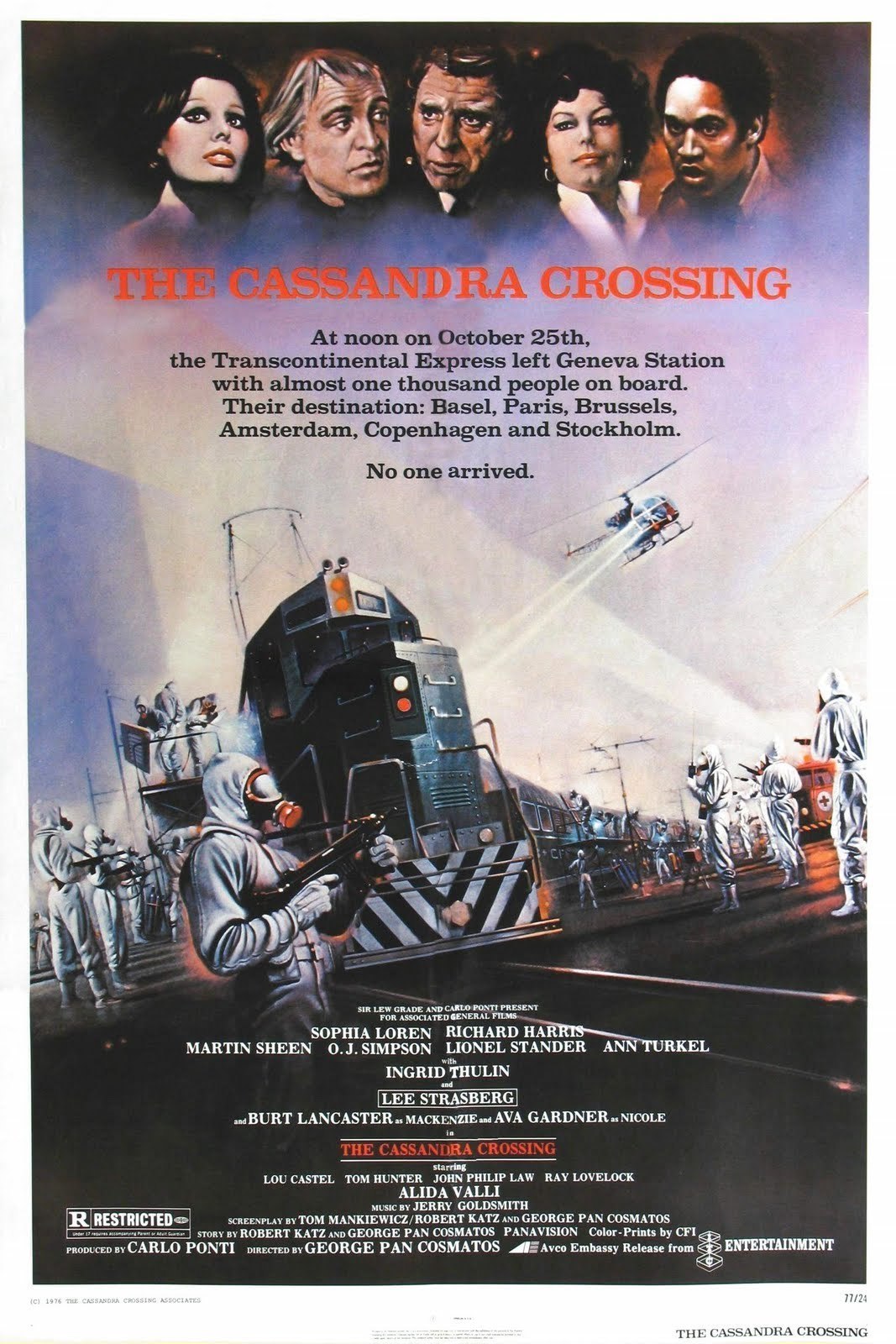
the cassandra crossing poster

The Cassandra Crossing which is one of those star-studded disaster movies that was so popular in the 1970s. It is about how an eco-terrorist accidentally contaminates himself with a deadly virus and then boards a train. Once the government learns what’s happened they seal up the train and make sure no one can get off. They reroute it to Poland where they will be quarantined until a cure is found. To get there they have to cross a disused and likely hazardous bridge called the Cassandra Crossing.

Richard Harris plays a neurologist who just happens to be a passenger on the train and becomes the defacto hero. Burt Lancaster is the government, military guy back at the base barking all the orders to keep everybody aboard. The cast also includes Sophia Loren as the neurologist’s wife, Ava Gardner as the wife of an arms dealer, Martin Sheen as her plaything, OJ Simpson as the world’s worst priest, and Lee Strasberg as a Jew who is none too keen to be returning to Poland (apparently the train is going to quarantine them at an old concentration camp.

That’s a good cast and the basics of the story are interesting, but like so many of these star-studded disaster movies it spends too much time giving each actor a good scene or two, and not enough making me care. Or at least be thrilled by the suspense.

It is confusing, too, I’m not 100 percent sure they were headed towards the concentration camp. Wikipedia says so, and Strasberg’s character has a nervous breakdown, but I didn’t hear any dialogue expressly stating that was their destination. I’m not really sure why they have to go to Poland anyway. The train was originally a Geneva to Stockholm exchange. It seems like they could just park it somewhere relatively isolated, board it up, and wait until the doctors figure things out. A lot of the plot is like that – confusing.

The actors, for the most part, seem to be having fun, and I always like watching lots of cool actors in a film together. But I wish they’d tightened things up a bit and concentrated on making this thing as tense as possible. Instead, it is a bit of a bloated mess.

Things do get a little exciting toward the end when our heroes do battle with the military goons in order to stop the train before it pummels off the bridge and it’s got one of those terrifically bleak endings. But it takes far too long to get there to make this a recommendation.

Awesome ’80s in April: The Final Countdown (1980)

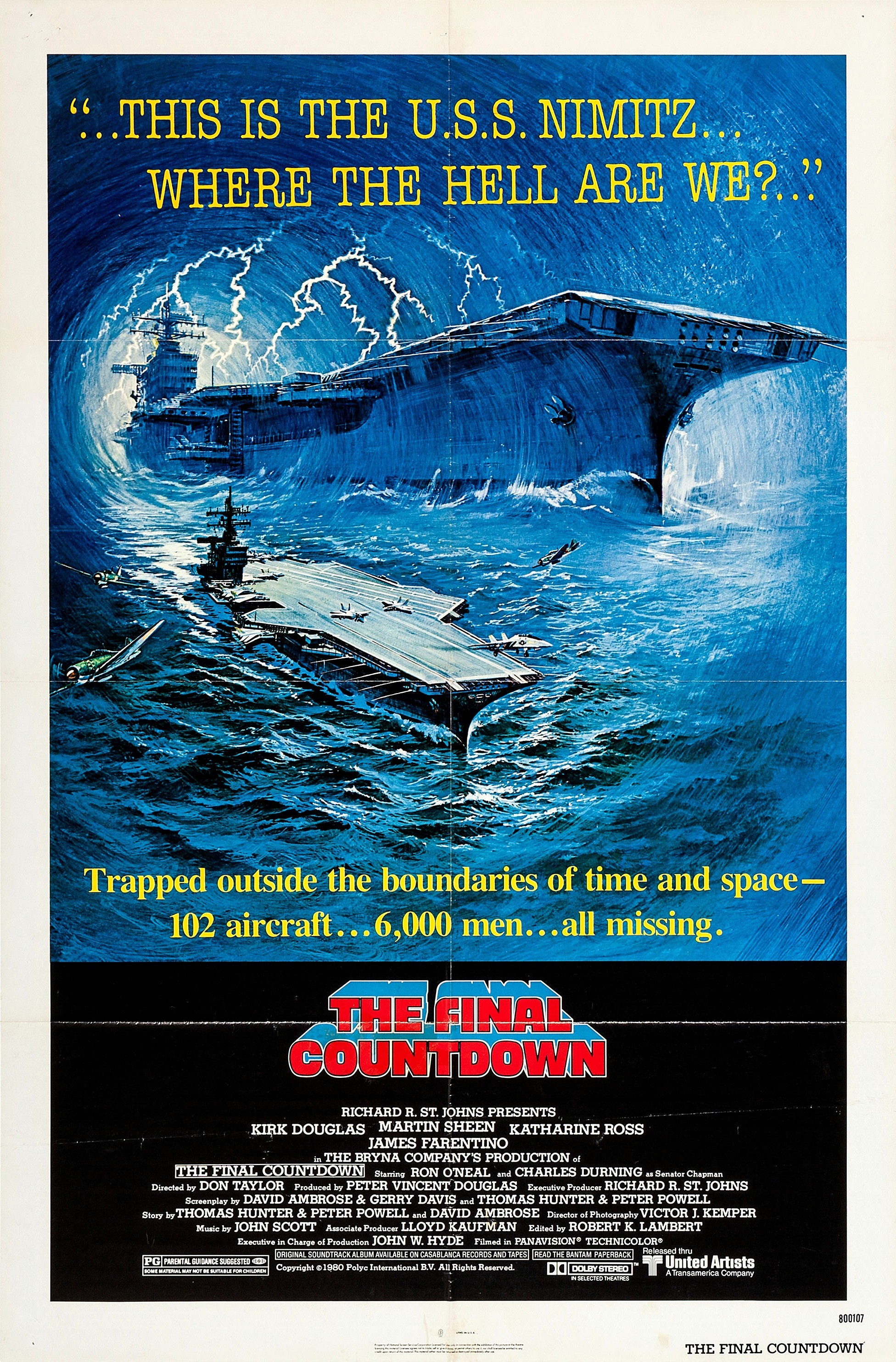
the final countown

I used to be really fascinated with time travel. I guess I still am, but I used to spend a lot of time pondering whether time travel could ever be real. One of the questions I raised was that if you could travel in time then wouldn’t you try to kill Hitler? Wouldn’t you find a way to stop the Holocaust from happening? But then maybe there is such a thing as fixed points in time. Certain events have to happen and you simply cannot stop them.

Or maybe time travel is real, but it isn’t invented for many thousands of years in the future. The Holocaust is one of the more terrible events of the last century, but for those removed from it by millenea it might just become a footnote in the history books.

Or something. I’m not smart enough to understand the complications of time travel. But I still enjoy a good time travel story. The Final Countdown is about an aircraft carrier from 1980 accidentally traveling back in time to 1941 just one day before the Japanese attacked Pearl Harbor. The ship’s crew must then decide if they will try to stop it from happening.

That’s a pretty cool idea, but the film doesn’t seem to know what to do with it.

Kirk Douglas is the captain of the ship. Martin Sheen is a civilian observer on board to make suggestions on how to improve efficiency. Charles Durning plays a US Senator from 1941 who just happens to be taking a leisure cruise on his yacht along with his assistant – played by Katharine Ross – off the shores of Hawaii on that fateful day.

The Senator is important because in real life (or at least the film’s version of real life) because he was someone who had warned of the Japanese attacking Pearl Habor and was in a position to become Vice President before the attack. But he mysteriously disappeared on that day. If the ship can save him it would impact history in unknown ways. Destroying the Japanese fleet would impact history too, of course, but there is a question of when they should attack. If they hit the Japanese before they hit the US then that could be seen as a sign of aggression, an act of war. But if they don’t then American lives will be lost.

Again all of this is interesting, but the film never makes it exciting. It is too busy moving to the next scene to allow time for the characters to chew on the dilemmas.

One of the difficulties for a film like this is how to end it. If they change history then we, as an audience, know the film is a fraud. It feels fake somehow. All cinema is fake, but alternate histories feel even faker. But if the characters wind up not changing history, then what’s the point?

I don’t mind so much when the film is good. But I found The Final Countdown to be rather dull. It doesn’t help that they gained full cooperation from the US Military and in return the film is filled with a lot of footage of the ship’s crew going about their work. If you like to see planes take off and land on a carrier (and it is technically impressive) then this film is for you. If you want some real action or drama, then you might look eslewhere.

Awesome ’80s In April: Firestarter (1984)

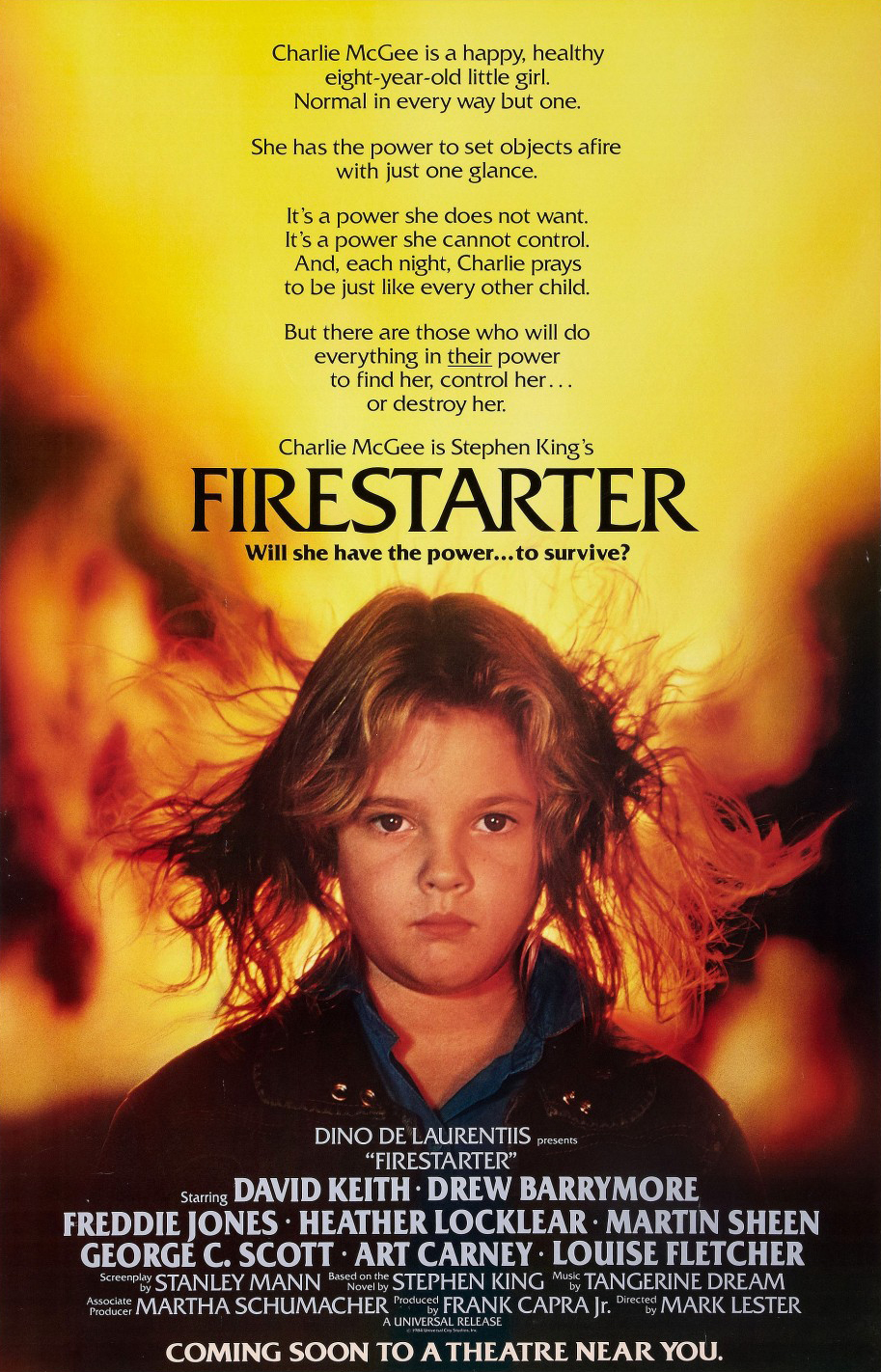
firestarter poster

One of my aims for this series is to watch films that I knew about as a kid during the 1980s but for whatever reason have never bothered to watch. All kinds of films were floating around the cultural ether – films that I’d seen trailers for or seen on Siskel & Ebert, or that my friends were talking about, but that didn’t appeal to me for some reason. Or that I just never wound up seeing. As an adult, a lot of these films have some kind of appeal, but not enough to usually make me sit down and watch them.

Firestarter is a good example of this. It starred Drew Barrymore, who was the biggest child star at the time. I was actually too young to watch the film when it came out in 1984, but she had something of a career resurgence in the 1990s by taking on more mature (and sometimes scandalous) movies like Poison Ivy (1992), The Amy Fisher Story (1993), and Boys on the Side (1995). I was a fan of the actress as a teenager and though Firestarter was a few years old at that point it was still very much part of the culture. It was often shown on cable television and the video stores still had copies of it on their shelves.

I guess what I’m trying to say is that Firestarter was part of my cinematic memory, even though I never did watch it. It is that kind of thing that fascinates me and those are the types of movies I’ll be trying to watch this month.

The film is based on the Stephen King novel of the same name and follows one of his more regular themes – that of people with psychic ability and the secret government agencies that want to exploit it.

Barrymore plays Charlie a girl with pyrokinetic powers. She and her father Andrew (David Keith) are on the run from those secret government agents. Years before Andrew and his wife were given experimental drugs by that agency which gave her the ability to read minds and him the ability to control them. The agency killed his wife and kidnapped Charlie. He got her back and that’s why they are on the run.

Eventually, they get caught and the Agency director (Martin Sheen) and his hitman (George C. Scott pretending to be Native American and sporting the most ridiculous-looking ponytail) attempt to befriend Charlie so they can get her to master her powers.

Writing all that out makes the film sound pretty good, but I’m afraid I have to tell you it is mostly a snore. The government plot is dull as can be, George C. Scott’s performance is just plain odd, and for a more about a girl who can start fires with her mind (and is titled Firestarter), it sure takes its time letting the girl start fires with her mind. It finally gets going in the last fifteen minutes or so and that scene is a real corker with tons of action and blazing fire action. But getting there takes a lot of effort.

Oddly enough it did make me want to read the book. The bones of the plot are good, and exactly the sort of thing King is good at writing. There is a scene in the film where Charlie and the father are picked up by an old man and taken back to his home where the man’s wife fixes them lunch. It is a perfectly fine little scene in the movie, but you just know King expanded it for multiple chapters allowing these characters to really bond and for us to get to know them. That’s the sort of thing King excels at, but that tends to get shortened down to nothing on the big screen.