Foreign Film February: The Magician (1958)

the magician poster

The Magician often gets overlooked when it comes to discussing the films of Ingmar Bergman. Part of this is due to timing. Made just a year after the duo masterpieces The Seventh Seal and Wild Strawberries it feels small and lesser in comparison. He followed it with The Virgin Spring, Through a Glass Darkly, and Winter Light, three deeply felt films that wrestle with the existence of God and human suffering.

But while The Magician certainly is a lesser film when compared with those movies, I wouldn’t skip it when taking in Bergman’s filmography. Were it made by a lesser director, or perhaps if it had even fallen somewhere else in his oeuvre I suspect The Magician would be talked about much more.

A traveling troupe of performers who sometimes sell themselves as magicians or spiritualists, and sometimes work as healers selling various medicinal concoctions are on the run from the law.

When they arrive in a small village in Sweden they are immediately stopped by the police and taken to a large house where they are questioned by the Police Superintendent (Toivo Pawlo), Dr. Vergerus, the Minister of Health (Gunnar Björnstrand), and Consul Egerman (Erland Josephson). Egerman, who is fascinated by the occult makes a wager with Vergerus, a skeptic, about the veracity of the troupe’s supernatural abilities.

After answering some questions the troupe agrees to perform their act the next morning. The troupe is ostensibly led by Tubal (Åke Fridell) who is the talker, the showman of the bunch, but the Magician is Vogler (Max Von Sydow) who pretends to be mute for much of the film. He is assisted by his wife Manda (Ingrid Thulin) who dresses as and pretends to be a man. There is also an old lady, simply called Granny (Naima Wifstrand), and their driver Simson (Lars Ekborg).

Because this is a Bergman film he is interested in the tension between the supernatural and science, faith and unbelief. It plays a little with whether or not the troupe has real powers before they admit they are frauds.

At the evening meal, Tubal tries to sell some of Granny’s potions. One of the maids is very interested in a love potion. She happily buys it from him then sly admits she doesn’t want it, but rather she wants him. Another maid (Bibi Andersson) drinks the potion and uses it as an excuse to seduce Simson. Everyone uses superstition to get what they want.

One of the other reasons I suspect this film doesn’t get its due is that tonally it is working in a few different playgrounds. It is sometimes a farce, playing the situation for laughs, and then it will switch into something more dramatic, towards the end it gives us a ten-minute scene that is pure horror. Those things don’t always gel well, but it mostly worked for me. The horror segment especially. It isn’t particularly scary, but Bergman, working with cinematographer Gunnar Fischer are such great technicians the scene works perfectly on a technical level.

The cast is as good as you would expect. I love when Von Sydow works with Bergman and he’s as wonderful as ever. It is a beautifully shot and constructed film. I’m always in awe of how gorgeous Bergman’s films look and this is especially beautiful, even though most of it takes place indoors.

It isn’t Bergman’s best film by far, but it proves that even when his films aren’t masterpieces, there is still plenty to enjoy and ponder.

The Friday Night Horror Movie: Needful Things (1993)

poster

Stephen King is one of the world’s most popular authors. His works have been adapted into movies more than just about anyone else. On paper that makes sense. Beyond his immense popularity, his books are full of well-drawn characters, plots that generally swing, and all sorts of killer clowns, small-town vampires, the living dead, rabid dogs, and murderous cars. That should easily translate to the cinema.

More often than not it doesn’t. Movies based on Stephen King’s books are usually pretty bad. Needful Things is no exception. My continuing theory is that the movies tend to focus on those crazy monsters and the supernatural, but as any fan of King’s books can tell you, you might come to King for the killer clowns, but you stay for his descriptive abilities, and the way he fully draws his characters. The movies tend to shorten the character development in order to focus on the monsters and other craziness.

I’ve not read Needful Things, but I can feel the filmmakers doing that with the story. The basic outline is that a strange character named Leland Gaunt (Max Von Sydow) opens a shop called Needful Things in the small town of Castle Rock, Maine. He’ll sell you the thing you most desire. And he’ll sell it to you for cheap. A little cash and maybe a favor or two.

The favors, of course, are of evil intent. He’ll get you to do something bad, but not too bad. At least it doesn’t seem that bad to the person doing it. He gives a young boy a Mickey Mantle baseball card and in return asks him to smear some mud on a lady’s clean sheets, hanging out to dry. That’s mean, maybe, but not evil. Except what the boy doesn’t know is that this lady will blame Nettie Cobb (Amanda Plummer) a waitress she’s been feuding with. Someone else will be tasked to do something against Nettie who will blame the sheet lady. On and on it will go until the two women are coming at each other with knives and a cleaver. Soon enough the entire town is at each other’s throats.

But the thing is in the King novel (I presume, still haven’t read it, but I’d be willing to bet money this is true) he plumbs into the details of each character’s desires and what makes those favors so disastrous.

For example, there is one character who is sold an old high school athletic jacket. One imagines that in the book King spends multiple pages telling us about this guy. Digging into how his best days were in high school, playing sports, getting the girl, and exceeding at life. About how every day after that has been a steady series of letdowns. We’d understand who this guy was, and why that jacket means everything to him. In the movie, we get a ten-second flashback of him riding around in a convertible with his jacket on and a girl at his side. That gets the point across, but not enough to make me actually care.

That happens over and over in the film. There are a lot of characters who buy a lot of things from Gaunt and have to perform a lot of favors for him. We get the gist of everything, but none of the details. And it’s the details that make us care.

The cast, including Ed Harris as our hero the sheriff, and J.T. Walsh as an asshole businessman are all good for what little they are given. Max Von Sydow is clearly having a wonderful time. He’s worth the price of admission alone.

In the end it isn’t the worst Stephen King adaptation, but it is far from the best.

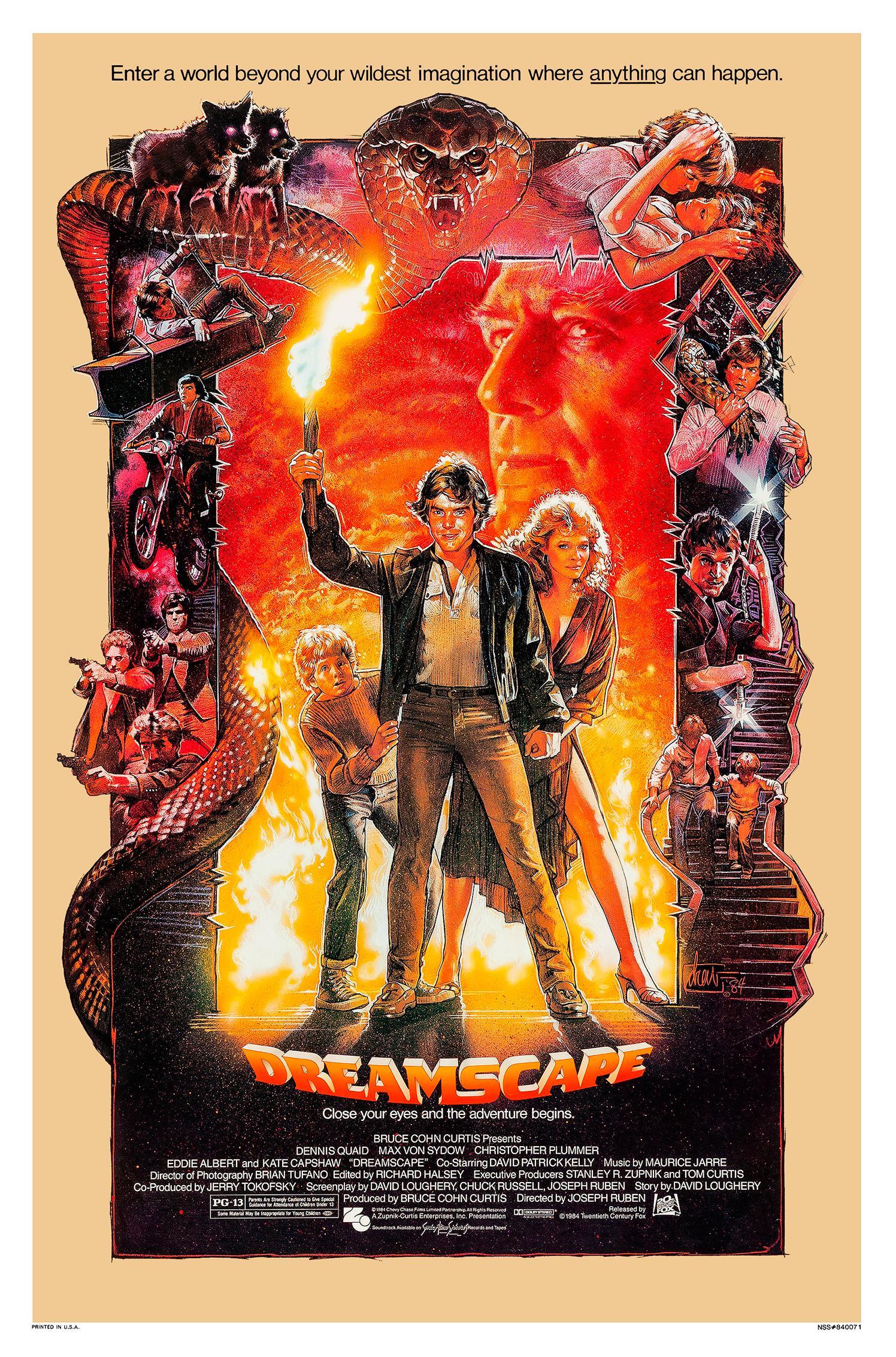
Dreamscape (1984)

dreamscape poster

I’m watching one movie from every year I’ve been alive in chronological order. We’re now up to 1984. I’m also running behind on writing these things as I watched this one a couple of weeks ago. I also skipped ahead and already wrote about my 1985 entry, Runaway Train. As such my brain is already a little foggy on this film, so this will be short.

Dennis Quaid plays Alex Gardner, a psychic who used to get probed and prodded by some big government agency, but then ran away to pursue gambling by way of the ponies. When he runs afoul with a gangster, he joins back up with the feds (run by Max Von Sydow, slumming).

They’ve got a big new project where psychics can link with a sleeping person and interact with their dreams. Alex uses it to help people. In one of the film’s best and dumbest sequences, he joins up with a kid who has nightmares about an awesome-looking cobra-man and teaches him not to be afraid anymore. There’s a nice touch inside that dream. As Alex and the kid are running from the cobra-man they see another man in a suit sitting at a table, the kid says something like “That’s my dad, he won’t help.”

Kate Capshaw is the love interest. This is the type of movie that finds it funny for Dennis Quaid’s character to invader her dreams and try and get sexy with her.

Christopher Plummer is the government agent who figures they can use this dreamscaping to assassinate undesirables. Which includes the President of the United States (Eddie Albert). The President has been having nightmares about starting World War III three and Plummer’s character is afraid that’s gonna turn him into a peacenik. Seriously.

It gets dumber from there. One would hope a film about dreams would be more interesting visually, but other than the cobra-man it is all pretty boring looking. The rest of it doesn’t fare much better.

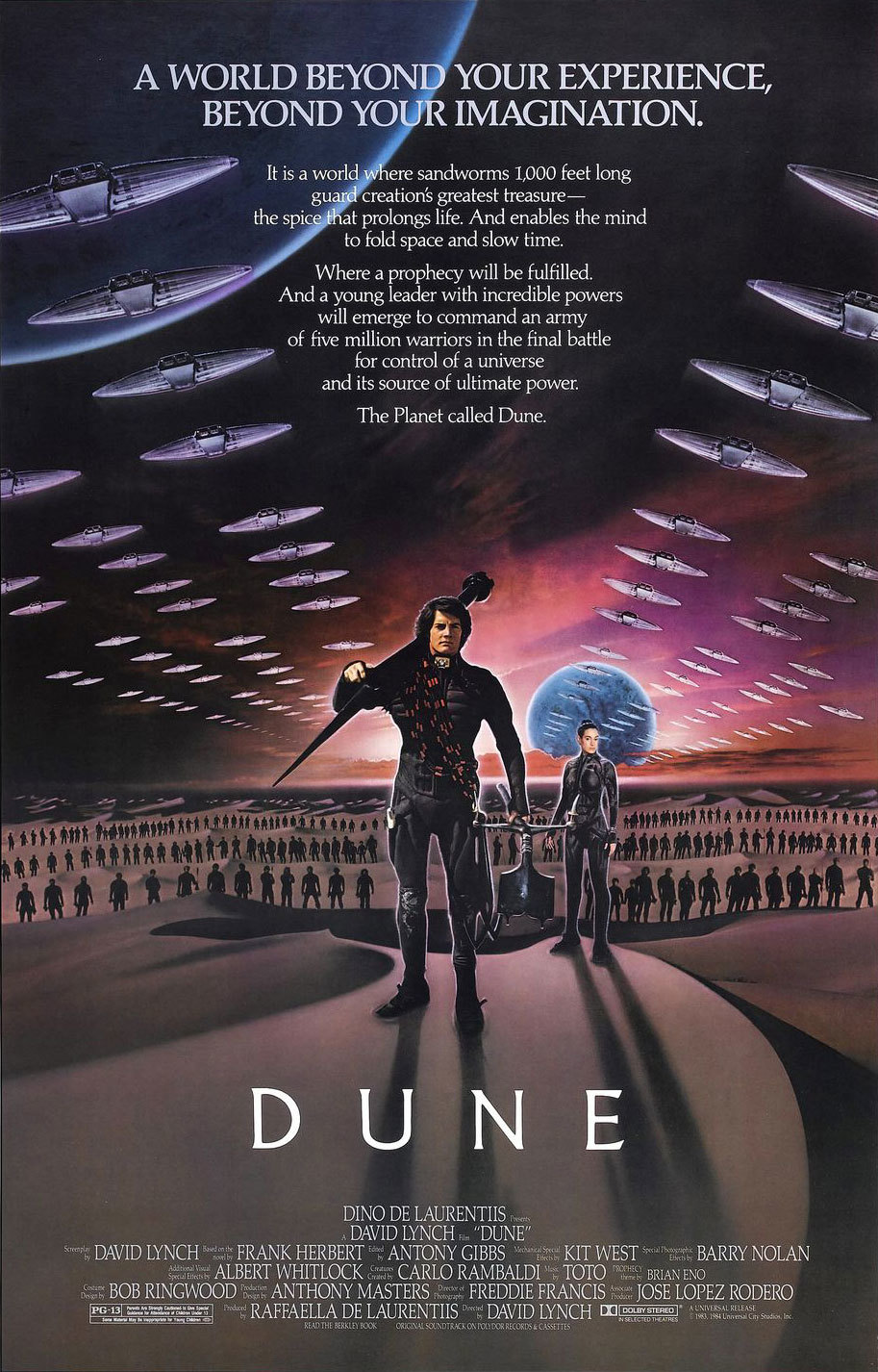
Awesome ’80s in April: Dune (1984)

duen movie poster

I’ve had a copy of Dune, the Frank Herbert novel, on my bookshelves for years. I’ve never managed to read it. I’ve tried a couple of times but I can’t get past the first few paragraphs. It is so dense, so full of new words that I feel immediately lost and that it isn’t worth my time to dig in.

I’ve had a DVD copy of Dune, the movie directed by David Lynch on my shelves for years as well. Until recently I had never managed to watch it. I tried once, many months ago, but didn’t get past the first few minutes. It was so full of exposition and new ideas that I was almost immediately lost and it didn’t feel worth my time to try and dig in.

Last year I did watch Dune, the movie directed by Denis Villeneuve and quite liked it. I’m a big fan of his films in general, and he somehow made this dense world full of numerous people and clans and ideas seem understandable and manageable. So, I figured now was the time to give Lynch’s adaptation another shot.

It was a notoriously expensive bomb. Lynch’s original cut ran about four hours and the studio made him cut it down to just over two. Critics hated it, audiences mostly stayed away, and Lynch has since disavowed it and refuses to speak of it in interviews.

It continues to be reevaluated by new audiences, and the general consensus of it is an ambitious failure.

It was David Lych’s third film. His first was Eraserhead (1977), a really weird, surrealistic body horror flick that became a cult hit. Mel Brooks of all people loved it and hired Lynch to direct his next film, The Elephant Man. That was a much more straightforward film, and it became a big hit and an award-winner. This is how Lynch came to direct Dune, a big-budget sci-fi epic.

I love it. With caveats. The plot is near incomprehensible even with multiple characters explaining what they are doing and with our ability to hear their thoughts.

Most of it takes place on a desert planet, the only place where the people of this universe can get something called spice. Which is a mind-altering drug, it can extend a person’s life and it allows people to bend space so they can travel across the universe in seconds. Or something. There are various warring clans who all are fighting over this planet. But it all seems to be covert. Outwardly the Emperor of the Universe has given control of the planet to one family. Their son is named Paul (Kyle MacLachlan) and he’s apparently some kind of messiah figure.

Everyone has weird hairstyles, one guy can float, and Sting spends a lot of the time practicing fighting with his shirt off. There are cool electronic shields of some kind, people have to wear these weird nose pieces on the spice planet and, oh yea, the planet is full of giant sandworms.

There is so much going on in this film that it is impossible to explain and even more impossible to understand. But it looks really cool. And it is populated by loads of great actors including Patrick Stewart, Brad Dourif, Linda Hunt, José Ferrer, Dean Stockwell, Max Von Sydow, and Sean Young.

The style and look of the film are completely Lynchian. So even while I wasn’t always sure as to what was happening on screen, I sure enjoyed watching it.

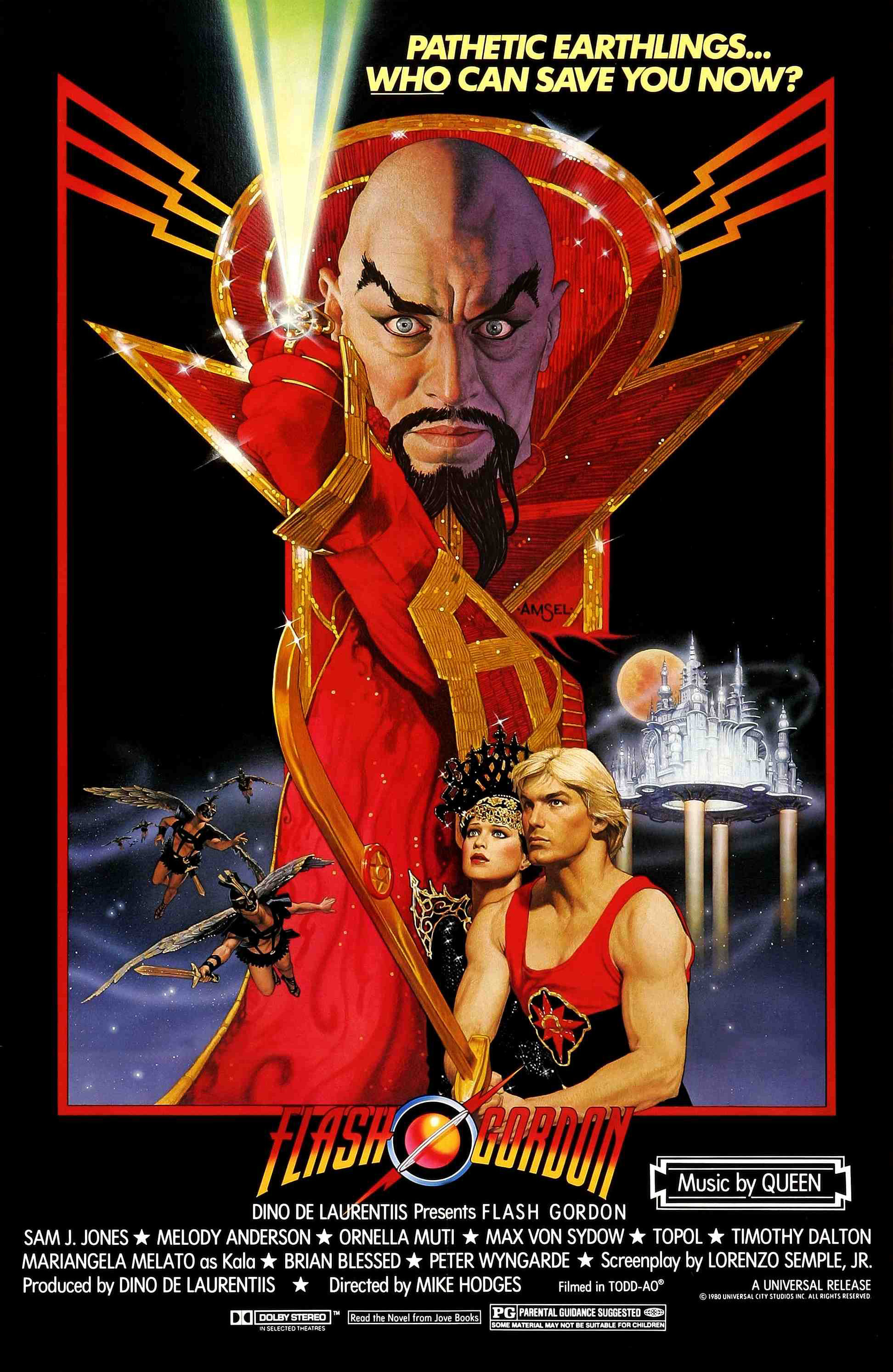
Awesome ’80s in April: Flash Gordon (1980)

flash gordon movie poster

After moving away for college and staying away for some twenty years, I moved back to my hometown a while back and started working in the family business with my father and brother. I wasn’t exactly thrilled with either of those things. Still aren’t if I’m being honest.

However, it has been really nice to get to know my brother better. We’ve always gotten along, but he’s four years older than me. He left home just about the time I was getting interested and by the time he moved back I was gone. So it has been wonderful forming a relationship with him as an adult.

We are both movie nerds so we spend a lot of our time talking about the various films we’ve recently watched. Since moving back he has told me many times of his undying love for Flash Gordon. This usually happens when a Queen song plays over the radio (and we tend to listen to the classic rock station so a Queen song often plays over the radio.) Queen, of course, wrote the soundtrack to the film.

Flash Gordon is one of those films that I was too young to have seen in the theaters, and have never really cared to catch at home. It bombed at the box office and the general consensus was that it was a stinker. That general consensus has stuck with me which is why I never bothered with it. But my brother’s love for it finally got me to track down a copy and I recently watched it.

I kind of loved it.

It is very silly and all kinds of cheesy, but intentionally so. His has more in common with the 1960s Batman television series than anything in the MCU. Of course, 1980 was a long way from the MCU or Christopher Nolan’s Dark Knight Trilogy, or even Sam Raimi’s Spider-Man movies. Christopher Reeve played Superman in 1978 but that was really the first big blockbuster superhero movie of the modern era.

At the time Comic Books were mostly kids’ stuff. Later in the 1980s, they would turn darker and grittier, but in 1980 they were still primarily for children. Flash Gordon was a newspaper comic strip that lent itself toward ridiculous situations, over-the-top villains, and general nonsense.

The movie follows in that same vein. It is bright and colorful, filled with outlandish sets, even more outlandish characters, and a plot that doesn’t pretend to be anything more than silly.

Sam J. Jones plays Flash Gordon, not a superhero but a football star. He boards his private jet and finds travel agent Dale Gordon (Melody Anderson) has snuck aboard. She’s pretty so he allows her to stay. Not long after they are in the air the plane is hit by a meteor and they crash land near mad scientist Dr. Hans Zarkov’s (Topol) laboratory.

He believes that the crazy weather they’ve been having (including massive earthquakes, volcano eruptions, and hurricanes) is part of an extra-terrestrial plot to destroy the Earth. He’s not wrong as it is Ming the Merciless (Max von Sydow – and I really would like to hear the story of how they talked him into starring in this film) who has wreaked this havoc on the planet – he gets bored easily and likes to destroy planets just to see how they react.

Zarkov has a space jet at his disposal and the three humans take off hoping to save the day (well Zarkov hopes to save the day, he pretty much kidnaps the other two). They fly through a time warp, or a wormhole, or something or other and wind up on Ming’s planet.

There they meet some men with wings, a young Timothy Dalton in a mustache, a dude in a golden Destro-looking mask, Ming’s very attractive daughter (Ornella Muti), and an assortment of other oddballs. Flash beats off Ming’s men by basically playing football with a metal ball against them. He plays a deadly game of don’t-get-bit by a deadly scorpion thingy with Timothy Dalton. He flies some cool-looking ships, gets lost in a swamp, and has all sorts of adventures.

Again, the whole thing is ridiculously silly but a whole lot of fun. And yes, that score from Queen is pretty darn great.

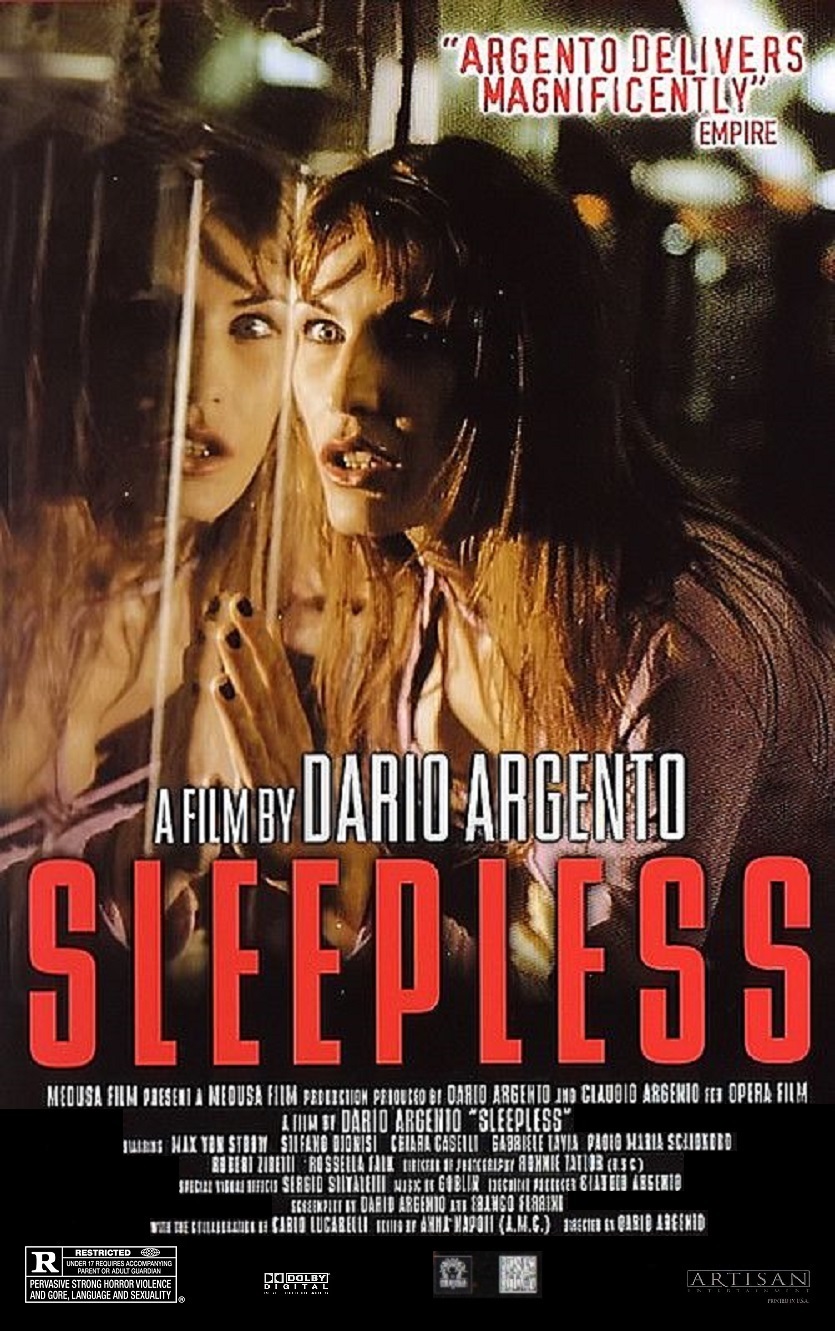
The Friday Night Horror Movie: Sleepless (2001)

sleepless movie poster

This is the third film from Dario Argento that I’ve featured in The Friday Night Movie posts. Clearly, I like the director. I’ve been trying to catch up on his filmography past the period of what would generally be called his prime. He’s definitely made some bad movies, most of them being made in the 1990s and beyond, and there was a time when I would have said he’d not made a good movie since Opera in 1987 (in fact I more or less said that in my review of Dark Sunglasses). But I think my opinion is changing.

Nobody is going to call his late career movies better than his output in the 1970s into the 1980s, but some of his later movies aren’t bad. Sleepless falls easily into that category. He’s very much aping some of those early films with a black-gloved killer, lots of stylish camerawork, red herrings galore, plenty of blood-soaked violence and he even got Goblin to do the music.

Unfortunately, it feels a little too much like an old master copying his greatest pieces long after he’s lost the particular genius that made them so special.

The great Max Von Sydow plays an aging, retired detective who gets sucked back into an old case, one he thought was solved years ago. But when more people start being murdered in the same manner he begins to realize he pinned the wrong man all those years ago.

He teams up with a man whose mother was killed by the murderer when he was just a boy. There are a lot of twists and turns and expectations that the killer is this person or that only to have everything upturned right at the end.

Argento’s signature style is there, but it feels a little muted. There isn’t any particular image that really stood out to me. Though there is a nice bit showing the insides of an answering machine that was pretty cool. The director never shied away from extreme violence, but here he leans more toward blood and gore than stylishness.

It isn’t top-tier Argento, but it is a long way from his worst and that’s always good to see at this stage in his career.