
Outland (1981)

outland poster

It has been a lot of fun working through my life in movies. That sounds wrong. These movies actually have no connection with my life, my one rule is that I’ve never seen them. I should say I’m having fun watching movies from all the years I’ve been alive in chronological order. But that’s a mouthful, I really do need to find some snappy title for this feature that will easily describe what I’m doing.

The one rule is that each movie has to have never been seen by me before. But that’s not always easy to follow. I keep track of what I watch through Letterboxd, but it isn’t always accurate. Sometimes I forget to log a movie. And for movies, I watched before Letterboxd existed, before even IMDB existed, well those are hard to track. Who can remember all the films they watched when they were a kid? Sometimes I watch a movie I think I’ve seen before only to find absolutely none of it ringing any memory bells. Other times I start a movie that I think is new to me and realize that I have actually seen it before.

Outland is a film I thought I had never seen. But after I watched it the other day, I discovered that I had actually logged it on Letterboxd. But there wasn’t a single scene, a single image that was familiar to me. The logging was dated before Letterboxd existed which means I found it at some point, thought I had seen it, and guessed when that might have been. So, I really have no idea whether or not I had actually seen it before. Maybe I did and have forgotten the film altogether, or maybe I just thought I had and logged it.

Either way, I’m counting it for this silly little endeavor of mine.

Outland is a space western. It’s basically High Noon (1952) in space. Sean Connery plays Federal Marshal William O’Niel who has been assigned to a tiny mining outpost on Jupiter’s moon, IO. He quickly becomes concerned with the number of workers who seem to be going crazy and committing suicide. Everybody else, including the operations doctor, Marian Lazarus (Frances Sternhagen) chalk it up to the poor living conditions on the station and the utter isolation. But O’Neil figures it is happening way too often for it to just be bouts or stir craziness.

Eventually, he discovers an illegal drug trade. A synthetic stimulant is being brought in and given to the workers to increase production. Use it enough and you eventually go psychotic. O’Neil tries to put a stop to it, but naturally, he comes up against the Company (who don’t officially approve of the use of the drug, but sure do like the boost in productivity).

There is a lot of Alien (1979) DNA in Outland, especially in the rugged, lived-in quality of the outpost, and the blue-collar nature of the people. Outland is rough and dirty, and the workers are tough and rowdy. They live in small spaces, their beds stacked one on top of the other with little privacy afforded to them. In contrast, O’Neil and the other high administrative positions live in comparatively fancy quarters with plenty of space and luxury. Also as in Alien, the real villain of the film is the faceless corporation, always putting profit above human lives.

It isn’t nearly as good as Alien. Director Peter Hyams doesn’t have nearly the skill or artistry of Ridley Scott. The script (also by Hyams) isn’t as tight either. But the world that he has created is really quite something, and Sean Connery gives one of his finer performances.
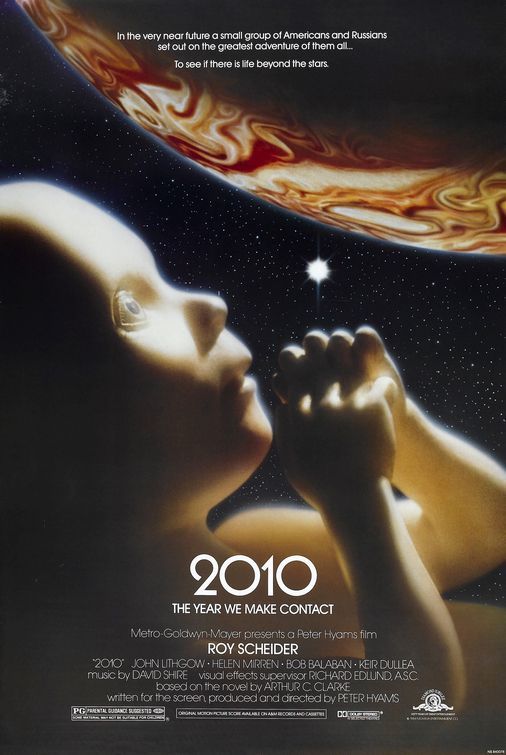
Awesome ’80s in April: 2010: The Year We Make Contact (1983)

2010 the year we make contact poster

2001: A Space Odyssey is arguably one of the greatest movies ever made. Certainly, it is one of the greatest science fiction films ever put on celluloid. It was made by the visionary auteur Stanley Kubrick. One of the many astounding things about the film is that it is almost entirely told through visual language. Great swaths of the movie contain no dialogue whatsoever. This is also one of the reasons the film is endlessly discussed – it never tells you what’s happening, it shows you.

A sequel was made in 1984. Directed by Peter Hyams 2010: The Year We Make Contact is a pale imitation of the original. As a sequel, it is not great. Where Kubrick’s film is mysterious, asking big questions and giving no answers, 2010 is all answers.

But if you can separate it from the original, and take it on by itself, it’s actually pretty good. Admittedly, that is a difficult task, as this film is basically an answer to the questions asked by the original. Its plot takes place right after 2001 ended and its characters spend their time hunting down what happened in that movie. But if you can get the original out of your mind and just let this one do what it’s doing, then I think you can find it enjoyable.

I said it begins right after the events of 2001, but really it begins 9 years after that movie (hence 2010 in the title.) At the end of the first film, the crew from the Discovery One spaceship which was on a mission to Jupiter are lost. The HAL-9000 computer, which controlled pretty much everything on board went a little crazy and killed most of the crew. Dave (Keir Dullea) the only survivor disappeared. As an audience, we know that he discovered a giant black monolith orbiting Jupiter and was sucked inside it. A long, psychedelic trip then turns him into a cosmic space baby. But in-film, the people of Earth have no idea what happened to him.

The Americans and the Russians are both planning missions to Jupiter to find out. There is a time rush as the Discovery One is slowly losing orbit and will soon crash. The Russians will have their ship ready faster than the Americans, but it is the Americans who have knowledge of the Discovery One and are the only ones who can reboot HAL. So, three Americans Heywood Floyd (Roy Scheider) who feels responsible for the entire Discovery One mishap, Walter Curnow (John Lithgow) who designed the Discovery One, and R. Chandra (Bob Babalan) who created the HAL-9000 computer, jump aboard the Russian ship.

All of this occurs during the height of the Cold War. During the mission relations between the two countries deteriorate with a Cuban Missile Crisis-type situation pulling them toward the brink of war.

The astronauts try to ignore the ongoing politics back home and instead concentrate on the mission. The film does explain what happened to HAL in 2001, but I won’t spoil that here. It explains further what the monolith is and what the aliens want, but again no spoilers. None of that is particularly thrilling or all that interesting. And if you want it to it can destroy all the mystery of 2001.

However, the design of everything is really quite good. I especially enjoyed the matte paintings and the various images of space, Jupiter and its moons and the placements of the ships within all of that. All of the space stuff is really interesting. I also enjoyed the relationships that develop between the various scientists (Helen Mirren plays one of the Russians and she’s always fun to watch, especially when attempting a Russian accent).

If this movie existed on its own, if 2001 had never been made I think 2010 would have been well-regarded. It might not be a classic, but It would definitely have a good following. I’d argue it should definitely be reconsidered, despite the Kubrick film always overshadowing it.

I wrote a different review of this film back in 2004. You can click here and read it if you like (spoiler alert, I hated it).