
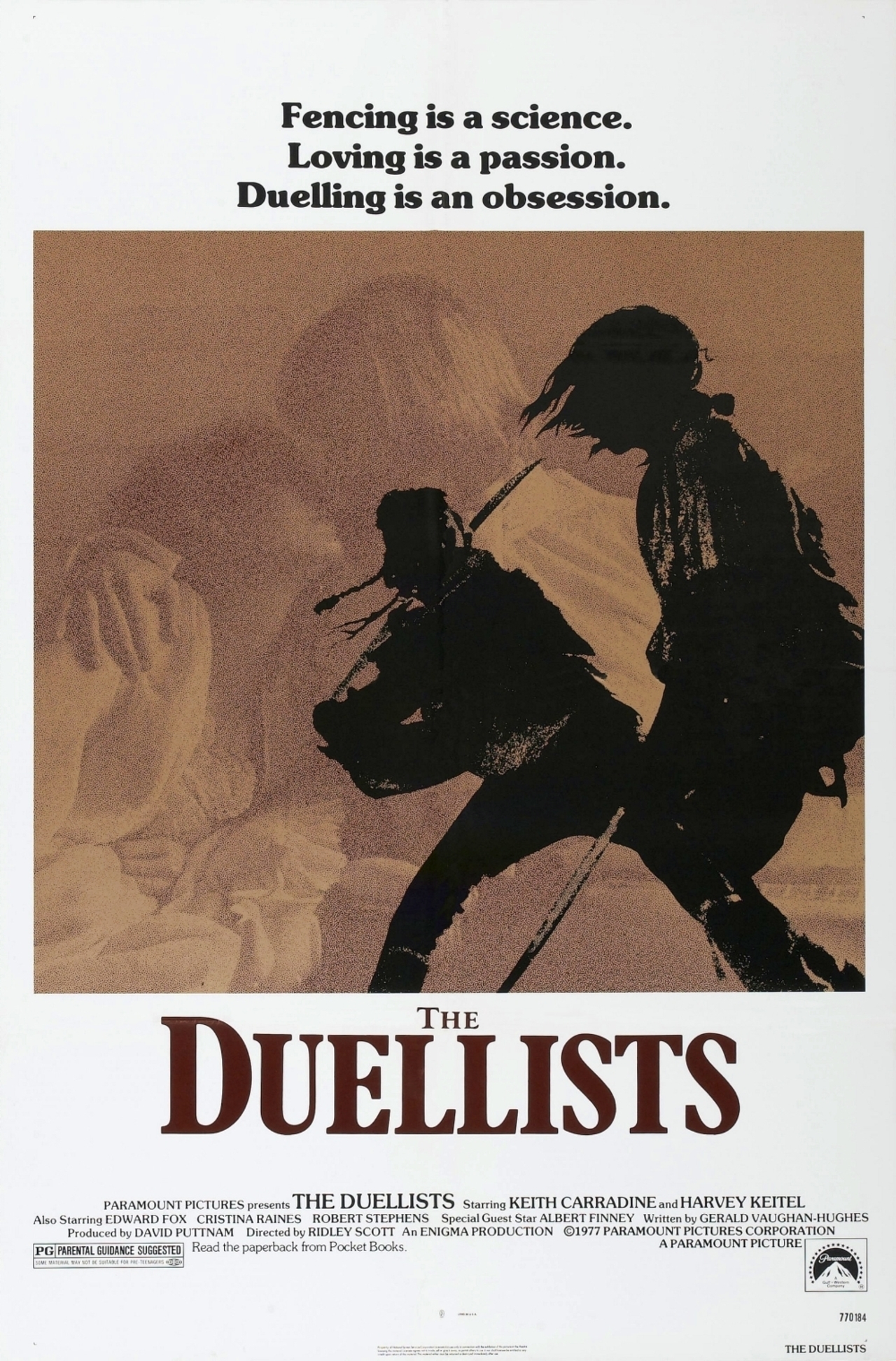
The Duellists (1977)

the duellists poster

For a while now I’ve had this idea of creating a list of my favorite films from every year that I’ve been alive. I was born in 1976 so I’d start there and then move forward. I’ve never actually gotten around to it because I figure I need to make sure I’ve seen all of the “classic” movies from each of those years. I don’t want to talk about my favorite films from say 1982 and have somebody chastise me for having never seen Fanny & Alexander or whatever. From there I figure I need to designate a month to each year and watch as many films from that year in that month and then I can really tackle that project. Then I realize I’m 47 years old and it will take me a few years to do that and I just give up.

The other day I randomly watched The Cassandra Crossing which was made in 1976, the year I was born. A new idea was born in my mind. What if I watched one film from every year that I’ve been alive, and do it in chronological order? That seems fun. The only rule would be it has to be a movie I’ve never seen before. And so here we are.

The Duellists is one of those films that’s been on my list to see for a very long time. It was Ridley Scott’s first film and while he is not by any means my favorite director, when he’s good he’s really good and I’d heard this one was really good. I heard correctly.

Based on a Joseph Conrad short story The Duellists focuses on two French soldiers during the Napoleonic Wars. It begins with Lieutenant Gabriel Feraud (Harvey Keitel) dueling with a young man, whom he promptly skewers with his sword. Turns out the young man was the son of the mayor of Strasbourg which puts Feraud into hot water. The higher-ups send Lieutenant Armand d’Hubert (Keith Carradine) to put Feraud under house arrest. He’s having none of that and immediately challenges Armand to a duel. Armand initially thinks the whole idea is ridiculous, dueling with a man he has been sent to arrest for dulling, but Feraud is relentless and the two eventually do duel. The fight ends when Armand knocks Feraud unconscious and is then clawed in the face by his mistress.

A few months later they duel once again and Armand is seriously wounded. Over the next decade, they duel several more times. It is never made clear why Feraud insists on dueling Armand every time they meet. For his part, Armand wants no part of it, but he is duty-bound. If Feraud claims some offense and demands a duel, then he must agree. They cannot duel if Armand outranks Feraud, nor if France is engaged in war. Luckily for Armand, Napoleon is in charge, and Napoleon is always at war.

The film never lets us know if there was an offense to begin with. It sometimes hints that it might have been over a woman, or perhaps Feraud thinks Armand is not loyal enough to Napoleon. But it doesn’t really latch onto either of these ideas. Maybe Feraud hates Armand for some imagined slight. Or perhaps he just likes to duel. The film mostly follows Armand, only letting us see Feraund during the duels, so maybe he spends all of his free time dueling as many people as he can.

The film was influenced by Barry Lyndon (1975) the only Stanley Kubrick film I have yet to watch. The cinematography is lush and beautiful. Keith Carradine is one of those actors whose name always rings a bell, but I can never remember who is he or what he’s starred in. Until I see his face and hear his voice, then I remember how good he is in everything. He’s terrific here. He is a man who wants a simple life, and mostly finds it, but that life is constantly interrupted by Feraud and his demands for duels. When he sees Feraud in a cafe, Armand promptly leaves. He doesn’t want to fight. Yet he always does because he feels honor bound.

The movie is all about honor and duty and how those are often foolish and futile things. Feraud wants to kill Armand over some perceived slight that is so minuscule Armand doesn’t even know what it is. Armand is willing to die (or to kill) to uphold his honor. One could easily expand these thoughts broadly into the futility and foolishness of war between nations. The movie doesn’t get bogged down into these high-minded ideas. It keeps things grounded.

It is amazing to think this was Ridley Scott’s first film. It is an ambitious film for any filmmaker and for it to be his first time as a director it is rather stupendous. That he followed this with Alien(1979) and then Blade Runner (1982) is astounding. Sadly, the rest of his career has not always been so monumental, but for those three films alone he may stand tall.
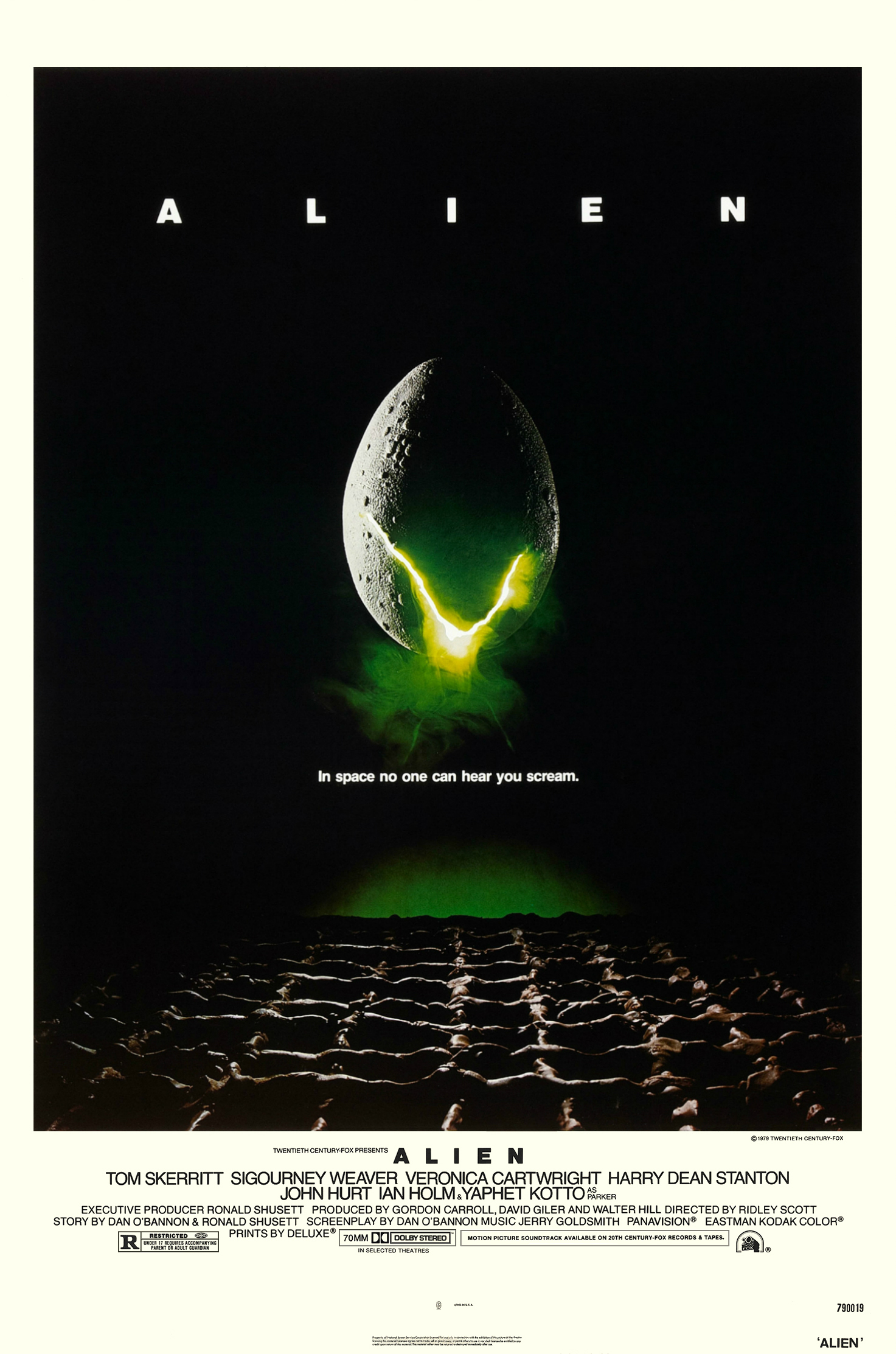
Alien (1979)

image host

Each film in the Alien quadrilogy has differed from the other. It helps that they each had a distinctive and imaginative director. Ridley Scott created a slow, tension-filled science fiction epic. James Cameron pumped it full of adrenaline and made an action-packed masterpiece. David Fincher cut his teeth on Alien3 by turning the action into a dark, mostly muddled mess. Jean-Pierre Jeunet tried to rescue the franchise but had no story to work with. Like the Star Wars movies what we’re left with is a couple of top-notch flicks and a few others that – while showing a few moments of visual brilliance – ultimately leave the series limp.

But my review is not of the series as a whole, but on the movie that started it all. In considering the franchise it is sometimes forgotten that Alien never started out as a quadrilogy. There was only this one movie about a group of average workers sent to capture a monster. Scott does a superb job of creating suspense. It is some 30 minutes into the picture before we actually see an Alien. And even then the action is slow to evolve. For the audience, this creates a great amount of tension.

Even for those who have never seen an Alien movie, the creature has so penetrated our popular culture that everyone knows it’s not an ET kind of alien. So, while watching it we know that the it is creeping around some corner just waiting to devour the characters. And yet we hardly see it. We not only don’t get to see any alien through a third of the film, but when it does come out and begin its slaughter, we only catch glimpses of the creature itself. It is seen in the dark creeping inside a corner, or in a flash as it jumps out of the darkness to attack.

Scott, instead, uses shots of the crew to show the fear in their eyes, before their destruction, rather than show the creature in action. There are only one or two moments where the audience sees the alien in full figure, and those last only a short time. Even then the alien does not move, never allowing us to see it kill. This stroke serves to scare the audience even more. How many times have we seen a movie’s monster in action only to laugh at its poor design?

The movie oozes with atmosphere. The cinematography is dark and shadowy. The ship’s quarters are enclosed and tight, creating claustrophobic spaces in which to encounter the monster. Then there is HR Giger’s amazing design. His designs of the alien ship and the alien are absolutely perfect. The ship seems to slither and move as if it’s alive. There are curves, ridges, and smooth edges as on the alien itself. All of which create an atmosphere, and mood that stimulates the horror to come.

All of the effects shot were done in without the use of CGI. Generally, they still hold their ground. Sure, the glimpses we get of the alien standing look like a man in a rubber suit. But overall the effects look great. This is a testament to their genius of Giger. My main complaint is with MOTHER. Like other science fiction films the crew’s ship, the Nostromo has its brains in a giant computer. Here, MOTHER is housed in an inner room of the ship and only accessible by the ship’s captain. We see her captain, Dallas (Tom Skerritt) go to visit MOTHER for a “your eyes only” type deal. Why a commercial ship needs this type of security is never mentioned. Mother turns out to be a Star Trekesque computer equipped with blinking lights and a faint whirring sound. All of this is so that Dallas can sit down to a DOS prompt and ask silly questions like “What’s the story, Mother?” They should have gone with a more 2001 approach and had the crew be able to actually speak to MOTHER.

All of the characters are very well acted and fleshed out. Each character is given their own personality and is fully realized. There is a nice scene in which the crew is searching for the recently non-sucking face sucker as it has disappeared. Ripley (Sigourney Weaver) has left the door open and Ash (Ian Holm) moves to shut it so the alien won’t escape. The look Ash gives as he is doing this is incredible. Ash and Ripley have previously had a bit of a fight and you can see the anger and irritation at Ripley perfectly in Ash’s face.

Sigourney Weaver plays Ripley beautifully. This is a female action star that is sexy but doesn’t pander to her sexuality (though they did manage to get her in her underwear.) She is tough as nails and intelligent. And Weaver plays her perfectly.

Alien is arguably the best in one of the most successful series in film history. It is also one of the best science fiction films Hollywood has ever made.