
Noirvember: The Night of the Hunter (1955)

night of the hunter poster

Apologies for not getting a Friday Night Horror movie up this week. I had planned to make this film that post as it blends both elements of film noir and horror, but Friday turned into a very long day. Work was a series of mistakes and irritations and then my daughter performed at the high school football game. I was happy to support her but by the time we got home, I was nothing but exhausted. I did manage to watch this, but there was no chance my brain could come up with something to write about it.

Four days later and here I am.

I think The Night of the Hunter was the very first film noir I ever watched. I can’t be quite sure of that because I didn’t always know what film noir even was so it is possible something else was seen earlier than this, but I don’t know what that would be. I don’t even know exactly when I first watched this film. I remember being spellbound by it, but nothing surrounds that memory to give me a clue as to what time frame it occurred. At a guess, I would say college or maybe just after.

It doesn’t really matter, but I like tracking these things. It was definitely early days in my life as a cinephile. I had started watching classic movies and understanding them as art, but not so early that watching a film like this was a revelation.

I hadn’t watched this in years and maybe it is a revelation. It’s just so damn good. So strange in some ways, and beautiful. It was the first and only film ever directed by actor Charles Laughton. It bombed at the box office and they never gave him another chance in the director’s chair. I weep at what we missed because of that.

Robert Mitchum plays Harry Powell a man who uses the veil of religion to lure women into his snare, marry them, kill them, then leave with their money. He’s got Hate tattooed on one hand and Love on the other. He loves to tell a flamboyant story about how Love conquers Hate which generally enthralls the listener.

While in prison for theft he meets Ben Harper (Peter Graves) a man sentenced to be hanged. In his sleep, Ben mumbles something about the $10,000 he stole and something else about his kids knowing where the money is hidden.

That’s all Harry needs to go on the prowl again. Once he’s out he finds Ben’s wife Willa (Shelley Winters) and quickly seduces her. Well, maybe seduce isn’t the right word. He woos her, talks her into marriage and then basically casts her aside. There is one chilling scene, their wedding night, where she comes in ready for the lovemaking and he lectures her that sex is but for childbearing, and since she’s already got two there is no need for them to consummate their marriage.

The kind veneer disappears for the children as well quite quick. At first, he acts as a loving father and gently works for them to spill the secret of the money, but wen that doesn’t work he gets angry and mean. The girl, Pearl (Sally Jane Bruce) dotes on Harry, but the boy, John (Billy Chapin) knows what’s up.

Soon enough the kids are on a skiff floating down the river, desperately trying to escape the murderous grip of Harry. They wind up at the home of Rachel Cooper (Lillian Gish) a widow who lost her own child to the Depression and has started taking in homeless children. There they find kindness, grace, and love.

But while the story is really good, the filmmaking makes this a true classic. It is very theatrical in its production. The sets look stagey. Even the supposed outdoor scenes have an artificiality to them. It is designed to constantly remind you that what you are watching isn’t real, it is a story. A morality play. But it is also gorgeously put together.

There is a scene that takes place in Harry and Willa’s bedroom. It is a strangely shaped room with a sharply angled ceiling and a high window. Light shines brightly through that window but shadows loom. The camera sits way back, through what would have to be a wall. blackness frames the room, again as if we were watching a play.

Another scene is shot inside a screened-in porch at Rachel Cooper’s house. She sits in a rocking chair with a shotgun in her lap. Outside stands Harry Powell, waiting. The light inside the porch is off. We see her in shadow. A streetlight illuminates the preacher. Then a young girl enters with a candle. Now we see Rachael more clearly but it darkens our view of Harry Powell. The candle is blown out and he’s gone. It is masterfully staged.

Everything about the film is masterful. Robert Mitchum has never been more menacing. Shelley Winters never more vulnerable. And Lillian Gish is an angel.

It is a great movie. A great film noir. One of the very best.
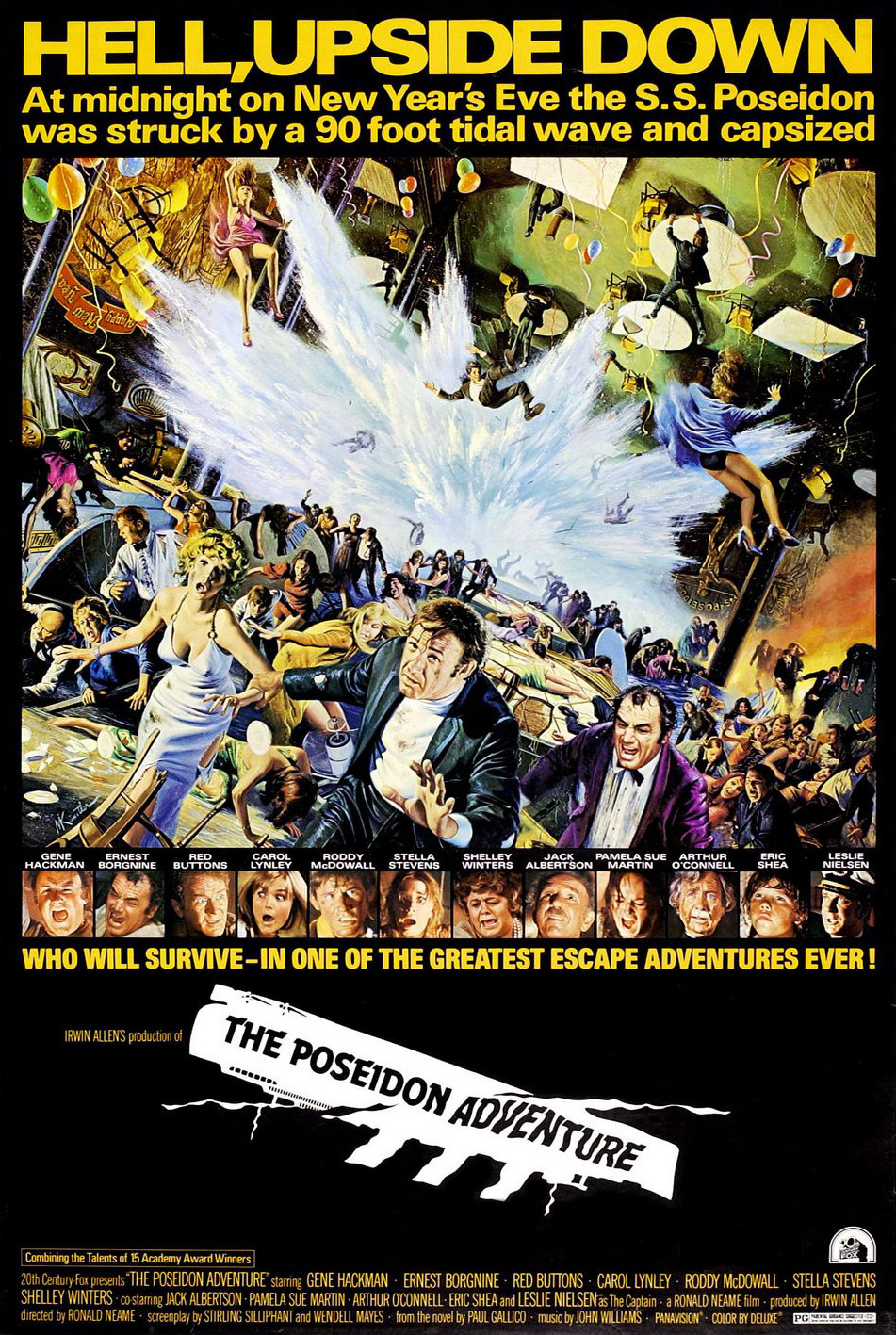
The Poseidon Adventure (1972)

the poseidon adventure

After writing all of the following out, I realized I had previously written a review of this film. I even edited it and made it public rather recently, and then promptly forgot I had done so. Rather than deleting what I’ve written here, I’ve decided to go ahead and post it. If you read the original review (which you can do here) you’ll notice my thoughts haven’t changed all that much.

I have a very distinct memory of watching this movie for the first time. My mother must have had some errands to run so she dropped me off at Grandma and Papa’s house. Flipping through the channels I landed on The Poseidon Adventure and was immediately entranced. I don’t remember how old I was, I must have been a young teen for I was old enough to appreciate the pretty actresses in their short shorts. But mostly I was there for the exciting adventure of it all.

I remember my mother returning to pick me up before the movie was over. She was a good mother, so instead of making me leave, she either stayed to finish it with me or returned later and took me home.

I’ve seen it a few times since that initial viewing and it never lives up to that original memory. I must have come to it part way through, on that first time watch because I’m always surprised at how long it takes to get to the crash. I’m also always surprised to see Leslie Nielson as the ship’s captain in a completely humorless role.

The basic plot involves an old cruise ship is completely overturned during a massive tsunami. A band of survivors must make their way up to the bottom of the ship where they hope to escape through the ship’s hull.

They are led by Reverand Scott (Gene Hackman) who has some radical ideas about God. He’s of the libertarian school of theology where you don’t pray to God for help, but rather He helps those who help themselves. There’s Ernest Borgnine as a hard-nosed New York City cop and his former prostitute wife (Stella Stevens), and Red Buttons as a love-lorn bachelor. Jack Albertson and Shelley Winters play an old married couple on their way to Jerusalem to see their new grandbaby, and Roddy McDowall is a waiter on board the ship. Two youngsters (Pamela Sue Martin and Robin Shelby) and the ship’s singer (Carol Lynley) round out our group of heroes.

Everyone is given very brief introductions with basic characterizations at the beginning of the film and they stick pretty closely to those types throughout the film but never really become fully fleshed-out people. Hackman’s preacher takes immediate charge demanding that everyone follow his lead to safety even though he really has no idea what he’s doing. Most of the named characters fall in line immediately, except for Borgnine’s cop, who constantly bickers and argues with him.

There are a lot of other characters, mostly extras, that don’t follow the preacher’s commands and naturally they all die horrible deaths. Most of the film has our heroes trying to escape from various perils – explosions, water sloshing in from the sea, fires, etc, etc, etc,. The big gag is that everything is upside down. Strangely the film doesn’t actually use this all that often. There is a funny scene in a bathroom with all the toilets in the ceiling and when the boat first overturns everyone is in a big ballroom and many people have to hold onto tables to keep from tumbling down to the ceiling. Red Buttons gets a kick out of the barbershop with its seat upside down, etc. But a big ship doesn’t lend itself to a lot of furniture or light fixtures that would make the gag even sillier. Mostly it is bit metal corridors and rooms full of pipes.

It does feel very much of its time now and again. The gang has to climb a giant Christmas tree in order to escape the ballroom and Hackman’s character tells the teenager and the former prostitute that they have to take off their gowns because they are too tight fitting to be able to climb easily in them. That might be true, but it is very cringe to hear a preacher telling these ladies to disrobe. Luckily the teenager has shorts on underneath, but the other lady has to put on her husband’s button-up shirt leaving her quite exposed. And the camera does seem to enjoy shooting them at low angles from behind. Interestingly the preacher doesn’t tell Shelley Winters (who was pretty heavyset at the time) to remove her gown. Everybody does get some big laughs in making fun of her size which seems particularly mean from this viewing.

It is still a fun film. The adventure is exciting and while the characters are played broadly you still feel for their predicament. The actors are mostly really good which allows them to feel more fleshed out than the script really allows for. It never quite lives up to my memory of watching it for the first time all those years ago, but then again, what does?