The Friday Night Horror Movie: Horror Rises From the Tomb (1973)

horror rises from the tomb poster

Paul Naschy was a Spanish writer/actor/director who is most known for a series of horror films he made where he starred as a werewolf named Count Waldemar Daninsky. The films are mostly unconnected to one another except that he plays a werewolf with the same name, but there is no continuity to be found within them. I’ve seen a couple of them and quite enjoyed the watch. So much so that I found a collection of Naschy films boxed up in a Blu-ray set and put them on my wishlist for Christmas.  My lovely wife bought them for me, and I opened them up tonight to start watching.

What I failed to recognize when I put this set on my wish list was that these films are just random Paul Naschy films, not a collection of his werewolf movies. Still, in for a penny, in for a pound, so I put on the first one and hoped for the best. 

According to the liner notes (and Wikipedia), Naschy was told by the producers they wanted to make a film with him, but in order to do so, they needed a script ASAP. So he popped some pills and sat down to write, pounding out the script to Horror Rises from the Grave in 36 hours.

It definitely feels like a movie whose script was written in 36 hours. There is very little story to it, and it plays like Naschy just took every horror movie he loved and blended them together. Then added copious amounts of gore effects and enough naked breasts to make Cinemax on a Saturday night blush.

Still, it is pretty fun to watch.

It begins in medieval times, where a warlock called Alaric de Marnac (Paul Naschy) and his witch companion Mabille de Lancre (Helga Line) are executed (he has his head chopped off, she is burned alive) for Satanism.

Flash forward to the present, and a group of young people, including Hugo de Marnac (also Paul Naschy) head out to Hugo’s ancestral grounds, where a psychic medium told them the bones of Alaric de Marnac are buried. They figure it will be fun to dig up an old warlock (also there might be treasure).

Naturally, they find the bones. Naturally, when they do, all hell breaks loose. But it is a strange sort of hell. This is where the rushed script becomes apparent. Eventually old Alaric de Marnac will rise from the grave, but first his severed head seems to mesmerize some local townsfolk, and then some of Hugo’s friends, where they go about killing everyone in sight. Later, some of those dead folks will rise, zombie-like, and wreak havoc. Alaric de Marnac takes a couple of our heroes as slaves, and one pretty (and scantily clothed) lady has her blood drained onto the bones of Mabille de Lancre, which brings her back to life.

The movie pretty much exists so that our villains can kill our heroes with full gruesomeness and pretty ladies can run around in sheer nightgowns taking their tops off (with echoes of the vampire films of Jean Rollin).  It does do both of those things very well, so who am I to complain? There are some interesting transitions, and the gore effects are good. It is goofy and dumb, but if you like that sort of thing, this film is pretty fun.

One of the bonus features on my Blu-ray is a selection of alternate “clothed” scenes. Some theaters in Spain at the time didn’t allow nudity, so they shot those scenes twice, once without clothes once with them on.  I thought that was pretty funny.

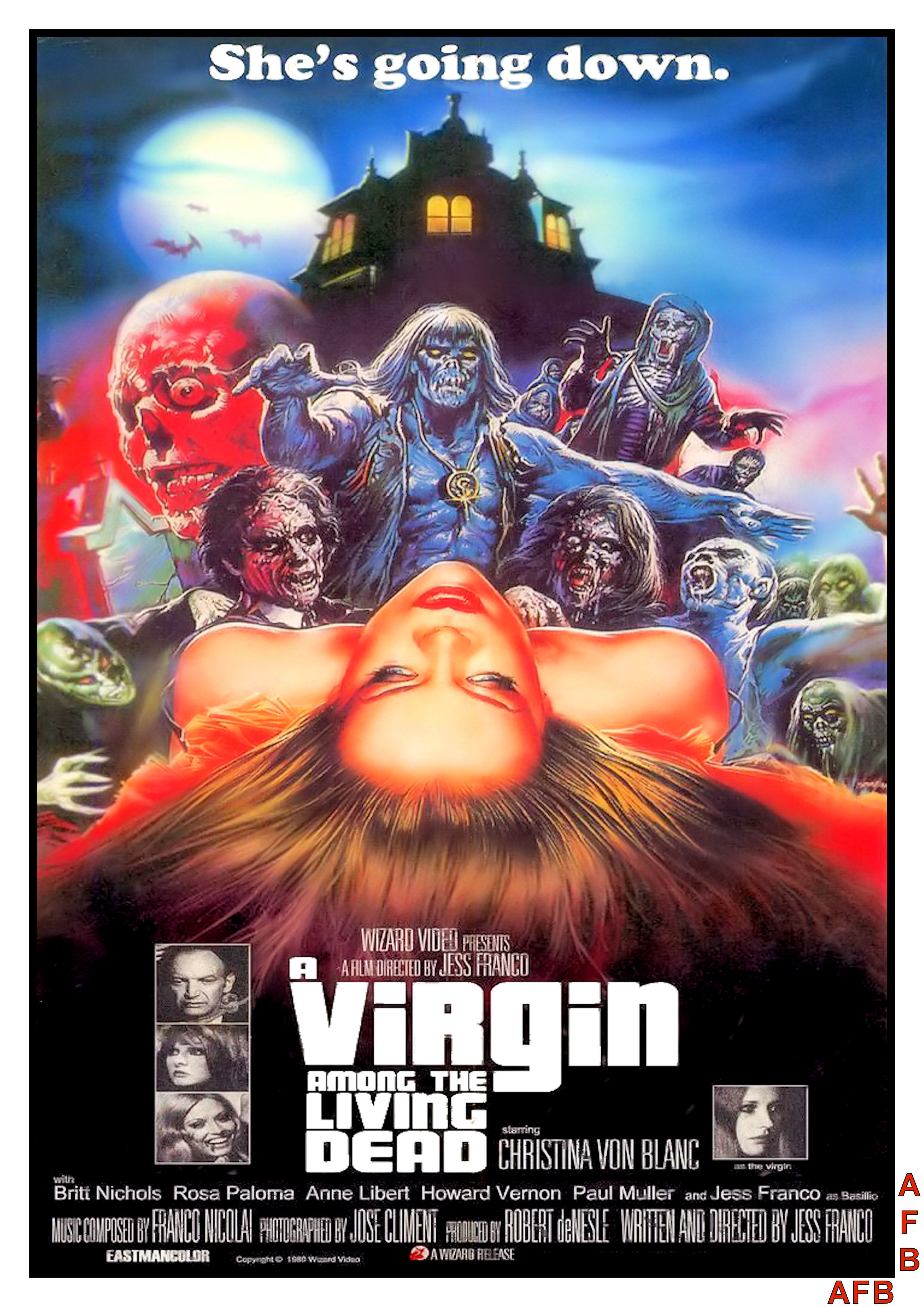
Foreign Film February: A Virgin Among the Living Dead (1973)

a virgin among the living dead poster

Jesús Franco was a prolific Spanish filmmaker who dabbled in a lot of genres (including hardcore pornography) but is mostly known as a horror director. He’s one of those guys whose name I’ve heard for years, but that I’d never gotten around to watching.

A Virgin Among the Living Dead is what you might call an erotic horror film with a gothic setting, a dreamlike plot, beautiful visuals, and, yet, lots of naked flesh. It is also pretty good.

It focuses on Christine (Christina von Blanc) a young woman whose mother died when she was very young. As a child, her father sent her away to boarding schools where she stayed, even through holidays, so that she doesn’t even really know who her father is. But when she’s notified that he has died she returns to his home in a small village.

Almost immediately we know things are strange because when she arrives in the village and informs some townspeople that she will be staying at her father’s manor, she’s told that no one has lived there for some time. But Christie just knows she has other family members living there. When she arrives she is greeted by her relatives, an odd bunch one and all (including the director himself as a drooling, sniveling mute).

As the title implies, and you’ll probably figure out pretty quickly, these relatives aren’t exactly what they at first seem to be. They might be the living dead, or they might be some manifestation of her deranged psyche. It all gets pretty weird and pretty confusing, but Franco imbues it with enough beautiful imagery that you won’t mind, at least I didn’t.

It isn’t quite good, but it is definitely not boring and it for sure made me want to watch some more films from the director.

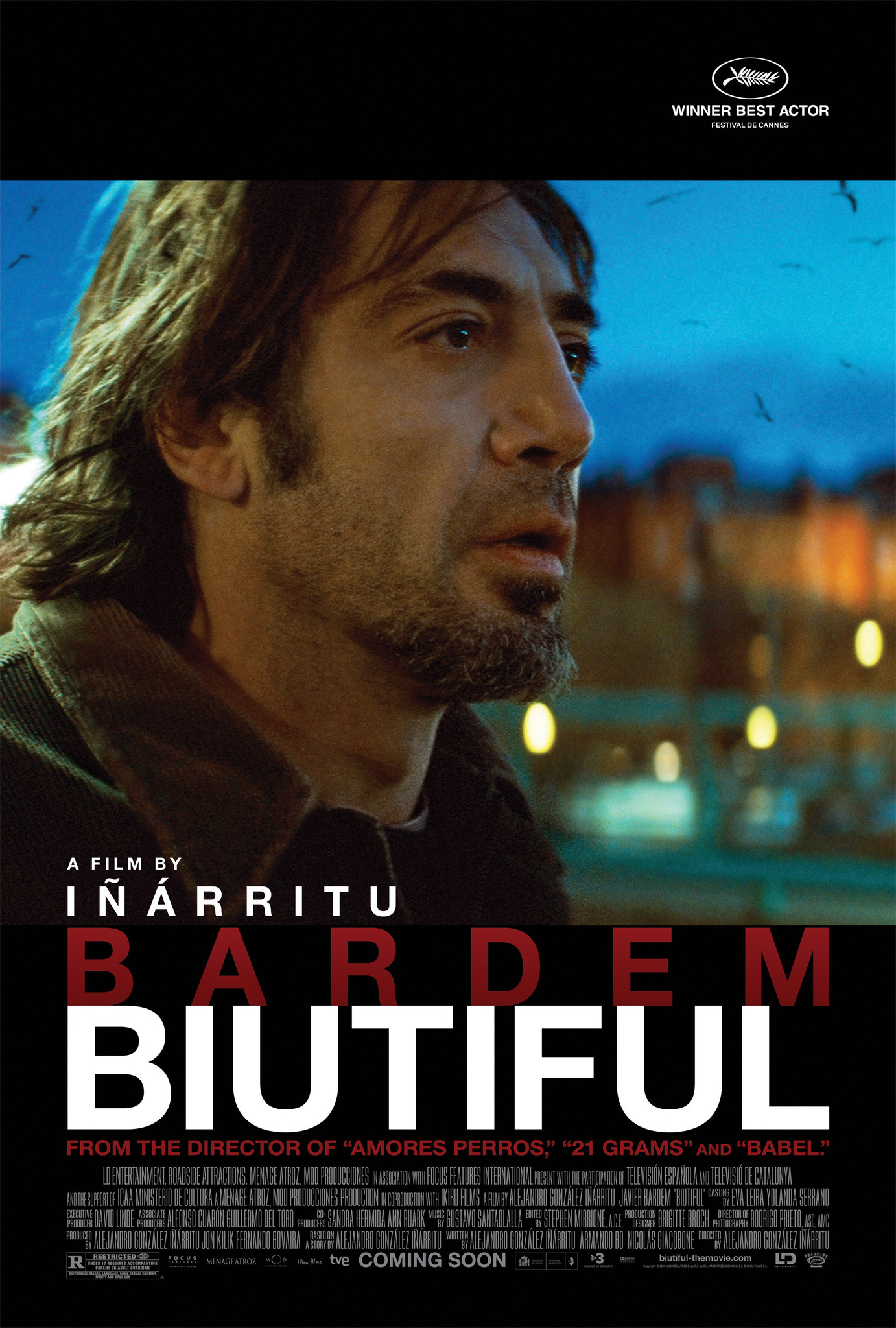
Foreign Film February: Biutiful (2010)

biutiful

Uxbal (Javier Bardem) is a decent man living a bad life. He’s a low-level criminal living in a shabby apartment in Barcelona. He manages a group of street vendors who sell knock-off Gucci bags and other fake products. He’s also in charge of some Chinese illegals who make those goods. He’s exploiting humans for profit, but he also seems to care, at least a little. When he realizes the Chinese immigrants are cold, sleeping together in a rundown basement he procures them some heaters (the cheapest he can buy, a decision that will haunt him later in the film). He seems to love his young children deeply. He tries to be kind to his ex-wife who sometimes works as a prostitute, and is bipolar, but his tolerance has limits.

Director Alejandro González Iñárritu keeps things close to the streets. This isn’t your tourist brochure of Barcelona. The city is dirty, corrupt, full of violence, and a struggle just to survive. Uxbal is a decent man, and Bardem’s portrayal of him is sympathetic, but he also makes a living off the backs of the downtrodden. The film gives him cancer, and a short time to live which makes him even more sympathetic. The plot is really about him trying to put his life in order.

It is also mostly a bore. It drags on for over two hours and the movie never gives us enough reason to stick with it for that long. I’ve enjoyed some of Iñárritu’s films, but this one is a misfire. Barden gives a great performance, his face is so full of hurt and resignation, but otherwise, I found it a bit of a slog.

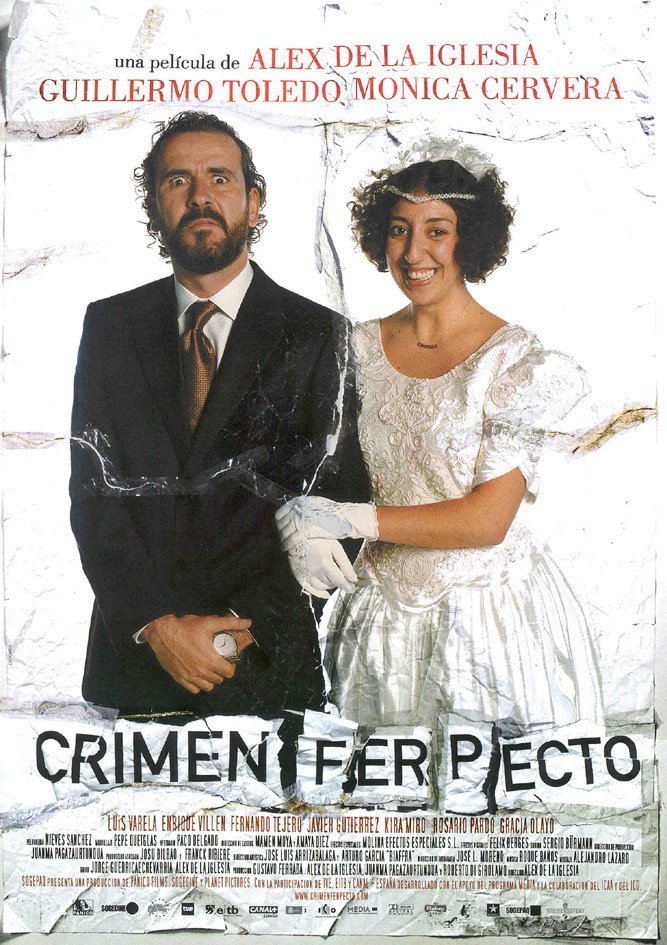
The Ferpect Crime (el Crimen Ferpecto) (2004)

the ferpect crime poster

It’s good to be Rafael – he’s got a sweet job as manager of ladies’ wear at YeYos, he is young, healthy, wealthy, and charming. The ladies adore him and the men wish to be him. He takes what he wants from life, and lives to the fullest. All that’s left is a promotion to floor manager at the store, and his life will be perfect. To obtain that promotion he must simply beat Antonio, the men’s clothing manager, in sales for the month — a task made easy by the doting middle-aged woman whom Rafael convinces to buy an expensive fur without even trying.

Yes, life is good for Rafael. That is, until the check for the coat bounces, and he is overlooked for the promotion. In frustration, Rafael yells at the coat woman and is fired by Antonio for it. An argument ensues and Rafael accidentally kills Antonio in a changing room. To make matters worse, the body soon disappears!

Poor Rafael, his life has gone from perfect to rock bottom in a matter of hours. Luckily he has Lourdes on his side. For she is the ugliest – and therefore completely invisible to the sexist Rafael – saleswoman in the store, and she has hidden the body to protect Rafael, for a price. Lourdes wants only the eternal love of Rafael, for her help and secrecy

Having to choose life in prison, or the love of an ugly woman, Rafael wisely chooses love, but may soon regret it. The Perfect Crime is equal parts Weekend At Bernie’s, American Werewolf in London, and War of the Roses, cranked up to 1.5 speed with Spanish accents.

Lourdes is the perfect crazed lover willing to do anything for the attention of the incredibly handsome and sexist Rafael. In a scene that would make Goodfellas proud, she slices and dices the dead Antonio without batting an eye, while Rafael gets deeper and deeper away from the life he has always wanted.

None of the characters are particularly decent, and I didn’t exactly care for their fate, but the story is told with such flair that I never really cared. The pacing is His Girl Friday fast with an eye for the absurd with its often hallucinatory imagery.

Guillermo Toledo and Mónica Cervera are pitch-perfect for the leads, adding a real emotional core to characters who are completely outlandish. Álex de la Iglesia does a nice job handling all the chaotic action with a smirk and flair.

It is an absolute joy to watch, and one of the most purely comical films I’ve seen all year. And yes, I know it is only March, and I haven’t seen that many comedies this year, but still, it’s a hilariously brilliant film.

Talk To Her (2002)

talk to her poster

A friend of mine recently lent me her Chinese bootlegged copy of Talk to Her. I have seen a few other Pedro Almodóvar films and expected another tale filled with bizarre violence and kinky sex. What I wasn’t expecting was a rather moving tale of unrequited love.

Talk to Her reminded me quite a bit of the films of Todd Solondz. Like his movies, this film manages to make characters who commit rather heinous acts quite sympathetic. Equally alike, Talk to Her deals with the immense loneliness of its characters.

The story begins with a chance meeting between Marco (Dario Grandinetti) and Benigno (Javier Cámara) at a dance recital. Neither man knows the other, but they happen to have seats that are side by side. They later meet again at a private hospital, where Benigno is the caregiver to a beautiful dancer, Alicia, who has been comatose for several months. Marco is there visiting his girlfriend, a bullfighter who was recently gorged by a bull and is likewise comatose. A friendship builds between the two men, as they care for the women they love, though they cannot be loved back.

The film’s title comes from Benigno’s insistence that Marco speaks to the women as though they could hear him. He urges Marco to open up and tell his lady the intimate details of his life. Benigno is deeply in love with Alicia and treats her as if she was his lifelong lover, though she cannot respond in any way.

The film is very subtle and nuanced in meaning. Both men, though apparently quite heterosexual, spend most of the film in more standard feminine roles. They are the caregivers: washing, cleansing, and taking care of the women. Benigno is a male nurse. They become very good friends, and indeed seem to love each other deeply, yet they are hopelessly devoted to women who are deemed hopeless, doomed to never awaken from their coma.

Neither Benigno or Marco really knew these women in their waking lives. Benigno watched Alicia in her dance classes, from across the street, through his window. Marco had just recently met Lydia, interviewing her for a magazine, and finding the beginnings of romance. It is really only through their caring for these women while they are asleep that they begin to feel love for them.

Almodovar is careful to portray the characters as sympathetic while still tainting their devotions with something sinister, something perverse. As the stories conclude, one character’s actions become slightly horrific, and yet we still feel sympathy for him. Almodovar understands life’s complications and that it is too easy to broadly label people as one thing when reality goes much deeper.

In keeping with the kinkiness of his prior films, Almodovar throws in a sequence with Benigno retelling a silent film he watched recently. It rivals the bathtub scene in Tie Me Up, Tie Me Down, and inside the cheerleader’s pants scene in the USA Up All Night classic, Getting Lucky. Let’s just say for lovers of perverse, whacked-out cinema, it is a must-see.

Ultimately, Talk to Her is a bizarre, but moving portrait of unrequited love, friendship, and the complexity of human life. It is undoubtedly a difficult film emotionally, but one definitely worth sitting through and contemplating.