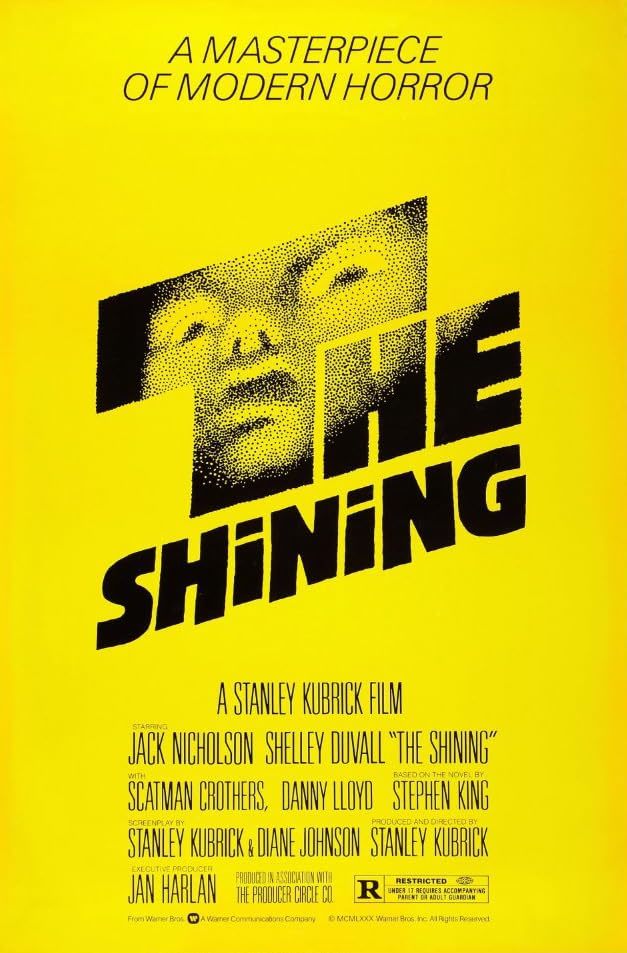
The Friday Night Horror Movie: The Shining (1980)

the shining

Though I keep saying that I love making these monthly movie themes and writing about them, I find it easy to slip out of that routine (especially in the writing department) and then quite difficult to slip back in. This time I have a pretty good excuse with Covid, but I’ve felt (more or less) well the last couple of days and yet have not had the energy to write any more Frozen in January reviews, despite having watched several more and (at least in theory) the desire to write about them.

Here’s hoping this Friday Night Horror Movie write-up will get me back in the spirit.

There is a documentary from 2012 called Room 237 which posits a number of theories about Stanley Kubrick’s The Shining (1980). Or rather it features a number of talking heads who all seem to think they know what The Shining is all about. What it all really means.

These range from the somewhat plausible – it’s about the assimilation of Native Americans and the destruction of their culture by rich white Americans – to the crack-pot – it is Kubrick’s apology for helping with the faking of the moon landing.

It is an interesting documentary, but what I really love about it is how it indicates just how malleable Kubrick’s film is. It is as if the director took Stephen King’s novel, and turned it into his own thing, and then when people ask what it all means, his answer is akin to:

It means what you want it to mean. Or it has no meaning. Or I don’t know what it means.

For those who don’t know The Shining is based on the Stephen King novel of the same name. Kubrick did make some significant changes to the book and King famously hates it. It tells the story of Jack Torrence (Jack Nicolson), a wannabe writer who is also an alcoholic, and abusive husband/father. After being fired from a teaching job he lands a job as the winter caretaker at the Overlook Hotel – a beautiful resort nestled deep within the Rocky Mountains. The long, meandering road into the hotel becomes too covered with snow to make it financially viable to stay open for five months in the winter so they hire someone to live there and keep it maintained.

Jack brings his wife Wendy (Shelley Duvall) and young son Danny (Danny Lloyd) who has some psychic ability (known as the Shining). The total isolation, the freezing cold (a huge blizzard traps them even further and isolates them more by knocking out the phone lines), and the ghosts push an already fragile Jack into psychotic territory.

The Overlook catered to the rich, powerful, and famous. People who make important decisions and devour depravity. Terrible things have happened there. Things the hotel is all too happy to cover up. In his initial meeting with the hotel manager, Jack is told of a previous caretaker whose cabin fever led him to murder his wife and two young daughters with an axe.

This violence and debauchery has left a psychic impressions on the hotel. Or perhaps, the hotel is a place of evil and it has left an impression on vulnerable people causing them to engage in horrible deeds. The film never gives an answer, it is a movie that wants you to come up with your own.

Kubrick films it in his usual technically proficient, yet emotionally detached way. His use of Steadicam (a fairly new technology) is masterful. Though the camera slowly wanders about the landscape of the hotel (truly making the setting a character unto itself) the geography of the place is disorienting. There are windows where there could feasibly be no windows, and doors that could only lead to nowhere. All of which makes the film deeply unsettling.

The performances while unanimously good, are cold and strange. Early in the film serious conversations are strangely monotone. Kubrick used many multiple takes (the scene in which Wendy swings her bat at Jack reported was shot over 100 times) to intentionally exhaust and unnerve the actors. The music is eerie and avant-garde.

It is nothing like a traditional horror film. While there are images of violence and horror – every character, especially Danny, flash on scenes from the hotel’s horrible past – the film unnerves you with its mood and calculating camera.

I love it. It is one of my favorite horror movies. I’m not alone in that assessment, and I’m sure many of you enjoy it as well. It works perfectly with this Frozen in January theme and I was happy to revisit it tonight.


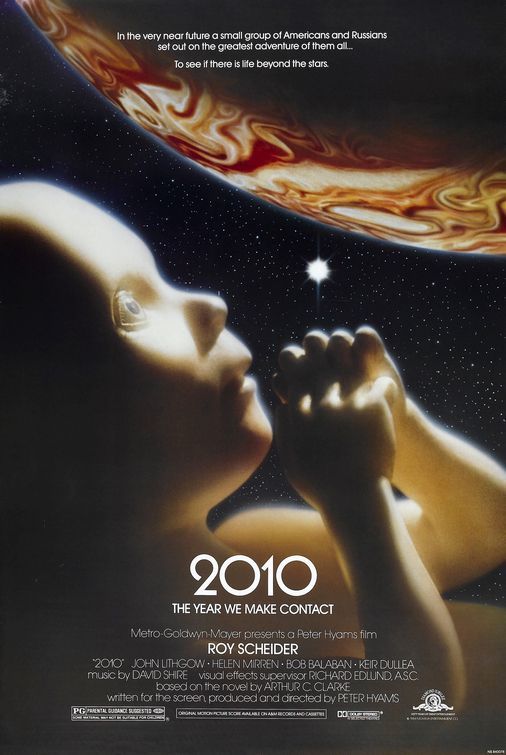
Awesome ’80s in April: 2010: The Year We Make Contact (1983)

2010 the year we make contact poster

2001: A Space Odyssey is arguably one of the greatest movies ever made. Certainly, it is one of the greatest science fiction films ever put on celluloid. It was made by the visionary auteur Stanley Kubrick. One of the many astounding things about the film is that it is almost entirely told through visual language. Great swaths of the movie contain no dialogue whatsoever. This is also one of the reasons the film is endlessly discussed – it never tells you what’s happening, it shows you.

A sequel was made in 1984. Directed by Peter Hyams 2010: The Year We Make Contact is a pale imitation of the original. As a sequel, it is not great. Where Kubrick’s film is mysterious, asking big questions and giving no answers, 2010 is all answers.

But if you can separate it from the original, and take it on by itself, it’s actually pretty good. Admittedly, that is a difficult task, as this film is basically an answer to the questions asked by the original. Its plot takes place right after 2001 ended and its characters spend their time hunting down what happened in that movie. But if you can get the original out of your mind and just let this one do what it’s doing, then I think you can find it enjoyable.

I said it begins right after the events of 2001, but really it begins 9 years after that movie (hence 2010 in the title.) At the end of the first film, the crew from the Discovery One spaceship which was on a mission to Jupiter are lost. The HAL-9000 computer, which controlled pretty much everything on board went a little crazy and killed most of the crew. Dave (Keir Dullea) the only survivor disappeared. As an audience, we know that he discovered a giant black monolith orbiting Jupiter and was sucked inside it. A long, psychedelic trip then turns him into a cosmic space baby. But in-film, the people of Earth have no idea what happened to him.

The Americans and the Russians are both planning missions to Jupiter to find out. There is a time rush as the Discovery One is slowly losing orbit and will soon crash. The Russians will have their ship ready faster than the Americans, but it is the Americans who have knowledge of the Discovery One and are the only ones who can reboot HAL. So, three Americans Heywood Floyd (Roy Scheider) who feels responsible for the entire Discovery One mishap, Walter Curnow (John Lithgow) who designed the Discovery One, and R. Chandra (Bob Babalan) who created the HAL-9000 computer, jump aboard the Russian ship.

All of this occurs during the height of the Cold War. During the mission relations between the two countries deteriorate with a Cuban Missile Crisis-type situation pulling them toward the brink of war.

The astronauts try to ignore the ongoing politics back home and instead concentrate on the mission. The film does explain what happened to HAL in 2001, but I won’t spoil that here. It explains further what the monolith is and what the aliens want, but again no spoilers. None of that is particularly thrilling or all that interesting. And if you want it to it can destroy all the mystery of 2001.

However, the design of everything is really quite good. I especially enjoyed the matte paintings and the various images of space, Jupiter and its moons and the placements of the ships within all of that. All of the space stuff is really interesting. I also enjoyed the relationships that develop between the various scientists (Helen Mirren plays one of the Russians and she’s always fun to watch, especially when attempting a Russian accent).

If this movie existed on its own, if 2001 had never been made I think 2010 would have been well-regarded. It might not be a classic, but It would definitely have a good following. I’d argue it should definitely be reconsidered, despite the Kubrick film always overshadowing it.

I wrote a different review of this film back in 2004. You can click here and read it if you like (spoiler alert, I hated it).

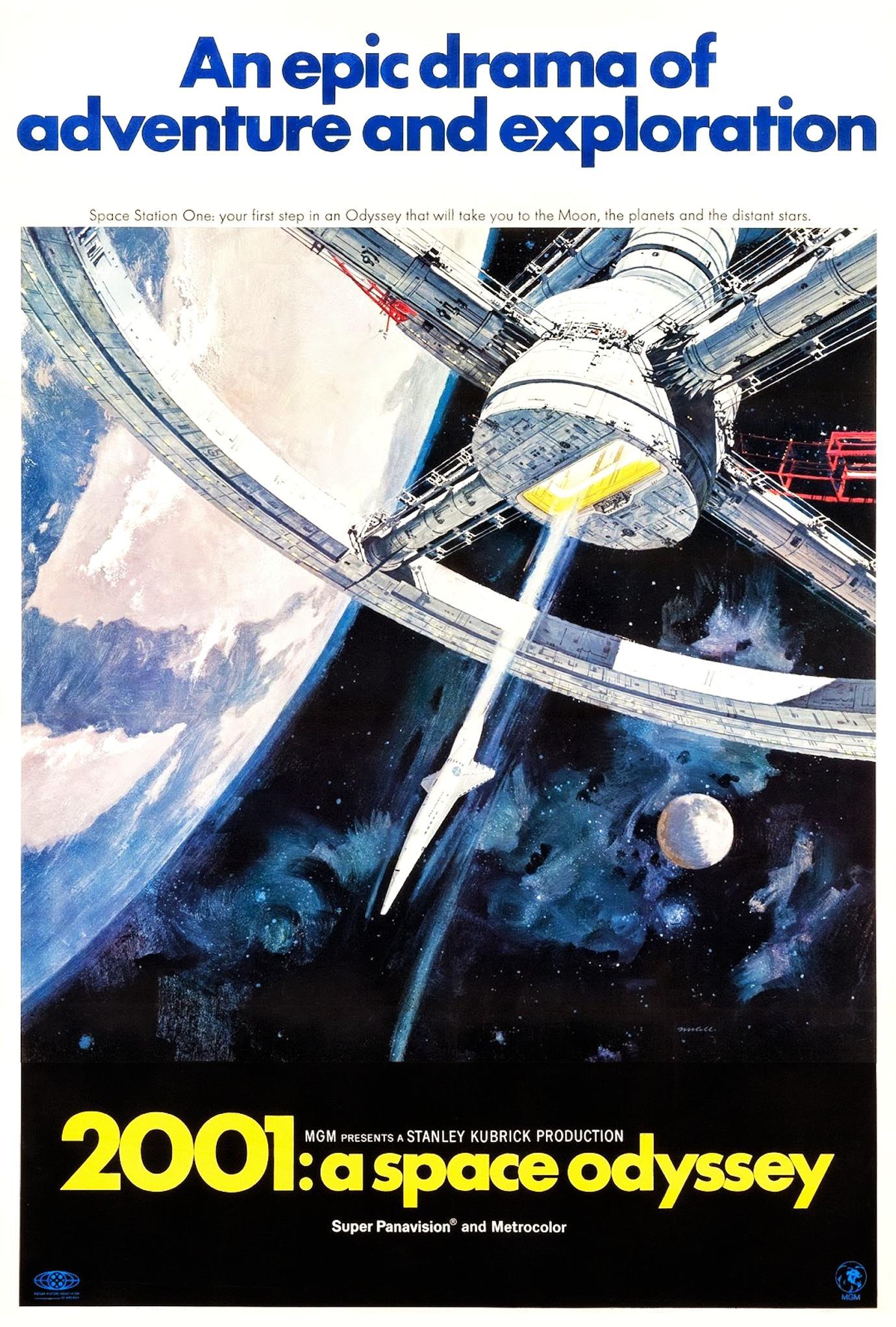
2001: A Space Odyssey (1968)

2001 a space odyssey poster

Editors Note:  I have watched this film many times since I wrote this review in December of 2004 and I no longer find it boring at all.  It is one of my all-time favorite films.  I might have to watch it again this weekend 😉

I will not attempt to discuss the meaning of this film or to answer most of the questions it poses. There are plenty of places on the internet that try to do that.

2001 is one of the few films I find absolutely amazing, and that I dread to watch. Like Citizen Kane I find this movie to be technically brilliant, but mostly boring. It was the first or second DVD that I purchased when I bought my player back in 1999. Yet in the interim 5 odd years, I have watched 2001 in its entirety only once or twice. Several times I have started to sit and watch it, but I just can’t get through it all at once. Even for this review, I watched it in sections.

It doesn’t help that the section I enjoy the most (the section involving the mission to Jupiter with HAL) is a good hour into the movie. It’s not that the other sections do not have meaning to me, it’s just that I find them very difficult to get through. The opening sequence “The Dawn of Man” is very well filmed, is vital to understanding the whole movie, and begins to ask some very good questions (does the advent of technology bring us closer to destruction as it also furthers our race?) Yet, I find this section mind-numbingly dull. Upon first viewing it was interesting, but now I know that the monolith is coming, I know that the ape-men discover the use of the bones as tools and this leads to their use as weapons. My knowledge of the action now bores me. I am the type of person who enjoys watching a movie repeatedly. I have a pretty large collection of DVDs and watch many of them often. So knowing the outcome of a scene does not always necessitate my boredom. It is just so with this particular film.

Likewise the next section of the film leading to the discovery of the monolith on the moon I find to be quite boring. It is only when we get to the middle chapter of the movie dealing with the journey to Jupiter and the madness of HAL that I remain interested as a film watcher. This section also happens to be the one I find most technically interesting. I must also admit this is the section with the most dialogue and most action. But I am not ready to say that this is the cause of my enjoyment. Because by most standards there is still not a lot of action or dialogue going on in the film. What I do enjoy is the use of sets to create the space station atmosphere. For example, I love trying to determine how they created the scenes where the astronauts appear to walk upside down or ‘turn’ with the ship? The atmosphere created by the use of the silence of space, the loneliness of the ship, and the remoteness of the all-seeing HAL eye is pitch-perfect. Kubrick builds the tension between the two conscience astronauts and HAL brilliantly. The scene in which HAL reads the astronaut’s lips is still one of my favorites in any film, ever. HAL, though a computer, has been rated as one of the greatest screen villains of all time, and rightly so. He is as calculating as he is cold.

Once this section ends, though we slip back into the brilliant but boring mode of the film. When Dave slips into the wormhole (did anyone call it a wormhole back then?) we are treated to a psychedelic ride of crazy colors and trippy music. But it goes on so long that I wish I did acid or smoked pot to keep me interested. It’s like the whale chapters of Moby Dick, where I have to agree that they are important for the sake of the novel, but I’d rather just skip past them and get on with the story. I believe the parts I find boring in the movie are essential to the film, and in many ways they make it the masterpiece of cinema that it is. This being so doesn’t make me watch it more than once every few years.