The Top Five Film Noirs Starring Humphrey Bogart

I meant to write and post this back during Noirvember, but I got distracted, and then I forgot.

Humphrey Bogart is my favorite actor. He made some incredible films in his storied career (including my all-time favorite, Casablanca), and more than a few of them were film noirs. More than just about any actor of the classic period, his name is (arguably) the one most associated with noir. So I thought it would be fun to do a Top Five favorite noirs starring Bogart.

high sierra movie poster

5.  High Sierra (1941)

Bogart wasn’t always the big star we know him as today. He spent the better part of a decade as a supporting player, often billed as a gangster or heavy. High Sierra changed that. He was lucky to get that role, as both Paul Muni and George Raft had been offered it first, and director Raoul Walsh didn’t think he was leading man material.  But writer John Huston thought Bogart was perfect for the role, and eventually Walsh relented. Huston would, that very same year, cast Bogart in his film The Maltese Falcon (more on that in a minute).

With this film he hasn’t quite left the gangster mold; he plays Roy Earle, a guy who’s just gotten out of prison and is already set for his next score. He’s holed up in a cabin in the mountains with three other guys and a girl, just waiting for the right time to rob a ritzy hotel. The girl (played by the always great Ida Lupino) will lead to trouble. Bogart is still perfecting his world-weary, cynical, but ultimately sentimental character, but he’s still terrific as Earle.  Lupino is great too, and Walsh’s direction is quite wonderful. 

the maltese falcon poster

4. The Maltese Falcon (1941)

If High Sierra made Bogart a star, then The Maltese Falcon solidified it. Based on the novel of the same name by Dashiell Hammett, this film is often considered the first truly great film noir. Bogart plays Sam Spade, a tough, cynical private eye who is hired by a woman (Mary Astor) who may not be who she claims to be and may not actually want what she claims to want. 

What she really wants is the titular object, which is a mythical, jewel-crusted statue of a bird that was supposedly gifted to the Holy Roman Emperor hundreds of years ago but has been lost to time. While trying to find the bird, Spade will run across a number of eclectic and strange people, including ones played by Peter Lorre and Sydney Greenstreet. 

The plot is complicated, the cast is perfect, and John Huston’s direction (it was his directorial debut) is fantastic.

in a lonely plac eposter

3. In a Lonely Place (1950)

This is probably the least noirish film on the list and quite possibly Bogart’s best performance. Based on the excellent novel by Dorothy B. Hughes, Bogart plays a troubled screenwriter with a penchant for violence who hasn’t written a hit movie in years. One night he takes a girl home with him, then changes his mind and kicks her out.  The next morning she finds herself dead, and he finds himself a suspect. Through this he’ll meet his neighbor Laura (a magnificent Gloria Grahame), and they’ll fall in love, but she’ll never quite be sure he didn’t kill that girl.

Bogart’s performance is heartbreaking. The script is full of great lines like, “I was born when she kissed me, I died when she left me, and I lived a few weeks while she loved me.” Just a magnificent movie.

key largo poster

02. Key Largo (1948)

Bogart and Lauren Bacall met on the set of To Have and Have Not (1944) and fell in love and stayed together until he died in 1957. They made four films together (three of them are absolute bangers, and the fourth one isn’t bad – one of the others almost made it to this list, and the other is #1).

Directed by John Huston (his second film on this list), Key Largo includes an incredible cast (including Thomas Gomez, Lionel Barrymore, and Edward G. Robinson).  Bogart plays Frank McCloud, a former soldier who stops by Key Largo to visit with his dead comrade’s father (Barrymore) and widow (Bacall) but gets stuck when a hurricane rolls in. Also stuck with them are a few gangsters awaiting a car full of cash that they’ll trade for counterfeit bills.  

The hurricane and the gangsters make for a pot of dangerous soup that’s ready to boil. This boasts a classic Bogart performance. He’s smart and tough, witty and sensitive. He and Bacall work magic together, and Barrymore is great as the father who doesn’t take any crap. But it is Robinson who steals the show. He gets one of the all-time great introductory scenes and remains awesome throughout.

the big sleep poster

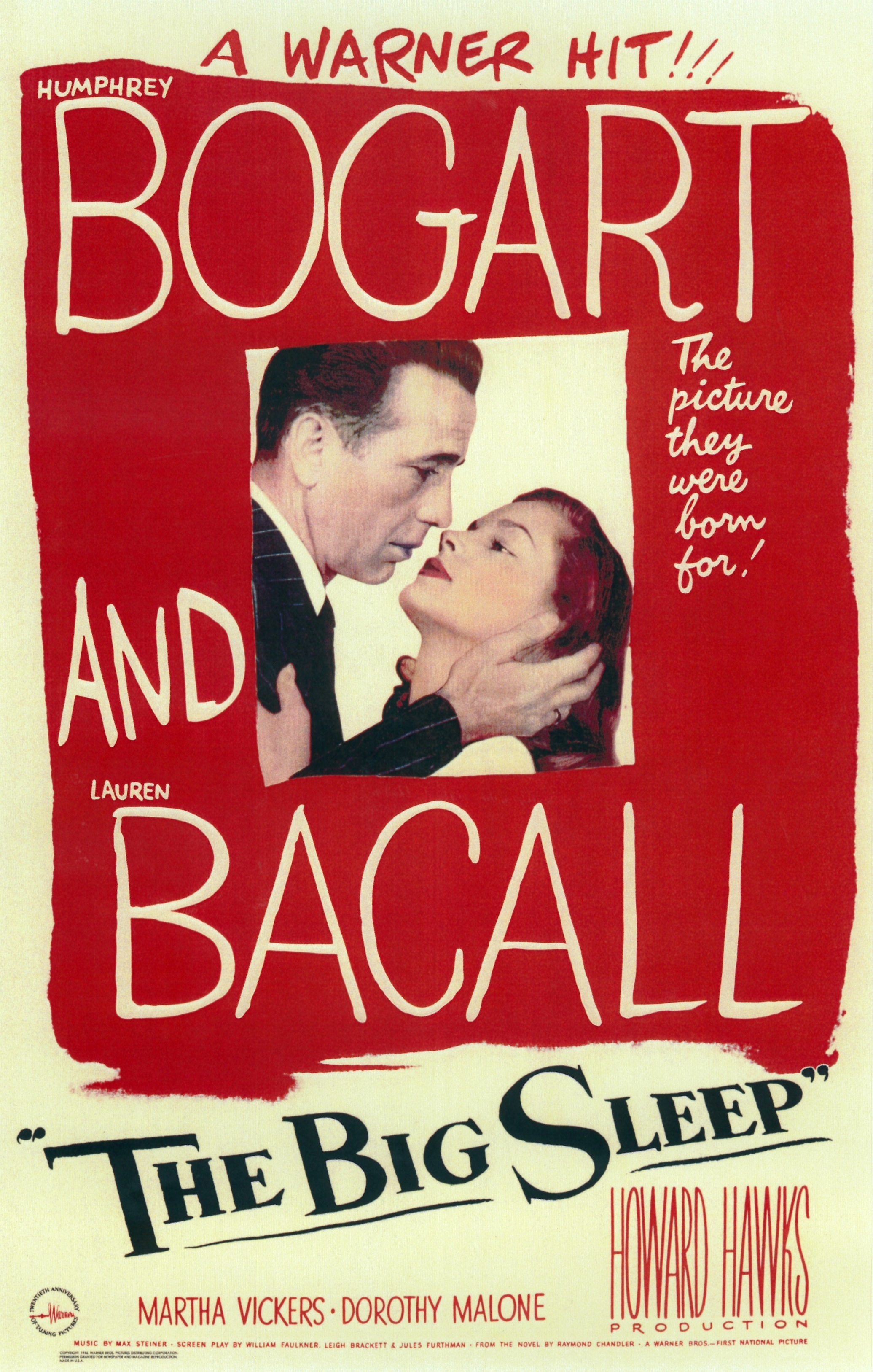
01. The Big Sleep (1946)

I think this was the first film noir I ever watched. Based on the fantastic book by Raymond Chandler, Bogart plays Phillip Marlowe, a private eye hired by an old man over some blackmail scheme involving his youngest daughter (Martha Vickers in a small but oh-so-memorable role). Quickly things turn complicated, convoluted, and murderous (director Howard Hawks famously phoned Raymond Chandler over who killed a certain chauffeur, and Chandler didn’t actually know the answer). But the plot isn’t really the point. 

The Big Sleep is all about its mood, its characters, and the way it makes you feel. Bacall is the older daughter and potential love interest. It is a blast watching her flirt with Bogart and become the femme fatale. Everyone flirts with Bogart in this movie. The two sisters, the cab driver, the bookstore clerk—hell, I’d flirt with him if I were in this movie. It is the perfect noir and an absolute blast to watch.

Well, there you have it, my favorite Humphrey Bogart film noirs. Do you have a favorite? Do you disagree with my picks? Honestly, if I wrote this tomorrow I’d probably have different picks. But this was fun.  I’ll try to do more of these when I can.
Five Cool Things and George Wendt

image host

George Wendt, the actor most known for portraying Norm on Cheers, passed away a couple of weeks ago. I absolutely loved that show and especially that character.

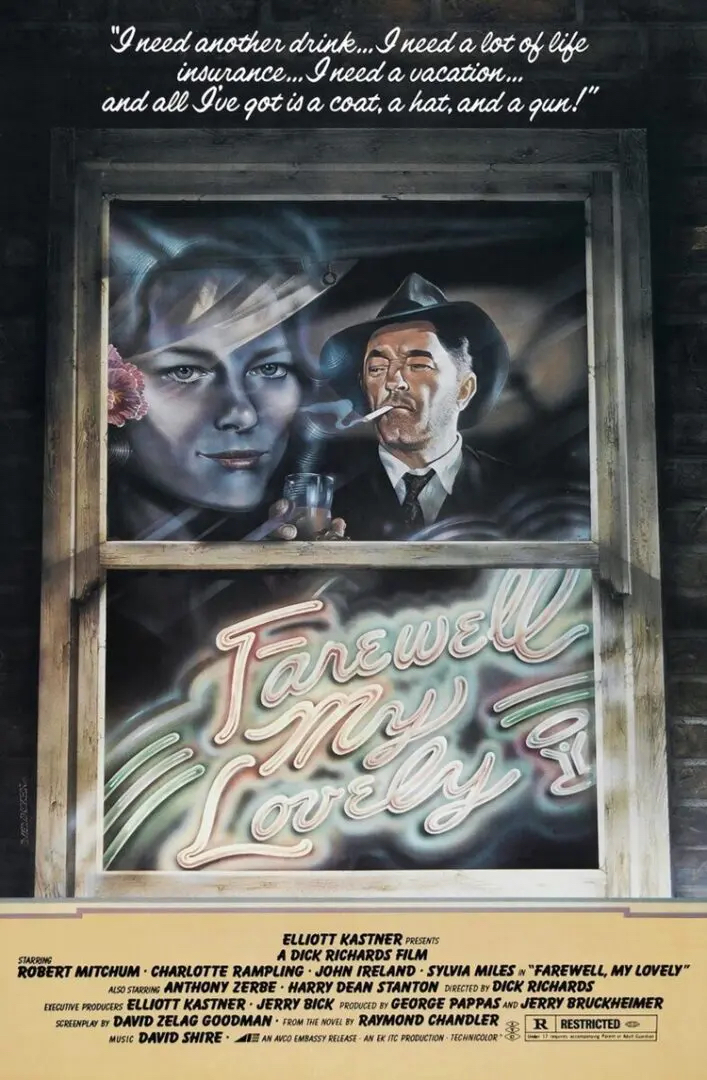
I paid tribute to him and wrote about three Raymond Chandler adaptations, a Thin Man sequel, and the opening credits to a fun new show in my latest Five Cool Things article.

You can read all about it over at Cinema Sentries.

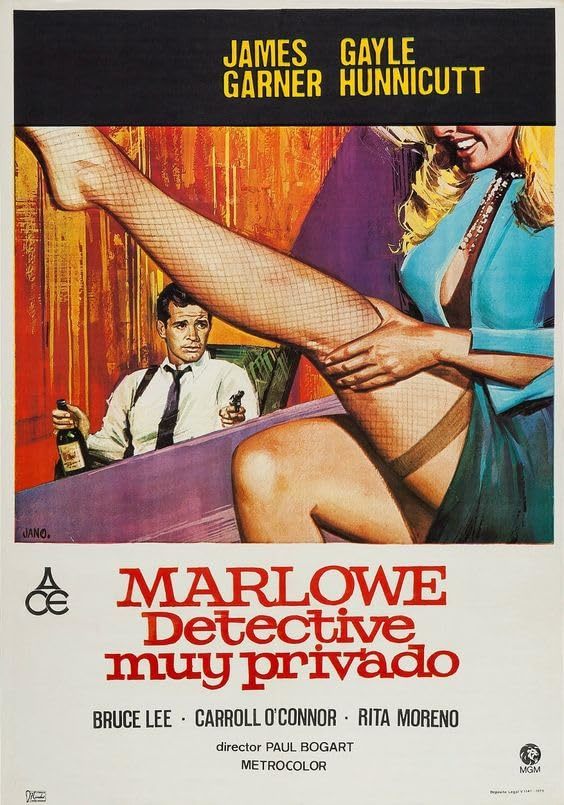
Murder Mysteries In May: Marlowe (1969)

poster

Phillip Marlowe is, perhaps, the quintessential hard-boiled detective. He is smart and tough. He has a moral code, but isn’t afraid to get his hands dirty. He works alone. He’s a hard drinker and plays chess by mail. It may take him a while, but he always solves his case. Humphrey Bogart’s portrayal of Phillip Marlowe in The Big Sleep is, perhaps, the quintessential cinematic depiction of the hard-boiled detective in film noir.

That character and Bogart’s portrayal of him, influenced countless detectives in countless movies throughout the 1940s and 1950s. But as the 1950s turned into the 1960s that hard-boiled film noir style was, well, going out of style.

In 1973 Robert Altman adapted Raymond Chandler’s The Long Goodbye with Elliott Gould as Marlowe. Altman has a lot of fun throwing this 1930s detective into the wild 1970s. Gould plays him as a sort of Rip Van Winkle, a man who has awoke from a long sleep only to find himself in a world he no longer understands. He kind of wanders, mumbling through the whole film, while the entirety of the uninhibited 1970s California sprawls out before him. It is a fantastic movie.

Marlowe sits somewhere between Bogart in The Big Sleep and Gould in The Long Goodbye. It is very much set in the late 1960s. The skirts are short, the music psychedelic, there is ample use of split screen and hippies abound. But the story sticks pretty close to the classic mold.

James Garner plays Marlowe like, well, James Garner, with a smirk to his delivery and a tongue planted firmly in his cheek. He’s smooth and slick, and rather delightful.

The plot is adapted from Chandler’s novel The Little Sister and finds Marlowe being hired by a squeaky young girl from Kansas to find her brother, lost in the big city of angels. There are mobsters and television stars, murders with ice picks, a strip tease act from Rita Moreno, and Bruce Lee tearing up Marlowe’s office.

It doesn’t always work. At times it feels more like a schtick than a fully thought-out movie. Altman’s film never has that problem. I love me some James Garner and he mostly works for me here, but in the same way that the film sometimes feels like a schtick, his act doesn’t always work for Phillip Marlowe.

But it is a fascinating time capsule of a movie, trying to move the film noir forward, making it current for the times. It is also quite a bit of fun.

The Big Sleep (1946)

the big sleep poster

This classic film noir has very few of the characteristics generally associated with noir. It contains no skewed camera angles, it is not overcome with murky, obscuring shadows. The hero is not down-and-out, poor, or desperate. There is no retrospective narration or flashbacks. Yet, The Big Sleep is widely considered to be one of the very best of the genre. It is a cynical, perverse, murderous world filled with loads of confusing action, and unknown motives. It is, in fact, one of the great films from one of the screen’s greatest actors, Humphrey Bogart (for my personal top 10 actors list, click here), and its most talented directors, Howard Hawks.

Hawks was fresh off of the successful pairing of Humphrey Bogart and Lauren Becall in To Have and Have Not (1944). The two star here again and it is easy to see why they made another two films together. Based on a Raymond Chandler novel of the same name, many people complain that this film is incomprehensible. Somewhat famously it is reported that Bogart and Hawks, after arguing over who killed one of the characters, called up Chandler to get the correct answer. Chandler didn’t have the slightest idea, for the novel is rather vague on this point. It’s true that both the novel and film leave many plot points as to who did what to whom more than unclear, but there is so much style in both that it’s hard to make a convincing argument against them.

A good deal of the confusion within the film comes from the production codes in effect at the time it was produced. Chandler’s novel deals with murder, homosexuality, heterosexuality, and pornography. At the time, these things were deemed unfit to show on a movie screen and so Hawks had to hint at them using various subtle methods. For instance, when Carmen Sternwood (Martha Vickers) is found by detective Phillip Marlow (Bogart) in the novel she is completely nude and sitting posed for a hidden camera. Since pornography is explicitly against the code, in the movie she is dressed in a silky, Japanese gown. There is still a hidden camera, and its missing film becomes a catalyst for much of the action in the film. We must infer from the exotic nature of the gown that there was more than just pictures of a woman in a gown going on. There are many similar instances in the film like this. For an audience member who has not read the book, they must pay close attention to the subtext, or the film will seem baffling.

Personally, I am very much a fan of the book, and all of Chandler’s work. While I appreciate that some of the finer plot points are a bit vague in this film, I also understand that the film succeeds not in the details of the story, but in a sinister sense of style. The film oozes with a dark, disquieting atmosphere. Nearly everyone Marlowe meets is hiding something and is of less than upstanding moral character. Hawks does a great job of keeping nearly every scene in the dark or in the rain, or both. There are so many characters coming in and out of the shadows with their own shady character that it is difficult to keep up.

Bogart, of course, does a marvelous job as Marlowe. He seems to understand a lot more information than the audience is ever given. Chandler wrote Marlowe as a detective who sticks by his own set of morals, remaining somewhat of a noble creature trying to stay afloat amongst the muck and sewers of the city. Lauren Bacall does a very good job portraying Vivian Sternwood Rutledge, in a role that is much different than the one in the book. Like many films from this era, they create a romance that wasn’t really in the source material. I don’t mind though, because Bogart and Bacall really sizzle.

What can I say that hasn’t been said before? This is really classic noir at its best. It’s got Bogart and Bacall. It was directed by Howard Hawks, and written by William Faulkner from a novel by Raymond Chandler. What more could a lover of classic cinema want?