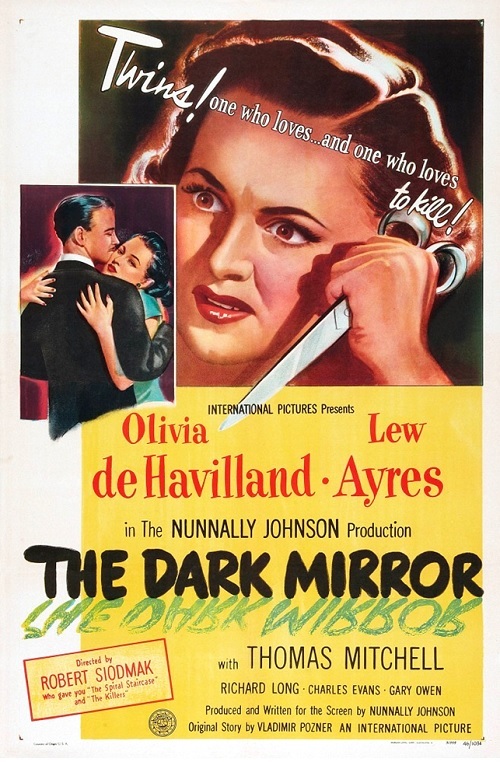
Noirvember #9: The Dark Mirror (1946)

the dark mirror

I’ve been slacking in my film noir reviews. I’d apologize, but I can’t imagine any of you actually care.

The first fifteen minutes or so of The Dark Mirror are terrific. A man is stabbed to death in his apartment. Several witnesses put the man’s girlfriend Terry Collins (Olivia De Havilland) at the scene. But when Lt. Stevenson (Thomas Mitchell) questions her, she provides several witnesses that can prove she was nowhere near the murdered man at the time of his death.

What the…? How can that be? Twins, that’s how. Terry has an identical twin sister named Ruth (also De Havilland). So, one of them did kill the man but the other has an airtight alibi. Trouble is no one can tell which one did what except the two sisters, and they aren’t saying.

The film has a lot of fun playing with that situation, befuddling the lieutenant at every turn. But then it introduces a psychologist, Dr. Scott (Lew Ayres) who has made a career out of studying twins. He begins seeing the girls individually, running them through a series of tests. Naturally, he also falls in love with one of them.

One of the twins is insane and has been gaslighting the other their entire lives. Naturally, there is a bit of a switcheroo with the twins, because you can’t have a movie about twins without having them pretend to be each other at some point. Once the doctor is introduced I started losing interest. He all but pushes the lieutenant out of the way and the story becomes less about a cop trying to solve a murder and more about a doctor analyzing patients. Boring is the word.

De Haviland is great. She creates two distinct characters out of the sisters while still making them fully believable as twins. Michell is very enjoyable as the lieutenant as well. I wish the film had stuck with him instead of getting all psychobabble with the doctor.
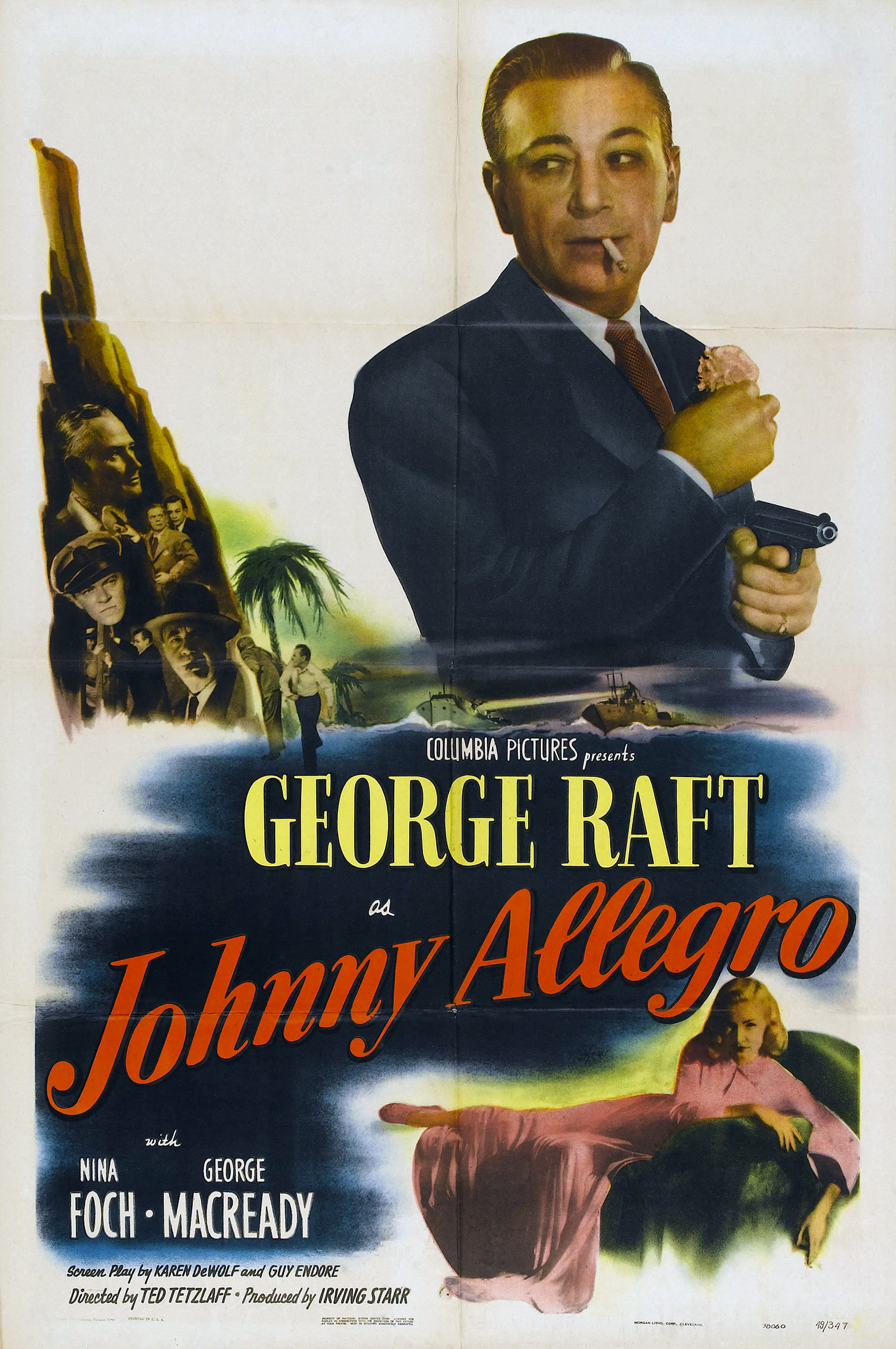
Noirvember #8: Johnny Allegro (1949)

johnny allegro

George Raft plays the titular Johnny Allegro, a florist with a secret past. When he starts playing nice with Glenda (Nina Foch) a federal agent takes an interest. It turns out she has a past too and a present. She’s married to Morgan Vallin (George Macready) a shady gangster that the feds are interested in, but have yet to be able to pin anything to. They figure Johnny can use his new connection to Glenda to get to Morgan.

He gets cozier with her and she invites him to meet Morgan on his private island. There is some discussion of Johnny being of service to Morgan’s counterfeiting scheme, but things turn sour pretty quickly. Morgan is a guy who eschews guns but loves playing with his big bow and arrow. Naturally, he uses it a few times and it all winds up a The Most Dangerous Game type situation.

George Raft was not a spectacular actor in the best of situations and here age has crept up on him. He plays Johnny like he’s bored most of the time. Big reveals in the plot barely get a raised eyebrow. George Macready matches his lackadaisical stance and between the two of them the film has a hard time creating any sort of tension.

It is, however, a ton of fun watching Macready fire off his bow and arrow. The actual story and the direction are all pretty good. Good enough to keep me watching anyway.

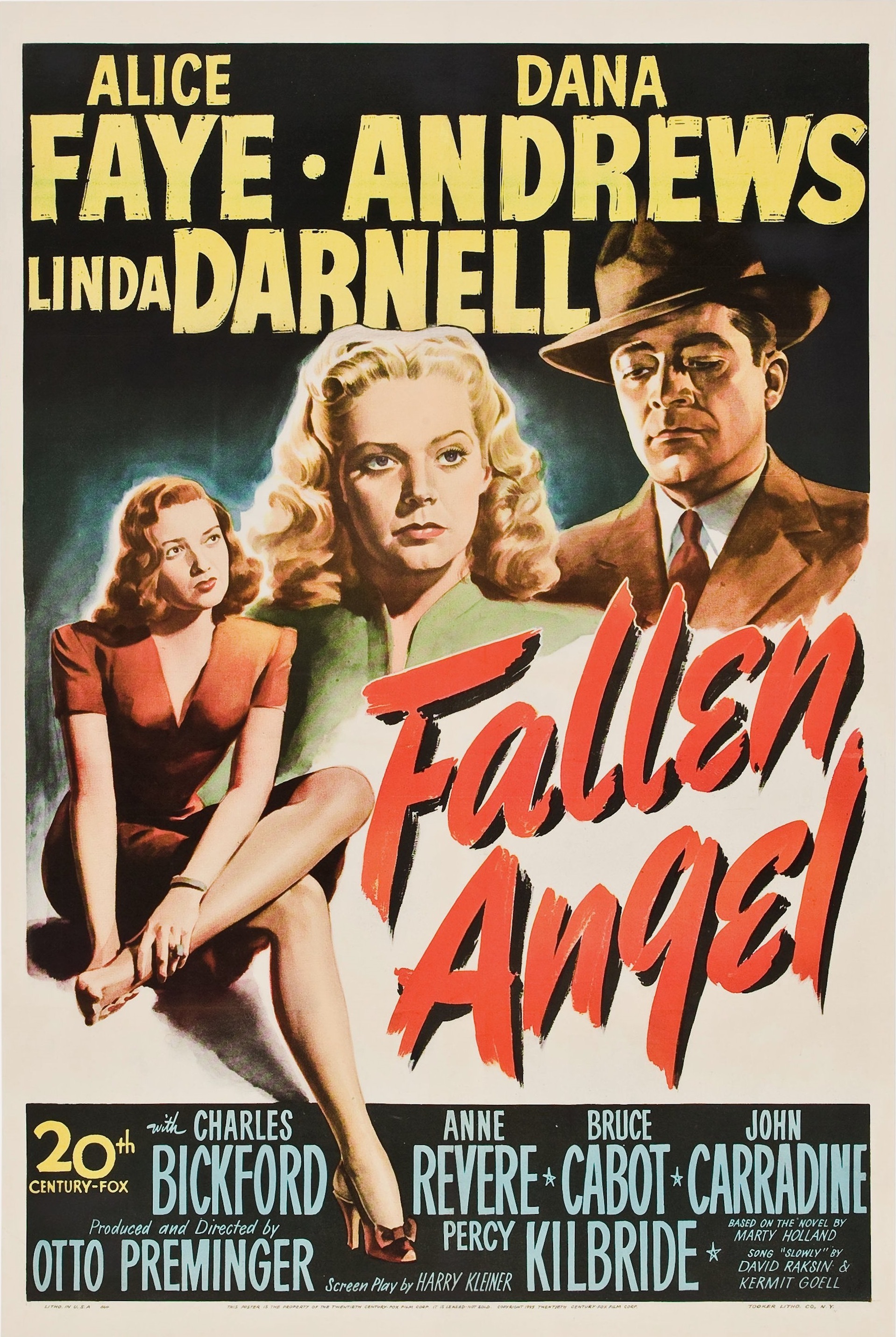
Noirvember #7: Fallen Angel (1944)

fallen angel poster

Laura the Otto Preminger film from 1944 is one of the all-time classic film noirs. It was a huge success upon its release and remains one of the genre’s most beloved films. Preminger followed it up with another noir, Fallen Angel, which also stars Dana Andrews. Here, he’s no longer a detective trying to solve a murder, but a drifter, a conman who gets into trouble he may not be able to get himself out of.

His name is Eric Stanton and he drifts into a small town called Walton because he doesn’t have the bus fare to make it to San Francisco and the driver kicks him off at the first stop once he learns Stanton doesn’t have a ticket. There he meets Stella (Linda Darnell) a beautiful, sultry waitress and like any good film noir sap, he falls immediately in love. But like any good dame in a film noir she won’t have him until he’s got some money. He figures he can get it from June (Alice Faye) a pretty, but reserved woman who hasn’t had much luck in love, but does have a lot of money.

Stanton figures she’s an easy mark. He can get lovey-dovey with her, score some cash out of her fat wallet then drop her and head back over to Stella. Naturally, things don’t go as planned and he finds himself on the run from the cops as a murder suspect.

The plot is just as complicated as Laura, but it isn’t nearly as compelling. Linda Darnell is the standout. She is radiant and mysterious. Unfortunately, she doesn’t get a ton of screen time and her character isn’t given much. Dana Andrews is fine. I love morally murky characters, especially men who think they have it all under control but are really quite clueless. Likewise, Alice Faye is perfectly acceptable but she’s missing that certain something to make this film truly great.

Well worth your time, but if you haven’t seen Laura grab that one instead.

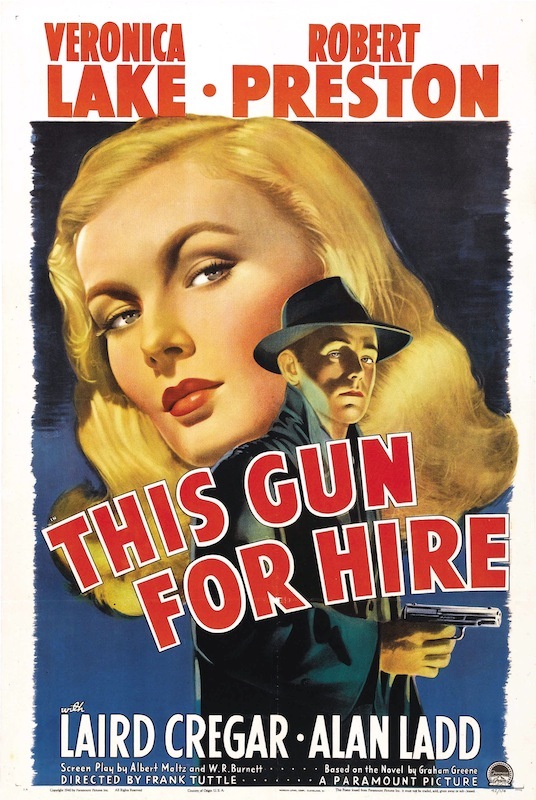
Noirvember #6: This Gun For Hire (1942)

this gun for hire

I had forgotten I had seen this before, but once I got started it was too good to turn it off.

Alan Ladd, in his first real role (he’d been in other films before but they were bit parts, so small he gets an “introducing” credit here) stars as Raven, a sadistic killer-for-hire. But he’s so good in it, he brings such emotional complexity to the role that you can’t help but root for him. He’s hired by Willard Gates (Laird Cregar) to bump off a chemist and steal some papers. Raven doesn’t ask questions, he doesn’t care what’s in the papers. He just does his job and takes his pay.

Gates double-crosses him by paying out in marked bills, ones that he claims to the police were stolen from his company. Detective Michael Crane (Robert Preston) is put on the case. He’s in love with Ellen Graham (Veronica Lake) who was just hired by Gates as a performer in one of his nightclubs. She accidentally winds up on a train next to Raven. Gates sees them sitting next to each other, thinks they are in cahoots, and calls the cops. Raven holds Ellen hostage in order to get away from the cops. Though she isn’t in cahoots with Raven she is working with a local senator who believes Gates is selling secrets to foreign agents.

As you can see, it is a complicated, convoluted plot. Director Frank Tuttle keeps things moving at a quick pace but still manages to more or less keep all the convolutions understandable. Veronica Lake is lovely as usual though she isn’t given much to do. She sings a couple of songs while doing some pretty fun magic tricks and makes googly eyes with Detective Crane. Her scenes with Ladd are good, but mostly she’s just there to look pretty. Preston has even less to do. He’s top-billed but he’s in the fewest scenes out of the three main cast members and when he is on screen it is just to move the plot along.

This is completely Ladd’s film and it is easy to see why he became a star. He really nails the nuances of the role and makes us feel sorry for a guy who kills for a living.

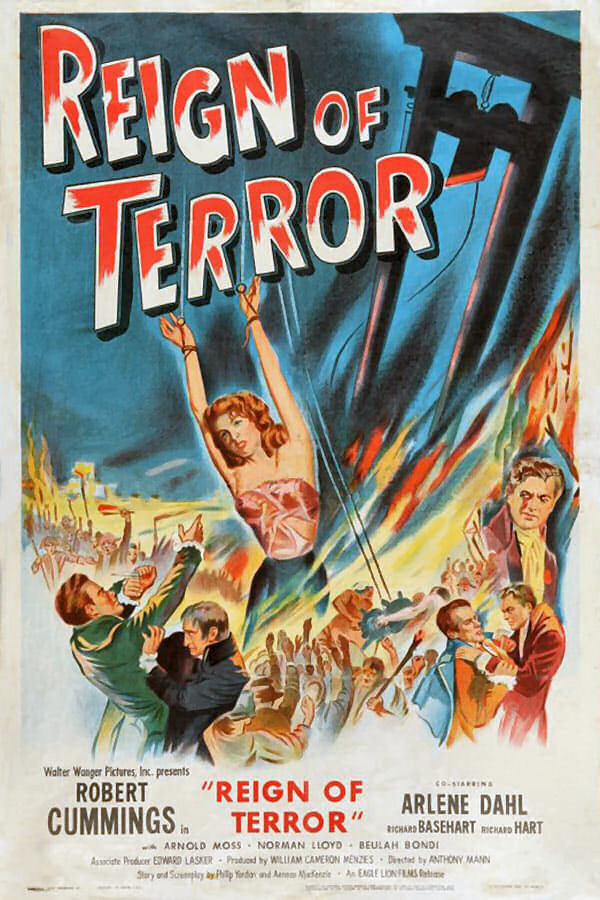
Noirvember #5: Reign of Terror (1949)

reign of terror

The thing about film noir is that nobody really agrees on exactly what makes a film noir a noir. The plots for this genre are all over the place. But the one thing everybody agrees upon is that a film noir has a certain style, a certain look. It is all about the light and the shadows. Noir had a way of lighting a set and a character like nothing else.

Normally you wouldn’t say a movie about the French Revolution could be a film noir, but director Anthony Mann who was no stranger to the genre having directed He Walked By Night, one of the great noirs, films Reing of Terror just like it was a perfect fit.

In this version of events, Maximilian Robespierre (Richard Baseheart) is not satisfied with having led France into a revolution, overthrowing the King and instilling a reign of terror by beheading anyone who opposes him, he wants to be dictator for life as well. Charles D’Aubigny (Robert Cummings) is tasked with infiltrating the Jacobin Party in order to find a Black Book. In this book written all the names, Robespierre intends to kill at one time or another. Since nobody knows whose name is in the book, everyone is afraid to oppose him. But if the book is opened to the people then the people may decide the time has come for Robespierre to face the guillotine.

Or something. The details of the plot get a bit muddled as it goes along. But it looks fantastic. The sets are brilliant and the lighting is full of bold, dark shadows. It is the sort of film where you can forget what is happening in the actual story because you are so mesmerized by how it looks.

Cummings is good but it is Arnold Moss who steals the show as one of Robespierre’s henchmen who wouldn’t mind seeing him at the wrong end of a guillotine if it helps line his own pockets and gains him a little more power.

Reign of Terror is definitely worth the watching.

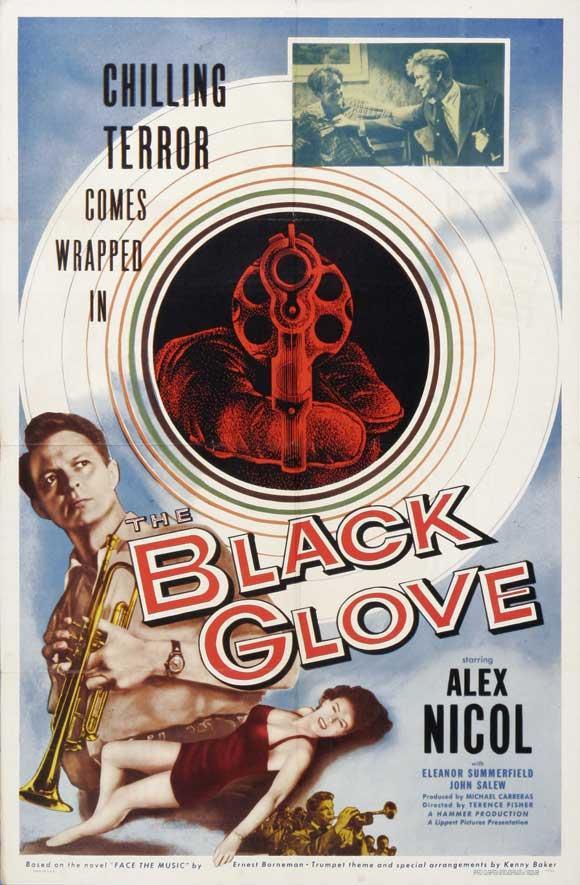
Noirvember #4: The Black Glove (1954)

the black glove

A popular jazz musician named James Bradley (Alex Nicol) arrives in London for a series of performances. One late night, on his way to his hotel, he hears a beautiful voice singing along to a nice jazz band. He stops his cab, slips inside the club, takes out his trumpet, and plays along. The girl is pretty. The girl is nice. He takes her home. In the morning the girl is dead. The cops think he did it. He spends the rest of the film trying to clear his name.

This British production was produced by Hammer Studios which is usually associated with horror films and directed by Terence Fisher who helmed some of their best horror flicks. But this is all crime drama with lots of noir trappings. It is yet another film I’ve watched of late that’s just pretty good. There is some nice jazz music, some good images, but the story never quite succeeds.

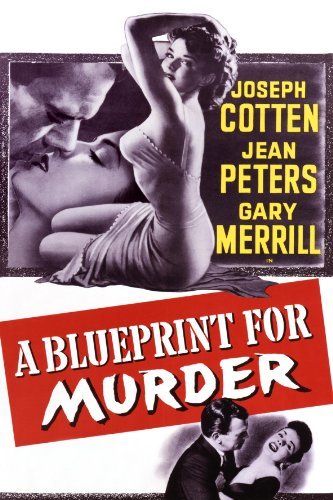
Noirvember #3: A Blueprint For Murder (1953)

a blueprint for murder

Joseph Cotten plays Whitney Cameron who is called to the hospital when his niece has taken ill. There with him is Lynne (Jean Peters) the widowed wife of his brother. When the girl dies Whitney decides to stay in town a little longer. When the doctor cannot figure out how the girl dies Whitney and his two friends suspect foul play. Lynne, it seems, stands to inherit a lot of money if her two step-children die. With one gone that only leaves the boy. With no proof that Lynne is the killer, Whitney must try to find some evidence while also keeping the child alive.

A Blueprint for Murder has many of the hallmarks of a good noir, but it never quite got there for me. It was directed by Andrew L. Stone who won an Oscar for a film called Julie (1956) but I had never heard of him prior to watching this film. It looks good, but it never quite builds up the tension it seems to be going for. Whitney Cameron has doubts as to whether or not Lynne is actually the killer but the film never gives us any reason to doubt. There are scenes in which the child’s life seems to be in danger, but what Hollywood movie from 1953 is going to kill off a child like that? And so there isn’t any real tension built up.

It is a perfectly run-of-the-mill movie. I suspect I’ll be watching quite a few of those this Noirvember, as I’m intentionally seeking out lesser-known ones. Yet I still love this sort of thing. I like Joseph Cotten quite a bit and I’m always glad to see more of his films. And, while seeking out and watching lesser-known films often brings movies that aren’t that great, you also find hidden gems, and that makes it all worth while.

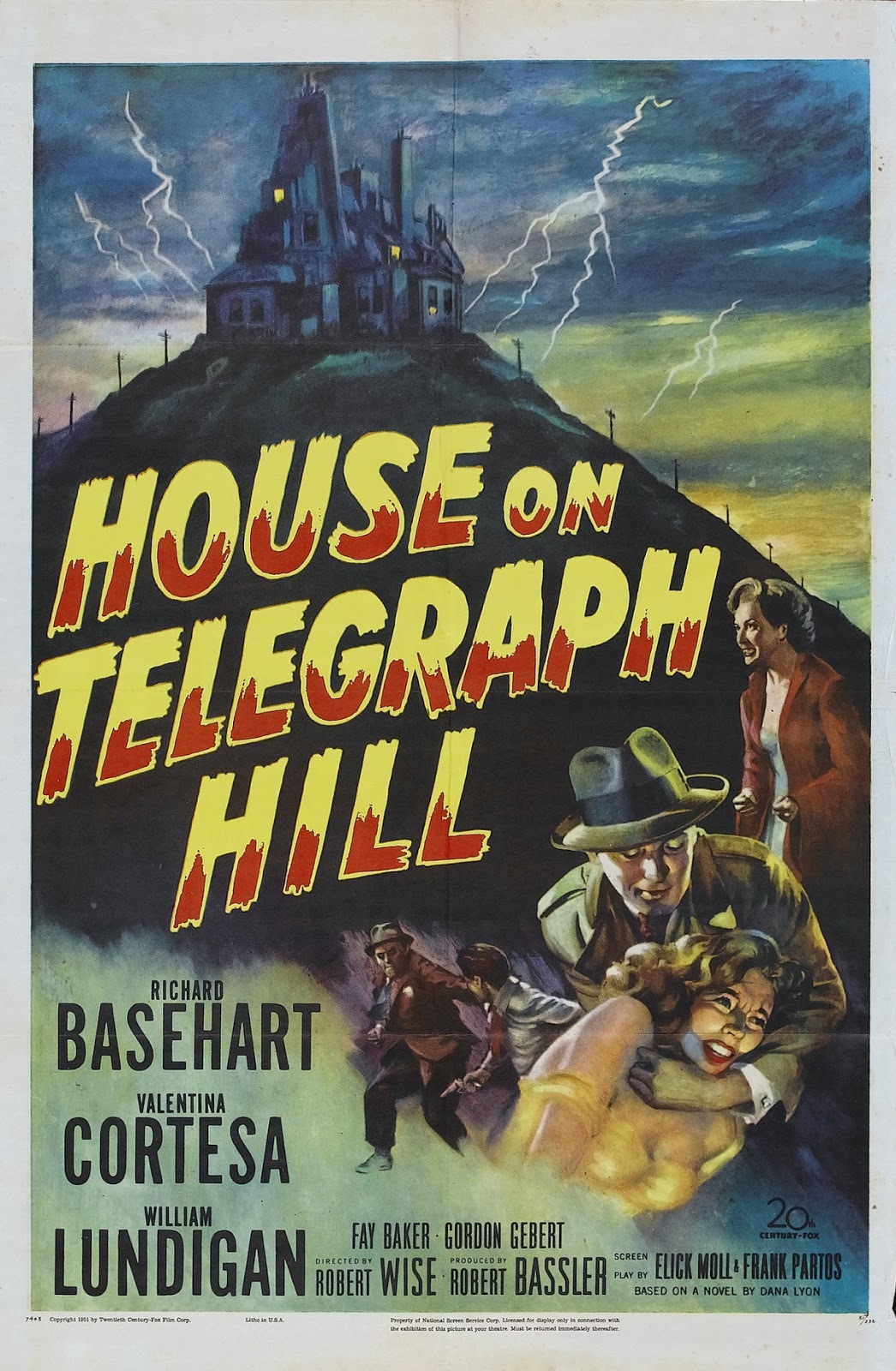
Noirvember #2: The House on Telegraph Hill (1951)

the house on telegraph hill

I know I said I wasn’t going to write about every movie I watched for Noirvember, yet here we are. I definitely won’t be writing full reviews of everything. Like tonight I’m too tired to say much. But I’ll say a little.

The House on Telegraph Hill was directed by Robert Wise which is why I decided to watch it. He directed the wonderfully spooky haunted house movie The Haunting (not to mention West Side Story, The Sound of Music and a bunch of others) which is why I watched it.

It is about a woman, Victoria (Valentina Cortese) who survives a Nazi concentration camp, and takes on the name of her friend who died there. The friend was American. When she arrives in San Francisco she discovers the friend (and thus her) has inherited a lot of money. She marries the man who has been taking care of her son, only to later discover that he is perhaps not quite what he seems. She’s pretty sure he is going to murder her.

It is a bit slow-moving and the intrigue never quite intrigues. The performances are fine and Wise’s direction is good. It isn’t bad, but neither is it all that good.

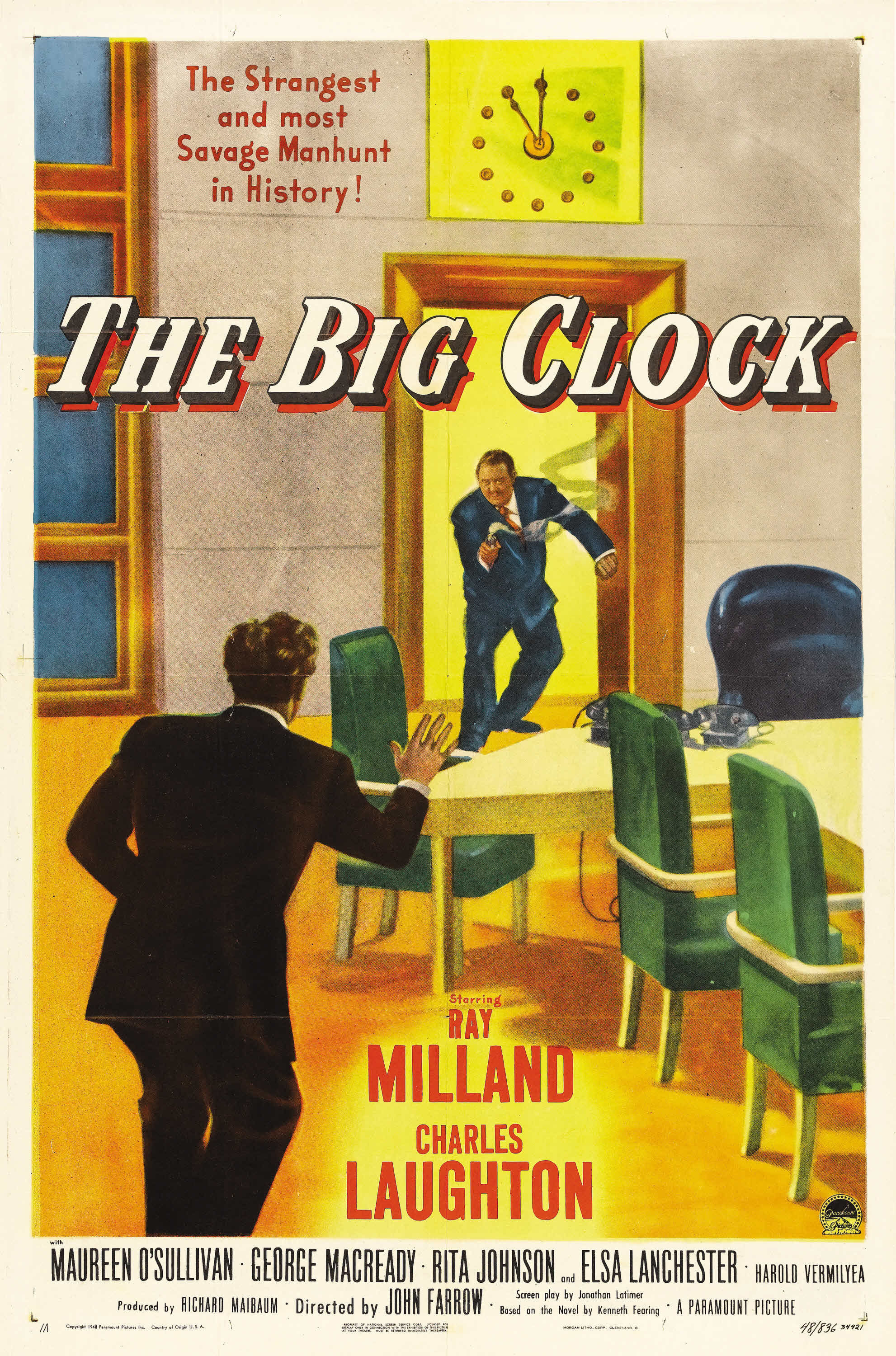
Noirvember: The Big Clock (1948)

the big clock poster

Knowing that I’m a big film noir fan, my wife recently bought me a bunch of postcards with film noir posters on them. Some of them I’ve seen, some of them I haven’t. A big chunk of my list of films to watch this month comes from those postcards. This is one of them.

Ray Milland plays George Stroud an editor at a big magazine in New York City. His boss Earl Janoth (Charles Laughton) is tyrannical. He’s the type of guy who calls a meeting to yell at everybody because subscriptions are down, then demands they come up with immediate solutions only to berate them when they respond. He doesn’t berate George because he’s just got a major lead on a missing person’s case. Janoth demands that George stick with the case even though he has a vacation planned for the next day.

George can’t miss that vacation. He’s missed too many vacations with this job, including his honeymoon. His wife is none too happy with him. He quits the job, but still misses his train. A glamorous woman, Pauline York (Rita Johnson) overhears his predicament and sees it as an opportunity. She’s Janoth’s secret lover and she’s ready to sell him out. She wants George to tell the story.

She gets herself murdered. Janoth learns that someone was seen leaving her apartment not long after the time of death. He forces George to supervise a team of reporters to figure out who that man was.

Spoiler alert: that man was George. He spends the rest of the movie trying to find himself.

The Big Clock is a lot of fun to watch. Milland and Laughton are terrific. Elsa Lanchester, in a tiny role, steals the show. It is one of those films that’s really quite good, but there is some little something that keeps it from being great. Still, it is a swell time at the movies.

Noirvember (2022)

Now that 31 Days of Horror is officially over we can now move on to Noirvember. That’s an amalgamation of Film Noir + November. Film Noir is a cinematic genre without a solid definition. When filmmakers were making film noirs during what is now considered the classic period (the 1940s and 1950s) the term wasn’t widely known. It was coined by a French critic in 1947 but was not widely used until the 1970s. Noir is the French word for black and even though the films are usually shot in stark black and white he was talking about the character’s dark night of the soul.

The fims are usually, but not always, crime dramas. They usually, but not always, follow a police detective or a private detective as they solve a case, or just as often they follow the criminal. There is often (but not always) a love interest, and if that’s a woman, she is usually a femme fatale. The criminal is often a bit of a schmuck. They are always cynical and hard-boiled.

Many of the plots come from the hard-boiled literary school of authors like Raymond Chandler, Dashiell Hammett, and Jams M. Cain. Classics of the genre are Double Indemnity (1944), The Third Man, Mildred Pierce (1945), and The Maltese Falcon (1941).

I love a good film noir, probably even more than I love a good horror movie. I’ve participated in Noirvember for the past several years and just like my 31 Days of Horror list I made a Letterboxd list of films I’d like to watch this month. This year I tried to include a lot of relatively obscure films in the list. I’ve seen most of the classics and I want to broaden my knowledge base of the genre. I know I won’t watch all of these films, and I will watch many other films that aren’t on this list. But it is a good place to start.

I will be writing about many of the movies I watch for this theme. I’ll try not to bomb you with quite as many reviews as I did last month. But I can’t really make a promise about that.