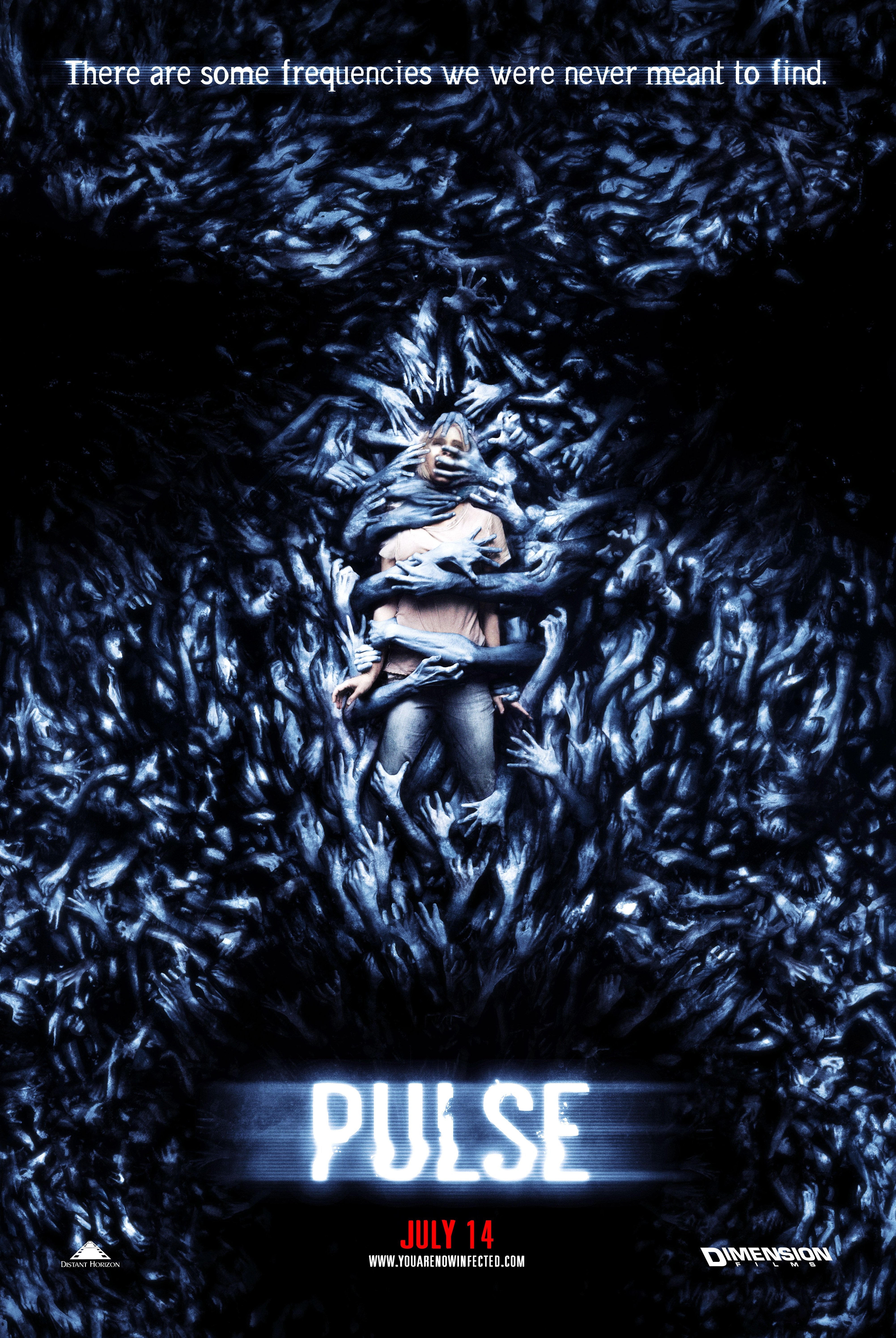
Pulse (2006)

pulse

Why?

Dear god, why did I waste 90 minutes of my precious life on this film? Why did the filmmakers waste so much of their time making it?

The story of how I came to watch Pulse yesterday afternoon is an interesting one. When it came out on DVD a few weeks ago I thought it sounded interesting. Or rather, when I learned that it was a remake of a Japanese horror film, I became interested in that.

I immediately went to Blockbuster.com and added the film to my queue. Well, I added the Japanese version, the American remake, plus another film named Pulse because I couldn’t quite figure out which version was the remake. Blockbuster’s website is amazingly slow, at least on my computer, and at the time it wasn’t worth the effort to try to figure out which was the proper one.

I put on the Japanese one first, figuring that if it was any good I’d determine which version was the remake and watch it. Of course, this being Blockbuster, their screwy queue system never works properly and I generally get my picks out of order. So, even though the Japanese import was number one in the queue, an American film titled Pulse, which was several movies down in the queue came first (and I should note the films above it are all listed as “available.”)

Putting the film in I assumed it was the American remake, but later found out later that it was in fact a British film titled Octane. Why the Americans have renamed it Pulse is beyond me. Is Pulse a better title than Octane? Do Americans not understand what “octane” means? The fact that it was changed means there was some board meeting discussing this very thing. Insanity reigns.

Anyway, the film was mostly lousy but contained a few interesting moments and was highlighted by a pretty good performance by Madeline Stowe. Then I soon discovered other movies that looked interesting, put them all way before the correct versions of Pulse in my queue, and promptly forgot about my desire to see the films.

Two days ago a friend and I went to see a movie (Night at the Museum – much funnier than I expected it to be for those of you keeping count) and afterward, he invited me over for some pizza. I had a Blockbuster return in my car so I decided to swing by there first. The only great thing about Blockbuster’s online rental program is that you can now return their mail-in movies to the local store where they will not only tell the computer to send another movie out but will let you exchange it for an in-store movie.

Being that my friend was expecting me, I quickly skimmed the new release aisle for something I hadn’t seen. Hmmm, what’s this? A new horror flick called Pulse? Sure, that sounds good. Now as insulting as it sounds, I really didn’t remember all the stuff that had happened previously in the above paragraphs and had no idea what Pulse was.

Took it home watched it and then remembered that this was the remake.

My kingdom for a better memory.

Oh! That I should have remembered and got something else. What a stinking goat turd.

Pulse has an interesting concept – the dead have found a way back into our world by slipping in through a previously unused and unknown frequency unleashed by some crazy virus-happy hackers. But the execution of this idea is astoundingly bad.

The dead find a way back to the real world, and what do they do? Drain the life out of the living, that’s what. That might make sense if this somehow made the dead more alive, but it doesn’t seem to have any effect. They just like making us living people want to kill ourselves. It’s fun, I guess.

The movie doesn’t concentrate on things like plot, or meaning, but rather spends its time trying to give the audience cheap scares. Honestly, I don’t mind a cheap scare movie, I can dig being jolted time and time again, but here they transcribe the scares minutes before they happen. Every. Single. Time. Oh, there’s a scary musical queue. Oh, the lights are flicking. Oh, suddenly our character is alone and in a strange place. Do you think something is going to jump out at them?

“Terrible” is the word.

Did somebody say plot holes? Did I hear the word continuity? You can almost hear the film saying in a Spanish accent, “we don’t need no stinking’ continuity.” You see the dead, they come through the internet onto your computer screen and then into your soul. Except when the plot needs them to come through other portable media like cell phones and PDA devices.

Then that’s okay too. Because those things have wireless connections right? Then well, okay, sometimes they can come through the computer even when it’s unplugged. But maybe they made their way into the computer before the power outage. That makes some kind of sense, until a character is in the basement doing her wash, then we need the bad guys to come out of the dryer. I guess it was a souped-up internet-ready dryer.

That kind of junk happens throughout. They make some arbitrary rules and then break them because they need another scare. But again, it isn’t scary because you know it’s coming from about three blocks away.

The only redeeming quality about the film was the inclusion of Samm Levine (who played Neil on the excellent, but quickly canceled series Freaks and Geeks) and even he has a small, nondescript part.

I spit on this movie. I fart in its general direction. I damn the 90 minutes I wasted watching it.

Bootleg Country: Tom Petty and the Heartbreakers – Las Vegas, NV (10/28/06)

Originally written in December of 2006. Sadly we’ve since lost Petty which only makes this article sadder.

In his 30-year career, Tom Petty has sold more than 50 million albums, received three Grammy awards, a Golden Note award, the Gershwin Award For Lifetime Musical Achievement, and been inducted into the Rock and Roll Hall of Fame. So why doesn’t he seem to get more respect?

To me, it stems from his ability to continually knock out solid albums in a steady fashion for all those years. Every couple of years, Petty puts out an album full of solidly good, if not great material. There are usually a couple of standout hits in each, but no album really rises above the rest. Think about it. Is there one Petty album that you would consider to be an absolute classic? What is his Revolver? Or Dark Side of the Moon? Or Blonde on Blonde? No, in my ever so humble opinion, none of his albums quite make it to that genius level.

Petty’s career has remained relatively stable over the last three decades as well. He continues to put out solid albums, record hit songs, and take his band on the road. There haven’t been any giant breakdowns or burnouts. He hasn’t even faded away. No, there has always been a Tom Petty making good songs and churning out classic rock. Where almost all of your great rock bands have all died by one means or another, Petty has remained one of the few rockers to keep truckin’.

I think by continually putting out good, not great albums so steadily it is easy for the casual fan to overlook Petty’s achievement. Without one brilliant album to cling to, his dozen really good ones get overlooked. By never leaving our presence, it’s easy to sort of forget about how remarkable his career really is.

10/28/06
Double Down Stage
Vegoose Music Festival
Las Vegas, NV

You can grab the show here.

One of the great things about Tom Petty’s long career is that he can play a different set list almost every night and still sprinkle it heavily with hit songs. For this performance, he performs half a dozen of his hit singles while mixing in songs from his newest album, Highway Companion, slightly obscure older songs, and a few BB King covers.

The Heartbreakers never veer far from the original versions of the songs, but perform with the vibrant energy only found at live concerts. Occasionally there is an extended guitar solo, but it never wanders far from the song’s melody and always ends way too quickly for these ears. Mike Campbell proves over and over that while he may never make it to any top lists of greatest guitarist lists, he is more than capable of producing sweet licks and charbroiled sounds.

This is a pretty decent audience recording, and as such there is a good blend of the band playing and the audience enjoying the show. The band mixes are a little muddled, so this is nothing to put on your A-list shelf, but the audience is so exuberant and excited in their response and sing-along that I find myself getting swept away in it all. When the light is just right, I close my eyes and almost feel like I’m right there.

Tom Petty may never find the diehard fanship of The Beatles, Dylan, or The Dead, but by continually writing good songs and putting on shows like this, he’s proven to be one of the most steady and long-lasting performers in rock and roll. Not a bad epitaph to have in the end.

Frankenstein Meets The Wolfman (1943)

frankenstein meets the wolfman poster

I’d like to say that I grew up going to the Midnight Movies and staying up to watch the old Universal horror movies on television. I’d like to say that, but I can’t because, well, because it simply isn’t true. I grew up watching movies from my generation, the 80’s, and that means the Goonies, Gremlins, Ghoulies, and others that don’t start with the letter “G.’ It has only been recently that I have dipped into the classics of horror and began watching them.

There has been a recent spat of high-quality DVD releases of the mainstays of the franchise – Dracula, Frankenstein, and the Wolfman – and I’ve filled my till with the magic, the brilliance that is those films. So, it was with pleasure that I recently found a VHS copy of Frankenstein Meets the Wolfman.

To say this is a great movie would be missing the point and make me think you were delusional. It’s far from anything anyone ought to call great, but it’s still a pretty fun bit of horror history.

The title is a little misleading – well not technically so since Frankenstein does in fact meet the Wolfman – but a picture like this makes one think they will either be locked in mortal combat for the entirety of the picture or team up to destroy some other force, like Dracula for instance.

More to the point it is something of a character study for the Wolfman as he is awakened from his grave and has to come to terms with his moonlight alter-ego. It is late in the film when he manages to come across Frankenstein’s castle and a frozen monster inside. The monster is awakened and wreaks havoc before coming to a not all too engrossing close.

The film has a good atmosphere and the sets are marvelous, but it never gets fully off the ground. There just doesn’t seem to be enough plot to keep the story moving, as it often plunges into a dulldrom.

Definitely worth checking out for classic horror fans, but not the first place to stop.

Rabid (1977)

rabid movie poster

Going to the video store with my wife is an interesting endeavor, as we have rather divergent tastes in movies. I have recently developed a devout love for all things Japanese and Italian horror, while my wife prefers obscure French cinema. This usually means that we spend way too much time wandering around the store looking for something we both can agree on until one of us gives up, and the other gets what they want.

I recently won out and settled on the 1977 Canadian horror picture, Rabid, starring adult film icon Marilyn Chambers and directed by David Cronenberg.

The second part of our video renting dilemma is actually watching the films we choose. My wife always complains that I never let her watch the videos she gets from the library (which is true for she gets rather dull-looking French films and horrible BBC series adapted from weepy women’s literature.) And I complain that she never lets me watch my gory, bloody zombie flicks (which is also true, because she doesn’t let me watch them.)

When we actually manage to find something we can agree on (usually classic American films) we make a cozy evening of it, otherwise we have to wait until the other one is either at work or back at the computer engulfed in something else.

Luck struck me twice and I was able to watch the aforementioned Cronenberg flick while the wife worked on her dissertation.

It is one of Cronenberg’s first pictures made strictly for the cinema and a rather low-budget affair but not without its merit.

The film begins with Rose (Marilyn Chambers) and Hart (Frank Moore) taking off on a motorcycle trip only to have a serious collision with a stalled van out on the highway. The two are taken to a plastic surgery clinic due to them being miles away from the nearest hospital in Montreal. Hart is merely banged up, but Rose is in serious condition.

Dr. Keloid (Howard Ryshpan) decides to perform an experimental skin graph on Rose and the surgery seems to go well, but Rose is left in a coma for many weeks. When she finally comes out of it, she feels very strange, and very cold and has what has to be the oddest placed film mutations ever – a small, Alien-esque spike that sprouts out of a very vagina-looking hole in her arm pit.

Rose then begins going around hugging her victims in order that the underarm-spike thing can stab them and suck their blood. These victims then mutate themselves into rabid zombies biting and infecting others until they slip into a coma and die.

It’s all fairly silly, but Cronenberg proves himself very capable of turning it into a pretty thrilling, if not particularly cinematic, piece of film. It is definitely a Cronenberg film too as it all moves fairly slowly, is filled with some very deliberate camera work, and makes a few social observations about plastic surgery amongst all the blood and death making.

Marilyn Chambers proves a very capable actress coming into her first non-porn role. Though after this she slipped right back into porn. Even here, though she has to do some actual acting, there is an abundance of boob shots. I swore I would never complain about naked boobies, and I shan’t here even though they are as bountiful as they are gratuitous and cause continuity problems galore.

The rabid zombies plague Montreal until martial law is declared and poor Hart realizes that Rose is the cause of it all leading to a not-so-happy ending.

This isn’t Shakespeare, nor even a big-budgeted Michael Bay picture, but Cronenberg manages to create something interesting and well made despite his obvious budget limitations. It is obviously influenced by Night of the Living Dead and an influence on films such as 28 Days Later. Certainly, a picture to see by Cronenberg fans and horror-philes alike.

Lucinda Williams – Car Wheels On A Gravel Road, Deluxe Edition

car wheels on a gravel road

I’ve mentioned before that Lucinda William’s Car Wheels On A Gravel Road is one of my all-time favorite albums. It stands to be mentioned again.

Car Wheels On A Gravel Road is one of my all-time favorite albums.

It’s a nearly perfect record. It’s full of sadness and heartache, and longing and lust In my review of the alternate version of Car Wheels I mentioned that I once included “Jackson” onto a mix tape I made for my wife long before she was anything but a friend. What I failed to mention was that I long contemplated putting “Right In Time” on there instead.

“Right In Time,” you see, is all about the singer missing her lover deeply, so much so that she turns off the lights, lies down, and does things that I was ultimately not so sure would turn my friend into the sort of girl I was interested in. Oh sure maybe she’d dig it and get the picture and moan awhile with me, but more than likely she’d take such an overt statement of lust into offensiveness and I’d be left all alone, on my own to moan.

Wisdom got the better of me and I chose the sad song instead of the sex song and years later I’m still happily married to that woman.

It is an album full of love, broken lovers, longing, and lust. From the opening song’s lustful longing to the tragic tale of a woman moving on in “Jackson,” it is an album full of dusty back roads, run-down juke joints, and the untold stories of America.

The good people at Lost Highway have seen fit to release Car Wheels in a two-disk Deluxe Edition full of all sorts of bells and whistles. The whole thing has been re-mastered and it sounds full and crisp and beautiful.

They’ve also included three additional songs to the first disk to add to your enjoyment. “Down the Big Road Blues” is a classic blues number and Lucinda sings it like a pro. She hasn’t belted out this kind of hard-core blues since her first album. “Out of Touch” is a full-on weeper that was later included on her follow-up album, Essence. Also included is an alternate version of “Still I Long For Your Kiss,” which you might recognize from the film Horse Whisperer.

For fans, the real treat is the second disk which includes a full live performance for the WXPN World Café radio show. It’s a spirited performance featuring most of the Car Wheels album, plus a handful of older tracks.

For those unacquainted with Lucinda, this is the perfect place to start – you get her finest album in pristine form and some live tracks to round out her older material. For fans, not only do you get a fresh re-master of Car Wheels, plus a few bonus songs but a full disk of unreleased live material.

Lucinda Williams – Alternative Car Wheels On A Gravel Road

Put me on a desert island, make me create a top 10 list, ask me what I’m going to grab while leaping from a fire and you’ll come up with the same answer: Car Wheels On A Gravel Road. It’s right up there in my favorite, all-time anything. Heck, it practically caused my wife to fall in love with me.

Back before my wife was my wife before she was my girlfriend even, we were pals with a predilection for long-distance flirting. I decided to make her a mix tape (for what girl doesn’t love a mix tape?) and included the song “Jackson” from this very Lucinda album we’re discussing. That may seem an odd choice of songs to make a girl like a person, what with the lyrics about not missing the listener when she’s gone, and I suppose it is a little odd. The thing was, there was quite a bit of distance between us at the time and plenty of travel, and anyone can tell that, though the lyrics tell otherwise, the singer is full of nothing but heartbreaking longing.

That mix tape turned out to be the first nudge of the girl who would become my girlfriend who would then become my wife towards becoming all those things. From that one song, she went off and bought other Lucinda Williams albums and has been a fan ever since.

I suspect Car Wheels is an album with a million stories just like that.

The story of the album goes that the record that actually hit the shelves as Car Wheels On A Gravel Road was, in fact, the second version of the album made. It seems, ever the perfectionist, Lucinda recorded the album with Gurf Morlix, but after a few listens scrapped the whole thing and started completely over. Luckily the master tapes for those original sessions were kept and have been making rounds through bootleg circles ever since.

With the re-release of the final version of Car Wheels on a Gravel Road in a two-disk expansion set, I thought I’d visit the original sessions. (And sorry, dear readers, I do not have a copy of this bootleg available to download right now).

While I still have to claim the official album as my favorite version, what landed on the cutting room floor is pretty dang good. I’m really quite surprised she scrapped it in the first place. I’ve paid good money for albums that didn’t sound half this good.

It’s not, in actuality, all that different from what did find its way to the record store shelves. The basic outline for all the songs is here in the original version. The melodies and lyrics are almost identical. The main differences lie in the instrumentation and Lucinda’s vocal delivery.

Where the original version relied heavily on the acoustic guitar, the official version replaces the softer acoustic with the bluesier electric guitar. Lucinda’s vocals are much softer here as well. She sings more straightforwardly, without tons of emotion. It’s a good performance but carries little of the sweat-drenched heartache of the final version.

This is no more apparent than on “Jackson.” The final version is stark in its simplicity and is completely heartbreaking. She sings with such longing that it’s difficult to not fall on your knees weeping after hearing it. Yet in its original form, it’s a much lighter number filled with a fiddle and a two-stepping backbeat. It’s still a beautiful, lovely thing, but completely different in its emotional effect.

“Joy” is the only song that manages to take a completely different turn. Instead of soft acoustics and honky-tonk it throws a curve ball and manages to come out more like snarling funk. It starts with a rolling snake groove and builds into a growl. At just over seven minutes in length, it is the loosest song she’s ever recorded and contains one of the strongest grooves.

There are two additional songs here that didn’t make the final cut on the official version: “Out of Touch,” a Lucinda Williams weeper that found its final resting place in her follow-up album Essence, and “Down the Big Road Blues,” a classic cover song performed like an old Delta bluesman.

It really is a wonderful album in its own right, and though I have to agree with her final decision to recut the entire album, I’m still kind of amazed at what didn’t make it. It’s an incredibly interesting slice of history and some dang fine music for your ears.

The Beatles – Love

the beatles love

Originally written on December 05, 2006

Sir George Martin, working in conjunction with the Cirque de Soleil has recently released Love, a sort of remix Beatles cover album for the famed theatrical group. It has the full support of the surviving Beatles and the estates of John Lennon and George Harrison.

It’s a bit like any cover album in that it is full of both the old and new and comes out as both brilliant and redundant. The old and the redundant come out of it being the Beatles songs with the Beatle’s voices and mainly the Beatle’s own playing. The new and brilliant are all in the arrangement and mix.

It’s all the same songs except that some of them have been slowed down a bit, and Sir George has taken various snippets and moments and slipped them into other songs brilliantly. He’s also added a little bit of his own orchestration to smooth it all out.

It is completely enjoyable to listen to, and quite a treat to hear how it all pieces together. But after a couple of listens, it all seems a little unnecessary. I keep saying to myself, ‘I have these songs already,’ and it seems rather pointless to have yet another grouping of them. To my ears, the novelty runs off pretty quickly and expect I’ll find myself reaching more for the originals more than I’ll ever be listening to this over and over.

Bootleg Country: John Prine – New York, NY (09/12/99)

It’s been a long time since the last installment of Bootleg Country, and I’m sorry about that. The truth of the matter is that I do most of my primary musical listening in the car. Sure tunes are often playing in the homestead, but it is usually regulated to the background as when I’m at home I’m either cleaning, or reading, or playing on this here computer and definitely not paying that much attention to the music that fills the aural cavities.

The thing that makes sense in that above paragraph is that I was laid off from my job back in August. Without a daily trip to and from the workplace, my automobile driving is rather limited. Well, I should say my automobile driving of my own car, for when I do go out these days it is usually with the misses and since she owns the better car, we take it.

Thus I’ve had little opportunity to do any listening to bootlegs, and without the listening, there isn’t much to write about.

Thanks to a long drive to visit my folks out in Oklahoma I’m happy to present the newest edition of Bootleg Country. I’d like to promise regular upcoming editions, but there still isn’t a decent job in sight.

Back in the days of college, I had a friend, well I had lots of friends, but there was one in particular that stood out. Musically that is. He had this big giant tape collection filled with all sorts of musicians I had never heard of.

You see when I was in the age of growing up I only knew music through the pop radio station, MTV, and my mom. MTV and the radio both played basically the same songs, that is to say whatever was a hit at the moment, while my mom had a nice collection of classic rock vinyl. It was there I first heard Dylan, the Beatles, Sonny and Cher, Simon and Garfunkel, the Beach Boys and many others. But even all this was not cutting very deep into the pantheon of rock music.

It was in the latter days of high school that I began to search out music out of the mainstream. With magazines like Spin and Alternative Press I began to learn of bands like Fugazi, Dinosaur Jr., All, and Operation Ivy. Periodically I actually had the cash to buy the albums I was reading about and my musical knowledge grew.

Then there was this fella in college who had such a lovely collection of tunes. We became friendly enough, and I dropped by enough that he gave me a key to his dorm room and I would often slip in while he was at class or on a date or whatever. I would sit all alone in that room playing tape after tape, filled with new music.

It was within those walls that I first heard a Grateful Dead bootleg. It was there I first fell in love with a man named Willie Nelson. And it was there I discovered Lyle Lovett, John McCutcheon, and John Prine.

John Prine
09/12/99
West 54th Street
New York, NY

In the liner notes to the first John Prine album, Kris Kristopherson tells the story of hearing an unsigned and unheard of John Prine play a few songs in a little club, after hours. He relates that moment to what it must have been like to hear Bob Dylan at the Gaslight in the early sixties. Kristopherson, no stranger to great songwriting, knows of what he speaks.

Prine laughs off the Dylan comparison in an interview on this bootleg with a breezy, “Yeah there were four or five of us,” and while Dylan comparisons aren’t really necessary, Prine has written some of the best-danged folk songs this country has ever seen.

This bootleg is from a taping of the television program, Sessions at West 54th and as such you get a few things that differ from the normal bootleg. The sound quality is great, though having been compressed for television signals, the extreme audiophile may beg to differ. The set is relatively short, fitting nicely onto one blank CD. And there are a few interview sections with John Hiatt.

I should also note that my bootleg is missing a few songs from the official set list, which makes me assume that it was recorded straight off of the television show, and not the later DVD release, or soundboard feed.

As an added bonus there are a few duets with the always lovely Iris Dement. The taping comes off of Prine’s release of the album, In Spite of Ourselves, which heavily featured Ms. Dement.

The show starts with a rollicking, rambling “Spanish Pipedream” with a full band, and they sound like they are having lots of fun, even if the music is a bit of a mess. It still remains one of my favorite songs and contains an oft-quoted (at least by me) chorus:

Blow up your TV, throw away your paper
Go to the country, build you a home
Plant a little garden, eat a lot of peaches
Try an find Jesus on your own

The band settles down to a gentle “so sad it’s pretty” version of “Six O’Clock News” followed by the relatively new, but still utterly sad “All the Best.”

Iris Dement sings on four songs (“(We’re Not) The Jet Set,” “Let’s Invite Them Over Again,” “When Two Worlds Collide,” and “In Spite of Ourselves”) and while she is always a welcome voice to my ears, on this set she only accentuates the raggedness of Prine’s natural voice.

There is an amusing anecdote given before “In Spite of Ourselves” where Prine discusses how he had to cajole DeMent a little to sing the song with him due to its “questionable lyrics” (which include sniffing undies and convict movie fetishes.) Ultimately she was won over and we have a song that’s pure Prine – raunchy, sweet, and hilarious – and the world is better for it.

During one of the interview sections, Prine mentions how he got started in the business by playing at an amateur hour for a local club. After hearing the first three songs he’d ever written Prine was hired permanent.

Those three songs? “Souvenirs,” “Paradise,” and “Sam Stone.”

As Hiatt says in the interview, “Good God, I would have hired you after that too.”

For those of you unfamiliar with Prine or those songs, that would be like Dylan saying his first three songs were, “Like a Rolling Stone,” “Blowing in the Wind,” and “The Times They Are A-Changin.”

This is the best-sounding Prine bootleg I have, and despite a somewhat ragged performance, it is still a great disk.

The entire session has been released on DVD and is available through Amazon.

Studio 60 On The Sunset Strip: Season 1, Episode 10 – “B-12”

studio 60 b12

This week’s episode was another jumble of time frames.  Unlike the Nevada Day episode, it didn’t start with a large culmination of events and then backtracked to give us an understanding of what happened.  Rather it was more like Pulp Fiction in that it moved backwards and forwards within one week.

Honestly, I spent the first 2/3rds of the episode cursing that it was yet again using an odd time sequence, and yet in the last third the payoff was so good that I am now praising the technique.

The episode begins with the opening monologue of the show within the show.  Howie Mandell is the guest host and he declares that he’s looking forward to leaving behind Deal or No Deal for the night and getting back to his improvisational comedy roots.  Danny Tripp then comes on the stage, critiquing his monologue and bringing with him two ladies carrying numbered briefcases.  The gag is Howie has to choose one case like on his game show.  Tripp even pretends to get a call from the banker.

It reminded me a lot of most Saturday Night Live opening monologues in that it was really silly and not very funny at all.

During this bit, the camera moves backstage and we see that most of the cast has contracted a nasty little virus.  They are all being injected with a B-12 booster shot to allow them to make it through the night.

Once Tripp is off stage he is handed a note from Matt stating “5 dead in Grosse Point.”

The reporter, Martha O’Dell is back, and Tripp tries to have it out with her over the story she wrote.  It seems she wrote that Tom’s latest movie was a failure and cites the anonymous Aint It News commenter, Dilbert27 as her source.  This infuriates Tripp as it doesn’t seem professional to him.  Despite Tripp’s protest, Martha has complete access to the show and remains unphased by his harassment.

Matt gives Lucy and Darius the chance to write a single sketch for the show involving a bumbled robbery/hostage attempt.  The two are completely unprepared and nervous so Matt brings in an old show writer, one described by Tripp as “very serious.”  He is, in fact, very serious and stoic, but he turns into a great mentor for the two freshman writers.

He abuses them and scolds them and ultimately talks Matt into letting them see if performed during the Friday rehearsal.  It bombs, as he knew it would but figures this in the only way to instill the fear of god into them and make them write a good sketch.  It does and it is slated to run on Saturday.

Through various flashbacks we see everyone engrossed in an ongoing news story about a man holding his family hostage.

Harriett has been inducted into the Falstaff society and at her ceremony she is required to tell a joke.  Turns out she can’t tell a joke worth crap.  In several hilarious scenes, we see Matt giving her a joke only to have her butcher it completely with her faulty memory and terrible timing.

Jack and Jordan have it out over her personal life getting in the way and she finally agrees to do a Time interview to try to smooth things out.  It goes extremely poorly as she first tries to make jokes for answers and ultimately rails against him for making assumptions about how the industry is working against her.

Matt tries to rile Tripp up over a bad joke concerning the B-12 and how it cannot be taken by someone pregnant.

Dylan collapses just after the completely unfunny Bachelor in Rome skit in which he is dressed as a woman.

Unfortunately, the freshman skit about the bumbling criminal cannot be performed due to the sad news about the 5 dead in Grosse Pointe.

Jordan breaks down in Tripp’s office but refuses to take the B-12 and the night’s bombshell comes out that she is pregnant.  This was a little sleight of hand by the marketing department as all the previews made this look like she was indeed fired.

Both instances completed the off-kilter time use and created a very moving couple of moments.

Review:  ****

The queer timelines ultimately paid off.  In retrospect, I like this episode more and more as it really demonstrated Sorkin’s ability to write a good story and interweave all the various lines.  The show moved back into serious drama territory but managed to score some very nice comedy with Harriett bumbling her joke.

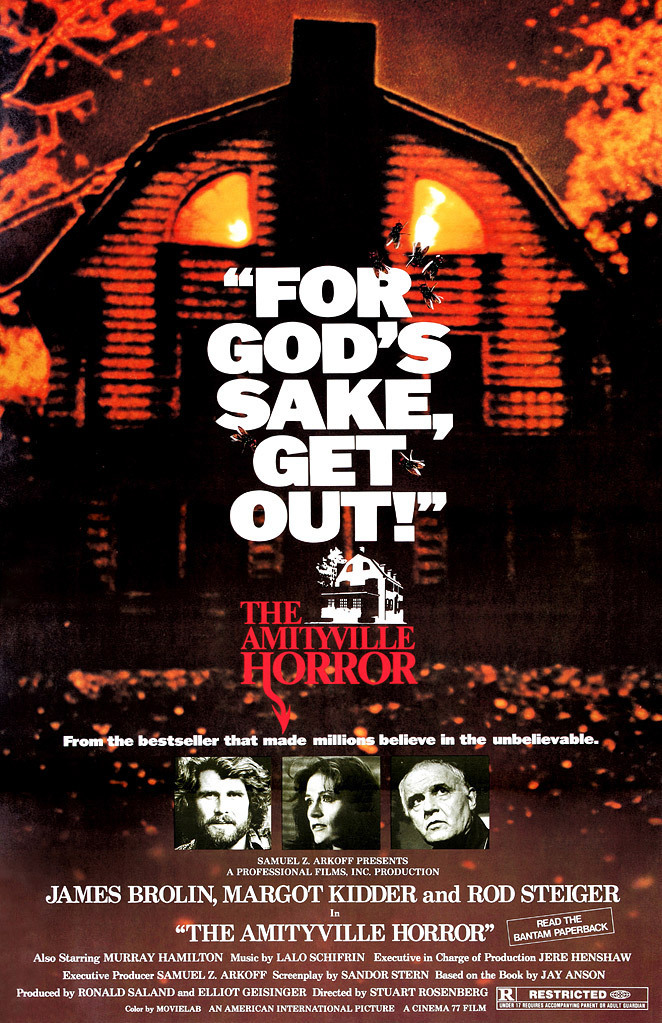
The Amityville Horror (1979)

amityville horror

Haunted House stories have to be some of the oldest examples of scary tales of horror. What’s scarier than the fear that resides right in your own home? Where can you find safety if not your own house? Where do we find much of our own horror but our own homes late at night with the creepy shadows and wind-blown creaky noises?

The Amityville Horror (1979) does a nice job of ratcheting up the spooks for about the first half but falters off towards the end.

Based on the book of the same name, which is supposedly based on true events, the story focuses on the Lutz family who just moved into a lovely old home that takes on some devious supernatural qualities. You see as the story begins we see that the family living in the home before the Lutz family were all brutally murdered in their sleep by one of their own. Even knowing this, the Lutz family buy the house for a bargain and move in because “houses don’t have memories.”

Houses it seems, not only have memories but have rotten dispositions too.

Strange things start to happen pretty immediately when the Lutz’s move in. The boathouse lights turn on and doors open in the middle of the night, the toilets get clogged with blood-looking ooze, and the priest who comes to bless the house (Rod Steiger) gets trapped in a room with a million flies and is told by a creepy voice to get out.

The film moves slowly towards its frights. This isn’t a film with a real live knife-wielding boogeyman ready to jump out and scare the family (and audience) at a moment’s notice. No, this film builds its horror with slow tension. Creepy things happen amongst the more mundane events of the family’s life. Between the scares we see the family unpacking boxes, attending weddings, taking boat rides, and chopping wood. Lots and lots of wood chopping.

Although amongst all of this in-between action, we hardly get to know the family at all. It is late in the film that it is revealed what George Lutz (a very hairy James Brolin) does. There is lots of talk about him needing to go back to work and all of these odd shots of the business van that only reveal that George owns his own business but strangely cut off the occupation. Eventually, it is revealed that he is a surveyor. And that’s how the whole movie is. We see a lot of the family doing things, but get no connection as to who they are as people.

Ultimately the slow build of tension fizzles out before it can really burst. This is the problem with making a haunted house picture. If there isn’t a ghost or phantom coming out of the walls, there is only so much horror a house itself can bring. Droves of flies, windows opening on their own, and chairs moving by themselves can build some tension, but without something bigger causing it all that’s left is a disappointment. In the end, all the filmmakers can muster is lots of heavy thunder and rain followed by a stairwell collapsing into a basement of blood. It’s just a house after all and that can be run away from.

Apparently, they followed the book pretty closely, and I’m not one to often ask for the creature behind the horror, but here it seems like they should have given us a little more. I can’t imagine the devil appearing for a final attack would have made the picture a great one, but it could have at least given a more adventurous ending.