The Friday Night Horror Movie: Get Away (2024)

get away

Horror often relies on putting characters in unfamiliar places. They might be somewhere remote and isolated, where help cannot be found. Or maybe they are in a different culture where they do not understand the language or customs. Putting our protagonists somewhere they do not feel safe gives us an immediate sense of dread.

Get Away falls in the tradition of films like The Wicker Man (1973) or Midsommar (2019) where are protagonists are both isolated from the outside world and surrounded by a strange and unfamiliar culture. It then plays with those conventions, subverting them in interesting and fun ways.

Richard (Nick Frost, who also wrote the script) and Susan (Aisling Bea), along with their two children, Sam (Sebastian Croft) and Jessie (Maisie Ayres), are taking a holiday on a tiny island off the coast of Sweden. They are looking forward to the island’s annual celebration of Karantan (where islanders nearly starved to death, resorting to cannibalism due to some forced quarantining).

Before they even arrive at the island, they are given the side-eye by the locals who warn them they won’t be welcomed there. They barely make the last ferry (which naturally won’t return for several days) and arrive on the island where they are greeted by scorn.

The one friendly face, Mats (Eero Milonoff), is the one who rented them the Airbnb, and he turns out to be a pervert, spying on Jessie and stealing her undergarments.

For the first hour, the film relies on the tropes of these sorts of films – miscommunications over cultural differences, an increasing sense of unease – and then it takes a big twist. I won’t spoil it, but unless you really aren’t paying attention, you’ll probably figure it out long before the film wants you to. It is a bit strange that it takes the film so long to get to that twist, because what comes after is where everybody seems to be having the most fun.

At that point, the unease turns into a straight-up gore fest with loads of well-done practical effects and very fun kills.

It is a film that isn’t nearly as clever as it needs to be, or funny, but it isn’t a bad cinematic experience. I like Nick Frost quite a lot, and it’s fun to see him just being weird and having a good time. I just wish I enjoyed myself as much as he seems to have.

The Friday Night Horror Movie: The Woman in Black (2012)

image host

My daughter is just starting to dip her toes into the genre of horror. I, of course, am doing my best to encourage this interest. She’s not actually much of a movie fan, preferring to watch various videos on YouTube and play games on her phone. So, I have to find my opportunities to suggest horror movies to her. This afternoon she seemed game to the idea and I spent a good bit of time trying to decide what movie I should show her.

She is relatively young so I didn’t want anything too gory, and I didn’t want the awkwardness of watching some sex scene or gratuitous nudity. I shied away from the old classics fearing she’d find them boring. I was leaning towards something from the 1990s, maybe Scream or I Know What You Did Last Summer.

By the time I was ready to pick something she informed me that her friend Zoe had invited her over for a hang-out. Disappointed I looked around some old digital content I had on a hard drive and landed on this, The Woman In Black. Ultimately, I was hoping she’d get home from the friend’s house and we could watch something together. That’s what I’d hoped to write about.

Alas, the play date turned into a sleepover and here I am.

The Woman in Black is the second adaptation of the novel of the same name by Susan Hill. It is a gothic horror story complete with an old mansion filled with ghosts. It has some good jump scares and sets a nice eerie mood. It is the type of film that you wind up staring into the backgrounds because often they’ll have something move in the shadows. But its story failed to excite me in any way and I found myself just waiting for it to end.

Arthur Kipp (Daniel Radcliffe) is a young solicitor in Edwardian London. He is still mourning the loss of his wife who died while giving birth to their son, who is now three. He is tasked to go to a small village and handle the paperwork of an old woman who has just died, leaving a large estate to be taken care of.

Upon arrival, nearly everyone in the village warns him not to visit the old house and does their best to convince him to leave immediately. One man, Sam Daily (Ciaran Hinds) is friendly enough and does his best to assist the young lawyer.

The house, of course, is large and spooky, and located across a watery marsh. The only road leading to it gets washed out for hours every day. Despite all the warnings Arthur is eager to do his duty. Almost immediately he hears strange noises and sees strange things, including a mysterious woman, dressed all in black roaming the grounds.

He’ll go back and forth from the house to the village several times over several days. Mysterious things will happen at the house and then he’ll talk them over with Sam. He’ll learn of the town’s many mysteries and the strange goings on at the house.

It is all pretty standard stuff and none of it is all that interesting. I found myself mostly bored with the story. It looks good and it builds a nice mood. The jump scares mostly made me jump. But overall I kept wishing I was watching something else with my daughter.

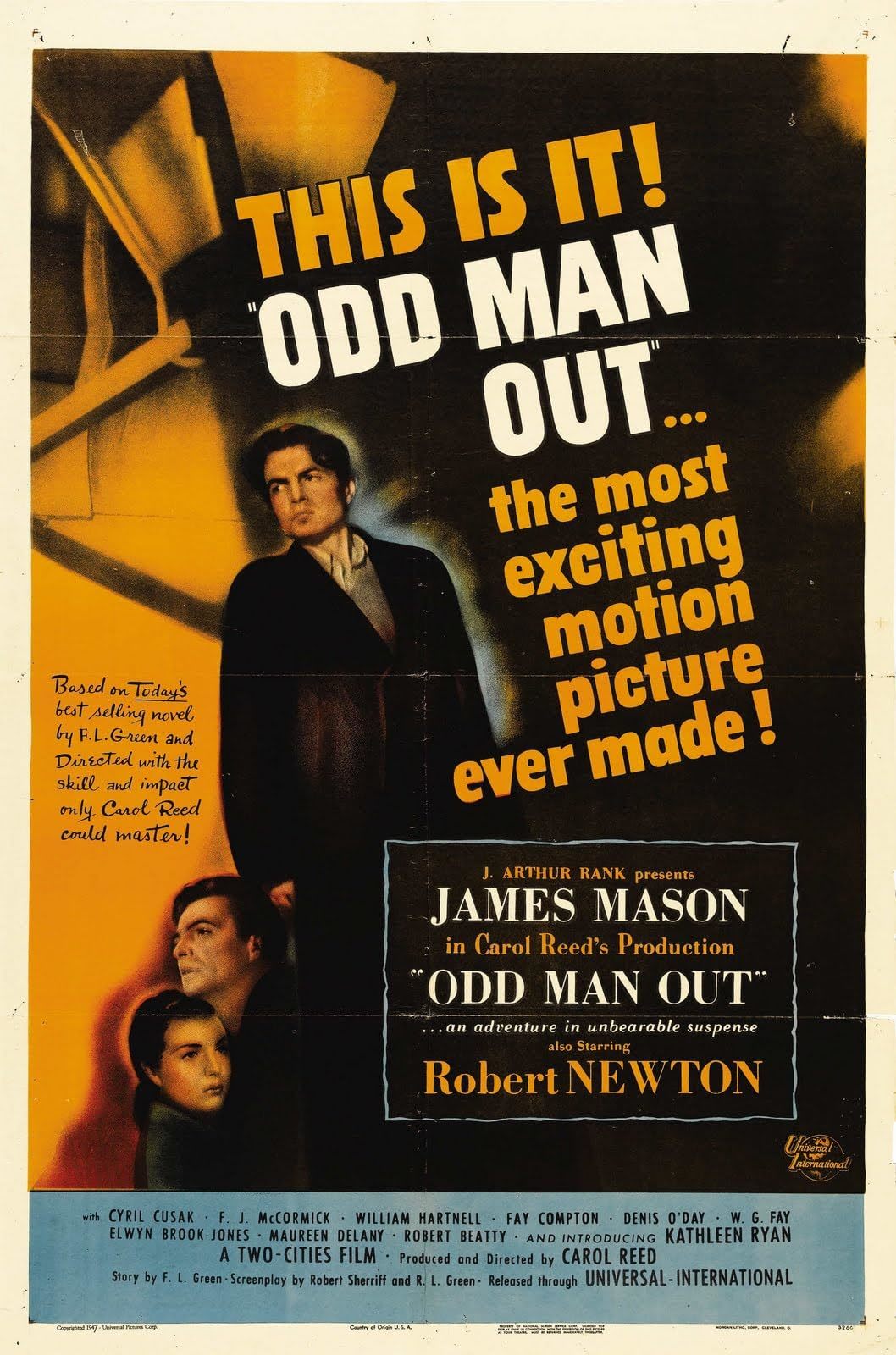
Noirvember: Odd Man Out (1947)

odd man out poster

Sometimes people suggest that The Third Man which was directed by Carol Reed and stars Orson Welles in a pivotal role was also secretly directed by Welles. Or that at the very least Welles gave Reed plenty of advice. The Third Man indeed contains the types of skewed camera angles and shrewd use of shadows and light that Welles so loved, but anyone suggesting that Carol Reed was incapable of such things has apparently never watched Odd Man Out. For it contains many such moments and it came out three years before The Third Man.

Odd Man Out stars James Mason as Johnny McQueen, an Irish Nationalist leader who becomes wounded after a botched robbery attempt. The film follows along as his friend and the police scour the city looking for him, while continually checking back on him as he hides out in an air raid shelter, a local pub, and finally an artist’s residence.

What is remarkable about the film (besides the filmmaking itself which is brilliant) is how much the film makes us care about all of these characters. Johnny is a criminal. He commits that robbery for the money, not out of desperation or need (there are political motivations, but the film never delves into what they are). He kills a man while fleeing the crime scene. While the film shows him remorseful for that act it never once lets us forget it. But it also makes us feel and care for him as a person.

Thematically the film delves deep into that question as to how we are as a society to deal with and react to a criminal – a fugitive from justice.

A couple of elderly women see Johnny fallen on the street. They think he has been hit by a truck. They take him in and attempt to patch him up. But once they realize he has been shot, and thus who he is, they change. They are no longer helping a wounded man but are aiding and abetting a criminal.

A priest asks for information about Jonny’s whereabouts. He won’t protect him from the police but would like to hear his confession. A local street hood tries to sell his hiding place to the highest bidder. An artist wants to paint him as he dies. Johnny’s girl Kathleen (Kathleen Ryan) will do anything to save him, even risk her life.

The film takes us through all of these interactions with great care and style. It doesn’t so much judge these characters as it asks us to ponder their dilemmas. Shot in stark black and white it makes great use of its sets, its location settings, shadows, and lights. It is breathtaking to look at. It is the sort of film that makes you think maybe Orson Welles learned a thing or two from Carol Reed.

It made for the perfect conclusion to Noirvember.

Noirvember: So Long at the Fair (1950)

so long at the fair poster

Vicky Barton (Jean Simmons) a young Englishwoman and her brother Johnny (David Tomlinson) travel to Paris for the Exhibition. They check into a nice hotel. They speak to the owner and the porter. The porter is miffed because Johnny gives him an English shilling for a tip.

They go to Montmartre for dinner and the Moulin Rouge for entertainment. They keep bumping into another Englishman, George Hathaway (Dirk Bogarde), and his two companions. His companions are staying at the same hotel and later that night he’ll borrow money from George to pay the cabbie.

Everyone goes to bed and when Vicky wakes up the next morning she finds that George is nowhere to be found. Not only that but his room doesn’t seem to exist. His room number, 19, is a bathroom and not a bedroom at all. No one at the motel will ever admit that they ever saw him. She arrived alone they say.

This story is based on an old urban legend. Usually, it involves a mother and daughter, but they’ve changed it to siblings here. It has been adapted into various stories over the years and it was the inspiration for Alfred Hitchcock’s The Lady Vanishes.

In the Hitchcock film, an elderly lady disappears from a train, and someone she only just met has to look for her. In that film the protagonist starts to think she’s gone crazy, that she only imagined the old lady. Which works because she didn’t really know the woman in question.

It seems much more difficult to convince someone that they don’t have a brother. Luckily, the film finds some clever ways to get past that. When she goes to the British consolute he says he believes her but that she’ll have to find evidence. He suggests finding someone else who saw her with her brother.

She remembers that a woman saw them together and that she was going to be at the exhibition. But something quite unusual (which I won’t spoil) happens to her keeping her from testifying.

The police chief likewise says that he believes her and goes to the hotel to question the owner. But again without evidence, there isn’t much he can do.

Enter George Hathaway again. Naturally, he helps the poor girl sort out exactly what has happened. It all leads to a surprising conclusion that is also somehow disappointing. They find a clever way to explain why they not only had to make Johnny disappear but his room too. It also satisfies questions of why they left her alone (except for the gaslighting).

And yet while it is clever, and it does explain everything, I found it not at all satisfying.

The film doesn’t amp up the mystery angle of the story very much. We know exactly who is involved, we just don’t know why. Vicky never seems to be in any real danger either. Instead, it is a story about a woman placed in an incredibly strange situation trying to understand what has happened and why no one will believe her.

On that front, it mostly worked for me. Jean Simmons is quite good and I always love Dirk Bogarde. He’s one of those actors that every time I watch him in a film I want to find him in other things.

In the end, it was a pretty good film, but I still prefer the Hitchcock version of this legend.

Noirvember: Dear Murderer (1947)

dear murderer

A man walks into a darkened house. He closes the curtains before turning the lights on. If he is a burglar he is a strange one, for he doesn’t take anything. He just looks around. He seems especially interested in some old letters, and flower cards that say simply “Love Always.”

He is Lee Warren (Eric Portman) and he lives in this house with his wife Vivien (Greta Gynt). He’s been away in America for many months on business. Those love letters are not from him, but from Vivien’s lover Richard Fenton (Dennis Price)

Lee devises the perfect way to murder Fenton and make it look like suicide. Even better he tricks Fenton into writing a letter that makes it sound like he’s killed himself over Vivien’s unwillingness to divorce Lee.

He almost gets away with it, too. Trouble is, Vivien had already broken it off with Fenton before Lee had even come home. There was only a brief affair and Fenton would not have killed himself over her. In fact, Vivien already has a new lover, Jimmy Martin (Maxwell Reed). Lee devises a new plan, with a little work, he can make it appear that Jimmy murdered Fenton and it was he that made it look like a suicide.

As this is a movie made in 1947 and is a film noir you can probably guess how well this works out for him.

This is a very British noir. It has little of that biting, cynical dialogue that comes with so many American noirs. The exchanges here are more polite, but still cutting. At one point Lee notes that he rather likes Fenton and under different circumstances, they might become friends. Later, Lee has a second change of heart and sabotages his own perfect murder because of his own feelings.

It has that detached British feel to the filmmaking as well. Like the camera is just an observer and we are an audience watching these strange events occur without ever needing to feel anything about them.

That’s not to say that this isn’t good. I mean it isn’t great, but it is an enjoyable watch. Greta Gynt is especially fun as a sort-of femme fatale who uses men to suit her needs and has no other use for them. Consider it middle-shelf noir.

The Good Die Young (1954)

cover

The Good Die Young is an odd little heist film. It spends more time developing its characters – four men who are not career criminals, and their wives – than it does with the heister (or its preparation, or what happens after.)

As a character study, it is pretty interesting. The acting is good (Gloria Grahame is in it and you can never go wrong with Gloria Grahame). But it lacks that certain something that makes a film great.

You can read my full review here.

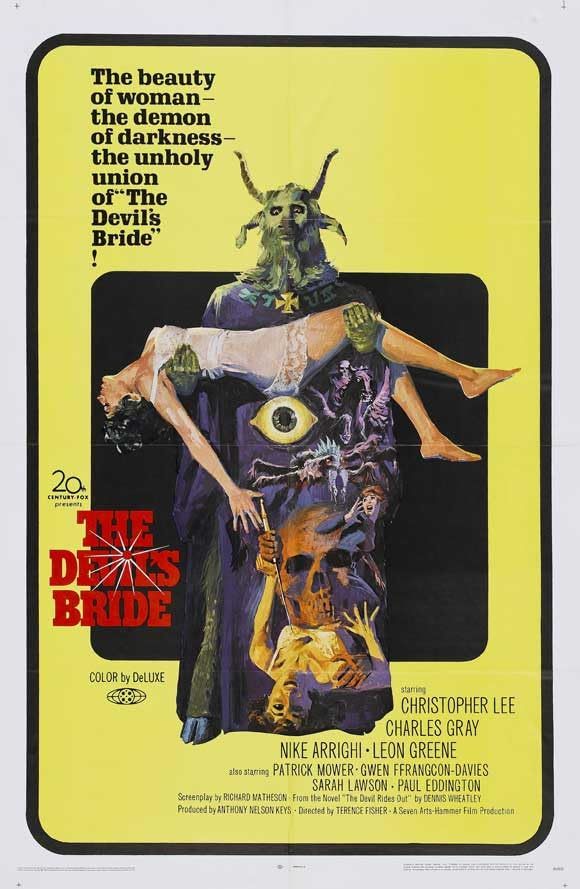
The Friday Night Horror Movie: The Devil Rides Out (1968)

poster

I am 100% a fan of Hammer Horror. I love the production designs, the sets and costumes, and the way their films looked. I love their stable of great British actors including Peter Cushing and Christopher Lee. I’ve watched something like 28 of the 70 or so films the studio made in the horror genre. So again I say I am a fan.

But I have to admit, that while I love a great many things about these films, I often find them rather dull. The films look gorgeous, and there is often a wonderful amount of sex and violence for a 1960s production, but the plots often have this staidness to them. There is a lot of boring talking and exposition that takes place that just causes me to nod off.

The Devil Rides Out (or The Devil’s Bride if you prefer) kept me completely enthralled from start to finish. It is quite wonderful throughout.

Christopher Lee stars as Nicholas, Duc de Richleau (who was apparently a recurring character in a popular series of novels from 1933 to 1970) a nobleman with a sturdy education and who is well-versed in the occult.

When his friend Rex Van Ryn (Leon Greene) returns home from a long voyage they decide to stop at their mutual friend Simon Aron’s (Patrick Mower) house. There they are met by a strange group of people Simon calls his Astronomy Club, but whom Richleau quickly deduces is a satanic cult.

They manage to rescue him from the house but almost immediately lose him again. They rescue him a second time, this time from a Satanic Orgy/Baptismal ceremony where a goat-headed Satan has been summoned. They also rescue Tanith Carlisle (Niké Arrighi) who was also supposed to be Satanically baptized that night.

Simon and Tanith are both somewhat under the spell of the head Satanist Mocata (Charles Gray). He can sometimes mind-control them into doing things for him (and sometimes he can’t depending on the needs of the script).

It is all a bit silly, but it won me over by the power of the performances (especially Christopher Lee who is always great, but especially wonderful here). Unlike a lot of Hammer films which tend to lean into their silliness, The Devil Rides Out is completely serious in its presentation and it is all the better for it.

There is a scene in the back half of the film in which Richleau creates a circle of protection that he and his cohorts must stand in to resist the power of Mocata. It begins with most of his friends being skeptical. It is a bit silly to think a chalk circle with some Latin written in it will protect them from anything. But then there is a loud knocking on the door and the sound of Simon yelling to be let in. Then a giant spider attacks, followed by Death riding a horse. The effects are cheap and goofy, but somehow effective. By the end, everyone is terrified, including me.

It is a scene that shouldn’t work. In the hands of less competent people, it wouldn’t work. And yet it is one of my favorite scenes in all of Hammer Horror. The entire film is like that. It shouldn’t be as good as it is, but somehow it is all pulled off magnificently.

Mademoiselle (1966)

mademoiselle

I reviewed a couple of Blu-rays for Cinema Sentries this past week and I’ll be linking to them today. First up is a British film set in France that stars a French woman speaking English (with a French accent) an Italian actor who speaks both English and Italian, and a bunch of other Europeans who all speak English with various British accents. All of which I find very funny for a film that is supposed to be made up of a bunch of French people.

But I’m not sure if I get to call it part of my Foreign Film February or not.

Also, it’s quite good. You can read the review here.

Noirvember: Brighton Rock (1948)

brighton rock

Watch enough British cinema and you will eventually come across the name Graham Greene. He was a novelist whose books were often adapted for the screen. Eventually, he became a screenwriter himself. His films include The Third Man (1949), This Gun For Hire (1942), Went the Day Well? (1942), Ministry of Fear (1944), and many others. I’ve seen quite a few of them and there isn’t a bad one in the bunch.

This includes Brighton Rock, a terrific little film noir about a group of hoodlums in the titular seaside English town. Richard Attenborough stars as Pinkie the razor-wielding, sadistic leader of a small gang of hoods. He happens across Fred (Alan Wheatley) a man he thinks is responsible for the death of the gang’s former leader.

He and the rest of the gang members (including the first Doctor Who, William Hartnell) chase Fred through a carnival until finally killing him on one of those creaky horror rides.

While trying to hide at the carnival Fred meets Ina (Hermione Baddeley), for having a woman by his side might work as a disguise. She winds up playing detective as no one else seems to care what happened to him.

Looking for an alibi Pinkie latches onto Rose (Carol Marsh) whom he comes across working as a waitress in a restaurant. She’s lonely and never had a guy before and falls in love immediately. He treats her terribly but says enough sweet things to keep her by his side (when he needs her to be).

It is an extraordinary performance from Richard Attenborough. I’ll always think of him as John Hammond in Jurassic Park (1993). He’s young here, and terrifying. He’s icy cold and the way he manipulates Rose is just awful (awfully good).

This is film noir all the way through with terrifically stark black-and-white photography, pitch-black characters, and wonderfully made from start to finish.