Westerns in March: Valdez is Coming (1971)

valdez is coming poster

Based upon a book by Elmore Leonard, Valdez Is Coming stars Burt Lancaster as Bob Valdez, a Mexican constable who is tricked into killing an African American by a rich rancher named Frank Tanner (Jon Cypher) and then takes his revenge. 

Tanner accuses the man of murder, and his hired gun, R.L. Davis (Richard Jordan) has been shooting his hovel up for quite a while before Valdez shows up. There is a great moment when the accused man’s Native American wife walks out of the hovel and over to a creek to fetch some water. Davis keeps shooting at her (intentionally missing; he just wants to watch her squeal), but she fetches the water with absolute calm.

Valdez figures he might be able to talk the man out instead of killing him. And he’s just about able to. He explains the man will have a better chance if he tells his side of the story instead of shooting it out with those men. As the man begins to agree, he leaves the door open, and Davis shoots at him. The man (and I’m sorry, I don’t think the film actually gives him a name, and I can’t figure out who played him) thinks it’s a setup and starts shooting at Valdez, who then shoots back, killing the man.

Once Tanner takes a look at the dead man, he realizes he wasn’t the murderer but shrugs it off as if it were no big deal.  Valdez figures they owe the man’s woman an apology and perhaps a little money for the mistake.  When he asks Tanner for $100, he’s laughed at and shooed away. When Valdez insists Tanner get his men to tie Valdez to a wooden cross and drive him into the desert.

He eventually gets himself free and finds his way home. Then he loads up with ammo and finds one of Tanner’s men and tells him to issue the titular warning:

“Valdez is Coming.”

And come he does. He sneaks into Tanner’s complex, kills some of his men, and then kidnaps Tanner’s woman, Gay Erin (Susan Clark.) The kidnapping is sort of accidental. It wasn’t part of the plan, but when Valdez gets into a bit of a jam, he grabs Gay Erin and runs.

I think this is supposed to show that Valdez isn’t the type of guy who usually kidnaps women, but that in these particular circumstances he had no choice. It helps that Gay Erin doesn’t actually like Tanner all that much. A sort of romance eventually develops between Valdez and Gay Erin, though the film is smart enough to not let it fully develop.

All of this is the type of thing we’ve seen before. There are plenty of films where a seemingly unsubstantial man gets pushed too far, and it turns out he’s an old badass after all. Valdez Is Coming doesn’t do anything particularly new with this, but it does what it does fairly well. If you can forgive Lancaster for playing a Mexican, his performance is actually quite moving.

I’m a big fan of Elmore Leonard’s crime novels, though I’ve never read any of his westerns. I have a copy of this one and have read the first few pages a couple of times, but it has never grabbed me, and I get distracted. The film has definitely made me want to go back to it. They say the film changes quite a bit and that the book is better (isn’t it always?)

The film is pretty good, so maybe that means the book is great.  Time will tell.
Westerns in March: Vera Cruz (1954)

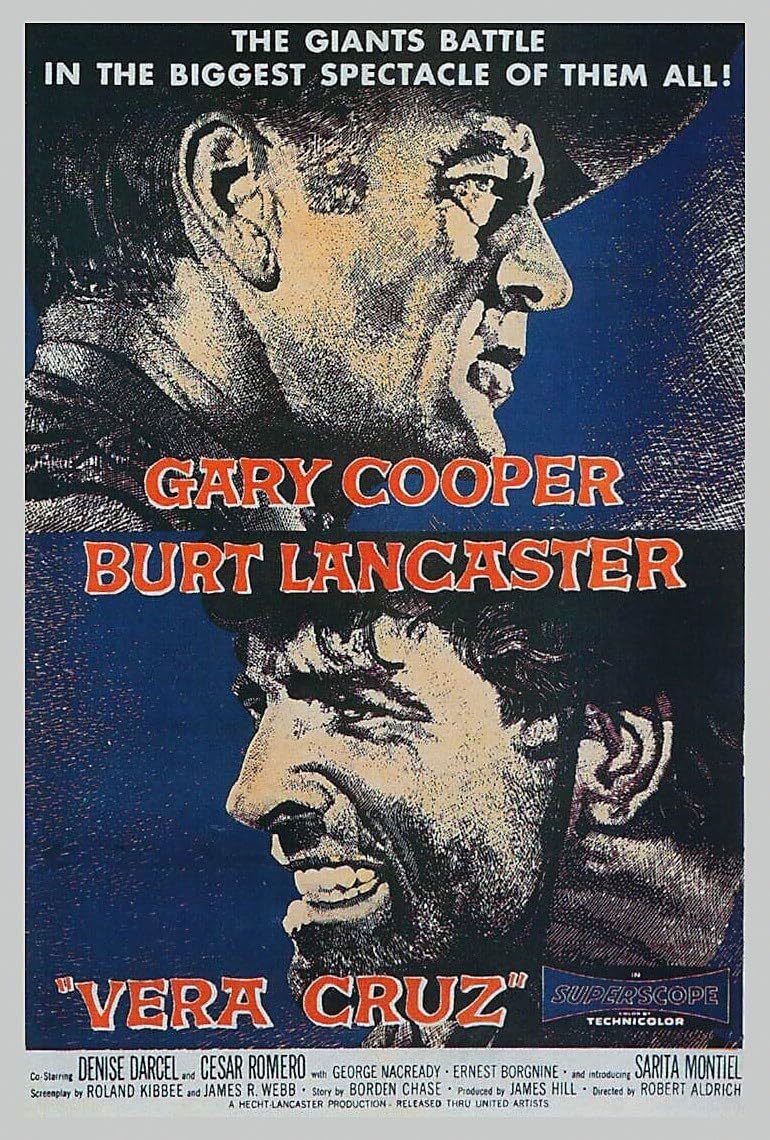
vera cruz

In my review of Blood on the Moon I talked a little about how the Western slowly changed from a genre about moral absolutes to one that sometimes lived in the grey. That film does have some grey tones to it. Robert Mitchum’s character is someone with a dark past, who contemplates destroying a family for money. But ultimately he chose the path of righteousness, and if we’re being honest, we always knew he would.

Anthony Mann and James Stewart would team up for five westerns (the first and probably best – Winchester ’75 came out in 1950) that explored the darker sides of men living in wild, lawless times. As the 1950s rolled along the genre changed in other ways too. They became more violent and dirty. Oh, Westerns had always lived by violence – gunfights and brawls are staples of the genre – but for decades the violence had been rather bloodless. But as times changed, as the culture changed, this violence became more explicit, more real.

Vera Cruz is often cited as a lynchpin for this change. All of its characters are amoral, cynical, and aggressively violent. At one point Burt Lancaster’s character threatens to murder several children if he doesn’t get what he wants.

Set just after the Civil War, Vera Crus follows Ben Trane (Gary Cooper) and Joe Erin (Burt Lancaster) as they look for work. Both fought during the war and now they aren’t cut out for much more than that. They head to Mexico because they’ve got their own war going on (the Franco-Mexican War). Ben has at least some sense of a moral code, those he’s still willing to kill for money, whereas Joe (and his band of cutthroats) is willing to do just about anything if the price is right.

They are recruited by both sides of the war – the Juarists and Emperor or Miximillian – but they get with Maximillian since he has deeper pockets. They are charged with escorting Countess Duvarre (Denise Darcel) to the city of Vera Cruz. Naturally, there are complications including the discovery of gold hidden in her stagecoach.

It is a dirty, cynical, violent film and both Cooper and Lancaster are good in it, but something about it just didn’t hit with me. I suspect part of the problem is the way it sits somewhere in between the Classic Western and the Revisionist Westerns that would follow in its wake. It has a classic structure to it, and while it is certainly more violent than those films, and its characters are more morally reprehensible, it never goes quite fully into those darker motifs. As such it feels a little out of sorts.

Or something. I really don’t know exactly why I didn’t love it, and to be honest I watched it a couple of weeks ago and its already faded in my memory banks. I’d say it is worth watching if you are a fan of the genre or those two actors. But it isn’t necessarily a must-see for everyone.

Run Silent, Run Deep (1958)

run silent run deep

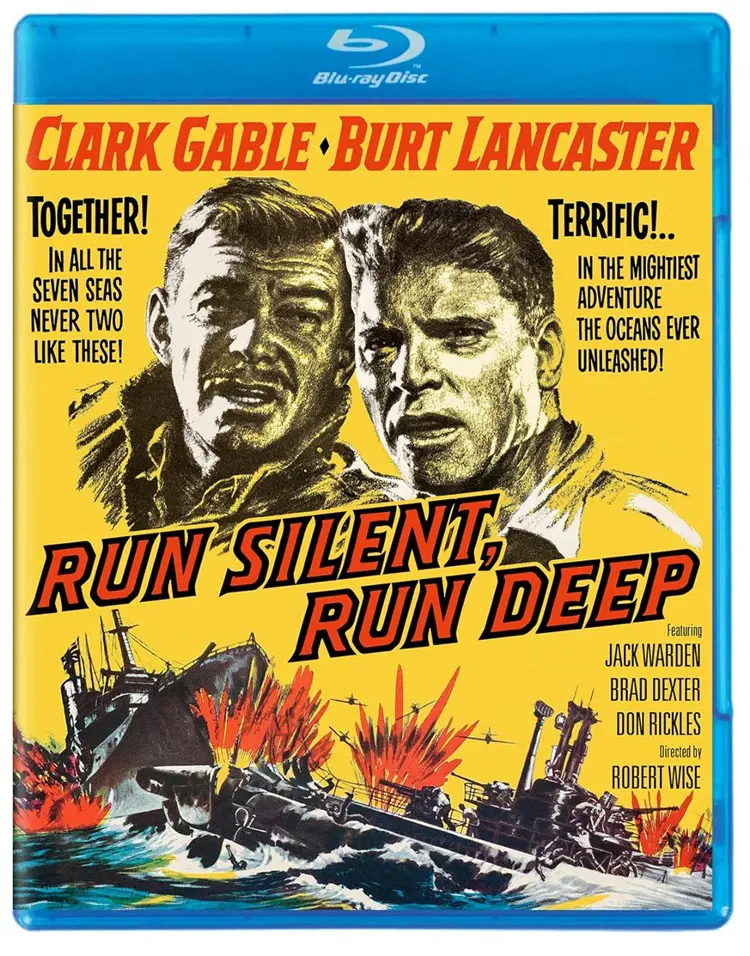
I love me a good submarine movie and this is the film that essentially created all of the usual tropes of the genre. It isn’t the best that was ever made, but it isn’t far from it either. Anytime you’ve got Burt Lancaster and Clark Gable in a picture you know you’re gonna get something interesting. Anyway, here’s my full review over at Cinema Sentries.

The Cassandra Crossing (1976)

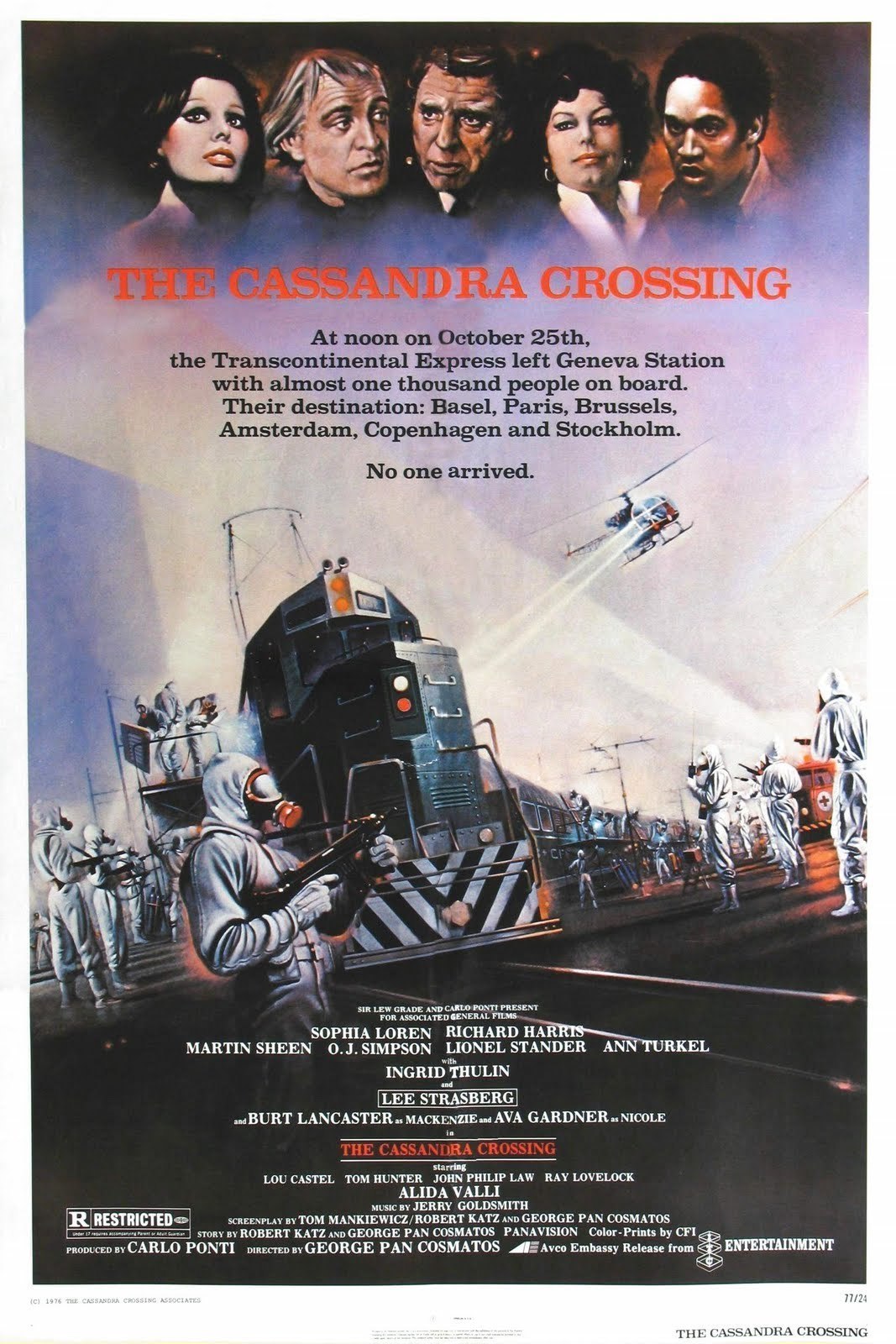
the cassandra crossing poster

The Cassandra Crossing which is one of those star-studded disaster movies that was so popular in the 1970s. It is about how an eco-terrorist accidentally contaminates himself with a deadly virus and then boards a train. Once the government learns what’s happened they seal up the train and make sure no one can get off. They reroute it to Poland where they will be quarantined until a cure is found. To get there they have to cross a disused and likely hazardous bridge called the Cassandra Crossing.

Richard Harris plays a neurologist who just happens to be a passenger on the train and becomes the defacto hero. Burt Lancaster is the government, military guy back at the base barking all the orders to keep everybody aboard. The cast also includes Sophia Loren as the neurologist’s wife, Ava Gardner as the wife of an arms dealer, Martin Sheen as her plaything, OJ Simpson as the world’s worst priest, and Lee Strasberg as a Jew who is none too keen to be returning to Poland (apparently the train is going to quarantine them at an old concentration camp.

That’s a good cast and the basics of the story are interesting, but like so many of these star-studded disaster movies it spends too much time giving each actor a good scene or two, and not enough making me care. Or at least be thrilled by the suspense.

It is confusing, too, I’m not 100 percent sure they were headed towards the concentration camp. Wikipedia says so, and Strasberg’s character has a nervous breakdown, but I didn’t hear any dialogue expressly stating that was their destination. I’m not really sure why they have to go to Poland anyway. The train was originally a Geneva to Stockholm exchange. It seems like they could just park it somewhere relatively isolated, board it up, and wait until the doctors figure things out. A lot of the plot is like that – confusing.

The actors, for the most part, seem to be having fun, and I always like watching lots of cool actors in a film together. But I wish they’d tightened things up a bit and concentrated on making this thing as tense as possible. Instead, it is a bit of a bloated mess.

Things do get a little exciting toward the end when our heroes do battle with the military goons in order to stop the train before it pummels off the bridge and it’s got one of those terrifically bleak endings. But it takes far too long to get there to make this a recommendation.

Sweet Smell of Success (1957)

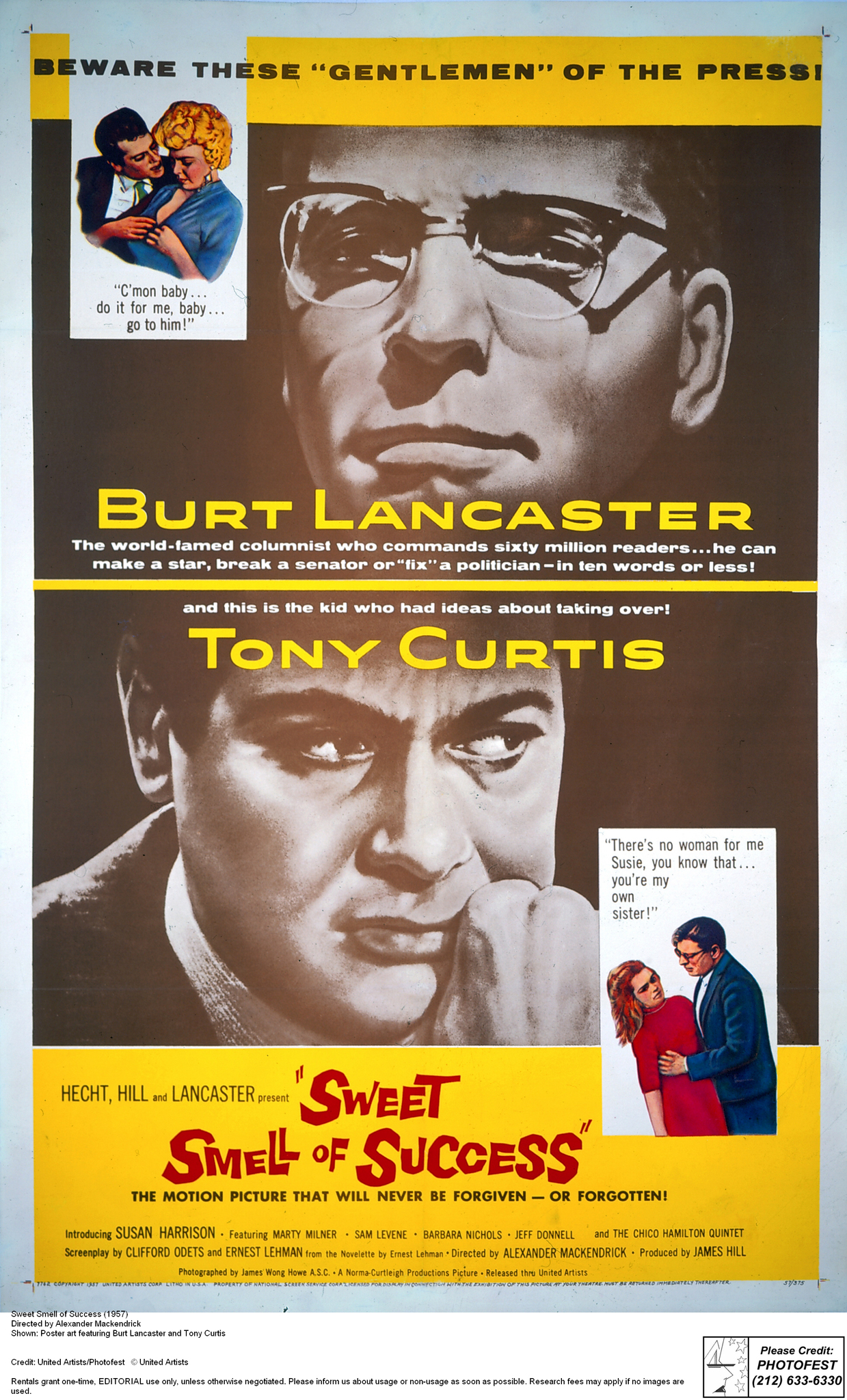
the sweet smell of success poster

This is the kind of film that could coin an expression like “They don’t make ‘em like that anymore,” except that people have been using that line for every piece of crap that was made more than two years ago. Go ahead and say it to yourself, and I’ll say that David Mamet’s Glengarry, Glen Ross comes close. Both feature snarling and biting dialog. Both have irredeemable characters that will do anything for success. Mamet’s characters are mostly down-and-outers who are scrapping at each other to find some sampling of their former successes. In Sweet Smell of Success, there are successful characters and losers, both of which need each other to survive. It is a tale of a successful columnist and his need for a low-life press agent. It is a bitter, bleak story of power, success, and the desire to have more.

Burt Lancaster plays JJ Hunsecker, a powerful columnist who is at the top of his game. He gets what he wants when he wants it with no questions asked. He can make or break celebrities with a quick blurb in his column. He dines with politicians and gets any girl he wants. Tony Curtis is Sidney Falco, a low-rent press agent who needs Lancaster’s blurbs for his clients to keep in business. The problem is, Hunsecker has cut Falco out of his columns because Falco hasn’t delivered on a deal they made. Though Hunsecker can garner the love and admiration of anyone he chooses, the one woman he cannot win over is his own sister. As he repeatedly says throughout the film, she’s all he has. The problem is she is in love with a jazz singer, and they plan to marry. Hunsecker can’t bear the thought of losing his sister, so he forces Falco to get rid of the boy by any means necessary.

The film is relentless. From beginning to end it never stops its pounding. There is never a breath of kindness. The two characters with some redeeming characteristics Hunsecker’s sister, Susan (Susan Harrison), and her boyfriend, Steve Dallas (Martin Milner), are so overshadowed by the continual foul play by Hunsecker and Falco that they come away with a foul stench.

Tony Curtis pulls a performance that reminded me of his turn as the Boston Strangler. It is not difficult to see his Falco turning to murder if it helped him succeed. Though as the strangler, he seems to have found some remorse for his actions, whereas Falco is irredeemable to the very end.

There is a scene in the middle of the picture where Falco pulls a trick to convince a mid level performer to make Falco his press agent. At this point, Falco needs all the clients he can get. Later the performer comes to Falco, ready to sign him as his agent. Falco, now feeling some signs of success brushes the performer off without a second thought. It is a telling scene of just how heartless and uncaring Falco has become.

Where has Burt Lancaster been all my life? Sadly enough, the only film I can remember watching him in is the 1986 toss-off comedy Tough Guys. His performance here is nothing short of astonishing. He is the king of his castle, never stepping off his high throne, treating everyone as servants. Even his shows of affection for Susan are grotesque and menacing.

This is a story that is hard to watch. It is brutal, and menacing with nary a redeeming aspect. But it is a film that must be watched. The craftsmanship of the filmmakers and the performances of the actors elevate it above so many others. It is nearly a morality tale of the horrors that befall humanities greed.