Last Known Address (1970) Blu-ray Review

last known address bluray

I love a good shoe leather movie. That’s a film that gets into the nuts and bolts of a job. Whether it is police work, newspaper reporting or any other thing, it is fascinating to watch people really do their jobs. Last Known Address has a lot of shoe leather. We watch our two cops knock on doors, meticulously dig through paperwork and do the type of policing most movies skip over.

There is a balance to that, you have to make the shoe leather interesting or audience will get bored and skip to something else. This movie keeps it interesting. I loved it.

You can read my full review here.

What Is It Good For? War Movies In June: Army of Shadows (1969)

image host

I did an absolutely terrible job of watching and reviewing war movies for this theme. I rewatched the great Army of Shadows this past month, and while I didn’t get around to writing anything about it this time, I did jot down some thoughts on my Letterboxd the first time I watched it a few years ago. So, I thought I’d reproduce those here:

There is a scene early in Army of Shadows in which three French Resistance fighters capture a traitor. They take him to an abandoned house to execute him. When they arrive, they find a family has moved in next door. The gun they hoped to use is of no use. It is too loud. The family would hear. 

They search the house for a knife. No luck. The basement connects to the neighbors’. No good. They stand together, these three men, alongside the man they plan to kill, discussing what to do. 

They could take him somewhere else. No time. They could call a friend and have him do it. No, it is their job. They could strangle him with a towel tied around a stick that would slowly tighten around his neck. Yes, that would work.

The trouble is, none of these men are trained killers or soldiers. They were regular people before the war, but now they’ve joined a make-shift army. They’ve found a cause. They cannot let this man live, or they jeopardize everything. 

They were prepared to shoot the traitor, which is impersonal and quick. They are not trained to watch the life drain out of him as they slowly tighten the towel. They do the deed and leave not as great heroes, but men who’ve lost some part of themselves, deflated, almost defeated.

Jean-Pierre Melville was a member of the French Resistance, and Army of Shadows is his film about the deep wounds, physical, psychological, and spiritual such a thing leaves inside a person. It isn’t a film with a lot of thrilling action sequences or where great heroes emerge. Like the scene I’ve just described, it is a movie about men and women who fight for a cause they believe in, who are willing to do things that destroy them inside for the greater good. 

This was my sixth Melville film in the last couple of weeks. I’ve loved nearly all of them, but this is his masterpiece.

He Loves Me, He Loves Me Not (2002)

he loves me he loves me not dvd cover

I’m back on my bullshit again – pondering why I write anything at all. While I do that, I figure I’ll keep posting old reviews from Cinema Sentries. Even if I never write a new thing specifically for this blog, I’d still like to make this a full depository of everything I’ve ever written.

This French film cuts itself in half, showing the same scenes from two wildly different perspectives. It stars the always wonderful Audrey Tautou, and according to my review, I mostly liked it.

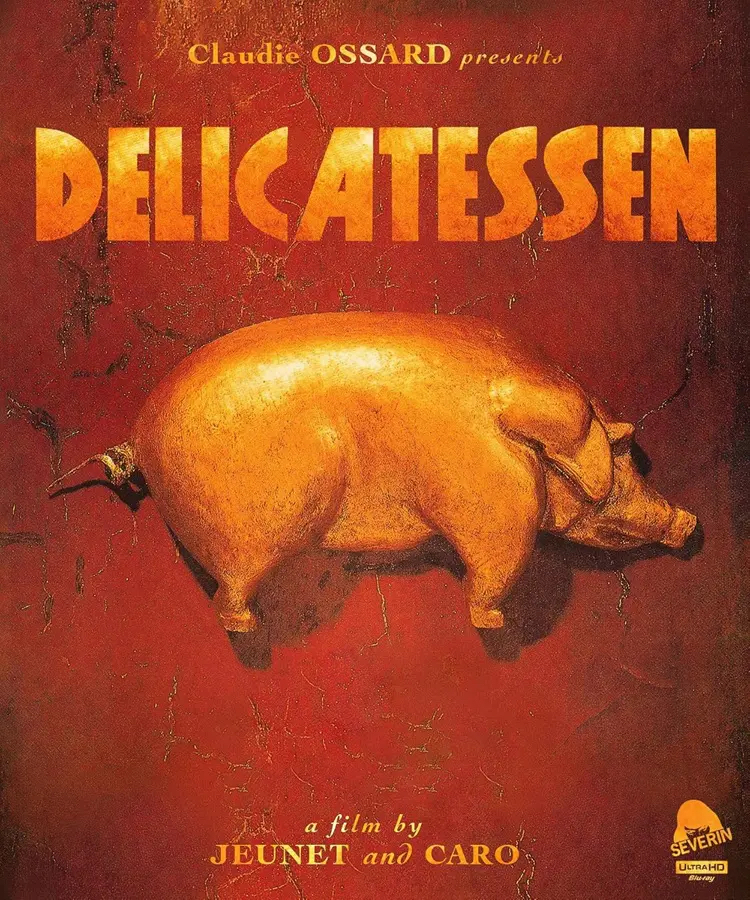
Delicatessen (1991) 4K UHD Review

image host

My wife speaks French. She has a Masters Degree in French Linguistics. She taught French at university for a time. She loves all things French. Especially movies. Obviously, I love movies and I dig foreign language films. I’ve seen a lot more movies than here, but she is the expert in French cinema in our house. She turned me on to director Jean-Pierre Jeunet with his absolutely delightful film Amelie. Then she hit me with his stranger, darker films Delicatessen and City of Lost Children.

Delicatessen is a visually stunning tale set in a post-apocalyptic world in which a butcher puts a help-wanted ad in the paper then murders those who answer and sells their meat to the rest of the apartment. It is romantic, funny, and a delight. You can read my full review here.

Weak Spot (1975) Blu-ray Review

image host

Weak Spot is a film that is difficult to explain or sum up. I reviewed it for Cinema Sentries a little over a month ago. I’ve been meaning to link to that review in these pages. I’ve literally queued it up at least four different times. But each time I’ve stared at this blank page not knowing how to write this little summary to get you interested enough to click over and read my review.

It is a French-Italian-German coproduction based on a Greek novel. It takes place in an unnamed location that is under totalitarian rule. It follows a man who may or may not be a subversive who is caught possibly passing a secret message onto another subversive. He is very casually taken to the capital city for questions by police who don’t seem all that interested in their jobs.

It is full of ridiculous situations played totally straight. It is confusing and weird and rather delightful.

I recommend watching it. I hope this intrigues you enough to click on this link and read my full review.

Foreign Film February: Le Corbeau (1943)

image host

In a small French town, someone calling themselves The Raven (or Le Corbeau in French) is sending out poison pen letters – gossipy missives accusing various townsfolk of scandalous goings-on. Though letters are sent to nearly everyone in town, accusing loads of people of all sorts of terrible things, they concentrate on Dr. Rémy Germain (Pierre Fresnay) accusing him of having an illicit affair and of performing illegal abortions.

At first, the letters are kind of funny, at least to those who are not being accused, but as more and more of the townsfolk are being accused things become serious quickly. One man commits suicide after being told something in a letter. Fingers get pointed. Demands are made to those in power. The letters must be stopped.

Directed by Henri-Georges Clouzot who also helmed the masterful Diabolique (1955) and The Wages of Fear (1953) Le Corbeau is a terrific little mystery in which the answer to who The Raven really is doesn’t matter nearly as much as what those letters do to the townspeople.

Made in the middle of the Nazi occupation of France the film can be seen as a commentary of the paranoia many French people felt during this period. Never knowing who to trust or what to believe. Interestingly, it also caused problems for its directors since it was produced by a German company, and the French were none too accepting of Germany-made things after the war. They eventually got over it.

It is sometimes called the first French film noir and I can totally see that with the moody black-and-white photography and Dutch angles. It falls just short of being the masterpiece that the two other films of his I mentioned earlier in this review, but Le Corbeau is still a wonderful film deserving your attention.

Foreign Film February: Certified Copy (2010)

certified copy poster

Certified Copy, Abbas Kiarostami’s 2010 drama is a strange, beautiful, perplexing film that puts a giant question mark up in the middle of its story and then never bothers to give the audience an answer.

It begins with a lecture. James Miller (William Shimell), a British writer is giving a talk about his new book, Certified Copy, which argues that copies of art – reproductions of paintings, sculptures, etc. – are themselves unique and therefore authentic art.

The film gives him space for the argument. In most films, whenever a lecturer stands before a class, we only hear a few moments of what they are saying before the bell rings, they are interrupted, or the film moves on. We only need to know they are a person with knowledge who is capable of passing that knowledge on to others. What they’re actually saying isn’t important. But here we spend quite a long time with the focus on Miller and what he is saying.

I got so caught up in his lecture that when a woman (Juliette Binoche, whose character name is never given) came in late and then fussed with her belongings, and quietly mimed to her young son I was annoyed at her interruption. How rude, I thought, can’t this woman sit quietly and let me hear what this man is saying? I had to remind myself I was watching a film and that this woman’s actions were what the movie was focussing on and thus I should pay attention to her, not the lecture.

Later he’ll find himself inside her antiques shop. It is filled with originals and copies. He’s delighted seeing that this will give them plenty to talk about. She’s irritated and notes that she only owns the shop by accident and that she doesn’t care for any of it.

They go for a ride. They talk about his book. They argue over art. She hated his book, yet asked him to sign multiple copies of it for her. She takes him to a museum and shows him a piece that was, for hundreds of years, thought to be an authentic bit of ancient Roman art. When they discovered it was a forgery, they kept it on display and added the story. Even the fake has meaning.

In a coffee shop, the proprietor will mistake them for an old married couple. She’ll run with the idea, creating an entire back story for them. I don’t want to spoil where the film goes from there, but it continues to toy with the idea of identity. Of what is real and what is fake, and whether or not the distinction really matters.

I suspect it is the type of film that critics love and the average moviegoer is either perplexed by or outright hates. I landed somewhere in the middle. I appreciated the discussions on art and that the film was taking some big swings toward something original and meaningful. My wife and I had a lovely little chat about the film after the credits rolled.

But I found it more of an intellectual exercise than an entertaining one. I tend to fall on the side of movies should be an enjoyable viewing experience over wanting movies to challenge me or stimulate my mind. They can do both, of course, and I’m not against challenging films, but these days I mostly want something I find enjoyable to watch.

I will say this is a film I’d like to see again. Knowing where it goes plotwise would help me concentrate on the other things it’s doing and I suspect I’d like it a lot more on a second viewing.

The Prince’s Voyage (2019) Blu-ray Review

image host

I’m an amateur film reviewer. I don’t do this for money. The closest I get is landing some free Blu-rays from Cinema Sentries. I do this for fun. I like movies. I like talking about movies. I think I’m pretty good at it, but I’m not professional. I didn’t go to film school.

I follow a lot of professional film writers on social media. Sometimes they complain about amateur film writers like me. Sometimes they complain that bad reviews just talk about the plot of a movie. Good reviews should talk about a film’s themes, about the filmmaking, and style. Plot synopsis can be found on Wikipedia.

I get that to a degree. But I’d also argue that it depends on what type of review you are doing. Often a review exists simply to give an opinion on whether or not the film is worth watching. To do that you are going to need to talk about plot. At least a little bit. People want to know what a movie is about before they decide whether or not they want to watch it.

I think about these things when I’m writing a review. I think about them when I read old reviews. Because I’m an amateur, because I’ve never studied film in a formal way I don’t always have something meaningful to say about a film. When I don’t have much to say I revert to talking about the plot. I hope I do it in an entertaining, or at least interesting way. I try not to give too much away while still letting you know something about the film. I never think those reviews are my best, but sometimes that’s what you get.

That is a lot of words to say that my review of The Prince’s Voyage is mostly about the plot. That’s actually good for me because I remember very little about it. I wrote this review back in May of 2021. Now you can read it too.

Foreign Film February: Keep An Eye Out (2018)

keep an eye out poster

Louis Fugain (Grégoire Ludig) discovers a bloody corpse outside his apartment complex and calls the police. At the police station, he is questioned by Commissaire Buron (Benoît Poelvoorde). Quickly we realize two things 1. Fugain is the main suspect. 2. Buron is an idiot of the Inspector Clouseau variety.

We first see them together at the station. Fugain is seated, waiting impatiently for Buron to get off the phone. His conversation is mundane, trying to set a date with someone for dinner. It lasts a long time. It seems a strange thing for a Commissiare to be doing in front of a man he thinks may have just committed murder. It is a strange movie.

After a few questions, Buron leaves to go speak to his son and eat a hotdog. He leaves Fugain with Phillippe (Marc Fraize) a one-eyed rookie who regularly ends his sentences with “Actually.”

A terrible accident occurs which Buron tries to cover up.

While Buron questions Fugain the film flashbacks to the scene. Sometimes Phillippe, or his wife, or Buron appear in those flashbacks and interact with Fugain even though they were not there in those scenes in the past.

The film plays it half-serious while regularly winking at the audience in its absurdities. It is difficult to explain just how ridiculous, how absurd, how French this film is. I won’t spoil how it ends, but to say it is utterly surprising and yet somehow fitting.