They Drive By Night (1940)

bluray

Humphrey Bogart is my all-time favorite actor. He was one of the biggest stars of Hollywood’s golden age. But he didn’t start out that way. He actually languished for over a decade before becoming a star. He spent most of that time being billed third or fourth in gangster pictures. They Drive By Night helped push him into the spotlight. It was not a gangster picture, and while he was still third-billed the movie was a big hit and it showed off his range. A year later he’d star in The Maltese Falcon and the rest is history.

George Raft is the star of the picture. And Ida Lupino. The film is a mix between a social message movie and film noir. It’s pretty good.

You can read my full review here.

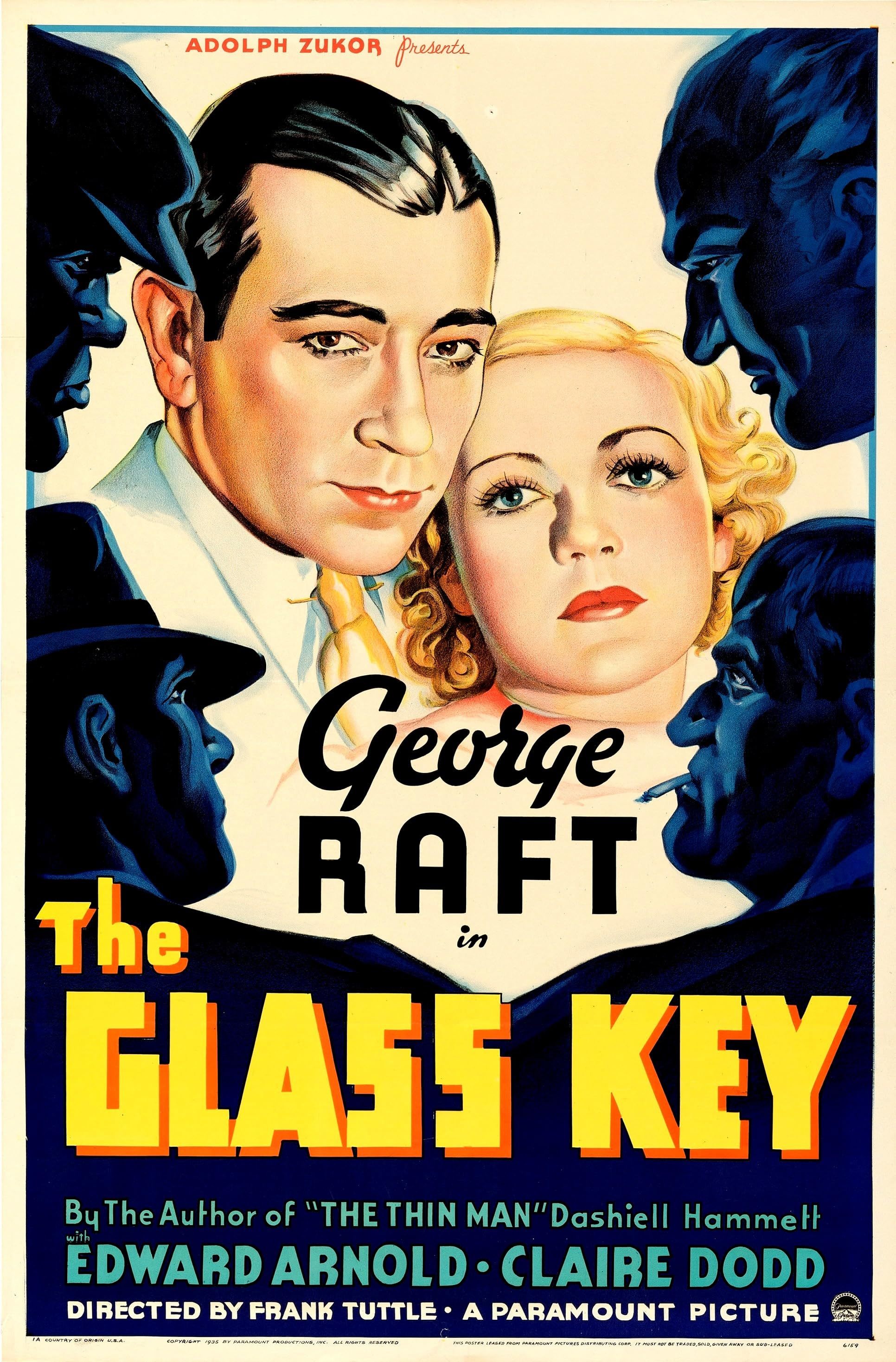
Murder Mysteries In May: The Glass Key (1935)

poster

It is easy to declare nowadays that Hollywood has run out of ideas, that all they do is remake older movies, or create endless sequels. But the truth is Hollywood has always bastardized itself. This is certainly true with the crime genre. There were actually two adaptations of The Maltese Falcon made before the famous one with Humprey Bogart.

Another Dashiel Hammet novel, The Glass Key was made into two films. The superior one, starring Alan Ladd, Vernonica Lake, and Brian Donlevy was made in 1942. This one was made just four years after the book was published. It isn’t bad, but if you are going to watch just one version of the book, watch the 1942 film. Actually watch the Coen Brothers Miller’s Crossing, which isn’t a direct adaptation, but it was certainly inspired by it.

Anyway, this one stars George Raft as Ed Beaumont the right hand mand of Paul Madvig (Edward Arnold) a gangster who controls pretty much everything is a smallish unnamed city. Pauls in love with Janet Henry (Claire Dodd) whose father is running for state senate. Beaumont thinks Janet is a grifter, using Paul in order to use his political sway to win her father the election. This causes tension between Paul and Beaumont.

When Janet’s brother gets murdered things get even more tense. Paul and Beaumont have it out and Beaumont seems to leave Paul for his rival.

The story is classic (like I said it greatly infuenced the Coen Brothers but it also inspired Akira Kurosawa’s Yojimbo, which was then remade as the Clint Eastwood Western A Fistful of Dollars).

This adaptation feels more brutish than the 1942 remake. It also feels like a proto film noir. Some of the pieces of that genre are here, but not quite polished (the remake is one of the classics of the genre).

I generally like George Raft, but he’s not exactly a world class actor. He tends to be a little wooden, which works okay in his gangster pictures, but Ed Beaumont is a guy who knows all the angles and holds his cards close to his chest. Raft just doesnt’ have the nuance to pull it off.

Claire Dodd is nice, but she’s not in the same league as Veronica Lake. There is a scene in both films where Beaumont is worked over by a gangster’s goons. In the remake one of them is played by William Bendix and he’s just terrific. That scene is one of my all-time favorites. Here its pretty much forgettable.

I’d say this is worth watching if you like the Hammett story or the 1942 film. But the remake is by far the superior film so if you haven’t seen that I’d head that way immediately.

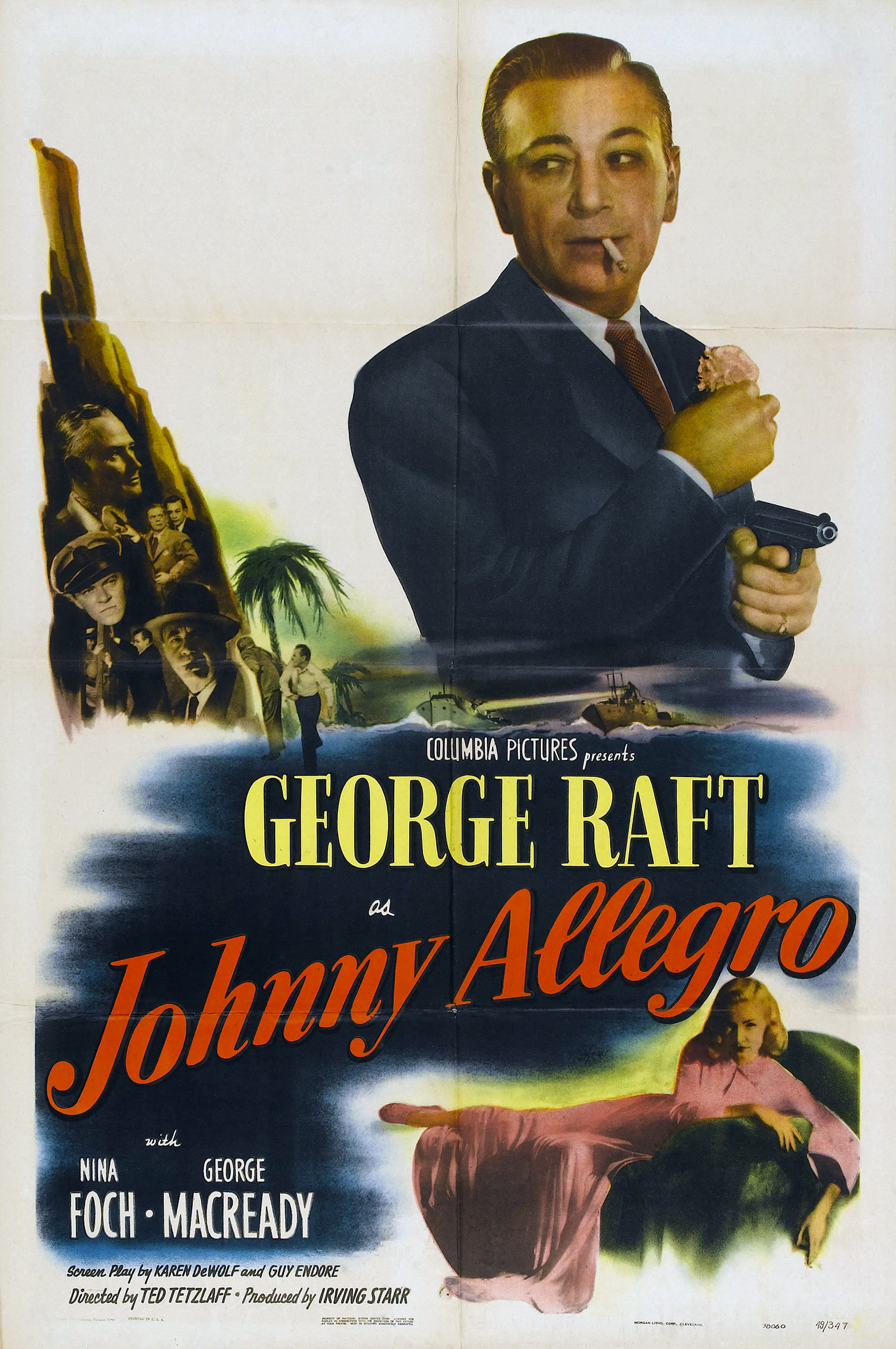
Noirvember #8: Johnny Allegro (1949)

johnny allegro

George Raft plays the titular Johnny Allegro, a florist with a secret past. When he starts playing nice with Glenda (Nina Foch) a federal agent takes an interest. It turns out she has a past too and a present. She’s married to Morgan Vallin (George Macready) a shady gangster that the feds are interested in, but have yet to be able to pin anything to. They figure Johnny can use his new connection to Glenda to get to Morgan.

He gets cozier with her and she invites him to meet Morgan on his private island. There is some discussion of Johnny being of service to Morgan’s counterfeiting scheme, but things turn sour pretty quickly. Morgan is a guy who eschews guns but loves playing with his big bow and arrow. Naturally, he uses it a few times and it all winds up a The Most Dangerous Game type situation.

George Raft was not a spectacular actor in the best of situations and here age has crept up on him. He plays Johnny like he’s bored most of the time. Big reveals in the plot barely get a raised eyebrow. George Macready matches his lackadaisical stance and between the two of them the film has a hard time creating any sort of tension.

It is, however, a ton of fun watching Macready fire off his bow and arrow. The actual story and the direction are all pretty good. Good enough to keep me watching anyway.

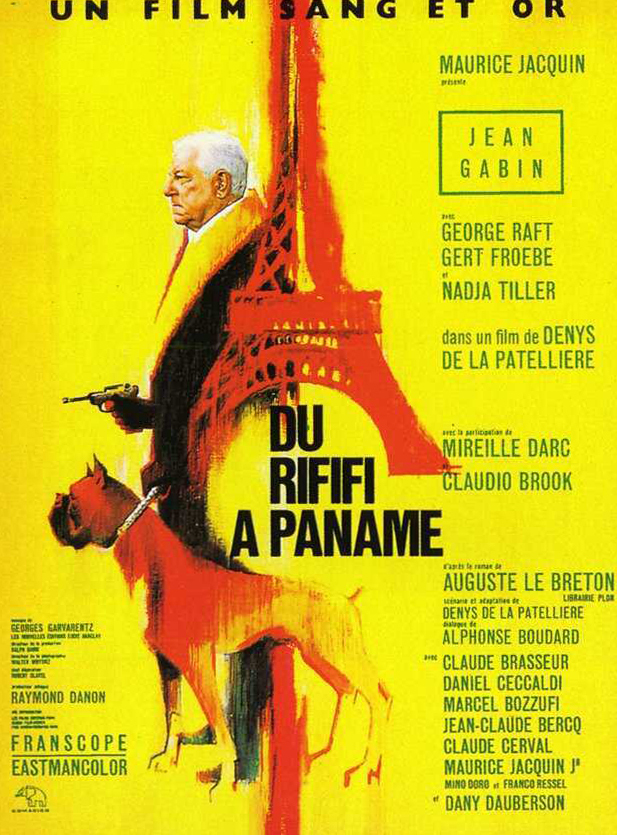
Rififi in Paris (1966)

rififi in paris poster

We now have a library card for the Strasbourg city library. In France, you have to pay an annual fee for a library card. There are actually two different prices, one if you wish to only check out books, and another higher priced card that allows you two check out multi-media items such as DVDs. Hearing that they had a selection of over 900 DVDs Amy and I decided we would shell out the expense of getting that type of card. We calculated that even if we only checked out one movie per week for the remaining time we are here, we would still come out cheaper than if we rented the same amount of films. The funny thing about their movies is that they almost never have any. Out of the 900 owned, there are usually only 6 or 7 of them available for check out at any time. We have been lucky that we’ve been able to find films that we would like to see. Both Rope and The Man Who Knew Too Much both came from the library.

This week I picked up Rififi in Paris thinking it was an old bank robber movie that I have heard good things about. Unfortunately, that film is entitled just Rififi. I am unsure if this is supposed to be a sequel or if it is just a coincidence in the title. There is limited information on The Internet Movie DataBase, and it wasn’t good enough to really look further than that.

The basic story of this film is that an American agent, Charles Binnagio (George Raft), is working undercover in Paris to stop a French group of gangsters. He uses his contact with a high-class hooker to start working for the gangsters by smuggling Gold to Tokyo. After saving the second-in-command mobster, Paulo Berger’s (Jean Gabin) life, Binnaggio is promoted to Berger’s bodyguard. Excitement ensues.

Due to complications involving the regional coding of the DVD I could only watch this film in an English dubbed version. I am universally opposed to dubbed movies, and try my best to only watch films in their original languages with subtitles if necessary. Watching this in the dubbed format was like slow torture. The plot was rather complicated to follow and I am not sure how much to blame on the language problem. What I was able to follow was resolutely bad.

There is no explanation why an American CIA agent would be infiltrating a group of French gangsters. There is a small subplot involving the weapons trade with Cuba, but it is not followed enough to make this the cause of the CIA’s involvement. To move the plot somewhere, a group of New York mobsters begins making threats to Berger and his cohorts to back off of several law-breaking activities. Violence ensues.

Binnaggio is so bad as an undercover agent that it is sheer movie magic that keeps him from being found out and killed. He visits the American consulate at will, talks with other agents as he pleases, and even snoops around the big boss’s house. It is surprising to see the French gang doing so well since they seem to have no ability to pay attention to their own members. The movie tries to build tension by having Binnaggio nearly found out or caught on a couple of occasions, but then the action moves forward and the enemy seems to forget. What little tension is built, always dies rather fast.

There is an odd quirk with the filming of this picture. More times than I could count there is a mirror located somewhere in the shots. Often we see one or more of the reflections of the character in the mirror, but many times we see only part of the stage. Once we even see a character’s reflection in a well-polished wall. I’m sure the filmmakers were attempting something meaningful out of all these reflections, but what that could be is beyond me. I was too busy being appalled by the sheer stupidity of the film to be bothered with such trivialities.