Saw II (2005)

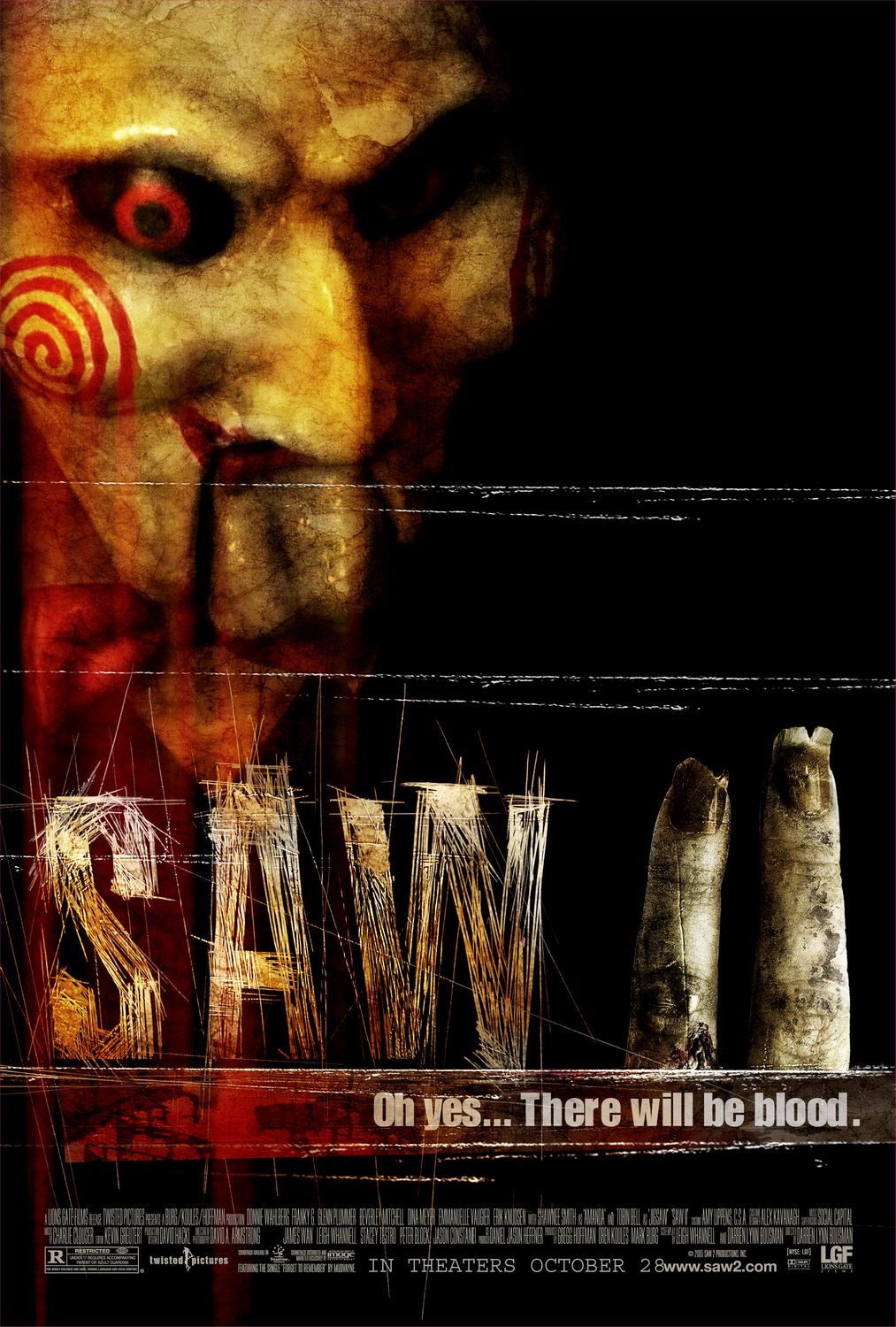
saw 2 poster

In my writing, there is often a conflict between the rational, intelligent critic, and the overly joyous fan-boy. There are many films, albums, and books that I enjoy that don’t stand up under critical observation. They are unoriginal, contain poor craftsmanship, and are quite often unintelligent and stupid, but for whatever reason, I enjoy them immensely. The difficulty lies in trying to review said material that criticizes its quality while still exuding the joy it can give while still maintaining my credibility.

This is doubly true for horror films. Perhaps more than any genre, horror cinema sets expectations very low in terms of overall cinematic quality. With few exceptions, horror films aren’t really very good and garner very little positive critical response.

For every Night of the Living Dead, there are a dozen Return of the Living Dead Part IIs. For every Dracula there exists countless Embrace of the Vampires. Gremlins spawn Ghoulies. And so on and so forth.

I can’t in any serious way recommend any of the Friday the 13th pictures, but when they come on the USA network you will always find me sitting in front of the TV anticipating the next gory move by Jason.

There is probably a secondary question in here about why I (and so many others) enjoy high-impact gore as much as we do. What is it about gushing blood and guts that excites me in some weird cinematic way? But that is more discussion than I have room for now.

I rented Saw II not because I expected it to be good, or a fine piece of cinema, for I expected it to be worse than the first one, and it rather stunk. Rather I rented the film because I wanted to see some inventive death traps, lots of gore, and plenty of blood even if to get there I had to wade through insipid acting, glaring plot holes, and a story that would make my grandma blush.

I got what I expected.

For those who missed the original or its sequel, Saw refers to Jigsaw a crazed serial killer who sets up elaborate games and traps to kill his victims. The games are often so intricate that they would take weeks to set up and involve so many improbable circumstances that they could only be produced in the movies.

In the first film, we are given absolutely no motivation for the killings. In the sequel, we are given a very basic, and rather insipid back story that is supposed to serve as reasons a person would create such elaborate murders.

Here, instead of random killings, Jigsaw has kidnapped several people and thrown them into a house, a house filled with traps and deadly games. Like in previous killings the players find a tape recorder whereupon Jigsaw tells them that the iron gates trapping them inside the house will not be released until two hours are up. However, a deadly gas is being loosed into the house which will kill them all in one hour. The only way to survive is to locate syringes located throughout the house which contain an antidote.

There are also several syringes in a large safe whose combination can be surmised once the players figure out what they have in common.

One of the players is the son of a police officer. The police officer, Eric Matthews (Donnie Walberg) manages to quite easily find Jigsaw in his lair and begins a stand-off with him to release his son, whom they can watch via closed circuit TV.

That’s way too much plot synopsis for a film that lives and dies by its gruesome traps. In the director’s commentary (yes I did listen to a few minutes of it before getting bored) it is noted that they created specific traps for each of the house players, but as the screenplay progressed their characters wound up doing more damage to each other than the traps. Thus we only see a few of the original death traps.

Herein lies a big problem for the film. The first one was effective (and I’ll use that term mildly) because of its creative use of death. The excitement was in the interesting use of gore and thrill. In the sequel, they try to create tension by making the characters go after each other a la Night of the Living Dead. But they can’t muster nearly that kind of tension. The few traps that we do see aren’t all that interesting either. The trailer for the movie shows one of the more interesting ones – a gun is bolted to a door which goes off whenever the characters use a key to open the door – and even that isn’t all that fantastic. Gore-ridden yes, but it is not exactly super original.

Again in the original, most of the traps entailed the player having to do something horrible to get out. Characters sawed their own legs off to get out of chains or dug through a corpse to get a key, but here most of the traps are pretty straightforward killers. Like the gun door, none of the characters knew it was a trap, there was no recording asking the character to do something to avoid getting shot in the head, it simply happened.

Perhaps asking a horror film to be intelligent, well acted, and actually scary is asking to much. Perhaps expecting the sequel to a mostly rotten gore-fest to be better than the original is expecting a miracle.

In the end, Saw II was a decent way to pass the time. No, there wasn’t anything to take away from the film, no revelations or interesting filmatic choices. But then again it isn’t meant to be. It made me squirm a little bit and be grossed out by the blood. And maybe that’s enough. Maybe

Dark Water (2005)

dark watert

In certain places around the world wide web, there are debates raging about the Hollywood craze of remaking films, especially those of the horror variety, and more specifically the Asian horror variety. For years those crazy Asians have been making twisted, bloody, and freaking scary horror films. Recently Hollywood has realized there is a market for such a thing and has been remaking them ad nauseam.

Scanning the Internet Movie Database you’ll come across all kinds of debates on such a thing, most of them beginning with:

“Why are Americans so dumb?”
Or
“American movies suck, all they do is remake other better movies. Can’t they think of anything original?”

Or my favorite

“Can’t Americans read? Why can’t they just read subtitles and stop remaking perfectly good non-English cinema?”

The fact is Hollywood has been remaking films almost as long as they’ve been making them. The third funniest movie ever made (His Girl Friday) was a remake of an earlier film, The Front Page, and it was released in 1940!

Do the majorities of Americans watch foreign language films? No, probably not. Do the majority of the French, German, and Japanese people watch non-dubbed, foreign-language films? I suspect not. It doesn’t seem that unusual for people to want to watch what is essentially a passive medium, passively.

Hollywood remakes films, and specifically Asian horror films because there is money in it. Let’s face it, if The Ring was a total bomb we wouldn’t have seen The Grudge or Dark Water. But it made a bundle and so more Asian horror remakes came. And they’ll continue to come until they stop making money.

For my money ($14.95 a month for 2 movies at a time via Blockbuster) they can keep on remaking J-Horror. Even when they are less interesting than the original (which is most of the time) they are still generally entertaining.

Dark Water, the American remake of a Japanese film of the same name starring Jennifer Connely is about 3/4th of a good movie. I haven’t managed to catch the original, so I came into the remake fresh, which probably helped me to like it more. Watching a remake when you’ve seen the original is a bit like watching a film when you’ve read the book. You always want the current bit to act more like the images in your head.

So, by not knowing anything about the original I could take on the remake without any preconceived ideas. Turns out it’s not a bad film at all – lots of good imagery, some good acting by great actors, and a rather unconvincing plot.

Jennifer Connely plays Dahlia a soon-to-be recently bitterly divorced mother. Dahlia and her young daughter move into a run-down high-rise apartment that has constant leaks.

Water permeates this picture. It is everywhere. In the constant rain, in sinks and baths, running down the walls and spilling over into the floor. It’s as if the water is a living thing and it wants to be the star of the show.

The real stars include a bloody good cast including John C. Reilly, Tim Roth, and Pete Postlethwaite. Connelly, who can usually hold her own, is completely outdone by her supporting characters. Both Reilly and Postlethwaite turn creepy, simmering, unhinged performances as the manager and caretaker of the apartment. Tim Roth takes a good guy role as a divorce lawyer with a heart of gold.

The direction draws out the suspense and creepiness very well. The apartment is filmed in dim light, with lots of scary shadows overcoming everyone. There is a real sense of dread throughout as we wrangle over the drama of Dahlia’s impending divorce, struggle with her child who seems to be going crazy and an apartment that just might be haunted.

As with many films of this type, Dark Water can’t sustain its premise for the entire length of the film. About the ¾ mark, many of the supernatural activities are oversimplified, and the ending is less than satisfying.

But up until the end, it is a pretty good flick. Not bad for a remake.

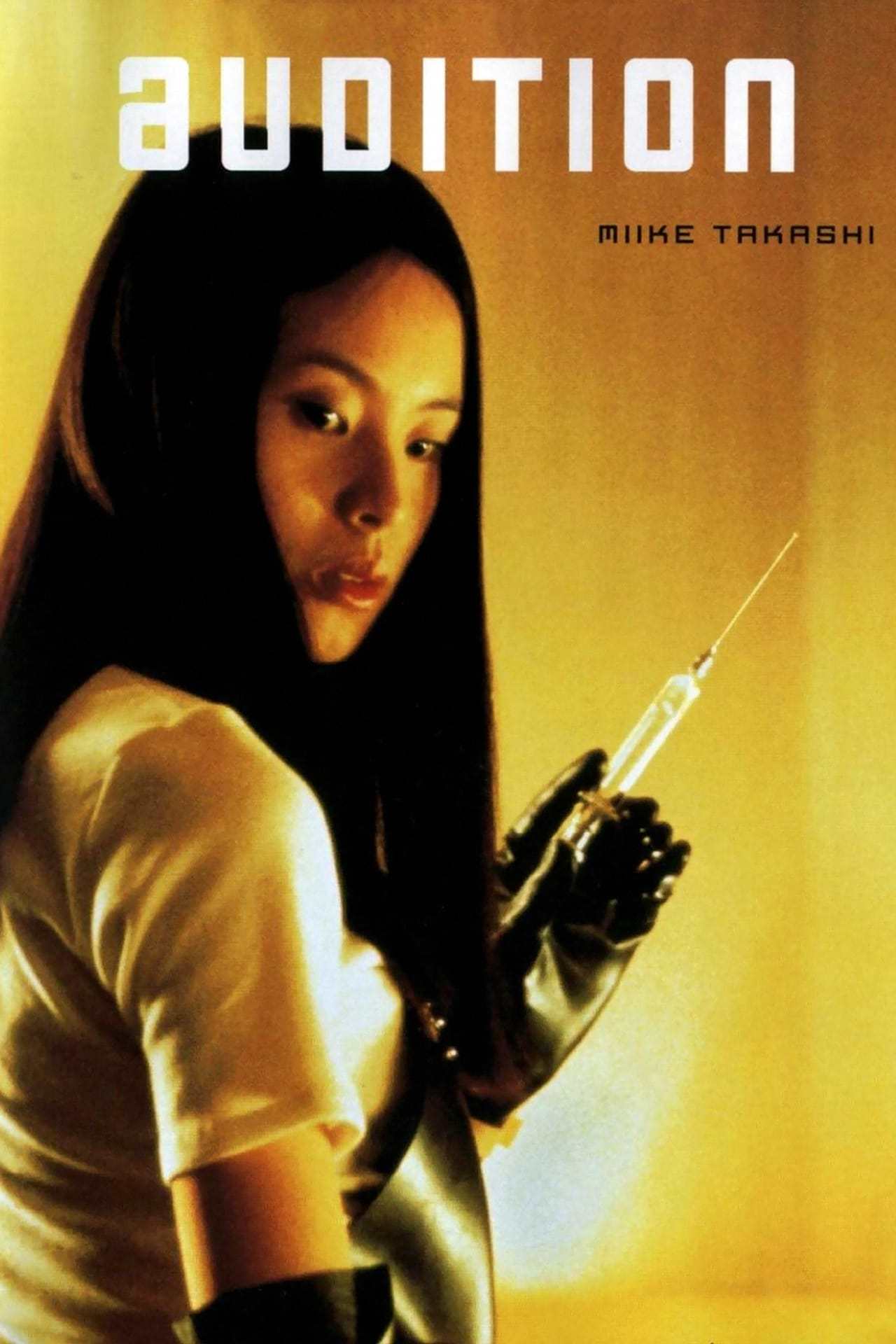
Audition (1999)

audition poster

Audition is a peculiar type of horror film. It is not the violent, gorefest that you might expect from the new stream of Japanese horror films, and certainly not from Takashi Miike, director of such bloodfests as Ichi the Killer and Full Metal Yakuza. It is also not the suspenseful, scare them with what you don’t see the type of horror film that Alfred Hitchcock might make.

In fact, for the first 2/3s of the movie, it is more akin to a family drama than anything you’d call horror. The plot concerns a middle-aged widow, Aoyama (Ryo Ishibashi), who is encouraged by his teenage son to start dating again. Not knowing how to go about this, he decides to hold auditions for his new wife. Real-life auditions, like you, ’d do in hiring actors for a movie.

Lots of women show up and are interviewed for the lifelong role of wife. Aoyama is intrigued by one woman, Yamazaki (Eihi Shiina), and begins to date her. Eventually, we find that Yamazaki is not all who she seems to be and thus the horror begins.

Miike’s ability to turn the conventions of an old romantic formula completely on its head is nothing short of masterful. Watching the first thirty minutes or so of the film, you would have no idea that horrible, bloody things were going to take place later on. Had I not known what to expect from a Miike film, I would have thought I was watching an old-style romance.

Yamazaki at first seems like a natural mate, she is beautiful, sweet, and shy. Miike lets the twist in her character come in slow, short, and shocking bursts. The screw tightens and the horror grows.

The gore is actually pretty minimal, but when the horror comes it comes quick and merciless.

Asian extreme horror is not for everybody. The blood and the gore are too much for a wide audience. But for those with the proper stomachs, Takashi Miike is a master and Audition is one of his best.

The Eye (2002)

the eye movie poster

There is an old horror story about a normal law-abiding citizen getting a transplant from a psychopathic killer. The killer’s body part still has the memory of its former owner and wants to take up the killings again.

This premise has been aped in countless movies and TV shows, most notably in Body Parts starring Jeff Fahey and that Simpsons episode where Homer has Snakes hair transplanted to his bald head. It is a pretty tired premise; one that has been done so many times all the originality has been drained from it. I’m waiting for the day when Hollywood green lights a picture about a little girl who gets a toe transplant from Charles Manson.

Chinese directors, the Pang brothers try to breathe some life into the concept with their 2002 feature, The Eye. Unfortunately, it is the first of the so-called Asian Extreme pictures that I’ve seen that I’ve found to be rather lackluster.

It isn’t for a lack of trying. The Pang brothers bring an eye of originality to the premise and create an atmosphere that is quite creepy and interesting. At least in the first half.

In this case, the transplanted body parts are eyeballs. A young blind girl, Wong Kar Mun (Angelica Lee) receives an eye transplant and thusly begins seeing dead people, a la The Sixth Sense.

The Brothers Pang introduce this concept by having the dead show up in shadows. Visually the first half of the film is stunning. We see the world through Mun’s adjusting-to-sight eyes and there are creeping things lurking just about everywhere. In an impossible-to-explain, but absolutely must-see series of scenes Mun comes to understand that what she sees with her eyes is beyond the realm of the natural. As a viewer, I was knocked upside the head by the brilliant display of imagery

There is no “I see dead people” revelation here. The revelations come slowly, building tension along the way. Having no concept of vision, Mun has no understanding of what is real and what may be supernatural. By allowing the audience to understand quickly what Mun must slowly learn, the film is quite effective in creating a sense of horror.

The camera pans slowly around corners as the music builds anticipation to what could be hiding just out of sight. There are nice jolts of music as the camera reveals a new surprise. Here it seems the Pang brothers have taken a page out of the American scary movie pages instead of the Asian counterpart. Scare the people with jolts instead of developing actual creepy situations.

In the second half, the film begins to truly unravel. With only a few conversations, Mun manages to have her psychotherapist, fall in love with her and be willing to drop everything and travel to Thailand to investigate the donor of her dead-seeing eyes.

From horror, the movie now travels into a melodramatic mystery. The doctor and Mun find dark secrets in the story of the young lady who had Mun’s eyes first. Of course, they are forced into setting things right, and the movie pretty much falls apart. Oh, it’s nothing terrible or cringe-inducing, but it is formulaic and not nearly as interesting as the first two-thirds of the film.

I found The Eye in the foreign section of my local Blockbuster. It was well worth the five dollars I laid down for it, if just for the glorious visuals of the first half.

Suicide Club (2001)

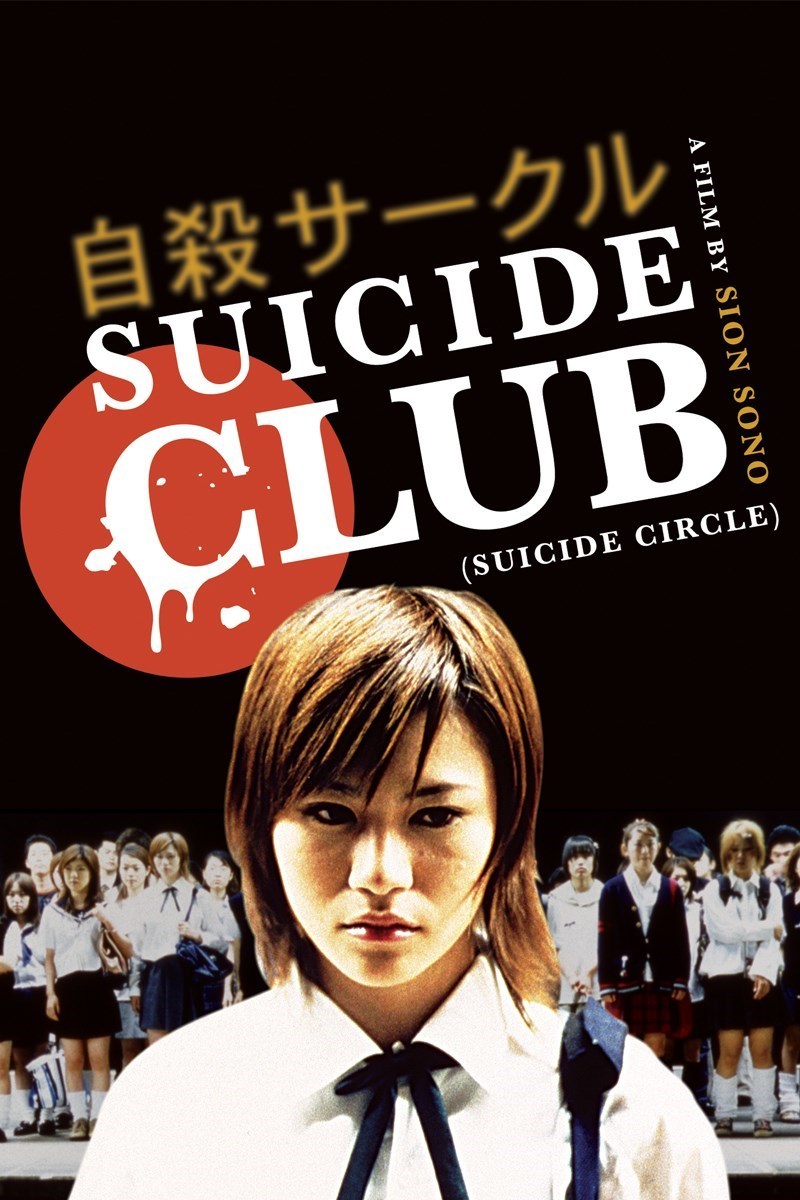
suicide club poster

Fifty-four Japanese schoolgirls stand on a train platform, holding hands, singing, and laughing. As the train approaches they clasp their hands tighter, and in sing-song fashion start to count. As the train arrives, the counting stops, and all 54 of them jump in front of the train. Buckets of blood and guts spray the train, the passengers, and the people passing by.

Later, another group of teenagers sits on the roof of a school building during their lunch break. They are eating and laughing and looking like happy schoolchildren. Conversations turn to the 54 and how cool it would be to form their own suicide circle. Amongst much joking and a good time having, a crew decides to end their lives then and there. Standing on the edge of the rooftop they hold hands and plunge their way to the bottom. Buckets of blood and guts spray all over the school grounds, teachers and students.

Amongst the bloodletting are some scenes about a pop group whose Britney Spearesesque pop wailings are irresistible to every teen. Adults everywhere do their best to quash any talk about the deaths being a part of a suicide club movement.  A theme develops about society’s herd mentality.

Call it Japanese horror with a message.

The cops have to rule all of these deaths as accidents for there seems to be no foul play involved. That is until a bag filled with little rectangles of skin sewn together shows up. Then the suicides become a matter of detective work.

The detectives begin getting calls from a cyber-savvy woman who seems to know more than she lets on, calling herself the Bat. She leads the detectives to an internet site keeping a count of the suicides before they actually happen. One of the detective’s kids finds another site with some peculiar type clues.

Call it a Japanese horror, detective thriller with a message.

Through all this shocking, blood-splattering suicidal carnage continues to occur.

The detectives find a suspect who acts like a cross between Ziggy Stardust and Graham Norton. He’s definitely a bad fellow, what with the squishing of animals, kidnapping, and the random sexing with girls wrapped in pillowcases lying in a bowling alley. But he may not be behind all the suicides.

Call it a Japanese horror, detective thriller by way of Asian MTV, with a message.

In the end, we’re left with nary an explanation of the suicides, but that’s not really the point anyway. There is lots of gory violence if you like that kind of thing. And let’s be honest if you are taking the time to search out a copy of a relatively obscure Japanese horror film called Suicide Club, you probably do. There are gobs of creepy, moody suspense, with some very dark humor thrown in. All mixed in with some pretty in-your-face, and spot-on social commentary.

What’s not to love?

28 Days Later (2002)

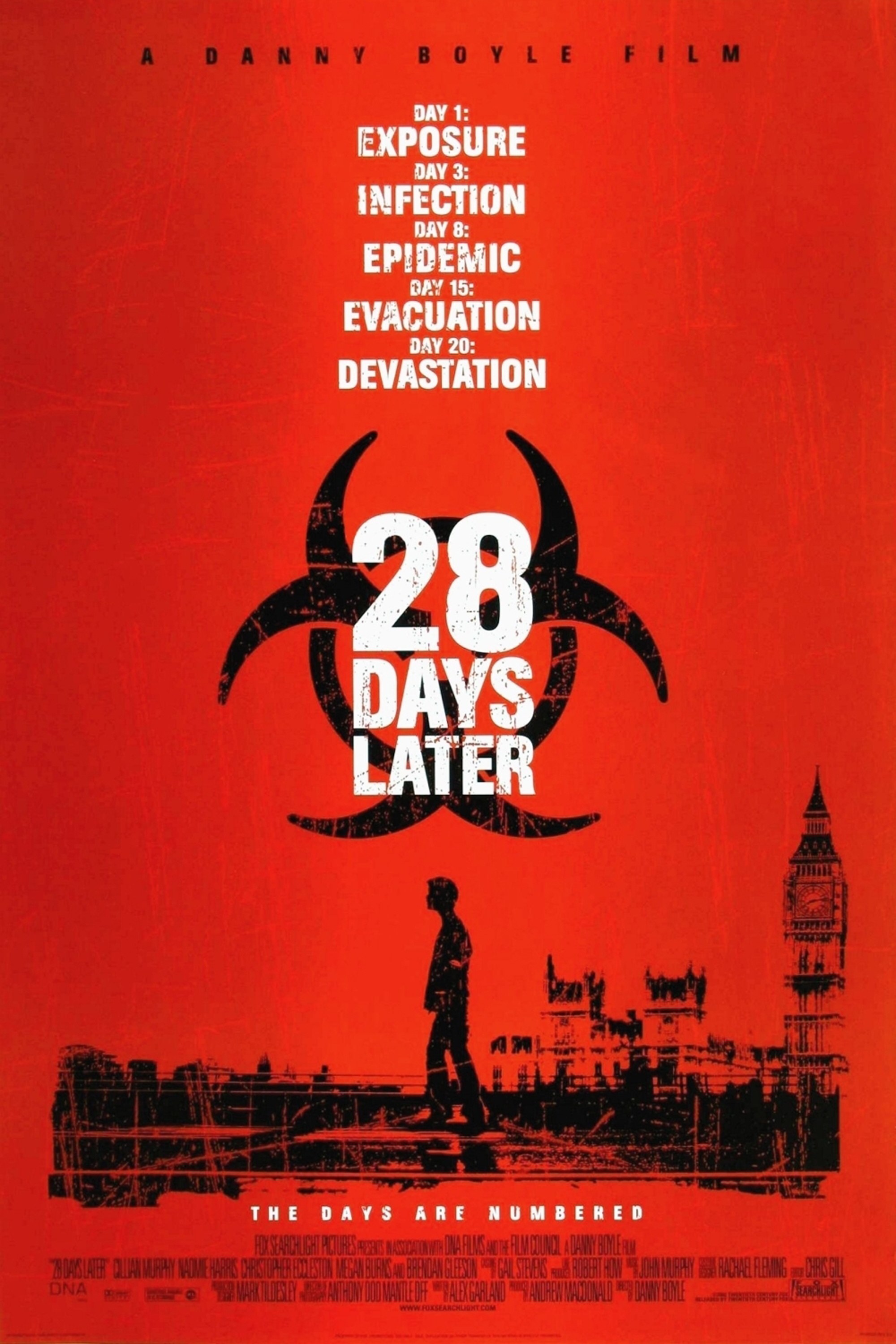
28 days later poster

The zombies are fast.

It’s true that in Danny Boyle’s 2002 film 28 Days Later the crazed, flesh-eating villains aren’t technically zombies. In fact, Boyle has gone to great lengths to qualify them as humans infected with a virus known as RAGE. Yet, to this reviewer at least, the differences seem moot. In traditional zombie pictures, and in this film the creatures are mindless, they carry a real zeal for human flesh, they have a predilection for turning everyone else into their like, and they are fairly easy to kill. Whether the creatures are the living dead so to speak, or infected by an incurable virus doesn’t make much of a difference. Though the zombies here, seem updated from their cinematic ancestors.

These zombies are fast.

Traditional zombies are a slow-moving lot. Having been rotting in their own graves for untold years, their reanimated flesh is a little atrophied, causing them to move at a slow, sluggish pace. This has always been a helpful plot point for the heroes in zombie films, for they are easy to run away from. In fact, zombies are generally able to kill their victims through sheer numbers. Individually they are easy to destroy, but as an oncoming onslaught, the sheer numbers win every time.  Boyle circumvented this convenience by allowing his monsters to run at normal human speeds. It is an excellent update to the genre, giving the ability for more scares.

Man, I dug the first half of this movie. Well, except for the very, very beginning. The opening scene gives us the origin of RAGE, with a bunch of Clockwork Orange-inspired monkeys. I’ve never really dug origin scenes in zombie flicks. I think it’s much scarier to just have the zombies running around eating brains, without any reason for their existence. Origins, generally, just seem dumb. And here, with the infected monkeys being freed by some Green Peace types doesn’t really inspire any other feelings. Though, I suspect it was another move to plant this film outside the zombie track.

But after the scene of the dumb origin, things get really good. We’ve got a naked guy named Jim (Cillian Murphy) hooked up to various tubes in a hospital bed. I always like it when there is a bit of male nudity in a flick since there is always so much of the female variety. Anyways, Jim gets out of bed and wanders the streets of London. There are plenty of shots of Jim (fully clothed now) walking by big famous London monuments without another soul around. It seems London has been vacated. It is creepy and effective.

In a bit, Jim clamors into a church figuring to find some sanctuary, or at least have a few questions answered. What he finds is a bunch of dead folks piled up. In a good holy crap moment, Jim says, “Hello” to find a couple of the dead guys not so dead and jumping up. From there until the second half of the film, it is a constant run from the zombies.

The zombies really work in this film. They are fast, furious, and vicious. Jim eventually teams up with some other survivors and they set about trying to figure out what to do. Boyle really does a great job of adding tension to the film and keeping the scares up.

Then the film changes.

The group is rescued by a gang of all-male military types, living in a compound. Turns out the military types are a bunch of psychos and the film turns from being a zombie flick into being a stranded-in-a-compound-with-a-bunch-of-psycho-military-types kind of film. To make sure we know this is no longer a zombie flick, a big group of zombies launches an attack on the compound only to be massacred with machine guns and land mines.

In this half of the film, I don’t dig nearly as much. Zombie flicks always have trouble filling out their whole hour-and-a-half time slot. Even with a good introduction of characters, and a slow build to zombie free-for-all, there is still plenty of filler time. Here, the filmmakers seem to have decided that they might as well dump the zombies and give us some other tension-filled concoction. But, there isn’t really enough time to develop the military end of the story and it feels wrong.

It’s too bad too because that first half was really promising.

Army of Darkness (1992)

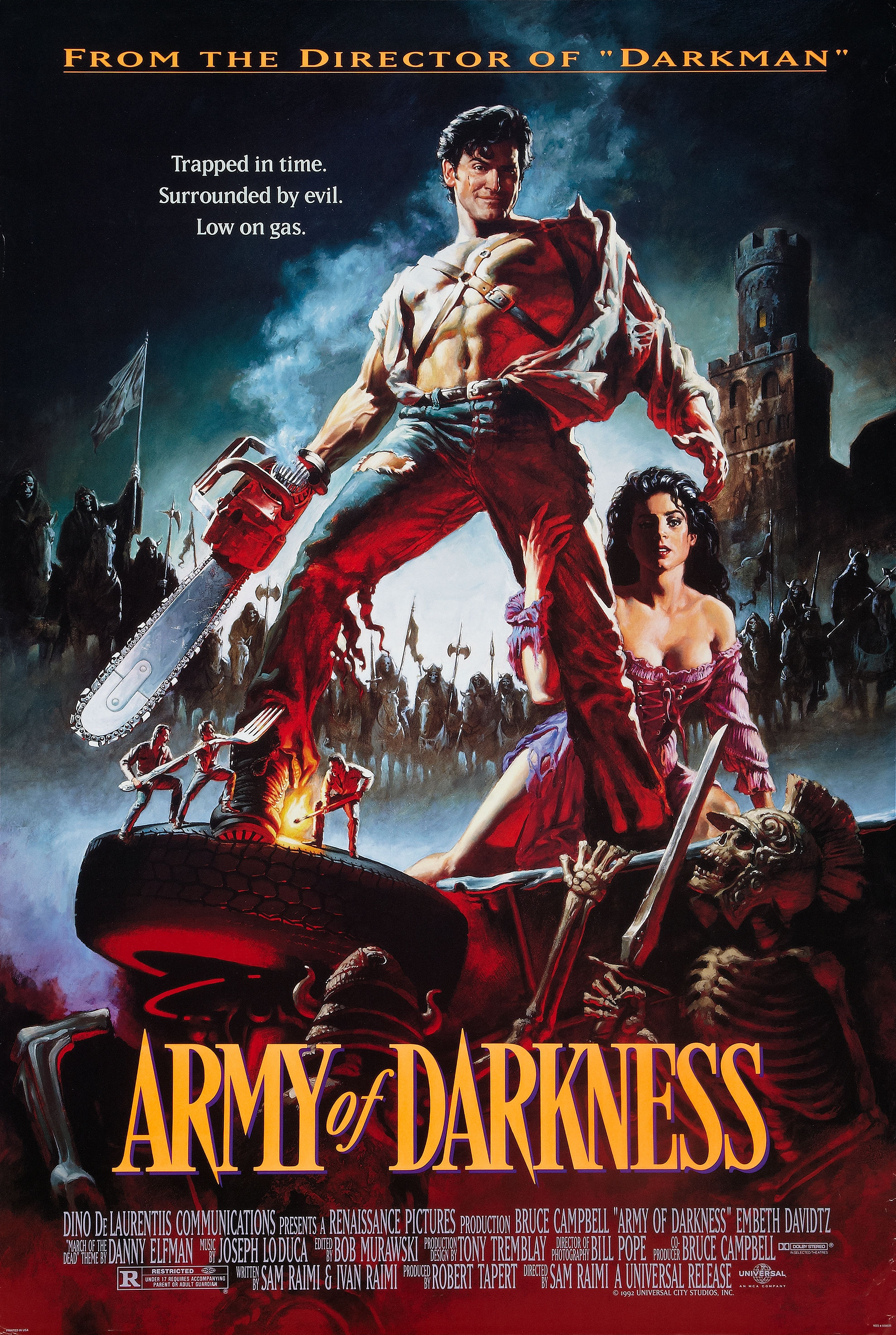
army of darkness poster

Those of you looking closely at my list of DVDs will notice there are a couple of movies before Army of Darkness. But on a Sunday night, you watch what your wife wants to watch. Especially when it’s part of the Evil Dead series and not a silly romantic comedy.

Army of Darkness is the third (and so far final) movie in the Evil Dead Series. Before director Sam Raimi went legits with a series of critically acclaimed dramas and the Spiderman Trilogy, he was a low-budget horror genius. Army of Darkness begins right where Evil Dead II ended, with Bruce Campbell trapped in medieval times to battle the deadites once again.

The trilogy began with  Evil Dead as a pretty straight horror movie. A group of people discover a book of the dead and unleash gore-filled horror upon themselves in a remote cabin. Evil Dead II basically re-tells the same story with a different cast (except for the ever-present Bruce Campbell), a bigger budget, and plenty of slapstick. The second movie is by far my favorite in the series. It keeps the ghoulish gore while adding hilarious physical comedy and some classic one-liners. Army of Darkness furthers this tradition by adding even more slap-stick and one-liners while removing almost all of the gore.

What little plot there is goes something like this: Stranded in the middle ages Bruce Campbell is at first captured by a small army, is mistaken for a member of a rival army. Bruce quickly uses his “boomstick” to gain clout with his captors and is sent on a quest to recover the Necronomicon which will both send Bruce back to his own time and save the army from evil. Bruce being Bruce he gets the book and unleashes an army of the dead. There are two endings released for this movie. One happier ending was released in US theatres and another sequel set up unhappy ending seen in a theatrical cut in the UK and on many US DVD versions.

Raimi once again does a nice job creating a mix of horror movie homages (which range from Jason and the Argonauts to Gulliver’s Travels) with the slapstick of the Three Stooges. Unfortunately, the comic elements seem to take over this picture leaving the horror end of it as more of a backdrop. It feels more like a Zucker brother’s movie more than a horror film. Most of the evil dead are formed as skeletons that crumble when destroyed rather than burst into a mess of blood and guts as they did in the first two movies. This may seem to be an absurd complaint, but as a fan of gory movies, I felt disappointed with that choice.

The cinematography is actually quite well done throughout most of the picture. My DVD copy is quite beautiful in scenes. Especially the exterior shots around the windmill. The use of color and lighting is well above par for most horror films. The pre-CGI special effects affect the quality of the print in several areas, but they still hold up as goofy Raimi effects. I kept thinking the picture was too pretty for what was actually taking place on screen.

Bruce Campbell once again does a nice job of making Ash come to life. He delivers his lines with the comic timing of a comedian while still delivering enough pain to make his albeit over-the-top beatings believable. The rest of the cast is hardly memorable as characters or for their acting.

Army of Darkness still makes a nice end to the trilogy. In a way it makes a nice bookend to Evil Dead’s pure gore horror with the single middle book being a mix between bloody gore and slapstick comedy.