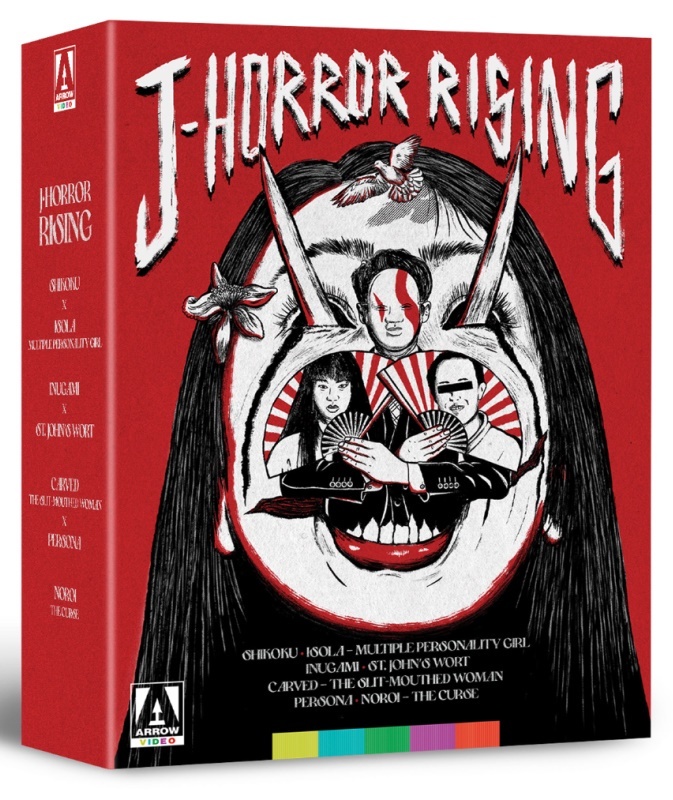
J-Horror Rising is the New Blu-ray Pick of the Week

image host

I’m on record as being a pretty big fan of the Japanese horror boom of the early 2000s, collectively known as J-Horror. I’ve written about several of those films and weirdly seem to explain exactly what J-Horror is in each of them (so to learn more, just click this link and read one of them). While I am a fan, I haven’t really delved deeply into the genre, and most have only seen the bigger names.

This set from Arrow Video looks like a fun way to dig a little deeper. I’ve only actually seen one of these films, Noroi: The Curse, which is also the only one I’ve ever heard of. But with titles like Isola: Multiple Personality Girl and Carved: The Slit-Mouthed Woman, how can I not be excited by it? Arrow presents these seven films in a nice-looking box and has filled them with loads of extras.

Also out this week that looks interesting:

Drop 4K UHD: This thriller has a fun premise – a single mom on her first date in years begins receiving increasingly threatening phone messages with terrible demands.

The Return of the Living Dead 4K UHD: This ridiculously silly and ridiculously fun zombie flick from 1985 gets the UHD treatment from Shout Factory.

The Wiz 4K UHD: This modern update of The Wizard of Oz has an all black cast and some super fun musical numbers. Criterion has the release.

The Wedding Banquet: Romantic comedy about a gay Taiwanese-American who agrees to marry a straight Chinese girl for her to get a green card. I’ve not heard of this before, but it’s got Lily Gladstone in a supporting role, and I’ll watch her in anything.

Dr. Jekyll and the Werewolf: Spanish director/actor Paul Naschy made several films with him, starring as a werewolf. I’ve seen a couple of them and thoroughly enjoyed them. Adding a Dr. Jekyll twist to this sounds really fun.

Lord of Illusions: Scott Bakula stars in this Clive Barker film about a private detective trying to protect his client from a deadly cult. I didn’t much care for this when it first came out, but I’ve been meaning to give it a rewatch.

Sean Connery 007 James Bond Collection 4K UHD: There have been so many different releases of these films, it is hard to keep up, but if you are looking for a cheapish collection of just Sean Connery playing Bond then this is for you.

The Friday Night Horror Movie: Ju-On: The Grudge 2 (2003)

ju on the grudge 2 poster

The Criterion Channel is featuring a plethora of horror movies this month. They have at least three different horror themes going on, one of which is Japanese Horror. Naturally, I’ve seen almost all of them, but I’d never watched this sequel. I try to watch the originals again before I watch the sequel which is why you were treated to my thoughts on Ju-On: The Grudge yesterday.

This sequel is basically the same film with different characters. Once again it acts like a series of vignettes in which a bunch of people are haunted, terrified, and murdered by some evil spirits. The same evil spirits that haunted the house in the first movie (er, the third movie as there were two films before Ju-On: The Grudge). There is the creepy kid and the freaky girl who can twist her body in extreme ways.

This one does have more of a semblance of a plot and there is a bit of a through line, but it still jumbles up the chronology. It, more or less, follows horror film actress “Horror Queen” Kyoko Harase (Noriko Sakai) who is given a role in a paranormal television show. They “investigate” haunted houses and the like. For this episode, they visit the house from the last film.

Naturally, things do not go well. Nearly everyone involved in the shoot is haunted by the curse and killed. The kills remain quite effective and creepy. I might even give the ones in this film a slight edge over the last one.

There is an excellent sequence in which a woman keeps hearing a banging on her apartment wall at a certain time at night. The reasons behind it are quite clever and scary.

The way this film moves back and forth in time is much more effective than the previous one. I was often confused during the previous film, but here they will show a snippet of the same scene, albeit from a different character’s point of view, before moving on to something we haven’t seen before. Those connecting points allowed me to understand what was happening at all times. That worked for me much better than in the previous film.

But really, much like the other film, the plot in this one is just an excuse to move us from one creepy scene to another. And again this worked completely for me.

31 Days of Horror: Ju-On: The Grudge (2002)

ju on the grudge poster

A title card tells us that a Ju-On is a curse that is born when a person dies in a deep and powerful rage. The film will then spend the next 90 minutes showing us exactly what it means.

Ju-On: The Grudge was part of a cycle of Japanese horror films (collectively known as J-Horror) that came out in the late 1990s and early 2000s. Unlike their American counterparts (which were mostly self-aware slashers and other schlocky, gore-inflicted films) J-Horror tended to focus more on mood, and the psychology of fear, with plots that revolved around Japanese folklore. The violence was usually off-screen and not very graphic (though there were exceptions – I’m looking at you, Takashi Miike).

For a few years, J-horror became quite popular in America and several of them were remade by Hollywood. Someday I may do a theme where I review the Japanese horror films alongside their American remakes, but for now, we’re just talking about this one.

Ju-On: The Grudge was actually the third film in the Ju-On franchise (the previous two were straight-to-video releases) but it was the first one most of us watched (I’ve only seen this one and the first American remake).

The film is really a series of vignettes, each focusing on a different character, most of which are set in the same house located in Nerima, Tokyo.

I’ll be honest here, I just watched the film but if you paid me $1,000 to explain who each character was and what their relationship to each other is, I’d still be broke. Each vignette is so short, and each character is given so little to distinguish each other from each other I’m at a loss to tell you who is who.

They all do seem to be related to one another either by family or friendship or work. It begins with Rika (Megumi Okina) a social worker volunteer being tasked by her boss to visit an old lady at the cursed house (though neither of them realizes it is cursed at this point.) She enters to find the old lady in a daze, lying in bed. She picks her up to find that she has soiled herself.

After cleaning her up and doing a little housekeeping she hears a noise upstairs. In the bedroom, she finds a closet that has been taped over and she hears a cat meowing inside. Opening it she sees the cat and then a small, pale boy. She goes downstairs to call her boss and witnesses a black fog kill the old lady. Rika then passes out.

Others come to the house and most find themselves infected by the curse. They’ll become haunted by the boy, the cat, and the boy’s parents. Sometimes they’ll be killed inside the house, other times they’ll take the curse with them infecting their homes.

The film jumps around in time, making it a bit disorienting.

We will learn more about the boy and his family, and why they are haunting this house, but it really doesn’t matter. The plot isn’t really the point. Scaring the bejeebus out of us is the point and this film does that really well.

There are jump scares aplenty, and all sorts of creepy noises and visuals. These evil spirits appear out of nowhere – sometimes they attack, sometimes they just scare the characters, and sometimes they aren’t even seen by the character but by the audience giving us a jolt of fear. This happens so often that you’ll find yourself tensing up in anticipation, looking in corners and backgrounds half-expecting to see a ghost.

Quite a few of these sequences have become iconic for horror fans. The girl walking on all fours, contorting herself in unusual ways, the hand in the shower, the girl under the covers, etc. have all become part of our communal horror fabric.

I can’t say that Ju-On: The Grudge is a great film in any sort of artistic, cinematic sense, but it is a great one to put on late at night when you are all alone and scare yourself silly.

The Friday Night Horror Movie: Noroi: The Curse (2005)

noroi the curse

For a very brief period in the early 2000s, Americans became obsessed with a certain type of Japanese horror (or J-Horror as it was known). We’d spent the 1980s watching slasher films, but by the 1990s those had grown stale. We didn’t seem to know what should take its place. So much so that in 1996 Wes Craven directed Scream which was essentially a self-aware slasher with hot TV stars. 

Whereas American horror tended to be filled with horrendous violence and jump scares, Japanese horror at the time was more foreboding. The violence was toned down and in its place was psychological horror and a brooding atmosphere.

The Blair Witch Project introduced Americans to the found-footage genre in 1999. That movie, which is about some independent filmmakers making a documentary about a mythological witch that is supposed to haunt rural Maryland. They go missing and the film is supposedly made up of their leftover footage. It is a mix of their professionally made documentary footage and a lot of handheld camera work created by the actual actors living for a few weeks in the woods. It created a craze of found-footage horror.

Noroi: The Curse is a mixture of J-Horror and found footage films. It begins with a voiceover telling us about the life of Masafumi Kobayashi (Jin Muraki) who was a journalist investigating paranormal activity across Japan. Recently his house burned to the ground, killing his wife, but his body was not recovered and he is presumed missing.

He left behind a series of videotapes full of his research. The film presents those tapes along with a series of newsreels and television footage of various occult specials and the like. It all creates a sort of documentary approach to this fictional story.

At first, his investigative reports seem unrelated. There is a young girl with psychic abilities. An actress (Marika Matsumoto) sees something spooky in a graveyard and collapses. Another woman hears a baby crying next door, but the family’s children are all much older.

Slowly all of these various stories connect and point to a demon that was released from a village that is now buried under water after a dam was built. It seems to have possessed someone and is causing nearly everyone connected to the story to die under mysterious circumstances.

The violence is mostly off-screen and there is essentially zero gore. Tonally it is filled with an eeriness and the creepy soaks right through. I’m not a big fan of hand-held camerawork in movies as it tends to make me dizzy. There is some of that here, but mostly it’s used quite effectively. The camera is framed so that there are often strange little things in the background or on the edges of the screen. It makes you pay attention.

Like a lot of found footage films in which the characters seem to always be carrying a camera, there are times when I wanted to scream at them to put the camera down and run, or fight, or at least help that person getting pummelled by a demon. At least here our hero isn’t the one carrying the camera, he’s actually got a cameraman (working for his documentary) to do that for him.

The film uses the various footage in interesting ways. The way in which it moves between stuff shot by Kobayashi, and various television crews keeps the movie moving in a manner that other found footage films cannot keep up with.

I was a huge fan of J-horror during its initial craze, but I somehow missed this one. I’m glad I found it tonight as it is a good one.

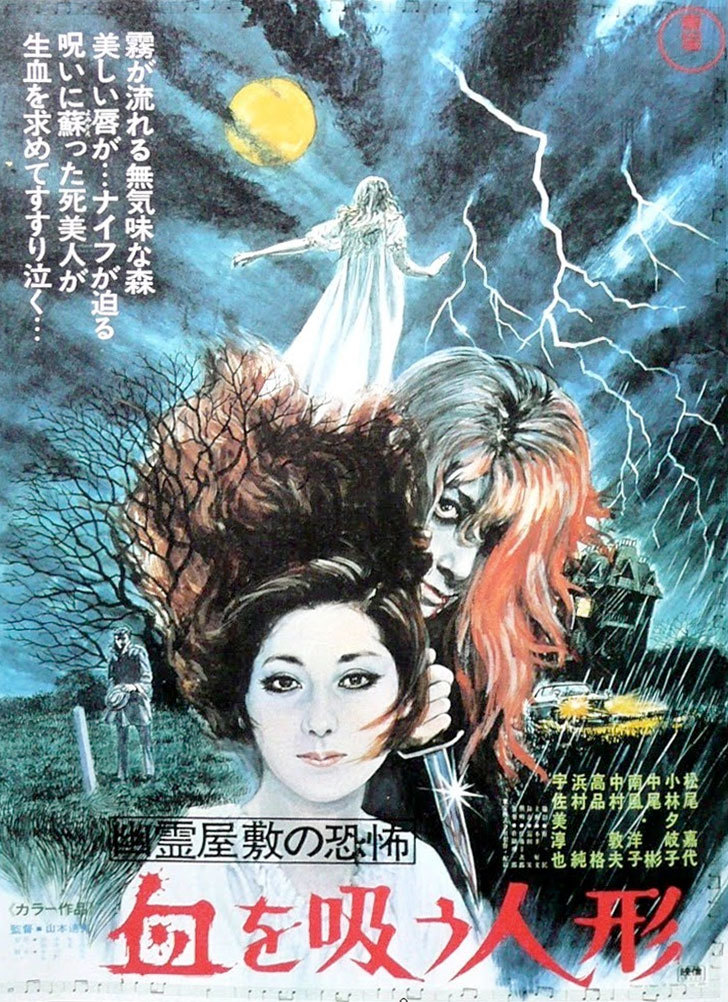
The Friday Night Horror Movie: The Vampire Doll (1970)

the vampire doll

I’ve talked about how the Criterion Channel is one of my favorite streaming services. Mubi is fast becoming a contender in that category. Mubi actually works as a kind of sister channel to Criterion. Where Criterion focuses on the world’s greatest films and lots of classic Hollywood films (and lots of other more esoteric themes like Snow Westerns and 1970s sci-fi) Mubi’s focus is on more modern art-house fair. They show films that premiere at film festivals like Cannes and Sundance, but that doesn’t necessarily reach a wider audience.

They also have a lot of what you might call cult films – genre movies that have been all but forgotten except by a small group of fans. The Vampire Doll is a good example of what I’m talking about. This was the Japanese film company Toho’s attempt at cashing in on the horror craze that so popular at the time.

It looks and feels like a Hammer Horror film with its creaky old mansion as a setting and its moody supernatural storyline. A man who has been traveling abroad for the last few months returns home to Japan. He immediately rides out to the country to see his girlfriend Yuko (Yukiko Kobayashi). Upon arrival, he is told by her mother (Yôko Minakaze) that Yuko is dead. She died in an automobile accident a few weeks prior.

That evening he sees a woman that appears to be Yuko. Flash forward a few days and the man’s sister, Keiko (Kayo Matsuo) and her fiancee Hiroshi (Akira Nakao) visit the old mansion because they have not heard from her brother in a while and that is unusual. Keiko immediately senses something is wrong and decides to stick around and investigate.

With a 70-minute run time, the plot moves along pretty quickly. Honestly, storywise the film isn’t great. It doesn’t do anything we haven’t seen before. But it works really well as a mood piece. The mansion is full of creepy shadows, and the music is particularly moody. I mentioned Hammer Horror earlier and that is fitting. If you’ve ever seen any of those old movies then you’ll know what I’m talking about. They have a particular look and feel to them that is perfect for this type of gothic horror.

And that’s why I love sites like Mubi. I’d never heard of this film before, but they spotlighted it and now I’ve seen it and I’m glad that I did.

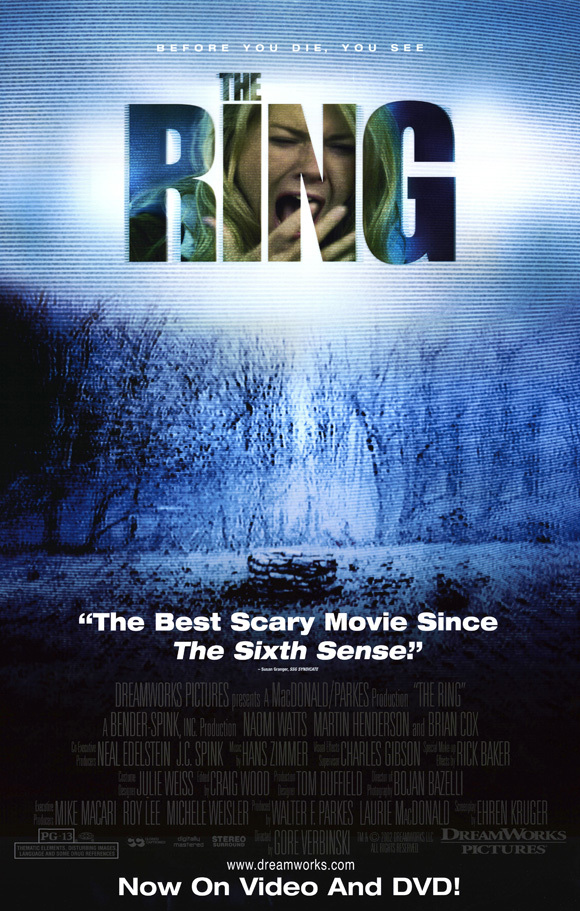
The Friday Night Horror Movie: The Ring (2002)

the ring

In the early 2000s, horror nerds like myself began to discover what was then called J-Horror. This was a cycle of horror movies made in Japan that started in the early 1990s. Unlike the films made in the United States at the time, J-Horror relied more on atmosphere and mood to create their scares. They often involved haunted houses and evil spirits, the supernatural rather than knife-wielding psychopaths that were so popular in America at the time.

Discovering these films was like a fresh of breath air for folks like me who had long since grown tired of slashers. I believe Ringu (1998) was the first J-Horror film to really make a splash here in the US (I’m sure some horror hound could pop in now to tell me they were watching Japanese Hororr films long before Ringu popularized the genre, but whatever). It was a huge film in Japan and had decent success in America.

Enough so that an American producer decided to remake it as The Ring (2002). That movie was a surprise success and started a succession of American remakes of J-Horror films. Snob that I am I watched pretty much all of them, but always preferred the Japanese originals.

Tonight I decided to rewatch The Ring. I liked it more this time than my previous watches.

It is about a VHS tape that kills you after seven days after your first viewing. Typing that out just now makes me realize how dumb that summary sounds. The film on the tape is like a short film some goth art school kid would make to try and freak everybody out. A couple of teenagers watch the tape and seven days later they die horrible deaths. Naomi Watts plays a journalist who was related to one of the teens. She sniffs a story and investigates.

She finds, then watches the creepy tape and immediately after she receives a phone call telling her she has seven days to live. When her young son accidentally watches the tape and starts drawing creepy drawings she knows she has to solve the mystery.

The original Japanese film is super creepy and atmospheric and really good (you can read my review of it over at Cinema Sentries). The remake is very Americanized in that it provides a few more jump scares, has slicker production values, and juices up the narrative a little bit so that the story is explained to the viewer in clearer turns.

Still, it is effective in its own way. The jump scares work for the most part, and it is still moody enough to give it that J-Horror feels even if it is a little sanitized.

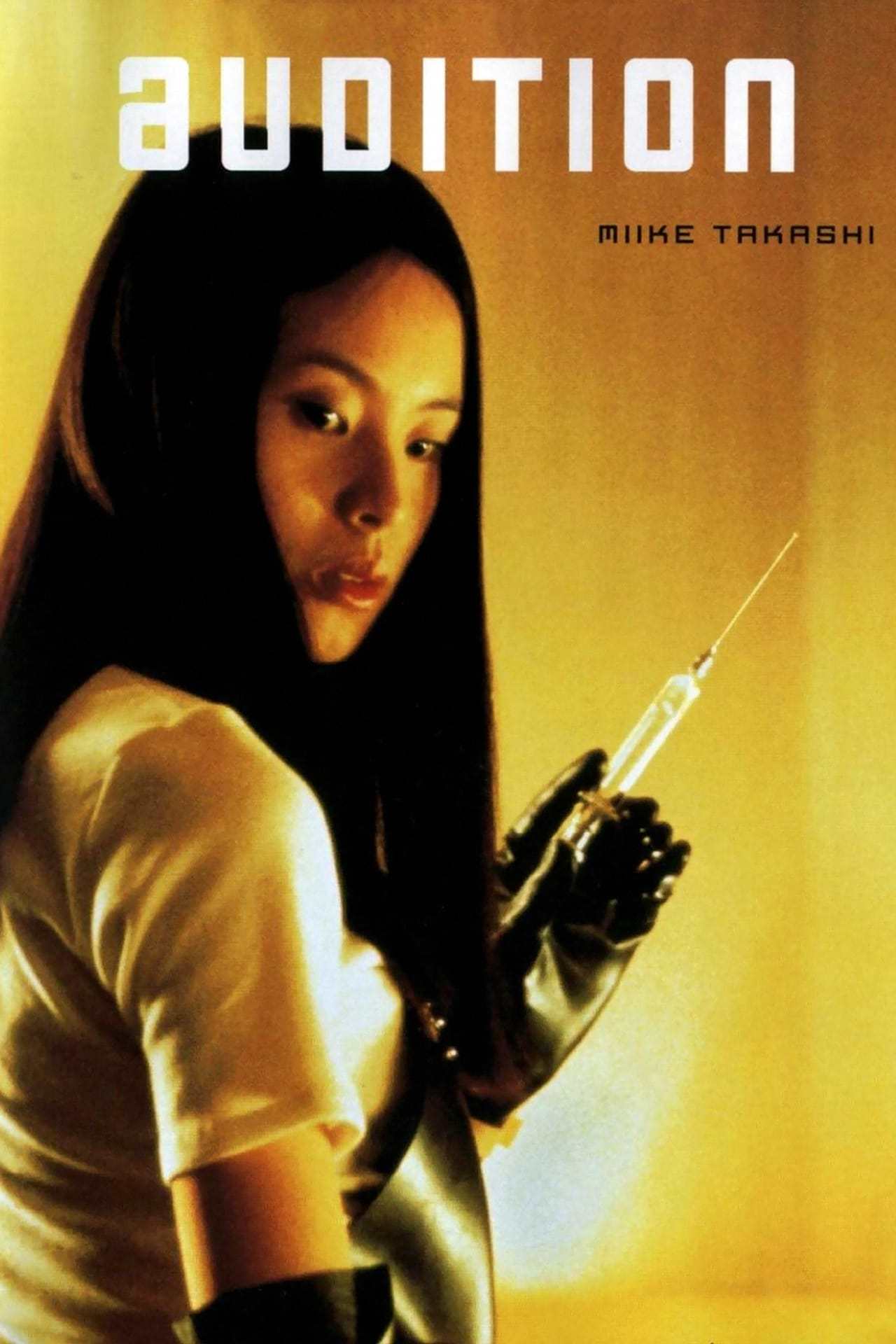
Audition (1999)

audition poster

Audition is a peculiar type of horror film. It is not the violent, gorefest that you might expect from the new stream of Japanese horror films, and certainly not from Takashi Miike, director of such bloodfests as Ichi the Killer and Full Metal Yakuza. It is also not the suspenseful, scare them with what you don’t see the type of horror film that Alfred Hitchcock might make.

In fact, for the first 2/3s of the movie, it is more akin to a family drama than anything you’d call horror. The plot concerns a middle-aged widow, Aoyama (Ryo Ishibashi), who is encouraged by his teenage son to start dating again. Not knowing how to go about this, he decides to hold auditions for his new wife. Real-life auditions, like you, ’d do in hiring actors for a movie.

Lots of women show up and are interviewed for the lifelong role of wife. Aoyama is intrigued by one woman, Yamazaki (Eihi Shiina), and begins to date her. Eventually, we find that Yamazaki is not all who she seems to be and thus the horror begins.

Miike’s ability to turn the conventions of an old romantic formula completely on its head is nothing short of masterful. Watching the first thirty minutes or so of the film, you would have no idea that horrible, bloody things were going to take place later on. Had I not known what to expect from a Miike film, I would have thought I was watching an old-style romance.

Yamazaki at first seems like a natural mate, she is beautiful, sweet, and shy. Miike lets the twist in her character come in slow, short, and shocking bursts. The screw tightens and the horror grows.

The gore is actually pretty minimal, but when the horror comes it comes quick and merciless.

Asian extreme horror is not for everybody. The blood and the gore are too much for a wide audience. But for those with the proper stomachs, Takashi Miike is a master and Audition is one of his best.

The Eye (2002)

the eye movie poster

There is an old horror story about a normal law-abiding citizen getting a transplant from a psychopathic killer. The killer’s body part still has the memory of its former owner and wants to take up the killings again.

This premise has been aped in countless movies and TV shows, most notably in Body Parts starring Jeff Fahey and that Simpsons episode where Homer has Snakes hair transplanted to his bald head. It is a pretty tired premise; one that has been done so many times all the originality has been drained from it. I’m waiting for the day when Hollywood green lights a picture about a little girl who gets a toe transplant from Charles Manson.

Chinese directors, the Pang brothers try to breathe some life into the concept with their 2002 feature, The Eye. Unfortunately, it is the first of the so-called Asian Extreme pictures that I’ve seen that I’ve found to be rather lackluster.

It isn’t for a lack of trying. The Pang brothers bring an eye of originality to the premise and create an atmosphere that is quite creepy and interesting. At least in the first half.

In this case, the transplanted body parts are eyeballs. A young blind girl, Wong Kar Mun (Angelica Lee) receives an eye transplant and thusly begins seeing dead people, a la The Sixth Sense.

The Brothers Pang introduce this concept by having the dead show up in shadows. Visually the first half of the film is stunning. We see the world through Mun’s adjusting-to-sight eyes and there are creeping things lurking just about everywhere. In an impossible-to-explain, but absolutely must-see series of scenes Mun comes to understand that what she sees with her eyes is beyond the realm of the natural. As a viewer, I was knocked upside the head by the brilliant display of imagery

There is no “I see dead people” revelation here. The revelations come slowly, building tension along the way. Having no concept of vision, Mun has no understanding of what is real and what may be supernatural. By allowing the audience to understand quickly what Mun must slowly learn, the film is quite effective in creating a sense of horror.

The camera pans slowly around corners as the music builds anticipation to what could be hiding just out of sight. There are nice jolts of music as the camera reveals a new surprise. Here it seems the Pang brothers have taken a page out of the American scary movie pages instead of the Asian counterpart. Scare the people with jolts instead of developing actual creepy situations.

In the second half, the film begins to truly unravel. With only a few conversations, Mun manages to have her psychotherapist, fall in love with her and be willing to drop everything and travel to Thailand to investigate the donor of her dead-seeing eyes.

From horror, the movie now travels into a melodramatic mystery. The doctor and Mun find dark secrets in the story of the young lady who had Mun’s eyes first. Of course, they are forced into setting things right, and the movie pretty much falls apart. Oh, it’s nothing terrible or cringe-inducing, but it is formulaic and not nearly as interesting as the first two-thirds of the film.

I found The Eye in the foreign section of my local Blockbuster. It was well worth the five dollars I laid down for it, if just for the glorious visuals of the first half.