Murder Mysteries in May: Murder Most Foul (1964)

poster
Margaret Rutherford played Miss Marple, the Agatha Christie crime solver, in four films (well, technically she has an uncredited cameo in The Alphabet Murders, but it’s just a gag). I’ve seen three of them and they are all delightful.

Murder Most Foul is the third film in that series. It finds Miss Marple on the jury in a murder case. One in which everyone thinks the man on trial is guilty. Even the judge pushes for a guilty verdict. But Marple has her doubts. So much so that she hangs the jury.

Naturally, she investigates. Clues lead her to a theatrical troupe (who have just performed a mystery based on an Agatha Christie story, Murder She Said – which was the first film in this series). She suspects the dead girl was blackmailing an actor in the troupe. Naturally, she finds a way to join them.

As always with this type of thing the cast is an eclectic group, each with their own secrets and possible motives for murder. Marple does her best to snoop them out.

Margaret Rutherford plays Marple as an eccentric, dotty old lady, who loves murder mysteries and uses her knowledge of them to solve real-life ones.

I think I liked Murder She Said slightly more than this one, though I’d put it on par with Murder at the Gallop. Though they do tend to get jumbled up in my mind. They are all very slight, but thoroughly enjoyable.

Murder Mysteries in May: P.J. (1968)

poster

The movies of the 1960s remind me a lot of the movies from the 1980s. Both decades featured a lot of neon-colored, flashy, stylish films without a lot of depth to them.

There were massive cultural changes taking place in the ’60s, the studio system was dying while the Production Code was lessening its grip. All of this changed the ways movies were made and the types of films audiences wanted to see. The 1980s brought in the blockbuster age and the advent of home video created a surge of low-budget, straight-to-video releases.

I don’t quite have an over-arching thesis about this, although I do think there are also similarities in the decades that followed – the 1970s and the 1990s, but I’ll save that ramble for another day.

What I’m really thinking about is Marlowe and P.J., two detective films that are very much 1960s movies, but that both throwback to all those film noirs from the 1940s.

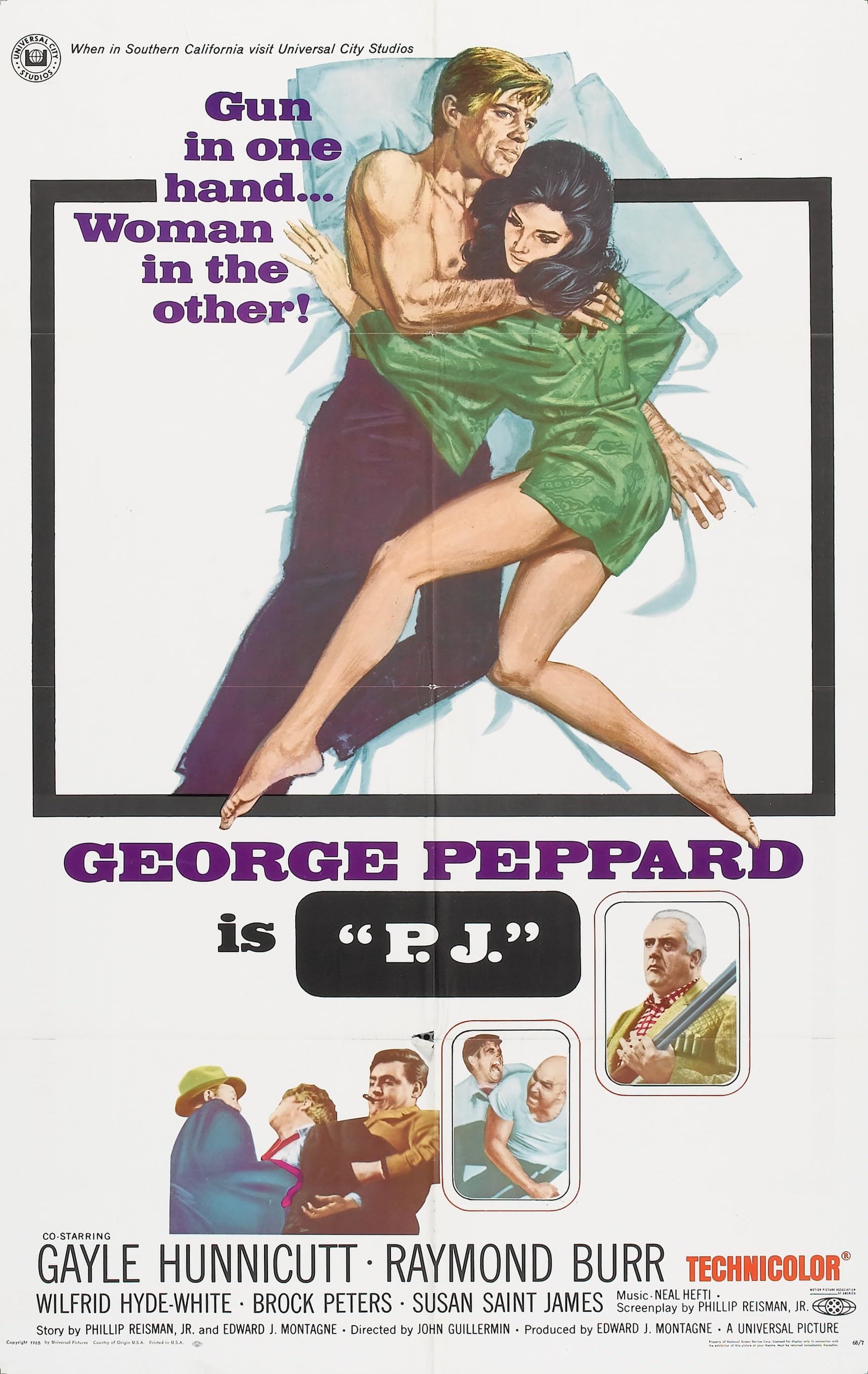
With P.J., George Peppard plays the titular Phillip Marlowe-esque down-on-his-luck private eye. He’s so far gone he doesn’t even have an office, just a bar he frequents where the bartender keeps his messages.

He is tasked by millionaire William Orbison (a deliciously sleazy Raymond Burr) to play bodyguard to his mistress Maureen (Gayle Hunnicutt) who has been getting some threatening letters.

Orbison takes the mistress and his wife (and P.J. and his business partner Grenoble) to the Bahamas for a little relaxation. When Grenoble finds himself murdered P.J. realizes he’s been set up. He was hired to become the fall guy.

Through a myriad of twists and turns he eventually clears his name and proves who did the murdering.

I’ll be honest, I watched this movie about a week ago and I’ve watched another eight films since then. The details of this one have grown hazy. I had to look up the plot and scroll the images on IMDB to remember anything about it. But I do remember liking it. I guess it just wasn’t all that memorable.

George Peppard is good. I’d only seen him in Breakfast at Tiffany’s but he’s incredibly charming and he works well as a private detective who’s both charming and headstrong. I love watching Raymond Burr play a heavy, especially one as slimy as he is here. I grew up watching him on Perry Mason reruns so it’s a lot of fun seeing him play someone so completely different.

The music and the feel of the film are very swingin’ ’60s. At one point there are a couple of girls in bikinis dancing in a giant martini glass. So, yeah, it is definitely worth watching, even if I can’t remember the details.

Murder Mysteries In May: Cover Up (1949)

poster

In my review of the 1935 adaptation of The Glass Key, I mentioned a scene in the 1942 remake that starred William Bendix. In that scene, Bendix plays a thug who gets to slap around Alan Ladd’s character. He does so with such gusto that he nearly steals the movie. It made me an instant fan.

I’ve since watched 11 films starring the actor where he’s mostly played tough guys, loveable lugs, and the like. He was a bigger man physically, and not exactly handsome so he fits the role of the heavy, but there is a goofy warmth to him, which makes him interesting.

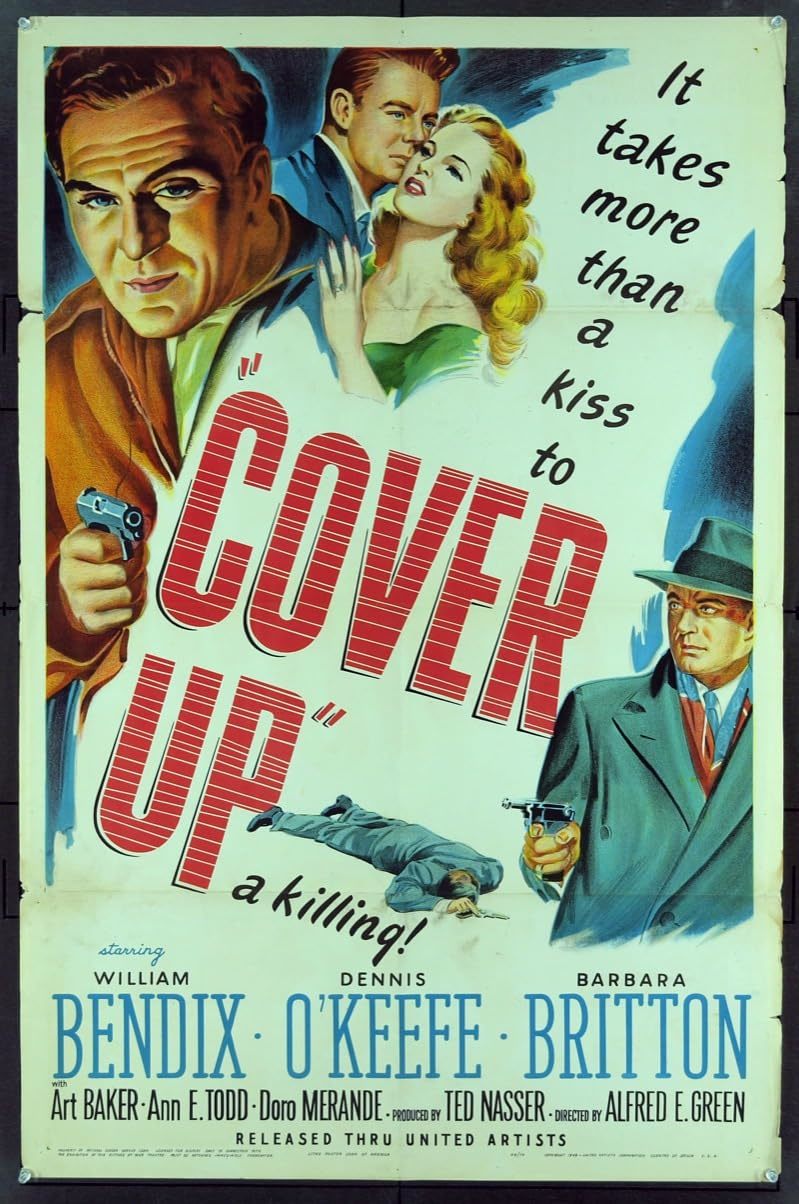
In Cover Up he plays Larry Best the sheriff of a small, Midwestern town investigating a murder. Except he doesn’t seem all that interested in investigating it at all.

It is actually an insurance investigator, Sam Donovan (Dennis O’Keefe) who does most of the investigating. The dead man was shot and the sheriff ruled it a suicide. The trouble is the gun is nowhere to be found, and there are no powder burns on the body which would indicate being shot at close range. When Sam pushes Larry for answers he just shrugs it off. In fact, no one in the town seems all that interested.

Turns out the dead man was good and hated by pretty much everyone. Clearly, he was murdered and clearly, it is being covered up. Almost everyone in town is helping with the cover-up because whoever killed him is well-liked and the dead man deserves to be dead. To a normal investigator, this would be enough. Suicide prevents an insurance pay out and that’s that.

But Sam is no normal investigator. He pursues the matter strongly even if murder means a double indemnity payout. The film owes a clear debt to Double Indemnity but it is nowhere near as good.

Naturally, there is a girl. Anita Weatherby (Barbara Britton) becomes the love interest. She’s also the daughter of one of the prime suspects. But there is little heat between her and Sam and almost no cleverness to their dialogue. Even my beloved William Bendix doesn’t add much. He’s fine, but rather more reserved than usual.

The mystery is serviceable and it is set at Christmastime which adds a nice holiday theme to what is really a rather cozy film noir. That’s the thing, it isn’t a bad film, it is exactly the kind of movie you might throw on during the holidays while you are at your in-laws, full of ham and good cheer.

The Friday Night Horror Movie: Guilty of Romance (2011)

poster

When you watch as many movies as I do you are sometimes going to venture into the strange. You’re gonna watch a few films that make you say “What the Hell did I just watch?” I’m not entirely sure I liked Guilty of Romance. I’m definitely sure I didn’t quite understand it. But I’ll never say I was bored watching it.

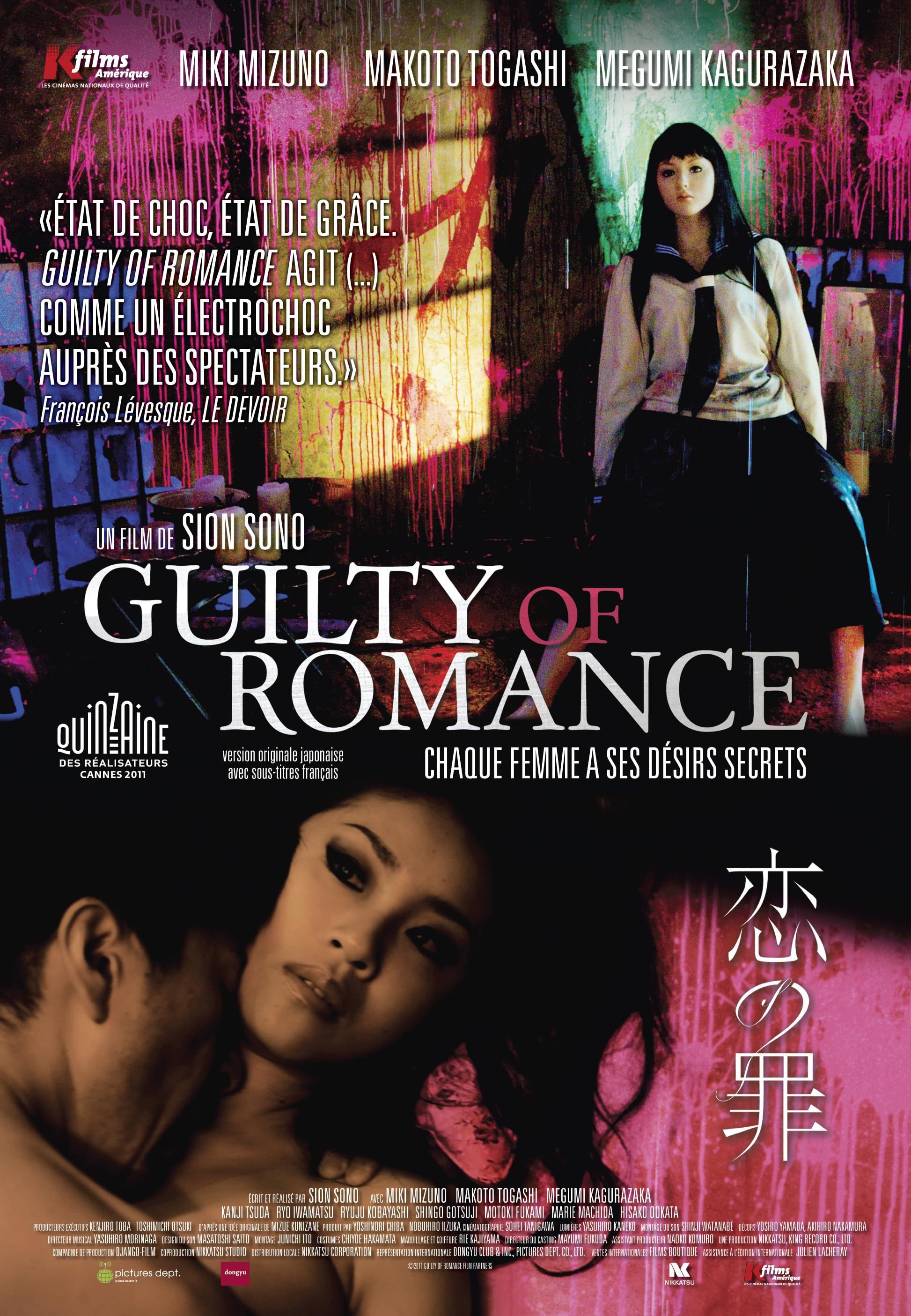
It begins with a grizzly murder. A young woman has been dismembered inside a rundown flat in the Love Hotel district of Tokyo. Parts of her body are wearing a pretty red dress with the missing parts being replaced by mannequin pieces. Other sections of the corpse are fitted out in the same manner but in a schoolgirl uniform. The head and sex parts are missing.

Police detective Kazuko Yoshida (Miki Mizuno) is on the case. The story intercuts the investigation with that of bored housewife Izumi Kikuchi (Megumi Kagurazaka). She’s married to a famous novelist. He’s an exacting husband. He leaves at the same time every morning and returns promptly in the evening. When he arrives he expects his slippers to be waiting for him in the entryway and to be placed in a precise manner. He complements her tea-making skills in a way that lets us know he’s chastised her about it before. When she places some Japanese soap (not the French stuff he likes) in the bath, he berates her.

Their marriage seems to be without romance, love, or satisfying sexual encounters. She’s approached by a woman in a shop who claims to be a talent agent. Izumi is pretty enough to be a model she says. The photos turn out to be softcore in nature. Later she meets Mitsuko Ozama (Makoto Togashi) a sex worker who convinces Izumi to join her in that work.

In some ways, the film is about this repressed woman, living a very traditional lifestyle, diving deeper and deeper into sexual liberation.

Kazuko is more modern and liberated. She’s a police detective, a working woman in a field dominated by men. She’s also married, to a man who seems perfectly nice. But she’s had affairs as well. Currently, she’s involved with a man who likes to play domination games.

There is a lot more to the story but to delve any deeper would be to spoil it. The murder mystery takes second shelf to all of the sexual shenanigans. Director Sion Sono is interested in the ways women must navigate their own sexuality, and society’s demands upon it.

It is a deeply weird, subversive film. At times I was quite uncomfortable watching it. Especially early on when Izumi is being pushed into sexual acts she’s clearly not ready for. But the film wants us to be uncomfortable. This isn’t sex for titillation, there is always a reason behind it. I’m not always sure I understand those reasons or can get behind them fully, but I’m glad I watched it.

Recommended, but not for the faint of heart.

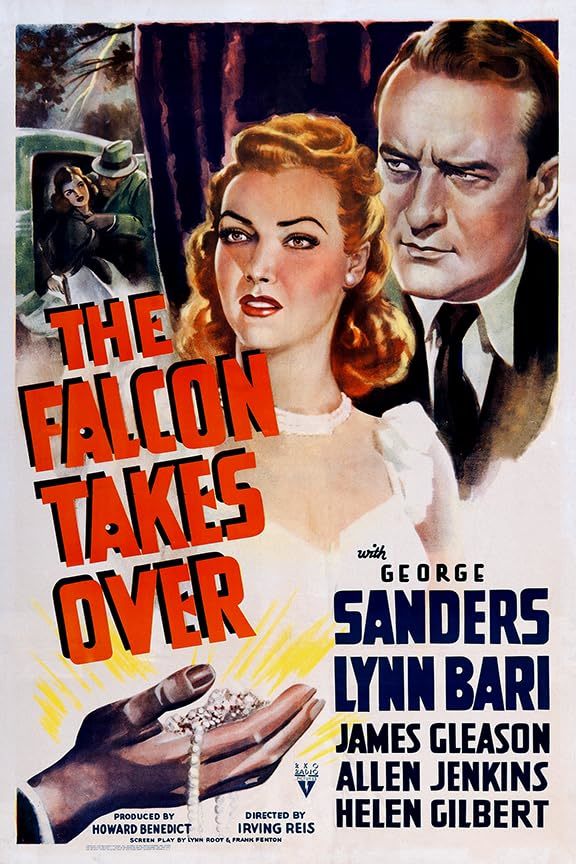
Murder Mysteries In May: The Falcon Takes Over (1942)

poster

A good murder mystery needs a good detective. Well, not necessarily a detective as mysteries have been solved by police detectives, private detectives, federal agents, spies, newspaper reporters, priests, and little old ladies. But whoever is solving the mysteries must be good. Also interesting.

Interesting detectives in good stories often find themselves in ongoing series, solving murders over and over again. Great ones become iconic and get adapted for decades. Consider Sherlock Holmes and Hercule Poirot. Sometimes a detective will be quite popular for some time and then be forgotten. Lost to time.

The Falcon was a suave English gentleman detective created by Michael Arlen. He was adapted into sixteen films – the first three starred George Sanders as Gay “The Falcon” Lawrence. In the remaining films Gay’s brother Tom (portrayed by George Sanders’s real-life brother Tom Conway) became the star.

All of the films were b-movies (and I’m using the original sense of the word – films designed to be the second half of a double feature) but popular ones.

I searched for the first two films (The Gay Falcon and A Date with the Falcon) but couldn’t find them streaming anywhere. So I settled on this one, the third in the franchise.

It is very loosely based on the Raymond Chandler novel Farewell, My Lovely. Moose Malloy (Ward Bond) a big, dumb, brute escapes from prison and shows up at a swank nightclub looking for his girl, Velma (Helen Gilbert). The club used to be a dump when she worked there and now nobody remembers who Velma is. In his anger Moose barges inside and questions the manager so fiercely he kills him. He forces a man named Goldie (Allen Jenkins) to drive him away.

Goldie just happens to be the Falcon’s right-hand man. Moose lets Goldie go and after he’s questioned by the police and is removed as a potential suspect he and the Falcon go Moose hunting.

The plot takes a lot of twists and turns with a stolen jade neckless, blackmail, and more murder all showing up. A cute reporter (Anne Revere) joins our hereoes to add a romance angle.

I’m a huge Raymond Chandler fan and his story helps the film a lot. Everything else going on makes me wonder if I’d enjoy these films very much at all. I love George Sanders but he’s fairly bland here. The Falcon is much more akin to Nick Charles in the Thin Man Films (svelte, sophisticated, and light-hearted) than Chandler’s hard-boiled, rough-and-tumble Phillip Marlow. I suspect me knowing the source material hindered things a big as the Falcon doesn’t jive with my notions of who the detective should be in this story.

But it goes off well enough. It is very light, and fun. Allen Jenkins is having a blast, and gets all the best lines. It is a perfectly fine Saturday afternoon type movie and worth watching if you like that sort of thing.

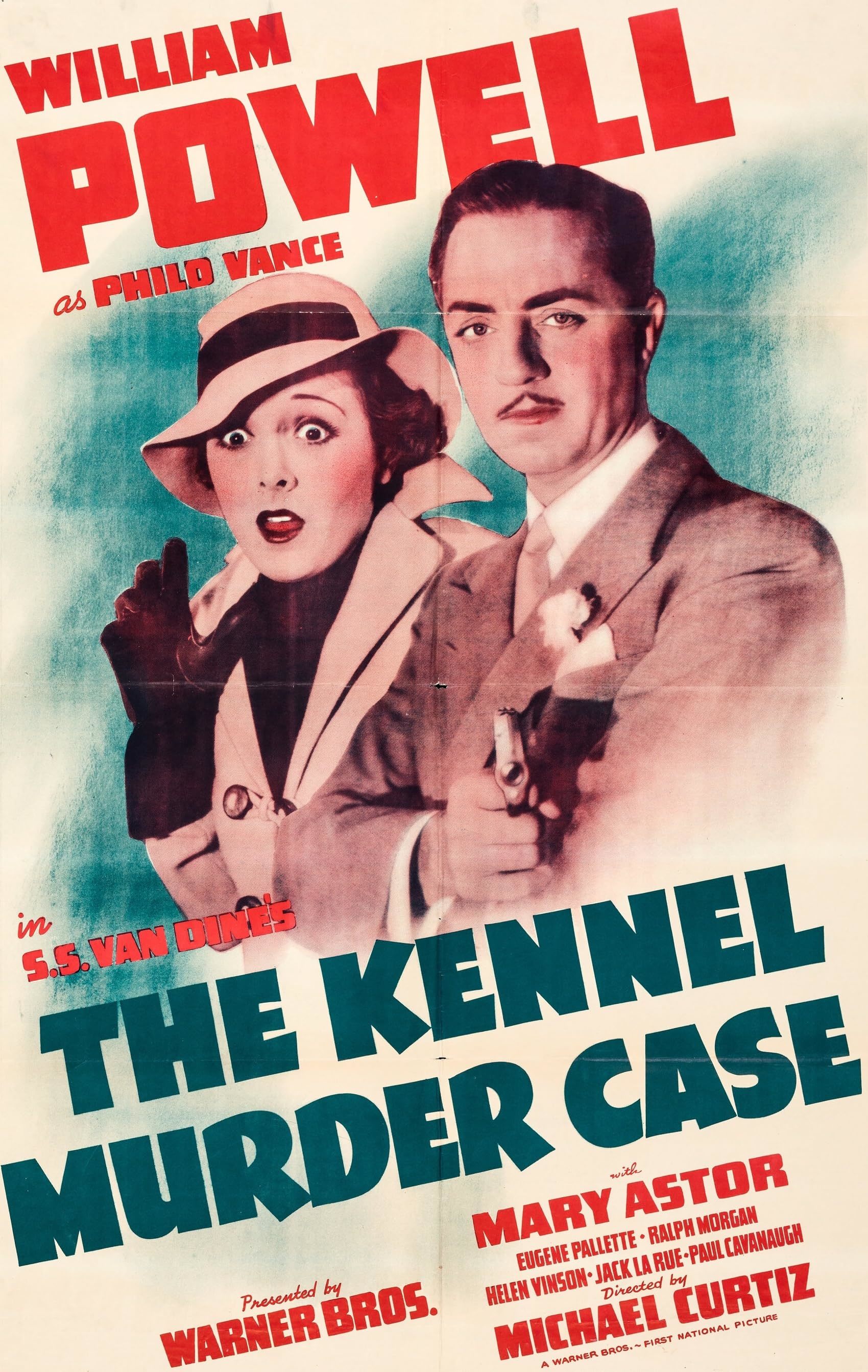
Murder Mysteries In May: The Kennel Murder Case (1933)

poster

I’m certainly not the only person who loves murder mysteries. Go to any bookstore and you will find shelves lined with them. Turn on the television to nearly any station and you’ll likely find one. Countless movies have been made in the genre. As I noted in my keynote it is an extremely malleable genre. It can be fitted to suit any audience’s needs.

As one might know from my yearly participation in Noirvember I am a huge fan of film noirs and the hard-boiled way of writing. It was actually the Coen Brothers who turned me on to such things. I’d heard their movie Miller’s Crossing was inspired by a couple of books from Dashiell Hammett so I went to the library and started reading him. That led me to Raymond Chandler and James M. Cain which led me to their movie adaptations and the rest is history.

But I’m getting away from myself. The Kennell Murder Case is based on a book by the same name by S.S. Van Dine. He was a conetemporary of Hammett, but his books have greatly fallen out of favor. They were getting that way by the time Chandler started writing a decade or so later. Chandler directly called Dine out in his essay on mystery writing The Simple Art of Murder in 1944.

Philo Vance was the name of Van Dine’s detective. Here he’s played by William Powell (who would find great success a year later in The Thin Man, written by Hammett). In the books, apparently, Vance is a bit of a dandy, an intellectual and aesthete who solves murders by picking up clues the police miss.

Powell (who had previous played Vance in three other films) plays the character like a prototype for Nick Charles in The Thin Man movies. He’s intelligent and upper class but not distinctly so. He’s witty at times but the script isn’t all that sharp.

The plot is basically a locked room mystery. A man is found dead inside his room. The door is locked from the inside, as are the windows. He was shot in the head and the pistol is laying by his side. Suicide is the obvious answer, but Philo Vance doesn’t think so. He just saw the man the day before at a dog race and he seemed perfectly upbeat. When the coroner realizes the cause of death was a blow to the head by a blunt object, and not the gunshot the case is on.

There are more murders and more mysteries that arise, but honestly I was bored from the begining. The pacing is sluggish. The dialogue comes with these odd pauses between lines and the scenes don’t cut out for several beats after everything that needed to be done is done. And as the dialogue isn’t all that clever, and the action not all that well done all of that slowness just makes the film seem like its longer than it actually is.

I always like William Powell, and he’s fine here, but the character is underwritten and the story so underwhelming, that I can only recommend this to die hard fans.

The Friday Night Horror Movie: Malignant (2021)

poster

It is time for both the Friday Night Horror Movie and Murder Mysteries in May. One would think it would not be difficult to find a film that fits both of those descriptions. Murder is horrific after all. But for tonight, I found it nearly impossible. The trouble, I’m realizing is that since mysteries and crime stories are some of my favorite genres, I’ve seen a lot of them. I wanted to watch something I’d never seen before and that proved difficult. I was probably using the wrong search terms.

I eventually landed on Malignant. It was directed by James Wan who has helmed several horror films I’ve enjoyed (namely The Conjuring and Insidious). Even when I’m more ambivalent about his films (namely the Saw franchise) I’m always impressed with his craft as a filmmaker. He definitely knows how to move a camera and create some true cinematic scares.

The basic synopsis of the film – woman begins having visions of terrible murders only to realize they are coming true – has been done many times before, but that type of thing can be effective and with Wan at the helm, I figured it would at least be interesting.

I was wrong. So very, very wrong.

In general, I’d say picking on a film’s plot holes (both real and imagined) is one of the lazier forms of criticism. A film is more than a plot and a great movie can overcome bits in the story that don’t make logical sense. But I also realize that when a film isn’t working for me I tend to get angry at those holes in the plot.

Malignant is a very stupid movie. So much of what happens either doesn’t make sense or is just completely bonkers. But the thing is Malignant is also a film that completely understands how utterly ridiculous it is. Few films from major studios are allowed to have such a ludicrous premise and are given the chance to just completely go for it.

Had I been in a better mood, had I been less tired, or had I been with some friends who enjoyed dumb, stupid, ridiculous horror films I might have allowed myself to just go with it and have a good time. As it is, I could barely make it through.

Frozen in January: Whiteout (2009)

whiteout movie

Sometimes you watch a movie knowing ahead of time it is going to be bad. You do so thinking maybe it won’t be that bad. Maybe it will at least be entertaining. And maybe, just maybe, it will defy expectations and actually be pretty good.

Mostly, you turn out wrong.

Or maybe that’s just me.

I knew going into it Whiteout wouldn’t be good. It actually has a kernel of an interesting idea – a lone US Marshall in Antarctica must solve a murder. But that’s also the kind of snappy idea that Hollywood all too often screws up.

I should have known not to watch it when I realized it stars Kate Beckinsale. I don’t actively hate Kate Beckinsale. I don’t think she’s necessarily a bad actress. She just has a habit of starring in a lot of bad movies. I don’t know if she just has bad taste, or she’s rarely offered anything any good or what. Maybe she has a terrible agent. But looking through her filmography I see very few movies that I either thought were good or that look anything like interesting.

But, like I said, this film has a setup that could be really cool so I took the plunge. 

The biggest problem with the film is that it doesn’t know whether it wants to be a mystery, a thriller, or a horror film. It even throws in a bit of World War II conspiracy for good measure.

Beckinsale plays Carrie Stetko, the sole US Marshall in Antarctica. Most of the base is preparing to fly out. Winter is coming and at the bottom of the world, winter is long and hard. Minimal staff is required.

Stetko usually stays but this time she’s leaving. As is her friend, the base’s only doctor, John Fury (Tom Skerritt). As an example of just how poorly this film thinks things through that is the base’s only law enforcement agent and doctor leaving for several months. There is no indication that anyone is being sent to replace them. While most of the personnel do leave for the winter, not all of them do. What happens when a crime is committed or someone needs healthcare?

But of course, the film doesn’t think about this because it knows those two characters aren’t going to be leaving the base. A crime will be committed and someone will need medical attention and they will stay.

A body is found lying face down in a remote part – a “no man’s land” of the continent. His face is smashed to bits so it is impossible to tell who he is. Stetko and Fury investigate. Stetko realizes he must have taken a great fall. She knows this because, as we see in a flashback she once shot a man causing him to take a tumble out of a high-rise building. 

The film loves its flashbacks. They pretty much all surround that one event in Stetko’s life, but the film doles it out like it is some great mystery that will reveal some insight into this current case. But really it is a pretty simple thing that lets us know what she’s doing in remote Antarctica in the first place.

The murder leads them to a remote station which then leads them to a WWII airplane buried in the snow. This should be an interesting mystery, a weird surprise for the audience. Except the film began with us watching the plane crash and showed us why. The only mystery left is what was in the box on the plane that everyone winds up fighting over. It might be old nuclear stuff which would be bad. Really bad. I guess.

Then Robert Pryce (Gabriel Macht), a United Nations security agent shows up. He’s there awfully fast for a guy who wasn’t in Antarctica before the movie began. Making us think perhaps he’s the killer. He’s not, but the movie likes throwing red herrings out like that. Anyone who has seen an episode of Law and Order will be able to figure out who the Big Bad really is before he’s revealed.

Oh, also, there is a huge storm rolling in causing the entire base to be evacuated in a few hours. Because this film doesn’t have enough going on, it needs to add that into the mix.

It is based on a graphic novel so maybe some of the script problems come from the source material. All of the plot twists and turns might work better in a comic. I’ve just started reading the book and it does seem to be more of a mystery than anything, and it definitely doesn’t begin with the plane crash so I’m prepared to say most of the film’s problems do come from the script. But only time will tell on that front.

Beckinsale isn’t bad. I don’t think she’s a particularly bad actress. But she doesn’t elevate the material either. And the material is bad. It is too much of everything and not enough of something specific.

The Friday Night Horror Movie: A Haunting In Venice (2023)

a haunting in venice poster

I follow a lot of film critics and culture writers on various social media platforms. Most of them like to periodically complain about the state of the movies. The Marvel Cinematic Universe has created a seismic change in movies, and more specifically the way movies are shown in theaters. Or rather how many movies are no longer shown in theaters.

The MCU has made billions upon billions of dollars. Their method of interconnecting their films into one giant universe (and making piles of cash in the process) has made every other studio chase those billions. In doing so they are no longer satisfied with smaller movies, where they can only make millions of dollars instead of billions, virtually erasing mid-budget films in the process.

These film critics complain and complain about how adult-oriented dramas, mysteries, and romances simply don’t exist at the movies anymore. They wax nostalgic about times in the past, two or three decades ago, when they could go to the movies and watch something that wasn’t based upon a comic book or a part of a larger franchise.

Yet, when those types of films do get made and do get shown in the theaters, these same critics tend to pan them and encourage others not to go see them.

Kenneth Branagh’s Hercule Poirot films are a good example of this. Based upon the novels of Agatha Christie, Branaugh has directed and starred in three films in which he plays the famous Belgian detective. I won’t claim that they are great films by any stretch, but they aren’t big-budget superhero films either. They are well-told mysteries with terrific casts and are made for adults. In a word they are exactly the sort of films that these types of critics complain don’t get made anymore. Yet when the movies come out, those same critics do nothing but grouse about them.

And that’s enough grousing from me. The latest Poirot film is probably the best one. As the title implies there is a supernatural element to it, and while it isn’t a straight horror it certainly contains elements of horror and that means I get to talk about it tonight. It also means that my daughter is having a sleepover and me and the wife had a much-needed date night and this is as close to horror as she’d let me get.

Hercule Poirot has retired into seclusion in Venice, Italy. There has been too much death and misery in his life and he simply cannot stand to tackle another mystery.

When his friend, Ariadne Oliver (Tina Fey), a novelist who writes thinly veiled Poirot mysteries, invites him to a seance he at first declines but her friendship wins him over.

The seance takes place on Halloween night in an old, decaying palazzo. It is being held by Rowena Drake (Kelly Reilly) who hopes to speak to her daughter who mysteriously killed herself in the palazzo one year prior. Also at the seance are an assortment of interesting people all of whom have a connection to Rowena and her daughter and, it will be found out, had a reason to murder her.

Poirot quickly exposes the psychic (Michelle Yeoh) as a fraud and is ready to leave, but when the psychic is murdered and someone tries to drown him in an apple bobbing bowl, he locks everyone inside the palazzo and finds himself once again back on a case.

This one is based on a much less famous book (Hallowe’en Party) than the other two films (Murder on the Orient Express & Death on the Nile). Apparently, it’s quite loosely based as well, which allows it to surprise you with its story rather than retell one that is quite familiar to casual fans.

The palazzo is reminiscent of all those gothic castles in those old haunted house movies that I love so much. It allows for plenty of creepy, atmospheric shots down long corridors, and shadowy rooms. The film has a lot of fun toying with whether or not the supernatural aspects are real or not, making it great fun to watch.

Kenneth Branagh clearly enjoys himself playing the famous detective and he’s become quite good at it. He’ll never replace David Suchet (who played Poirot in the long-running British television series) but he’s still quite entertaining. I love that he’s able to make these lavish adaptations with large, wonderful, casts. I hope he gets to make a dozen more.

Great British Cinema Cottage to Let (1941)

cottage to let

Mrs. Barrington, a kook of a woman (Jeanne de Casalis), has agreed to take in child evacuees from London during World War II. She’s also agreed to allow her cottage to become a military hospital. Naturally, she has forgotten to inform her leasing agent of any of this so besides the children and the infirmed she has let her cottage out to a strange man, Charles Dimble (Alastair Sim). Also living at her estate is her husband John Barrington (Leslie Banks) an inventor who is currently working on a new bombsight which is of great interest to the Royal Airforce and Nazi spies.

Cottage to Let is a wonderful little drama filled with mysterious and eccentric characters and enough twists and turns to keep everyone guessing.

Mrs. Barrington might be a bit dotty, but she’s smart enough to realize she only has so many rooms so she only takes one child evacuee, and one soldier in need of attention. Still, that amounts to a large cast of characters. Moreso when the British military higher-ups come into town when John Barrington refuses to come to London to clue them in on his work.

Early on we realize there must be a spy amongst this lot, but we aren’t sure who it could be. The film has a lot of fun insinuating various characters but never quite letting us know who it is.

It is suspenseful in the way Hitchcock’s films are often suspenseful – which is to say it creates some interesting tension while also letting you know no real harm is going to come to our heroes. It is also clever and quite funny.

I found it to be wonderfully delightful.