Sci-Fi In July: The Quiet Earth (1985)

cover

There is a scene early on in The Quiet Earth – a film about a man who thinks he is the last human left alive on the planet – where he takes a big truck and drives it through a small convenience store, smashing it to bits. My dad, or maybe my uncle, rented the film when I was 12 or 13 years old. I thought that scene was the coolest. Me and my cousins decided that’s exactly what we would do if we were the last people on Earth – destroy a bunch of stuff. We already liked breaking glass bottles and blowing up Coke cans with firecrackers. So how cool would it be to drive a truck through a building?

I don’t think I finished the film back then. I probably thought it was boring after that. But that scene has stuck with me all of these years. I’ve often thought about it and wondered what the film was. Some two decades later and here I am looking at lists of science fiction films and I come across it once again. The film is so much better than that one scene, there is a lot more to it.

That man is named Zac Hobson and he’s played by Bruno Lawrence. We first see him lying in bed naked. The time is 6:12 AM. His alarm goes off and Zac seems confused to be there. He turns the radio on and finds only static. His clock is stuck at 6:12. He gets dressed and drives to work. On the way, he stops at a petrol station. Nobody is there. Nobody is on the road either, though there are some cars just randomly stopped here and there. The city is empty of people.

He works at a scientific station. The building is empty. He uses his computer to send messages to other stations across the globe, but he gets no reply. He finds a man dead in a chair next to a bank of terminals. He looks burned by radiation. He reads a screen that says Project Flashlight took place that night.

His company destroyed the world.

He goes to a radio station and records a message for any survivors to contact him. He drives around using a bullhorn to search for others. He starts to drink. He’s slowly losing his mind.

Then he meets Joanne (Alison Routledge). She somehow also survived. They are thrilled to find each other.

Collectively, they systematically begin looking for survivors. Being a scientist he’s constantly trying to understand exactly what happened, and what other changes this event might have wrought.

It is a slow, meditative film. It spends a lot of time pondering what someone would do if they thought they were the last people on Earth. Before that scene in the truck smashing a convenience store, Zac goes through a whirlwind of feelings. He goes shopping. He moves into a large house. He puts on a woman’s slip. He goes into a church and questions God (then blows a statue of Jesus on the cross to bits with a shotgun). He declares himself the president of the world.

With Joanne, he keeps his sanity. There are questions about what they will do next. Will they try to repopulate the world? Should they travel farther away in case people in other countries survive? The film mostly leaves those unanswered. It doesn’t always even ask them. But it leaves the audience time to ponder them. Eventually, things do get moving at a faster clip and there becomes a need for urgency, but those things are best left unspoiled. It ends with one of the most beautiful closing shots in all of cinema.
Sci-Fi In July: Sphere (1998)

cover

I’ve previously mentioned how The Silence of the Lambs helped me to become a lifelong reader. Well, Michael Crichton was no small slouch in that regard either. He became the first author that I really followed. I have fond memories of a couple of friends and me discovering his books and fighting over who would get to check one of the books from the school library first and who would have to wait.

The first book of his that I read was The Andromeda Strain – about an alien virus that crashes to Earth aboard a satellite and the scientists that study it. I loved it. I loved its realism and attention to detail. Just now I’m realizing that the Hannibal Lecter books by Thomas Harris and the stories of Michael Crichton appealed to me in the same way. Harris dug into the details of forensic and behavioral science – why serial killers behave the way they do and how the F.B.I. catch them. Crichton also leans heavily into his science background. Both authors lay out science in an organized and detailed manner. That appealed to me in some way.

I don’t remember much about Sphere. I remember reading it on the bus – slouched down, knees on the seat in front of me. But I don’t remember much of the actual story. Except that, I was disappointed in it.

I was even more disappointed by the movie which took quite a few liberties with the book, though again my memories are fuzzy.

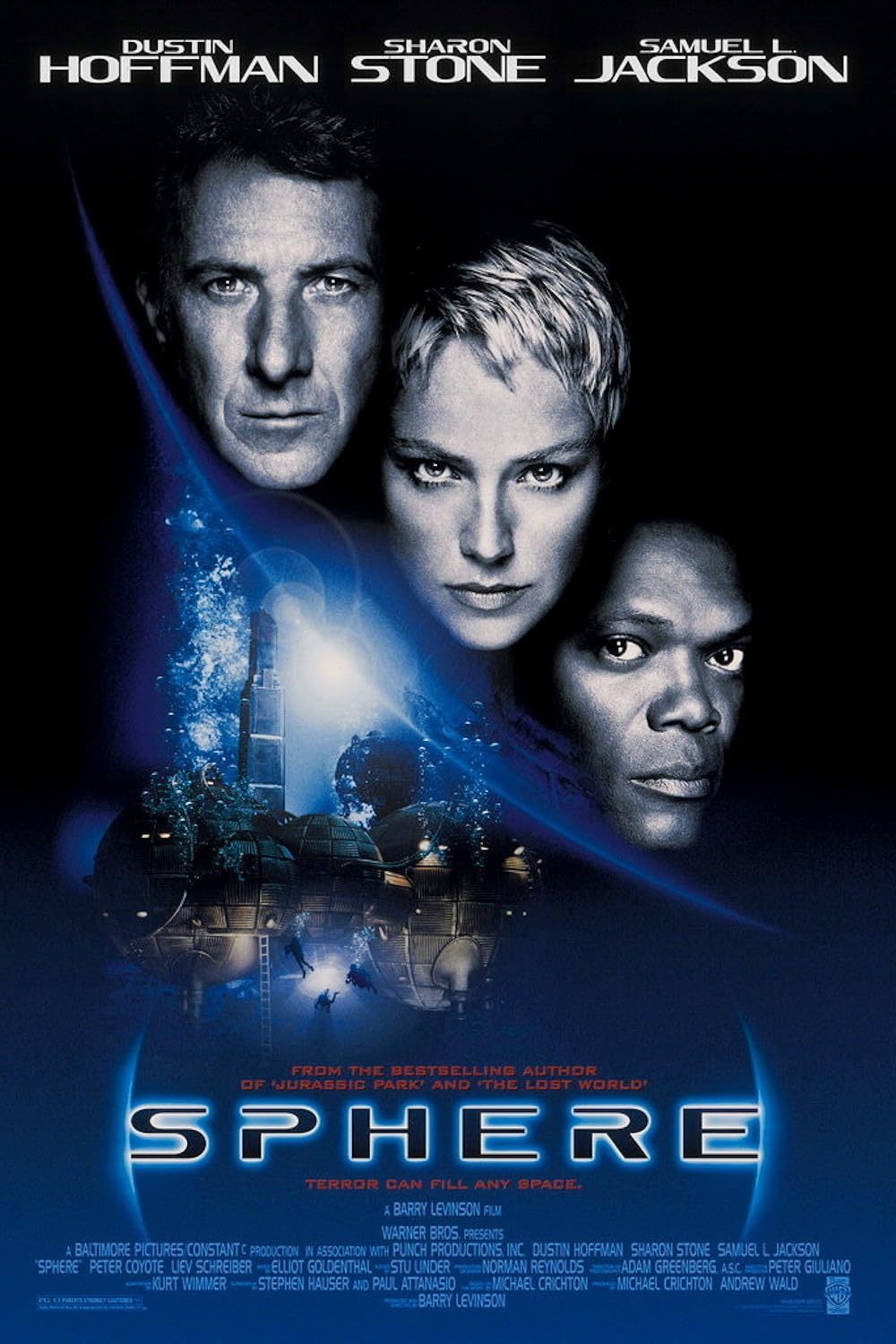
But it has been many years since I saw the film, and sometimes movies I was disappointed with as a college kid become better with age. Since this is Sci-Fi in July and that film stars Dustin Hoffman, Samuel L. Jackson, Sharon Stone, and Liev Schreiber I decided to give it another try.

Friends, it has not gotten better with age.

The basics of the plot are pretty good, especially in the beginning, but then it does a deep dive into stupidity and never recovers.

So, a ship is discovered at the bottom of the ocean. Several inches of coral have grown over it. Coral grows at a specific rate which indicates the ship has been down there for three hundred years. Since humankind didn’t have spaceships 300 years ago it is determined that this ship is extra-terrestrial in origin.

A few years prior psychologist Dr. Norman Goodman (Hoffman) was tasked by the Bush administration to write a paper detailing what should be done if aliens were discovered on Earth. He filled in some procedures and proclaimed you’d need an astrophysicist (Schreiber), a mathematician (Jackson), and a marine biologist (Stone).

That’s a very Michael Crichton setup. He loves putting together a crack team of smart people to solve a crisis. But in this story (or at least this adaptation of this story) Goodman half-assed that paper. He needed the money and didn’t think anyone would read it. All of the scientists he claimed they’d need were just people he knew. Some of these folks are super smart, but they aren’t exactly the elite group of people one might actually ask for.

The military has already established a sea station on the ocean floor next to the spaceship. Our heroes take a sub down and investigate. Inside the ship they discover a few things I won’t spoil but also a large CGI sphere. It reflects everything around it except for the humans suggesting it is an intelligent life form.

One of the characters later goes inside the sphere but when he comes out he can’t remember anything. Soon after strange things start happening like the base station is attacked by a giant squid and strange sea snakes come out of the sink. Meanwhile, up above a huge storm has rolled in causing the Navy ships to have to leave for a few days, stranding our heroes down below.

At some point, the alien starts talking to our heroes through text messages on the computer. It is friendly at first and then it begins acting like a petulant child. Luckily, our psychologist knows how to talk to angry children. For a little while at least

For a little while I enjoyed the film. The basic setup is solid and I like the actors, but the longer it rolled the sillier it becomes. And stupid. As I said one of the things I liked about Crichton is that he took science seriously. He loved to get into the details without letting the story get bogged down. He probably made some stuff up, but he did it well. The film takes a lot of shortcuts with the science and it makes the film worse.

Director Barry Levinson is known for his character-driven dramas and he is clearly out of his depth with this blockbuster-fueled science-fiction horror story.

Sometimes it is best to remember that a movie is bad, and not try and prove those memories as faulty.

Sci-Fi In July: Barbarella (1968)

cover

Barbarella is the sort of movie that was infamous in my junior high. It was infamous everywhere, really, but I was a pubescent boy amongst many other pubescent boys and the film got a lot of talk. between us. This would have been the late 1980s. It seems strange to me now that 13-year-old boys would be talking about a movie made more than a decade prior. It must have come out on home video or been playing a lot of HBO or something.

At the time Jane Fonda was known more for her exercise videos than her movies. I didn’t get to see the movie. To be honest I don’t know if any of my friends did. But there was this buzz about it. Jane Fonda had a nude scene in it and was all kinds of sexy. That’s what we talked about.

The film was notorious outside of my junior high for those reasons as well. In 1969 Fonda was a well-established movie star. Barbarella was a sexy, cheesy sci-fi flick directed by her husband Roger Vadim. Critics didn’t know what to make of it (they mostly didn’t like it) and audiences didn’t know what to do with it (they mostly didn’t watch it). But everybody talked about it, even a decade later.

It has remained on my cinematic radar ever since. But until this week I’d stayed away from it. The film has a reputation for being notoriously bad and campy fun. Now that I’ve seen it that’s pretty much how I’d describe it.

It is not by any means good cinema. But it is deliriously entertaining. The set design is magnificent and the costumes are outrageous. It looks like psychedelic cotton candy. The story is ridiculous and everybody but Jane Fonda seems to be phoning it in, but gosh I had fun watching it.

Set in the faraway future Barbarella the film stars Jane Fonda as Barbarella the character, who is tasked by the President of the Earth to find Durand Durand, a scientist who has created a psionic ray. Now in this future violence has been eliminated and sexual hangups have gone bye-bye. Barbarella is a groovy chic who hangs out in her shag-carpeted spaceship digging on cool tunes and having a good time.

But now she has a job to do. She flies to the planet Tau Ceti to save Earth from destruction. There she has lots of crazy adventures including having sex with an angel, being locked in a cage and attacked by birds, and attached to a machine designed to make her orgasm to death.

It never takes itself too seriously, it looks amazing, and mostly it is a lot of fun. It does run a little too long (technically it is only 98 minutes in length but it feels a lot longer) and there is a very little to it. I can’t see myself returning to it often. I’m glad I watched it, but I don’t imagine it will entice me again anytime soon.

Sci-Fi In July: I Married A Monster From Outer Space (1958)

cover

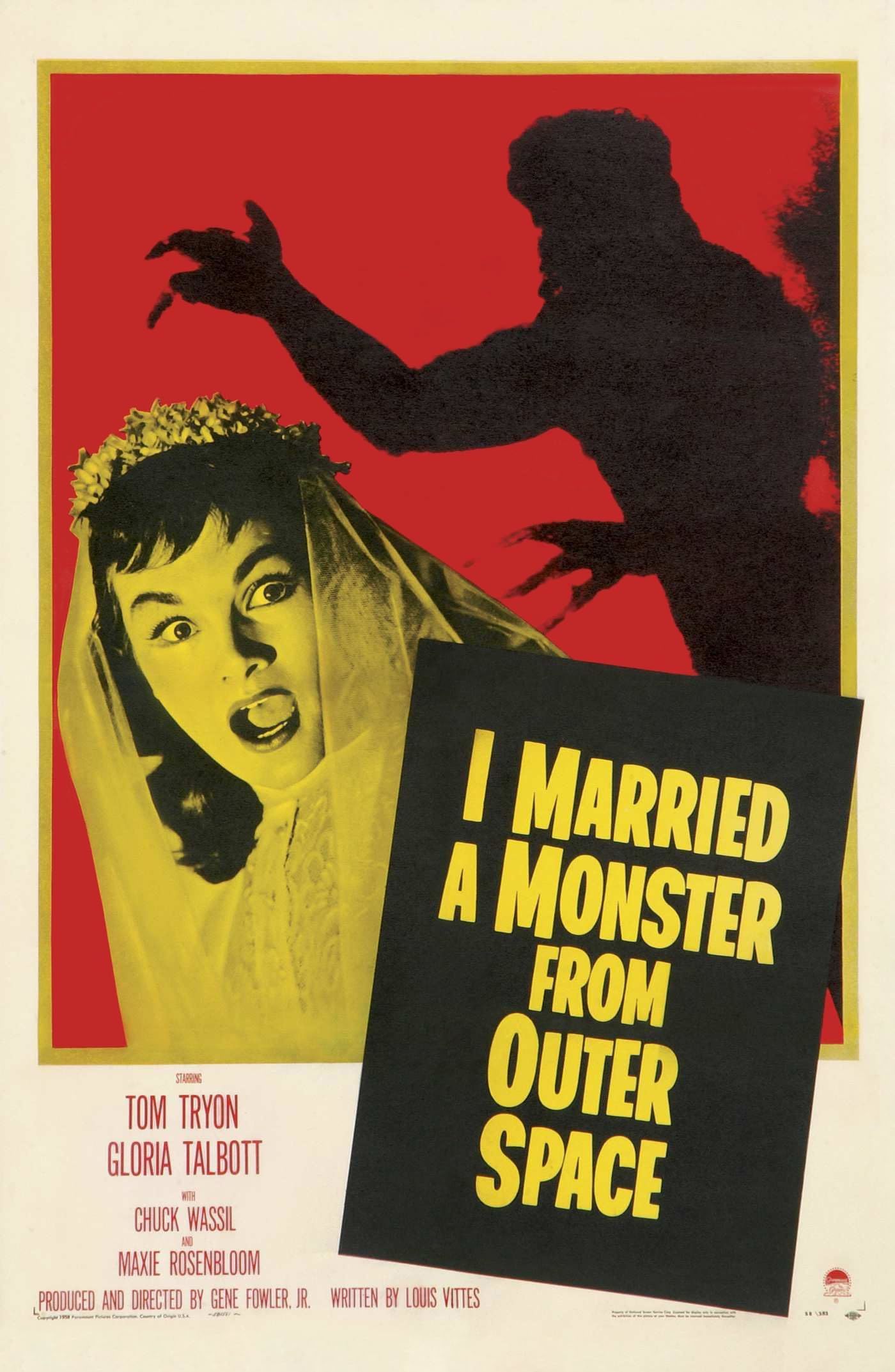
They say that horror movies reflect the anxieties and fears of a culture at the time of release. If that’s true then I Married a Monster From Outer Space says a lot about America in the late 1950s. Made on a shoestring budget and initially run as the b-side in a double feature with The Blob, it nevertheless dips its toes in anticommunist rhetoric and the changing roles of women in the post-war decade.

Marge Farrell (Gloria Talbott) is a nice girl set to marry Bill (Tom Tryon) a nice guy. The night before their wedding he is attacked by an alien monster who then takes Bills form. The alien follows through with the wedding, but a year into their marriage Marge is beginning to suspect something is wrong.

Bill rarely goes out. He’s stopped drinking. Dogs bark at him, and cats hiss. Worst of all she’s still not pregnant. The doctor assures her it isn’t because anything wrong with her, but maybe Bill should come in for a few tests.

One night she notices Bill get out of bed and leave the house. She follows him down the road, into a field, where she sees him enter his spaceship and take his true form.

Marge runs to the chief of police who swears he believes her, but behind her back indicates she’s overworked, tired, or just plain crazy.

She confronts Bill who admits everything. His planet, along with all the women folk was destroyed by their son. They found Earth to be hospitable and hope to colonize it. They can apparently have sex with human women, but as yet cannot figure out how to impregnate them.

Marge runs to her doctor who makes comforting motions that he believes her, but he doesn’t do anything about it. Bill indicates there are more just like him, and they’ve taken over the bodies of other men in the town.

Fully realizing she cannot tell which men are aliens and which are human, she still runs to other men for help. Never once thought she could just form an army of women to destroy the aliens.

During World War II women had to fill the gaps left by the men in the workforce. They got jobs in factories, making weapons, and manufacturing goods. They made money and enjoyed an autonomy rarely found before the war. When the men came home some of them were reluctant to go back to the way things were.

This film seems to indicate that maybe they should.

It can also be read as an anti-communist film. The monsters look just like us, that’s the same line of fear Joseph McCarthy had been spreading for years.

If you take this a little further the men whom the aliens have taken over are mostly childless. They have failed the American ideal of masculinity. The men who destroy them are family men, good, old-fashioned manly men. True Americans. Marge is smart and tough, in today’s parlance she’s a badass. But she’s more than happy to take a backseat to the men and let them save the day. By the time the credits roll, she’s happy to go back to being a happy housewife.

Or maybe this is all a load of bollocks. Maybe it is just a silly little science-fiction horror film, riffing on Invasion of the Body Snatchers that came out a few years prior.

I’ll say this: the effects look good for what they are. At 78 minutes it doesn’t overstay its welcome. All of that stuff I just wrote is fun to theorize about, but I’m not sure it makes for an enjoyable watch. For a low-budget sci-fi flick from the 1950s, you could do a lot worse. But it isn’t the first film in that genre that I’d recommend.

Sci-Fi In July : The Girl With All the Gifts (2016)

cover art

A young girl sits counting in her cell. Suddenly an alarm sounds and the lights come on. Armed soldiers come calling. Though she can walk she sits down in a wheelchair. The soldiers strap her arms and legs down and her head so she cannot turn it. She is wheeled into a classroom with numerous other children likewise strapped to wheelchairs.

Soldiers look in on the classroom calling the kids names like “freaks” and “abortions.” Their teacher, Helen Justineau (Gemma Arterton) is the only adult who is kind to them. In a moment of grace, she touches the girl’s head. Immediately, the soldiers, led by Sergeant Parks (Paddy Considine) come in and chastise Helen for touching a student. He then spits on his hand and pushes it under one of the children’s nose.

Immediately, the kids go feral, writing in their wheelchairs and attempting to bite the soldiers. They are zombies. Or more correctly, they are zombie hybrids. They will attack with fury when they smell humans, but can also talk and think like normal people.

They may also be the key to a cure. The zombies in this film were caused by some sort of fungus that grows inside the brain. These kids were In Utero when the virus first came about (the film occurs some ten years after the beginning of the apocalypse). They absorbed the virus when their mothers got it which may have caused them to be…well not immune as they are definitely hungry for human flesh, but special. The scientists, led by Dr. Caldwell (Glenn Close) think this specialness may lead them to a cure.

I feel like I’m getting bogged down in the plot, but really what I’ve just described happens in the first ten minutes or so. But it is such an interesting setup for a zombie movie I wanted to dig into it a bit.

All of that occurs at a well-guarded military base, but just after those events, it is attacked by hundreds of zombies and overcome. Our heroes narrowly escape and the rest of the film finds them traveling into London in hopes of rescue.

That girl I mentioned is named Melanie (Sennia Nanua), she is smart chatty, inquisitive, and kind. In the time we spend with her on the base, she always says hello to the military people even when they are cruel to her. She always asked a lot of questions and was the top student in her class. This both endears her to her capturers and ingratiates them.

The look and feel of the film has a lot in common with the recent television series The Last of Us (the series came out in 2023 but was based on a game from 2014 game – the book this film was based on also came out in 2014 so I’ll let you be the judge of who created this look first). The landscapes are overgrown with vegetation while the city buildings and infrastructure are beginning to collapse. This creates a beautiful yet eery look to everything.

The plot is your basic quest scenario but it is well done. This type of movie often will involve a child but they are usually just there to add a sense of danger. Melanie is something different. Because she is a zombie the other do not sense her as food. She is safe from them. But when she gets hungry she is a force of danger. Yet she is also the human’s only hope. That makes the plot more interesting than your standard zombie fare.

This all worked for me quite well. I dug the the look of the film, the action scenarios, and all of the characters. If you like zombie films I highly recommend this one. It also has a fantastic ending.

Sci-Fi in July: Palm Springs (2020)

cover

I love Groundhog’s Day-type movies. There is something really interesting about watching characters relive the same day over and over again. Ironic, since when our daily lives feel like that, we want to strike out and do something different.

Actually, now that I’m thinking about it, I think that is what makes these films so interesting. Because the characters are literally stuck on the same day, getting a reset whenever they fall asleep or die, they are free to do whatever they want. Knowing everything will go back to normal the next day, they can do all the things they were too afraid to do in real life.

Palm Springs came out in 2020 when many of us were stuck in lockdown. It felt like every day was the same because we couldn’t go anywhere or do anything. It is fun reading reviews of the film when it came out because everyone was feeling like they were stuck in their own time loop.

It does a couple of interesting things with the concept. First, the film is a romantic comedy which I don’t believe has ever been done with this type of film. Second, it brings other people into the time loop with fascinating results.

We suspect something is different from near the start. Niles (Andy Samberg) behaves strangely. He attends a wedding reception in a Hawaiian shirt and shorts. He gives an impromptu speech that seems well-rehearsed. He dances to impress a girl, Sarah (Christin Miloti), but his moves incorporate all the other people at the reception in a way that seems impossible.

Of course, he’s been stuck in the time loop for a long time. That’s something else that’s different about this movie. Normally we enter the loop with our main character, here he’s already been inside it for years.

He starts to hook up with Sarah but before they get too far he’s attacked by a strange man named Roy (J.K. Simmons). Niles runs into a cave and even though he shouts for Sarah not to follow, she does anyway.

Now she’s stuck in the time loop. They are stuck together. They get to know each other. They have fun. They do crazy stuff. She tries to kill herself. It is all the same basic time loop movie stuff, but they make it fun.

Roy is also stuck in the loop. Years ago he and Niles connected at the wedding reception, got drunk, had a lot of fun and Niles took him to the cave. Now Roy hates Niles for putting him into the loop.

One of the interesting things about this film is that it delves a little into what a time loop would do to you psychologically. Niles has become ambivalent about everything. Nothing matters because it will all reset tomorrow. At one point Sarah becomes depressed and tries to kill herself. Later, she’ll become angry and she lashes out violently against some men. Niles stops her because he says, that while those people won’t remember what she did to them, she will. Knowing she is capable of such violence will take its toll on her own mind.

But mostly it is a silly little romantic comedy. The jokes don’t always work for me, they are a little too broad and silly for my tastes, but I still laughed quite a bit. What makes it work in a big way is the chemistry between Samberg and Miloti. Christin Miloti is especially great. I haven’t really seen her in anything, but she deserves to be a star. Together they make it work. I wanted to spend all the time with them living through each day, even though it was the same day.

Sci-Fi In July: Paprika (2006)

cover

I rarely remember my dreams. Sometimes I remember them for just a few seconds as I’m walking downstairs in the middle of the night to use the toilet (for I am of the age where I walk downstairs in the middle of every night to use the toilet) but by the time I get there the dream has been forgotten. Like mist, it fades away no matter how hard I try to capture it.

I’m not one to put much stock into dreams and their significance. Once in a while, I’ll remember a dream and it will seem to have some deeper meaning. During my brief tenure in graduate school, I had a dream about my grandmother, some hot air balloons, and a bunch of turkeys which guided me through a major decision, but mostly I think dreams are just your brain playing Etch-A-Sketch while you’re sleeping.

Paprika is a Japanese animated film from the mind of Satoshi Kon (who also made Perfect Blue). It is a strange, beautiful film that is all about dreams, reality, and our relationship to movies and pop culture.

Taking place in the near future scientists have invented a machine that allows others to view (and even record) people’s dreams. It was built as a psychiatric tool, but it has been stolen by a terrorist. The devices, called DC-Minis, are prototypes and lack restrictions, thus anyone (including terrorists) can enter anyone else using the machine’s dreams.

Our hero is Doctor Atsuko Chiba, the head of the psychiatric department developing the DC-Minis. She’s secretly been using the machine to help people outside the purview of the research facility. When she does this she uses the alias “Paprika.”

One of the people she’s been helping is Detective Toshimi Konakawa who has been having recurring dreams about a murder case he has been unable to solve.

Together (along with Doctor Toratarō Shima the chief of staff for the institute and Doctor Kōsaku Tokita, the childlike inventor of the DC-Mini) they try to solve the mystery of who stole the device.

I think. Honestly, the plot of this film was beyond my grasp. Like a lot of films that deal with dreams, Paprika embodies dream logic to tell its story. Things are constantly changing, morphing before our eyes. Characters jump into painting and movies on a whim.

There are a lot of movie references within the film. Not to specific movies (at least none that I caught) but to genres like mysteries and romances. In doing so the film seems to be toying with the idea of reality versus fiction and how movies and books and stories sometimes seem more real than reality.

Or something. Seriously, I’m not sure what I just watched, but I sure as heck enjoyed watching. The animation is simply gorgeous. And weird. And wild. And trippy.

Go see it.

Earth to Echo (2014)

cover

I truly have no memory of watching this. I did enjoy reading my review and noting how movies had kicked into nostalgia overload (the review was written in 2014) and chuckling about how quaint that sounds today.

I guess the movie was a mash-up of a bunch of 1980s family adventure films, but not nearly as good as any of them. This is probably why I don’t remember it. I’m sure I sold the Blu-ray so all I have left is this review.

Awesome ’80s in April: Starman (1984)

poster

I have this very vague memory of watching Starman as a kid. This would have been the mid to late 80s, I was in my early teens, definitely pubescent. I think Mom rented it. I wouldn’t have known who John Carpenter was at that point, but I’d definitely known Karen Allen from Raiders of the Lost Ark, and I’d probably seen Tron by that point and known Jeff Bridges from it.

Starman seems like a very mature movie for me to have watched at the time, so I’m guessing Mom got it for her and since I knew those actors and I liked alien movies I gave it a watch. I definitely remember not liking it, finding it rather boring.

I know I was pubescent because Karen Allen has an early scene in her underwear and that image has stuck in my brain all these years later.

I’ve since become a very big John Carpenter fan, but have put off watching this since that early viewing for having that memory of it being dull.

But it is the Awesome 80s in April and I’ve been watching a lot of early Jeff Bridges movies so I decided to give it another shot.

I still found it to be kind of dull.

Boring means something different to me now, and Starman definitely has its merits, but there is still something flat about it that didn’t appeal to me.

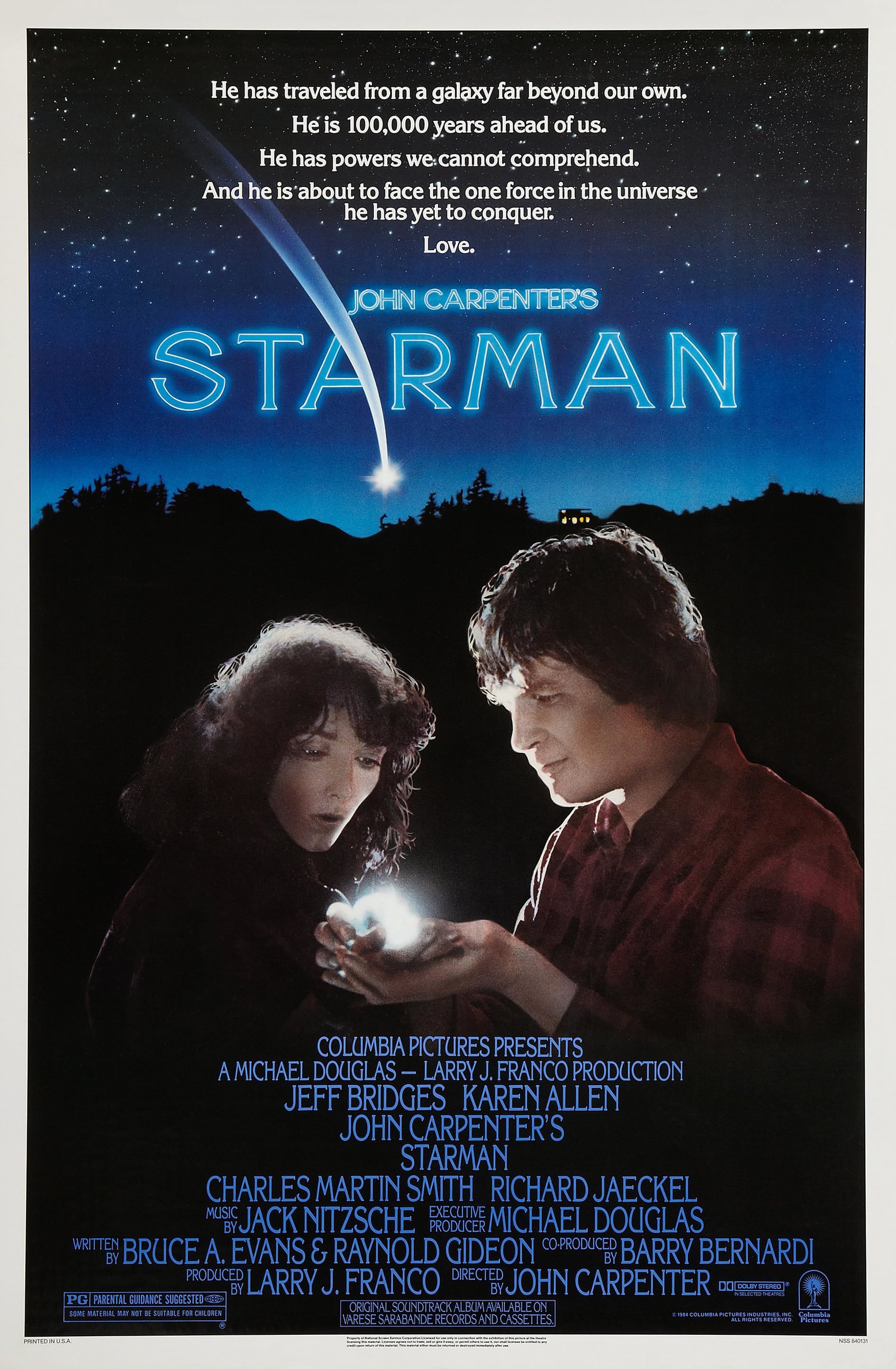
Karen Allen plays Jenny Hayden, a woman living on her own in an isolated lakeside cabin in Wisconsin. She’s a widow, having recently lost her husband in an accident. She spends her nights watching old home movies of him and feeling sad.

The Voyager 2 space probe makes contact with a distant alien race. They send Jeff Bridges (or rather an alien form that eventually takes the shape of Jeff Bridges – or rather Jenny’s late husband who is played by Jeff Bridges).

He immediately decides the planet is hostile and takes Jenny hostage on a road trip to that big crater in Arizona. They eventually become friends, and fall in love. Meanwhile, they are being chased by the Military led by Mark Shermin (Martin Cruz Smith) who is really a scientist interested in aliens, and unlike the rest of the Army men, doesn’t want to hurt the alien.

Basically, it is a road movie with the two leads getting romantic while Bridges is a fish out of water.

Allen and Bridges are great (Bridges was nominated for an Oscar). He gives his alien a lot of physical quirks and ticks. Carpenter and cinematographer Donald M. Morgan created some lovely images. Some of the effects are a little dated, but there’s nothing cringe-worthy.

It is a fine little film, but there’s just not much to it. Carpenter says he was inspired by The 39 Steps and It Happened One Night both of which are much better films. He also says he was trying to get away from the thriller/horror films he’d become famous for. But it should be noted he made Big Trouble In Little China after this.

The Friday Night Horror Movie: Forbidden World (1982)

forbidden world

We are edging ever so close to Totally Awesome ’80s in April, so I thought I’d let my Friday Night Horror be an ’80s flick. I will have at least one more Western In March review up before the end of the month to make it not a total loss, but as I’ve mentioned before there aren’t a lot of Western horror flicks.

Roger Corman remade Alien and it’s pretty good, actually.

Corman was a prolific producer (who also directed some pretty great Edgar Alan Poe adaptations). He famously gave Martin Scorsese and Jonathan Demme their starts and mandated the films he produced have at least one scene of violence and/or sex every fifteen minutes.

Forbidden World has ample amounts of both. But it also has a bit of style, a pretty good story (even if it is mostly ripped off from other, better science fiction films), and it is rather entertaining.

Military fixer Mike Colby (Jesse Vint) is called to an isolated planet to investigate some troubling messages from an experimental research station there.

Upon landing, he learns that the scientists have been experimenting with a synthetic strain of DNA that when combined with another creature has turned into something strange and dangerous. Something alien you might say.

There are a couple of sexy scientists (Dawn Dunlap & June Chadwick), a disheveled, chain-smoking genius (Linden Chiles), and other miscellaneous (and thus disposable) crew members. The monster thing continues to change and grow and kill all the while the survivors try and…well…survive.

It is very much a low-rent Alien knock-off with bits of The Blob, Star Wars, and other science fiction/horror flicks from the time period thrown in for good measure. Oh, and at least a couple of naked shower scenes, because why not?

But it is well made for what it is, the effects are surprisingly good all things considered, and I found it to be quite a bit of fun.