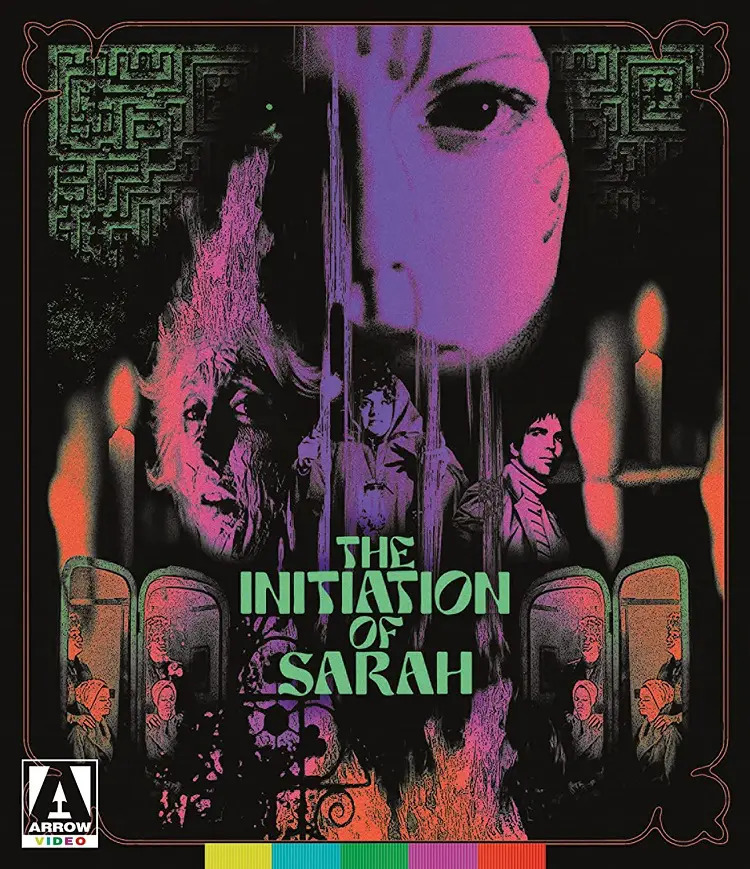
Suspiria (1977)

suspiria poster

Editors Note: I feel it necessary that I originally wrote this in April of 2007. That was nearly 16 years ago. I have seen Suspiria many times since then and my opinion of it has only grown.  I mostly stand by this review, though the writing makes me cringe a little (and I don’t think the acting in most of Argento’s films are bad, don’t know where that thought came from).  But I haven’t changed a word.

Petit and pretty Suzy Banyon flies from New York to Germany to attend a prestigious dance school. The night is dark, mysterious, and lonely, and it is storming with great torrents of rain. Upon arriving at the school, she finds the door locked, and the woman on the intercom refuses to let her inside.

Soon another woman comes to the door, not to allow entrance, but to flee. She looks greatly frightened, and shouts something to unknown persons behind the door, then runs out into the night and rain.

Shortly thereafter, we see a brutal, bloody, completely awesome murder at the school, complete with a knife stabbing directly into a heart, via an open chest, and the coolest hanging this side of The Good, the Bad, and the Ugly.

When Suzy returns the next day she finds everyone distraught over the murder, but much more welcoming than the previous night. She meets the rest of the dancers, and things begin to settle into normalcy. For a moment anyway.

On her first day of class, Suzy falls ill and is forced to become nearly bedridden and given a very special diet. Strange footsteps are heard outside her door every night, maggots fall from the ceiling, bats fly in through the window and more murders pile up. Is there a mass murderer on the loose, or is it something more sinister, more mystical?

The film is beautifully shot, with the lighting causing all sorts of creepy shadows while being bathed in primary colors. Mostly red.

Lots and lots of red.

The score, by the group Goblin, is full of creep and circumstance and sets an eerie mood throughout.

Unlike a lot of Dario Argento films, the acting here is pretty good. All of the leads do a fine job of conveying the right amounts of suspense and dread, or menace and evil, depending on what their characters call for. The plot is pretty thin, as it jumps about quite a bit. Despite what the tagline says, the last 12 minutes veer well into the ludicrous instead of terrifying, but for what the film lacks in these details it absolutely nails in terms of setting a mood and atmosphere.

Cinema Macabre Issue – Friday The 13th, Part 3

friday the 13th part 3

Some of the movie reviewers over on Blogcritics have created a little monthly horror filmic feature. It’s basically us talking about our favorite scary movies. This month’s feature includes devil worship, psycho killers, and lesbian vampires! What more could you want?

I’ll only include my bit here, but please head over to Blogcritics (sorry the Blogcritics link no longer works) and read the rest, it will be worth it, I promise.

What is it about the 3-D effect that keeps it resurfacing every decade or so? Why do we want our films to come screaming right into our seats? I’ve only seen one full-on 3-D flick in an actual theatre, and that was Jaws 3, not this third installment in the Jason franchise.

While we’re at it, why do film producers think they’re being even more clever by making the third film in a series in 3-D? That ran out of style somewhere around Plan 9 From Outer Space, Part 3: The Revenge of Patrolman Kelton. I never saw Friday the 13th, Part III in the theatres or in 3-D. In fact, I never saw any of that series in the theatre, only on the long departed, and dearly missed late-night television series, USA Up All Night (whatever happened to Rhonda Shear anyway?).

To a prepubescent boy, even in a highly edited version, Jason kicked lots of sexy teen arse. This one includes lots of good 3-D scares like Jason shooting a spear gun right at the screen, but the creative kills and bountiful bosoms kept me coming back. As a kid, I always looked forward to Friday the 13th on the calendar because I knew Rhonda would be showing a marathon of the films. I stayed up way too late on many a lonely Friday night watching that masked murdered wreak havoc.

They are all short on plot, convention, acting chops, and anything else a critic might try to find, but it had everything a geeky little kid from Oklahoma wanted in his late-night viewing.

Premier’s 25 Most Dangerous Movies

Editor’s Note:  I first published this in April of 2007.  To this day it remains my most popular post, having been viewed some 95,000 times.  I have since seen most of these movies, but my memory is too fuzzy to be able to write anything new about them.

Premiere magazine online has rolled out a new list. I love lists, I really, truly do. I know they don’t actually mean anything, and I know that often the conversations they start quickly move into rubbish, but I love them just the same. I do like to hear what other people say, to argue, and to find new things which I may consume and love.

This list is the 25 Most Dangerous Movies. They don’t do much to explain that except to mean more than just controversial, but controversial and important, or meaningful, or movies that make you think. Whatever that means.

I’ve included their words first, and then if I have seen the film, my own thoughts afterward.

bonnie and clyde25. Bonnie and Clyde

Premier: As shocking and stomach-churning as the picture’s legendary ambush-atrocity ending is, it only really works in context — that is, after you’ve spent more than an hour and a half getting to like the messed-up, bumbling, perhaps-not-quite-irredeemable criminals who are on the receiving end of a seemingly endless hail of bullets. (Their demise takes up only 21 seconds of screen time, but you’re praying “Make it stop!” throughout.) Outlaw lovers, incarnated by two of Hollywood’s most physically beautiful stars (Warren Beatty and Faye Dunaway), are reduced to carrion in nothing flat, and the rest is silence — deafening silence.

Me: It’s been a very long time since I have seen this film. It was one of the first DVDs I ever bought, but that was partially due to it being very cheap. I remember being confused, as a young man, by the ambiguous sexuality, but loving the crap out of Gene Hackman’s character. It also seemed kind of boring in parts to me then, as I was expecting a big action flick.
The performances, as I recall, were quite brilliant all around, and the robberies entertaining. I still remember the final shoot-out, and probably always will.

24. Boys Don’t Cry

Premier:
“I don’t know who I am.” Such is the plaint of, well, just about everybody in this world at one time or another. Brandon Teena’s problem was that she did know who she was, but her body did not conform to it. Or perhaps that’s not it at all. Director Kimberly Peirce’s debut feature tells the true story of a Nebraskan girl (played, in a career-making performance, by Hilary Swank) who passed herself off as a boy and, in so doing, helped other girls find themselves. Boys Don’t Cry would be powerful and provocative enough if all it did was make you think hard about the difficult questions it raises concerning identity and difference. But the movie goes even further by showing how simple human violence can render such questions moot.

Me: Such a beautiful and sad film. It raises some big questions not only over sexuality and violence, but what one’s gender really means, and about our own personal identity. It doesn’t really attempt to answer these questions, as the violence pretty much destroys them before they’ve really formed. Hilary Swank’s performance is moving, strengthening, and unflinchingly sad.

23. In the Company of Men

Premier: Neil LaBute’s debut feature has a premise that can polarize audiences before they even see the film: Two corporate scumbags collude to seduce and devastate a fellow office worker, simply because, as the saying goes, they can. To top it off, the woman in question is deaf. On one level, Men is the nastiest shaggy-dog story ever concocted; on another, it’s a blanket denunciation of all that is male, American, and Caucasian; on yet another, it’s an enraged critique of, whatddya know, capitalism itself. Very clever of LaBute to camouflage his unfashionable politics with some of the most coruscating dialogue ever heard in a film.

Me: Absolutely brutal. The men in this film want to make me do something drastic with my own physical masculinity. They are the epitome of all that is wrong with being male. It’s a film I don’t want to like, or watch, but I couldn’t help but stare transfixed. Surely, I thought, they’ll come around and see the error of their ways. I was so totally wrong, I don’t even want to talk about it. The low-budget shows, and it’s not a film I’ll be watching again anytime soon, but I’m very glad it came across my screen.

dead ringers

22. Dead Ringers

Premier: David Cronenberg takes the notion of the divided self beyond mere metaphor in this story (suggested by actual events) of identical twin gynecologists (both played, impeccably, by Jeremy Irons) and their descent into madness. The subject matter alone ensures an almost unprecedented level of creepiness, and you can bet Cronenberg makes the most of it; when one of the twins commissions a set of surgical tools for use on “mutant women” (for he is just about at the point where he thinks all women are mutants), it’s permanent gooseflesh time. But the picture ultimately goes deeper, plunging us into the desperate, confused loneliness to which we are all prey, whether we’re cursed with doppelgängers or not.

Me: Another film I saw too long ago to really remember. It’s painfully slow, horribly boring, and strangely transfixing. You would think a film about twin gynecologists going mad would be either titillating or fascinatingly twisted, but mainly it’s methodical. That’s Cronenberg though. He never gives a quick jolt when he can linger slowly. This isn’t to say it isn’t a good film, for it is, just not something I’m all that excited about watching again, even if age may give me a much greater perspective.

21. Eraserhead

Premier: You’ve heard of new-wave movies? David Lynch’s debut is a no-wave movie, projecting a fear of sex (among other things) so palpable that one could deem it the male-perspective version of Repulsion. Shot in deepest, darkest black and white, it sees universes in clouds of eraser dust and contains a chicken scene that outdoes both John Waters and the Farrelly brothers. The fact that Lynch still hasn’t revealed how he made the movie’s notorious baby just makes the sight of it more squirm-inducing with each viewing. Not to be watched, under any circumstances, by expectant couples.

Me: Cripes, what a film! Like so many David Lynch films the plot is very muddled, but visually it is absolutely stunning. The deep black and white photography is beautiful even if the images it is showing are completely disturbing. And yeah, that baby is whack.

20. Gimme Shelter

Premier: Brothers Albert and David Maysles, with codirector Charlotte Zwerin, didn’t see Altamont coming when they set out to make a documentary of the Rolling Stones’ 1969 North American tour. The picture they constructed in the aftermath of that anti-Woodstock, where some Hells Angels stabbed a gun-waving black concertgoer to death, is complex and perpetually unsettling, full of portents that the Age of Aquarius isn’t due for a terribly long engagement. Even before the violence starts mounting, the film depicts a bunch of kids who are far from all right; the final shots, of scattering silhouettes on what could be a lunar landscape, are among the most desolate ever put on a movie screen. Not only is the dream over, the filmmakers seem to be saying, but maybe the dream itself wasn’t worth all that much to begin with.

happiness poster

19. Happiness

Premier: Here is a film that at one point creates the most insidious suspense scenario since audiences rooted for Marion Crane’s car to sink into the swamp in Psycho. We bite our nails as a future child molester frets over whether or not his intended victim will ever eat the doped-up tuna salad sandwich he’s prepared. This is viewer manipulation on a level that even Hitchcock wouldn’t dare; no wonder some critics accused writer-director Todd Solondz of grandstanding. Except that he isn’t; nor is he merely poking cheap fun, which was how many took the scene where two of the picture’s very unattractive characters fall into a clinch with an Air Supply song providing the soundtrack. No, Solondz is merely sharing, making manifest a variety of private hells and insisting that they are each all too human.

Me: I’ve seen this two and a half times. The third time I just couldn’t make it through. Every character is horrid, despicable, disgusting, and painfully real. When I first read that it had made a pedophile character sympathetic I scoffed. In the first 3/4ths of the film, I wondered what they were talking about. Then there is the scene between said pedophile and his son, explaining why he was going to jail. I was moved. I cried. Managing to make me feel for such scum as that, is quite a thing.

18. Bad Lieutenant

Premier: Betting money he doesn’t have, letting robbery suspects walk, boozing it up with whores, smoking heroin with a gamine-ish smack connoisseur, pulling over a pair of bridge-and-tunnelers and pulling out — no, it’s too much. Harvey Keitel’s performance as the world’s most rotten cop has a stunning, savage honesty. Stripped naked and howling, he’s an open wound, the supreme passion player in what is, finally, a tale of redemption and one of the few truly religious films of the 20th century.

17. M

Premier: “Ich muss!” shrieks trapped child-killer Peter Lorre to the kangaroo court of thieves, holdup men, gamblers, and prostitutes who have gotten to him before the police could. (They are, perhaps understandably, irritated that his activities have resulted in a municipal crackdown that’s cutting into the vice business.) He must, he protests, then quite rightly insist that none of them know what it’s like to be him. But Fritz Lang’s technically stunning, emotionally wrenching thriller, his first sound film, dares to try and bring the viewer into the world of this pathetic murderer, who, finally, is something of a child himself.

Me: Love this film. Probably my favorite out of the whole list. Just a beautifully crafted film. Peter Lorre is perfect as the creepy, whistling murderer, and just like the pedophile of Happiness, he makes me feel for him.

once upon a time in the west

16. Once Upon a Time in the West

Premier: The movie begins in virtual silence — a ten-minute credit sequence punctuated only by a few ambient sounds (a fly buzzing, a wheel squeaking, a telegraph tapping, a scrap of dialogue), culminating in a typical western shoot-out. Then the scene switches to a homestead, where, with a single gunshot, director Sergio Leone blows away every romantic Hollywood myth about the West.

A boy runs out of his house to see that his entire family has been slain. Five marauders emerge from the brush. The camera pans around to see the face of their leader, and we see with astonishment that it’s the reassuring visage of Henry Fonda. He spits, raises his pistol… and shoots the kid. The scene was written with Fonda in mind, and Leone persuaded the star, whose screen presence was synonymous with heroes such as Abraham Lincoln, to make the film by describing this icon-shattering moment.
As an Italian working in the most American of genres, Leone knew the power of stepping out of context. The western would never be the same.

Me: I had only seen a handful of Fonda films before this one, so he wasn’t etched into my brain as super wholesome. But those beautiful blue eyes holding such cold menace is a sight to see. The opening sequence is one for the ages. Just brilliant as all get out, and what follows does fall far from that.

15. A Clockwork Orange

Premier: Its director, Stanley Kubrick, obviously thought this picture was dangerous in a more than merely existential way: In 1972, he withdrew it from exhibition in Great Britain — a self-imposed ban, if you will, that stayed in place until March 2000, a year after Kubrick’s death. The ignorant brutality (coexisting so comfortably with rakish charm) of its droog antihero Alex is one thing; the picture’s indictment of society’s ability to give birth to such brutality and then have no clue about how to deal with it is another. But what makes the film really hurt is its cold, clinical kick in the teeth to things we used to consider innocent sources of pure joy — e.g., the song “Singin’ in the Rain.”

Me: This film became something of a legend in college. There became a kind of club formed around those who had seen it. I remember seeing the last half hour of the film on cable and being absolutely mesmerized. It was another several months before I saw the beginning, but I was no less transfixed then. It is a disturbing film. It gets right into your bones. It helps that Kubrick is so technically amazing, and the set design is so ludicrous it seems surreal.

14. Repulsion

In this remarkable Roman Polanski film, as in Jean Cocteau’s Beauty and the Beast, the walls have arms — not to provide illumination but rather to grab the impossibly beautiful and limitlessly terrified Carol Ledoux (Catherine Deneuve). The movie unsparingly yet sympathetically charts the sexually repressed young woman’s breakdown on a weekend when her slatternly sister takes off with an oily boyfriend. Ledoux’s nightmares are so utterly, unforgettably convincing that you’re sure her eventual victims really have got it coming; witnessing the insanity is a dead rabbit whose disposition hardly improves with prolonged lack of refrigeration.

reqeium for a dream

13. Requiem for a Dream

Premier: Chronicling the downward spirals of four characters who have ceased to get high on life, Darren Aronofsky’s film of Hubert Selby Jr.’s novel posits addiction as the defining factor of the human condition. Unlike so many other depictions of the junkie lifestyle, it never makes drug-taking look cool — Nancy Reagan might have found this a useful movie. While Aronofsky’s polyglot technique is sometimes overbaked, the movie’s best moments are as harrowing as he wants them to be, and the conclusion — that addiction to hope is perhaps the most insidious jones of all — is genuinely chilling.

Me: I remember reading somewhere that if you pictured the addiction as the hero of the film it worked like a normal kind of story – it is victorious in the end. Aronofsky liters the picture with interesting camera angles, and tripped-up shots to give the viewer an itchy crazed feel, but it is the performances by the actors that give the film legs.

12. Reservoir Dogs

Premier: The shocking moment that everyone remembers isn’t actually in the movie. When Michael Madsen’s Mr. Blonde cuts off the ear of the cop (Kirk Baltz) tied to a chair, the camera demurely pans away. But Quentin Tarantino, directing his first film, ratchets the tension so high and establishes Mr. Blonde’s casual brand of sadism so effectively that you imagine he shows more than he does in this tale of a botched robbery. “The movie itself is an implication,” Madsen says. “You never even see the robbery, but you sure think you have.”

Tarantino did shoot a more graphic version of the torture. “We had a tube running up to where the ear gets cut off,” Baltz recalls, “and there was a guy pumping blood so it was squirting out.” Says Madsen of the scene as it ultimately played out, “I thought it was rather tame.” Few others — teased and agitated by Mr. Blonde’s bopping to the song “Stuck in the Middle With You” as he wreaks havoc — would agree. To prepare for the role, Baltz asked Madsen to lock him in the trunk of his car. “I thought he was insane,” Madsen says. “I went through the drive-thru at Jack in the Box and got a Coke. Quentin was a little distraught. When we popped open the trunk, Kirk was awful sweaty.” Just as the scene begins, you can see Madsen leaning against a pole, sipping that Coke.

Me: I first watched this at my uncle’s house.  He was a conservative Christian who was working in his study while I watched. Somewhere around the halfway point I had had enough and turned it off. From the study came “I’m proud of you Mathew.” I’m not so sure he’d be proud anymore as I have it in my DVD collection along with an assortment of other films of uncertain moral fiber.

I watched it all the way through in college, late at night, in a tiny little dorm room. There were a dozen of us or so crammed in that room, enthralled by what was going on. But of course, we don’t see anything in the ear scene. That’s what makes it so shudder enducing. If we had actually seen the ear come off, it would be fun, and not so harrowing. It’s like the scene in Pulp Fiction where Uma has the adrenalin injection. It is the reaction of others that makes it remarkable.

11. The Sweet Hereafter

Premier: The incest subplot is a jawdropper and heartbreaker, but this movie really haunts you with its even-handed, compassionate, and yet utterly anguished perspective on the inevitability of death and the indifference of the universe. Watching that school bus go down through the ice from an omniscient long shot, one feels even more helpless and doomed than if director Atom Egoyan had actually put his camera in the bus as it sank. This will happen, one way or another, to you and me too, Egoyan is saying; and he can’t tell us how to deal with it.

taxi driver poster

10. Taxi Driver

Premier: The New York City that Taxi Driver depicts has been almost entirely torn down; Robert De Niro now isn’t nearly as “cool” as he was then. You’d think these factors would weaken the movie, but, in fact, this bloody drama of urban alienation only gains in power as it grows further removed from the time in which it was made. Today, for some reason, the unwholesome emotions screenwriter Paul Schrader and director Martin Scorsese were trying to exorcise are closer than ever to the surface of the screen. And they are unwholesome emotions — tragic, desolate, angry ones. Back in the day, the “You talkin’ to me?” sequence seemed like the movie’s key scene, but it’s more likely that the real core of Taxi Driver is the part where De Niro watches two lovers quarreling in a soap opera and, feeling no connection with anything, just lets the TV fall on its back and short out.

Me: I was too young the first time I watched this film to really grasp it. I must have been 16 at the time, and with a driver’s license, for this is surely not a film mother would have rented for me, and I didn’t have friends that interested in film. I was just starting to get into film study as art and had always heard this one was brilliant. I liked it at the time but didn’t really understand what was going on. In the years since I have come to love this, and nearly all other Scorcese films.

09. Blue Velvet

Premier: Long before the white picket fences, red roses, and suburban dysfunction of American Beauty, there were the white picket fences, red roses, grub beetles, decaying ear, and small-town dysfunction of David Lynch’s corrupt fantastia Blue Velvet. At a time when audiences were flocking to the sanitized rah-rah Americana of Top Gun, the spectacle of a snooping college student forced to strip at knifepoint by a crazed lounge singer just before a spectacularly profane, gas-sniffing psychopath named Frank Booth appears and does sexual gymnastics involving pieces of a blue velvet rode was appealingly, or appallingly, subversive.

But this audacity was precisely what Lynch intended, despite the seeming naïveté he exhibited. “David Lynch, at that time, was such a Boy Scout. And I mean that in a sweet way,” laughs Dennis Hopper, who played Booth. “He would say things like, ‘Oh, that take was peachy keen!’ or ‘That’s solid gold!’ It was like Howdy Doody was directing. Or he’d say, ‘Now when you say that word…’ And I’d say, ‘David, that word is fuck.’ And he wrote the script!”

At screenings, the actor says, people fled the theater in disgust. Lynch’s twisted imagination, combined with genuine innocence, had opened the door to the unexplored world of the irrational and absurd. Hopper says, “I really feel that Blue Velvet was our first American surrealist film.”

Me: One of the first art films I ever loved.

08. Dancer in the Dark

Premier: Splicing together The Passion of Joan of Arc, The Umbrellas of Cherbourg, and A Short Film About Killing onto a grim fairy-tale spine, Lars von Trier’s divisive musical tragedy is some kind of filmmaker’s film, to be sure. But whether you’re familiar with its influences or not, the relentlessness of its tragic-story trajectory and the almost embarrassing intensity and intimacy of Björk’s performance, as the ultimate self-sacrificing mom (she makes Stella Dallas look like Auntie Mame), combine to produce a viewing experience that’s at first intriguing, then uncomfortable, then utterly overwhelming. It’s a little facile to call Dancer an anti-death penalty parable, but then again, it might be worthwhile to screen it for the capital-punishment maven in your life.

freaks poster

07. Freaks

Premier: Its title characters — midgets, pinheads, bearded ladies, limbless wonders, and such — are circus performers who, shunned by the “normal” world, form their own loving, microcosmic society. Then a little fellow’s good fortune excites the interest of a gold-digging trapeze artist. “One of us! One of us!” chant the freaks at the most unnerving wedding reception ever filmed; their shock and disappointment upon learning that the gold digger has, in fact, zero interest in becoming one of them is all the more moving for being so awkwardly acted. The outside world’s cruelty then causes these innocents to take a grisly vengeance. This is a trip into another world, with a surprising, and most vehemently stated, message at its core: Don’t mess with family.

Me: I saw this in college with a bunch of friends and we were all equally disturbed and fascinated by this film. .

06. Peeping Tom

Premier: For anyone who ever thought moviemaking, or even moviegoing, was a fairly innocent pursuit, here master director Michael Powell levels a savage indictment against both himself and us, insisting that the voyeuristic compulsion of his soft-spoken lead character (a killer who films the deaths of his female victims — deaths that he actually forces them to witness themselves) is one we all share. The picture is all the more unsettling for being so beautifully made.

Me: I remember wondering how in the world this film got made in 1960 with the kinky voyeuristic sex, the wild violence and the filming of said violence. Upon reading further I found that it pretty much did ruin Michal Powell’s career. Watching it now, it winds up being fairly tame, and amazingly prescient. In a world full of reality television, and saturated violence (not to mention live, streaming videos full of sex and violence on the internet) this tale is amazingly current.

05. The Lost Weekend

Premier: Sure, the bit with the bat doesn’t quite make it anymore, but nobody ever claimed Billy Wilder was a master of special effects. He does, however, have an uncanny way of plumbing the darker recesses of the human heart. Combine that with the story of a writer battling alcoholism and the result is a movie that stings with the power of the most remorseful, impossible-to-squelch hangover ever. The scene of Ray Millan walking down Third Avenue looking to hock his typewriter for a drink is the ultimate trip down lonely street.

natural born killers

04. Natural Born Killers

Premier: As obvious, ham-fisted, and often downright silly as it is, Oliver Stone’s ultra-controversial (there’s been at least one lawsuit filed claiming it inspired actual murders) portrait of a Bonnie and Clyde for the MTV generation manages to get somewhere. Maybe it’s the sheer sensory overload. Maybe it’s the raw power of the performances, from the feral Juliette Lewis to the dripping-with-sleaze Tom Sizemore. Or maybe it is, in fact, the film’s rabid exuberance, the very real and very scary nihilism that seems to lurk underneath its glib pronouncements on our “sick” society.

Me: I saw this three times in the theatres, and a couple of times on video, and I suspect I’ll never watch it again. It is such a sensory overload type of film, that I felt, at the time, that I had to watch it several times. But having done that, it’s not something I care to watch again. It has some interesting parts, and certainly, there’s something being said, but I think he mainly fails at making his point. I get that he’s trying to point out our culture’s obsession with celebrity and violence by making a film full of celebrity love and violence, but he goes so over the top with it, that the finger points back directly at him. Definitely a film worth seeing though. Perhaps more than once.

03. Romper Stomper

Premier: Or, Nazi-Worshipping Skinheads Have Feelings, Too. Which may well be true, but is it a point worth making? And what, exactly, is director Geoffrey Wright saying by casting the unfailingly charismatic Russell Crowe (in an early lea,ding role) as the ringleader of the skinheads? No way does Stomper endorse the bigotries of these hooligans, and the film is pretty definite in its view that their lifestyle is nasty, brutish, and short. But by making these kids characters (as opposed to caricatures) and allowing them their anger, the movie shakes up your complacency, forcing you to acknowledge that they are, in the end, members of the same species as you.

02. Un Chien Andalou

Premier: Luis Buñel and Salvador Dali’s infamous 16-minute film insouciantly mocks would-be explicators with its uninterpretable images, which cook up a death’s-head soup of anxiety. The liquid of the slashed eyeball, the putrefying wounds of the dead donkeys that adorn a pair of grand pianos, the blood caking on the chin of a man in the throes of unspeakable sexual ecstasy — the movie is a sticky orgy of lust, ooze, and rot, no less funny for its power to get under your skin and stay there.

01. Weekend

Premier: Apocalypse ’67. A bickering bourgeois couple, already drunk on betrayal, set out on a little excursion. It goes very badly even before it starts. From the epic traffic jam they almost immediately drive into, to a diversion into a curdled Lewis Carroll parody, to a final capitulation to a group of counterculture cannibals who make the future Baeder-Meinhof crew look like the Mickey Mouse club, Jean-Luc Godard’s film — work completely drained of the sort of exuberance that marked his debut, Breathless, — is an exhausting proof of Yeats’s prediction that “things fall apart/the centre cannot hold.” As much an expectoration as a work of art, Weekend’s entirely apt and believable end title reads “Fin du Cinema.”

Bootleg Country: Pete Seeger and Big Bill Broonzy – Evanston, IL (10/25/56)

There are many thoughts that come to mind when I hear the name Pete Seeger: Socialist, outspoken folkie, encyclopedic knowledge of music worldwide, compatriot to Woody Guthrie, Pinko-Commie, and axe-wielding madman running after an electrified Bob Dylan. It is his love and gift for folk music from around the globe, though, that I hope he will always be remembered.

Listening to Pete Seeger, in concert, is like being with a historian and archaeologist of the world’s music. He seems to know every song ever sung, and to be friends with their writers and singers. He is the soul of America, a true treasure trove of song.

I have a handful of concerts by Seeger, some official, others not, and in everyone is a historical road map of folk. Though he often plays by himself, with banjo for accompaniment, he is never short of musicians, for he makes everyone in the audience part of the band. No, Pete Seeger concerts are not Holy Places where the music is sacred, and the audience mere worshipers. We are part of the song, singers and clappers, and performers one and all. In nearly every song, he points out a chorus or a repeating line that he encourages the audience to sing. Where they can’t sing, he says they can clap and hum.

To be honest, I was not at all familiar with Big Bill Broonzy before I listened to this concert. I’m not particularly well-versed in the blues, and Broonzy is a name that circumvented my musical heritage.

To be even more honest, I’m not one to particularly care for the blues. For the most part, I just don’t *get* it. For his part, Broonzy makes me wish I did. He is of the acoustic blues school, and his tunes are jaunty, even happy at times, and it is a simple pleasure to listen to him sing.

As for positioning, each performer takes turns singing his tunes, song for song for the most part, while the other one sits in the back ground listening. They perform together on a couple of songs, and they spend a lot of time conversing, talking about music, and telling jokes. But mostly it is a solo show, split between two people.

Seeger likes to talk, and I for one, could listen to him talk for days on end. He tells stories about the songs, about the writers of the songs, and of his life. And what a life! He’s been everywhere, done everything. Most people talk in hushed tones about the night Bob Dylan went electric at a folk festival. For Pete, that’s personal history. He was there. He’s the exciting part!

In no way would I consider this a brilliantly performed performance, musically speaking, for Pete doesn’t show off. He seems more interested in creating a community of music, than coming off as a musical savior. In doing so, he creates something special, something different than a simple concert. It is a communal experience akin to a religious service, or family reunion. I don’t suppose there’s anyone who has heard a Seeger concert that will ever forget the experience.

Broonzy is less talkative than Seeger, but shows his own gift of humor by asking if he can sit down whenever Seeger launches into one of his long stories. He plays his guitar with the fervor of a true prodigy and his songs bridge the divide between Seeger’s folk and children’s music.

The highlight of the show is when Seeger plays what he calls the “Goofing Off Suite.” Folk music, he says, needs its own version of chamber music, for the thinking man, so he’s writing his own high-minded piece. If you’ve ever seen the movie Raising Arizona, you will instantly recognize the number. It consists of what must be the main theme of that movie, which if you’ll remember is composed of this incredibly goofy bit of banjo and the wildest bit of yodeling known to man. He even throws in the humming and banjo version of “Ode to Joy” as the middle section.

The first time I heard this I was driving in a heavily trafficked piece of down town. I’m surprised I didn’t get pulled over for all the swerving I did from the tears rolling down my face from laughing.

I am quite saddened to know that I will probably never be able to attend a Pete Seeger concert. His age and health keep him from appearing much in public. But I am heartened by the knowledge that there are these recordings, and that a man like Pete Seeger ever lived and shared his love for great music.

You can download the show over here.

Shutter (2004)

shutter movie poster

A young couple races down a dark, deserted stretch of road. Out of nowhere, someone appears on the road and the young couple tears into her. Shook up, the couple heatedly discuss what to do, with a corpse on the road, and quickly decide to leave it lying there.

Sound familiar? The Shutter starts with an I Know What You Did Last Summer twist, and continues through its 95 minutes stealing from, er paying homage to, all sorts of horror films. There’s a creepy, long, black-haired Asian girl slinking out of regular household objects a la Ringu, and strange effects keep happening to photographs as in Ju-On (The Grudge). In some ways, it is very much a pastiche of other horror films.

Don’t let that discourage you from seeing this film, for though it doesn’t come out all that original, it still manages to be effectively horrifying. The tension builds quite nicely, and there were more than a few moments where I was squirming in my seat.

Post running over the poor girl, the couple – Tun (Ananda Everingham) and Jane (Natthaweeranuch Thongmee) – begin experiencing some strange, even supernatural, events. A young girl begins haunting their dreams and even appearing in the shadows, the bathroom sink, and their photographs. Tun is a photographer by trade, and he begins finding strange white streaks in his most recent photographs, followed by shadowy glimpses of a girl. Could it be the girl they ran over?

They follow the photographs to people who collect pictures of the dead, of ghosts, and discover a few old mysteries along the way. As they attempt to find out why they are being haunted, and losing a few friends via suicide, they discover more about this mystery girl and each other.

As an audience, we are treated to a handful of really effective films that amp up the tension and give us more than a little fright.

There are a few scenes in which the camera rolls over a series of “real” photographs borrowed from actual true believers outside the confines of the film. I had seen some of these pictures on ghost websites, and though I am completely skeptical, those scenes creeped the crap out of me.

The score is amazingly well done, being filled with clatters and screams and freaky noises even in the non “scary” scenes adding a surreal mood for the entire film.

On a purely critical level, there are several things to dislike. Many of its effects are taken directly from other films, and there are a few giant holes in the plot upon which to frown. But ultimately, it is very effective at what it attempts to do. That is to create a creepy hour and a half in which to scare the bejeesus out of its audience.

The Ferpect Crime (el Crimen Ferpecto) (2004)

the ferpect crime poster

It’s good to be Rafael – he’s got a sweet job as manager of ladies’ wear at YeYos, he is young, healthy, wealthy, and charming. The ladies adore him and the men wish to be him. He takes what he wants from life, and lives to the fullest. All that’s left is a promotion to floor manager at the store, and his life will be perfect. To obtain that promotion he must simply beat Antonio, the men’s clothing manager, in sales for the month — a task made easy by the doting middle-aged woman whom Rafael convinces to buy an expensive fur without even trying.

Yes, life is good for Rafael. That is, until the check for the coat bounces, and he is overlooked for the promotion. In frustration, Rafael yells at the coat woman and is fired by Antonio for it. An argument ensues and Rafael accidentally kills Antonio in a changing room. To make matters worse, the body soon disappears!

Poor Rafael, his life has gone from perfect to rock bottom in a matter of hours. Luckily he has Lourdes on his side. For she is the ugliest – and therefore completely invisible to the sexist Rafael – saleswoman in the store, and she has hidden the body to protect Rafael, for a price. Lourdes wants only the eternal love of Rafael, for her help and secrecy

Having to choose life in prison, or the love of an ugly woman, Rafael wisely chooses love, but may soon regret it. The Perfect Crime is equal parts Weekend At Bernie’s, American Werewolf in London, and War of the Roses, cranked up to 1.5 speed with Spanish accents.

Lourdes is the perfect crazed lover willing to do anything for the attention of the incredibly handsome and sexist Rafael. In a scene that would make Goodfellas proud, she slices and dices the dead Antonio without batting an eye, while Rafael gets deeper and deeper away from the life he has always wanted.

None of the characters are particularly decent, and I didn’t exactly care for their fate, but the story is told with such flair that I never really cared. The pacing is His Girl Friday fast with an eye for the absurd with its often hallucinatory imagery.

Guillermo Toledo and Mónica Cervera are pitch-perfect for the leads, adding a real emotional core to characters who are completely outlandish. Álex de la Iglesia does a nice job handling all the chaotic action with a smirk and flair.

It is an absolute joy to watch, and one of the most purely comical films I’ve seen all year. And yes, I know it is only March, and I haven’t seen that many comedies this year, but still, it’s a hilariously brilliant film.

Madagascar (2005)

madagascar movie poster This review was originally written and posted on January 17, 2007.

Living during the animation renaissance is not always the wonderful experience people who call it that would have you believe it to be. There certainly have been some amazingly designed and animated films in the last ten years, and yet there have also been plenty of copycat clunkers, as there will always be.

Pixar seems to be at the forefront of the Renaissance creating beautiful films that are fun and entertaining to the littlest tikes to the oldest adults. A difficult task to achieve given the constraints both of those two groups place together – it can neither be too juvenile to bore the adults nor too progressive as to offend those same adults around their children.

Dreamworks has been much more hit-and-miss in their animated kid fare. With Shrek, they nailed a series that rivals the best of Pixar’s work, yet by all accounts a Shark’s Tale was disastrous, and having just seen Madagascar I must say they have struck out again.

All is not rotten in the state of Madagascar, but its flaws are detrimental enough to keep me from watching it again. The jokes are mostly funny and most of the characters are enjoyable. The basic storyline is a good one with plenty of potential, but they run out of gas too quickly and things run aground about the halfway point.

The basic plot is that a bunch of New York City zoo animals escape the confines of the zoo and flee into the city only to be captured, and shipped off to a Kenya wildlife preserve. Unfortunately, before the ship lands it is hijacked and the animals are plunged into the sea, winding up in Madagascar.

From there it is a classic fish-out-of-water tale with these city animals having to deal with life in the wild. My problem with the story is that once they get to Madagascar they take the story into serious territory, but, due to this being a family story, chicken out before coming to its plausible conclusion.

The lion, you see, has been living large at the zoo as the most visited animal. He lives like a king, basking in the love of the humans and eating as many steaks as he can. Once he is in the wild he begins reverting back to his natural state – for there are now no processed steaks – and starts to have thoughts of slaughtering his friends for lunch.

However, since kids would be very upset to find the lion eating the characters they have grown to love, the filmmakers must create a different kind of solution. Since there are no likable fish characters in the picture the lion is able to chow down on raw sushi. It is a ridiculous, tacked-on solution. I understand the need not to cause undue mental stress to children, but making him devour the fish – who are also very much alive and cute – seems a bad choice. Besides not fitting with the character, it doesn’t really resolve anything other than he’ll no longer eat his friends.

The main characters are mostly unlikable. None of them were particularly funny or interesting, and two of them were underused and annoying. It’s not hard to realize that the lion’s reluctance to leave the zoo will result in him eventually accepting the wild and becoming the true king of the jungle. But the transformation winds up being barely existent, and the character never becomes really likable.

The only truly interesting characters were the secondary ones. The penguins were great fun, and it is good to see the filmmakers realizing this by placing them in some short films. Likewise, the monkeys as sophisticated socialites (who still throw poo) were brilliant. Too bad they had such short screen time.

The animation felt too clunky and stylized to my eyes. There are lots of odd, stiff angles and lines that made the characters look more like plastic toys than living creatures. The lion was also full of kinetic energy, causing him to jump around like crickets on crack which got annoying really fast.

It’s not a bad film. There were numerous funny moments and the basic concept is a good one. The plot falls apart in the second half and the main characters never gain the dimensionality that their animation would suppose. I’d categorize it as an enjoyable kids’ film that adults will get a few laughs out of.

Pulse (2006)

pulse

Why?

Dear god, why did I waste 90 minutes of my precious life on this film? Why did the filmmakers waste so much of their time making it?

The story of how I came to watch Pulse yesterday afternoon is an interesting one. When it came out on DVD a few weeks ago I thought it sounded interesting. Or rather, when I learned that it was a remake of a Japanese horror film, I became interested in that.

I immediately went to Blockbuster.com and added the film to my queue. Well, I added the Japanese version, the American remake, plus another film named Pulse because I couldn’t quite figure out which version was the remake. Blockbuster’s website is amazingly slow, at least on my computer, and at the time it wasn’t worth the effort to try to figure out which was the proper one.

I put on the Japanese one first, figuring that if it was any good I’d determine which version was the remake and watch it. Of course, this being Blockbuster, their screwy queue system never works properly and I generally get my picks out of order. So, even though the Japanese import was number one in the queue, an American film titled Pulse, which was several movies down in the queue came first (and I should note the films above it are all listed as “available.”)

Putting the film in I assumed it was the American remake, but later found out later that it was in fact a British film titled Octane. Why the Americans have renamed it Pulse is beyond me. Is Pulse a better title than Octane? Do Americans not understand what “octane” means? The fact that it was changed means there was some board meeting discussing this very thing. Insanity reigns.

Anyway, the film was mostly lousy but contained a few interesting moments and was highlighted by a pretty good performance by Madeline Stowe. Then I soon discovered other movies that looked interesting, put them all way before the correct versions of Pulse in my queue, and promptly forgot about my desire to see the films.

Two days ago a friend and I went to see a movie (Night at the Museum – much funnier than I expected it to be for those of you keeping count) and afterward, he invited me over for some pizza. I had a Blockbuster return in my car so I decided to swing by there first. The only great thing about Blockbuster’s online rental program is that you can now return their mail-in movies to the local store where they will not only tell the computer to send another movie out but will let you exchange it for an in-store movie.

Being that my friend was expecting me, I quickly skimmed the new release aisle for something I hadn’t seen. Hmmm, what’s this? A new horror flick called Pulse? Sure, that sounds good. Now as insulting as it sounds, I really didn’t remember all the stuff that had happened previously in the above paragraphs and had no idea what Pulse was.

Took it home watched it and then remembered that this was the remake.

My kingdom for a better memory.

Oh! That I should have remembered and got something else. What a stinking goat turd.

Pulse has an interesting concept – the dead have found a way back into our world by slipping in through a previously unused and unknown frequency unleashed by some crazy virus-happy hackers. But the execution of this idea is astoundingly bad.

The dead find a way back to the real world, and what do they do? Drain the life out of the living, that’s what. That might make sense if this somehow made the dead more alive, but it doesn’t seem to have any effect. They just like making us living people want to kill ourselves. It’s fun, I guess.

The movie doesn’t concentrate on things like plot, or meaning, but rather spends its time trying to give the audience cheap scares. Honestly, I don’t mind a cheap scare movie, I can dig being jolted time and time again, but here they transcribe the scares minutes before they happen. Every. Single. Time. Oh, there’s a scary musical queue. Oh, the lights are flicking. Oh, suddenly our character is alone and in a strange place. Do you think something is going to jump out at them?

“Terrible” is the word.

Did somebody say plot holes? Did I hear the word continuity? You can almost hear the film saying in a Spanish accent, “we don’t need no stinking’ continuity.” You see the dead, they come through the internet onto your computer screen and then into your soul. Except when the plot needs them to come through other portable media like cell phones and PDA devices.

Then that’s okay too. Because those things have wireless connections right? Then well, okay, sometimes they can come through the computer even when it’s unplugged. But maybe they made their way into the computer before the power outage. That makes some kind of sense, until a character is in the basement doing her wash, then we need the bad guys to come out of the dryer. I guess it was a souped-up internet-ready dryer.

That kind of junk happens throughout. They make some arbitrary rules and then break them because they need another scare. But again, it isn’t scary because you know it’s coming from about three blocks away.

The only redeeming quality about the film was the inclusion of Samm Levine (who played Neil on the excellent, but quickly canceled series Freaks and Geeks) and even he has a small, nondescript part.

I spit on this movie. I fart in its general direction. I damn the 90 minutes I wasted watching it.

Bootleg Country: Tom Petty and the Heartbreakers – Las Vegas, NV (10/28/06)

Originally written in December of 2006. Sadly we’ve since lost Petty which only makes this article sadder.

In his 30-year career, Tom Petty has sold more than 50 million albums, received three Grammy awards, a Golden Note award, the Gershwin Award For Lifetime Musical Achievement, and been inducted into the Rock and Roll Hall of Fame. So why doesn’t he seem to get more respect?

To me, it stems from his ability to continually knock out solid albums in a steady fashion for all those years. Every couple of years, Petty puts out an album full of solidly good, if not great material. There are usually a couple of standout hits in each, but no album really rises above the rest. Think about it. Is there one Petty album that you would consider to be an absolute classic? What is his Revolver? Or Dark Side of the Moon? Or Blonde on Blonde? No, in my ever so humble opinion, none of his albums quite make it to that genius level.

Petty’s career has remained relatively stable over the last three decades as well. He continues to put out solid albums, record hit songs, and take his band on the road. There haven’t been any giant breakdowns or burnouts. He hasn’t even faded away. No, there has always been a Tom Petty making good songs and churning out classic rock. Where almost all of your great rock bands have all died by one means or another, Petty has remained one of the few rockers to keep truckin’.

I think by continually putting out good, not great albums so steadily it is easy for the casual fan to overlook Petty’s achievement. Without one brilliant album to cling to, his dozen really good ones get overlooked. By never leaving our presence, it’s easy to sort of forget about how remarkable his career really is.

10/28/06
Double Down Stage
Vegoose Music Festival
Las Vegas, NV

You can grab the show here.

One of the great things about Tom Petty’s long career is that he can play a different set list almost every night and still sprinkle it heavily with hit songs. For this performance, he performs half a dozen of his hit singles while mixing in songs from his newest album, Highway Companion, slightly obscure older songs, and a few BB King covers.

The Heartbreakers never veer far from the original versions of the songs, but perform with the vibrant energy only found at live concerts. Occasionally there is an extended guitar solo, but it never wanders far from the song’s melody and always ends way too quickly for these ears. Mike Campbell proves over and over that while he may never make it to any top lists of greatest guitarist lists, he is more than capable of producing sweet licks and charbroiled sounds.

This is a pretty decent audience recording, and as such there is a good blend of the band playing and the audience enjoying the show. The band mixes are a little muddled, so this is nothing to put on your A-list shelf, but the audience is so exuberant and excited in their response and sing-along that I find myself getting swept away in it all. When the light is just right, I close my eyes and almost feel like I’m right there.

Tom Petty may never find the diehard fanship of The Beatles, Dylan, or The Dead, but by continually writing good songs and putting on shows like this, he’s proven to be one of the most steady and long-lasting performers in rock and roll. Not a bad epitaph to have in the end.

Frankenstein Meets The Wolfman (1943)

frankenstein meets the wolfman poster

I’d like to say that I grew up going to the Midnight Movies and staying up to watch the old Universal horror movies on television. I’d like to say that, but I can’t because, well, because it simply isn’t true. I grew up watching movies from my generation, the 80’s, and that means the Goonies, Gremlins, Ghoulies, and others that don’t start with the letter “G.’ It has only been recently that I have dipped into the classics of horror and began watching them.

There has been a recent spat of high-quality DVD releases of the mainstays of the franchise – Dracula, Frankenstein, and the Wolfman – and I’ve filled my till with the magic, the brilliance that is those films. So, it was with pleasure that I recently found a VHS copy of Frankenstein Meets the Wolfman.

To say this is a great movie would be missing the point and make me think you were delusional. It’s far from anything anyone ought to call great, but it’s still a pretty fun bit of horror history.

The title is a little misleading – well not technically so since Frankenstein does in fact meet the Wolfman – but a picture like this makes one think they will either be locked in mortal combat for the entirety of the picture or team up to destroy some other force, like Dracula for instance.

More to the point it is something of a character study for the Wolfman as he is awakened from his grave and has to come to terms with his moonlight alter-ego. It is late in the film when he manages to come across Frankenstein’s castle and a frozen monster inside. The monster is awakened and wreaks havoc before coming to a not all too engrossing close.

The film has a good atmosphere and the sets are marvelous, but it never gets fully off the ground. There just doesn’t seem to be enough plot to keep the story moving, as it often plunges into a dulldrom.

Definitely worth checking out for classic horror fans, but not the first place to stop.