Welcome New Visitors

Recently, the excellent Bob Dylan site Expecting Rain linked to a couple of my posts (Fifteen Years of Bootlegs and my review of Pledging My Time). That brought a lot of new traffic to The Midnight Cafe which, in turn, brought in several new followers. I thought I’d take a moment to both say “Welcome” and to give the new folks a breakdown of what to expect.

Most days I provide a handful of links to downloads of unofficial and unreleased recordings of concerts. Those links come in two forms – links to the individual posts I previously did of each show, and for new shows, a direct link to Google Drive where you can download them. For many years I did individual posts for each show where I’d provide basic info about the show – location, date, setlists, source info, etc – and then provide a link. For various reasons, I recently stopped doing that. For new shows, I just provide a Google Drive link.

For years I used Amazon Drive to host these shows, but they recently dropped that service and I started using Google Drive. That left a whole lot of old shows with bad links and I’m slowly trying to reupload them to Google Drive. When I do so I provide a link to the original post, to let everyone know there are fresh download links. If you dig through those old posts and find something with a dead link that you are interested in, please leave a comment in the original post.

You will also find, on these pages, movie reviews, book reviews, and various pop cultural ramblings. I started this blog in 2004 as a way to journal the ten months me and my wife spent living in France. Eventually, I started writing about pop culture and that eventually led to me writing about concert recordings which led to me providing download links. At first, these download links were blended in with all my other writings, and then they took them over completely.

When Amazon crapped out I rekindled my love of writing about pop culture and here we are.

For reasons I won’t get into, all those old ramblings were put into a private mode so that nobody could read them. Now, I’ve decided to take them out. I’m slowly working my way through the old posts, doing some light editing, and then making them public again. When I do this you will get an email showing you those old posts.

This is a little confusing as you will get a new e-mail with things I wrote over ten years ago.

I try to pace all of this so that you aren’t getting a deluge of e-mails each day, but sometimes I get going and that will happen. I hope you enjoy everything I write, but I totally understand if you have no interest in stories about my life from years ago, or my thoughts on a horror movie from the 1960s. But that’s the way things go around here. If it gets to be too much you can always unsubscribe and just come in every day for the music links.

Anyway, welcome.

The Movie Journal: August 2023

angels with dirty faces

I watched 52 movies in July of 2023. Only two of those were films that I had seen before. 27 of those were made before I was born. The Criterion Channel was showing a collection of British Noirs and I watched several of them. I love a good film noir and it was interesting to see that very American genre through a British lens. Towards the end of the month, I got a little obsessed with Italian Giallos and I watched several of them. I also continued my little experiment of watching a new movie from every year I’ve been alive in chronological order which has been a lot of fun. Especially as I’ve seen a lot of movies from the 1980s, it is probably the decade that I’ve seen the most films from. This means I’ve had to really look for films I haven’t seen in any given year. I also watched three films from 2023 which is a rarity for me. I tend to watch older films.

My favorite new watches this month were Angels With Dirty Faces, The Petrified Forest, The Small Back Room, and yes, we’ll go ahead and throw Barbie in there too.

We are currently halfway through 2023 so my stats are coming together nicely. I’ve seen 295 films to date. 85 percent of those were new to me. Thriller is my most-watched genre (128) followed by Drama (115), Crime (83), and Horror (80). 248 of the films I’ve seen were in the English language, 20 were in Italian, 10 were in French, and 7 were in Japanese.

My most watched actors of the year look a lot like last month. Wilbur Mack, Boris Karloff, Courtney Cox, Rogers Jackson, and James Coburn all starred in six movies. Mack and Karloff were part of the Mr. Wong series that I watched last month. Cox and Jackson were the Scream movies and I watched that entire thing earlier this year. James Coburn is just awesome.

Most watched directors are also the same. Sam Peckinpah leads the pack with six films. Wiliam Nigh and Fernando Di Leon follow with five films watched. And Peter Hyams, Wes Craven, and Martin Scorsese all had four films.

Did you watch anything interesting last month?

Here’s the complete list:

Thank you, Mr. Moto (1937)
Everly (2014)
To Catch a Killer (2023)
Ishtar (1987)
Asteroid City (2023)
Barbie (2023)
Wagon Master (1950)
The Editor (2014)
The Brides of Dracula (1960)
Nine Guests for a Crime (1977)
Delirium (1979)
Night School 1981
Eyeball (1975)
Bullets or Ballots (1936)
The Time Machine (1960)
Duel in the Sun (1946)
Lured (1947)
Juggernaut (1974)
Meteor (1979)
The Last Gangster (1937)
Short Night of Glass Dolls (1971)
The Hunt (2020)
Each Dawn I Die (1939)
Angels with Dirty Faces (1938)
Journey into Fear (1943)
The Petrified Forest (1936)
Marked Woman (1937)
Think Fast, Mr. Moto (1937)
Lifeforce (1985)
Amityville 3-D (1983)
Amityville II: The Possession (1982)
Runaway Train 1985
Assault on Precinct 13 (2005)
Dreamscape (1984)
See How They Run (2022)
Yield to the Night (1956)
Silkwood 1983
Hanky Panky (1982)
Five Dolls for an August Moon (1970)
The Whip and the Body (1963)
The Night Eats the World (2018)
Nightmare Castle (1965)
Ghost in the Shell (2017)
Independence Day (1996)
Outland (1981)
Nine to Five (1980)
Pool of London (1951)
The Woman in Question (1950)
Dark Star (1974)
The Small Back Room (1949)
Obsession (1949)
Green for Danger (1946)

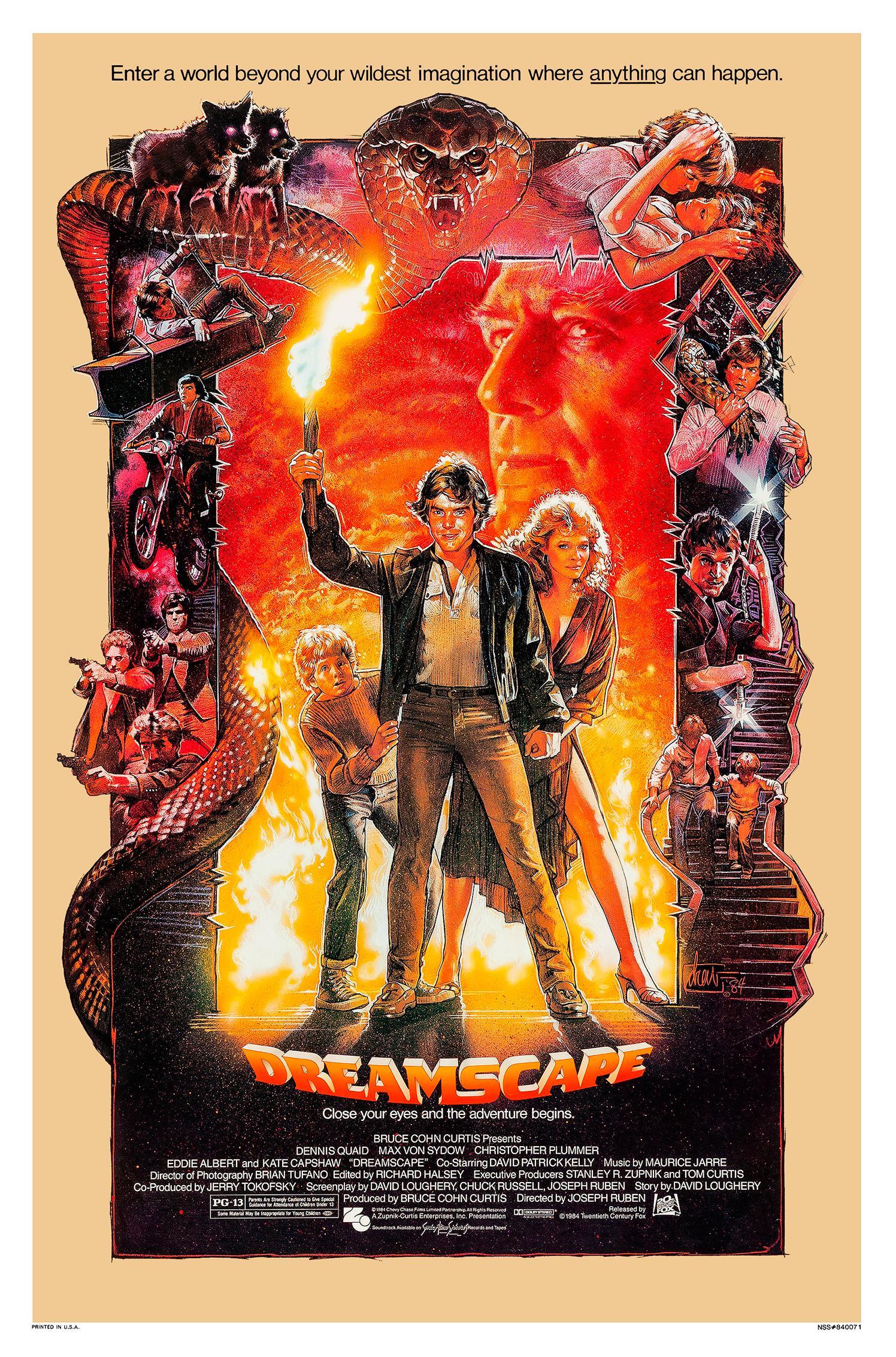
Dreamscape (1984)

dreamscape poster

I’m watching one movie from every year I’ve been alive in chronological order. We’re now up to 1984. I’m also running behind on writing these things as I watched this one a couple of weeks ago. I also skipped ahead and already wrote about my 1985 entry, Runaway Train. As such my brain is already a little foggy on this film, so this will be short.

Dennis Quaid plays Alex Gardner, a psychic who used to get probed and prodded by some big government agency, but then ran away to pursue gambling by way of the ponies. When he runs afoul with a gangster, he joins back up with the feds (run by Max Von Sydow, slumming).

They’ve got a big new project where psychics can link with a sleeping person and interact with their dreams. Alex uses it to help people. In one of the film’s best and dumbest sequences, he joins up with a kid who has nightmares about an awesome-looking cobra-man and teaches him not to be afraid anymore. There’s a nice touch inside that dream. As Alex and the kid are running from the cobra-man they see another man in a suit sitting at a table, the kid says something like “That’s my dad, he won’t help.”

Kate Capshaw is the love interest. This is the type of movie that finds it funny for Dennis Quaid’s character to invader her dreams and try and get sexy with her.

Christopher Plummer is the government agent who figures they can use this dreamscaping to assassinate undesirables. Which includes the President of the United States (Eddie Albert). The President has been having nightmares about starting World War III three and Plummer’s character is afraid that’s gonna turn him into a peacenik. Seriously.

It gets dumber from there. One would hope a film about dreams would be more interesting visually, but other than the cobra-man it is all pretty boring looking. The rest of it doesn’t fare much better.

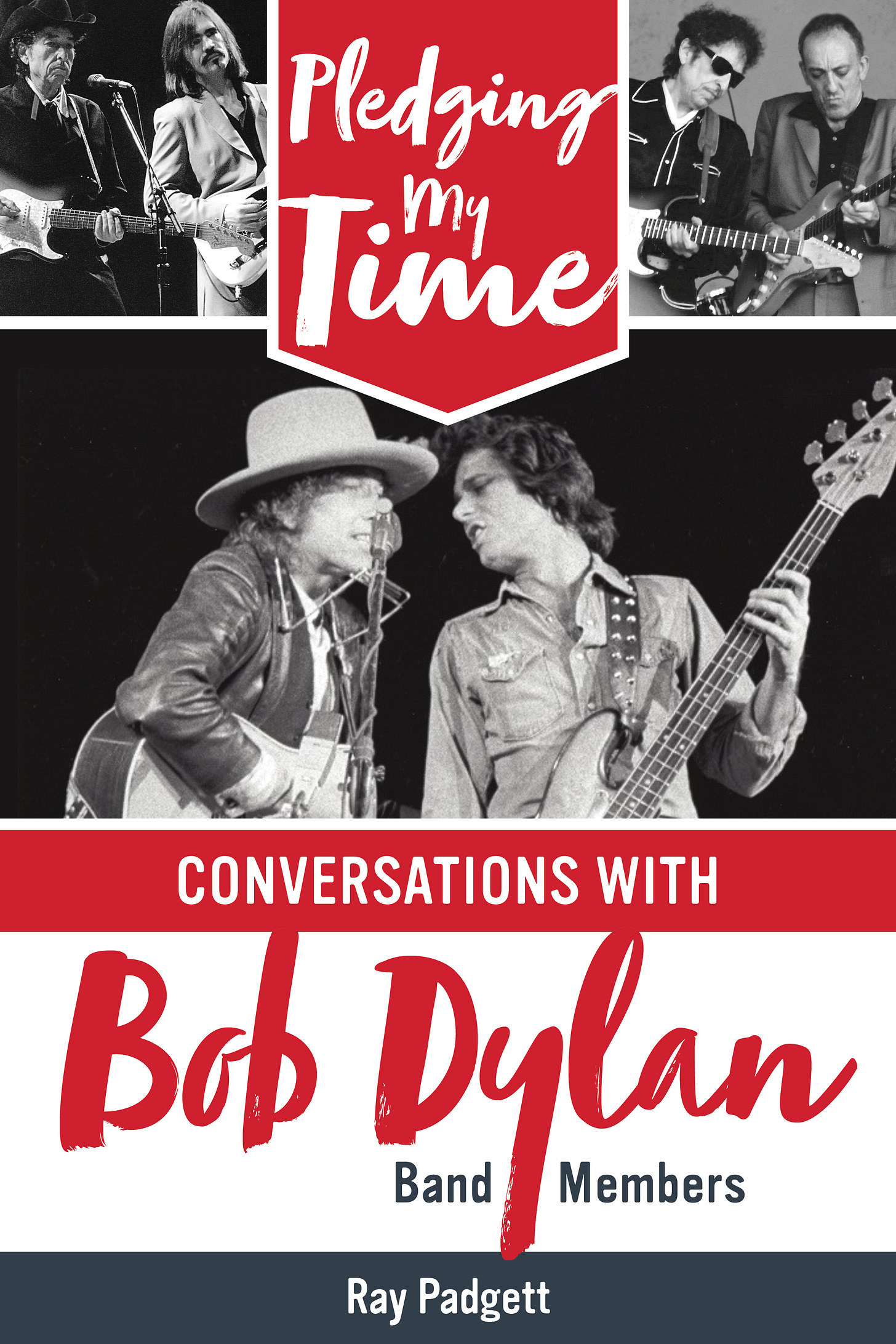
Pledging My Time: Conversations With Bob Dylan Band Members

pledging my time book cover

Bob Dylan is an enigma. A mystery wrapped inside a riddle. He rarely gives interviews and when he does you come out more confused about who he really is than when you began. Even his own autobiography has a questionable relationship to the truth.

Maybe it’s better that way. Maybe that’s the way it should be.

I’ve never been one to obsess over an artist’s life. It is about the art – or in this case the music. That’s what’s important.

Still, Bob Dylan is a fascinating human. He’s arguably the greatest songwriter of his generation, or any if we’re being honest. He’s performed live and on stage more than just about any person ever. If we can’t get to know Dylan through the man himself, then what better way to at least try and understand him, than with the people who have played with him on that stage?

Ray Padgett, through his wonderful newsletter Flagging Down the Double E’s has been chronicling Dylan’s career show by show, song by song, and interview by interview. I don’t think he’s ever interviewed Dylan, but he’s interviewed dozen upon dozen of people who know – or knew – him. As much as anyone can really know Dylan, anyway.

Many of those interviews, with musicians who have played with Dylan throughout his career, can now be found in Mr. Padgett’s new book, Pledging My Time: Conversations With Bob Dylan Band Members. Thanks to a generous contribution from a fan of The Midnight Cafe, I was able to purchase the book and it is wonderful.

I’m not even halfway through it, but I just had to share it with you all. It works, more or less chronologically with Padgett interviewing people who knew Dylan back in his early folk days and moves forward through most of his career. It begins with Noel Paul Stookey (of Peter, Paul, and Mary fame) who arguably helped launch Dylan’s career, and ends with Benmont Tench who played on a couple of tracks from Dylan’s 2020 album Rough and Rowdy Ways.

Of course, it wouldn’t be a Bob Dylan book if it didn’t wander in and out of that chronology. Many of the interviewees met and performed with Dylan numerous times, at different stages of his career and Padgett lets them talk about everything.

Padgett mostly lets them talk. He’s not one of those interviewers that injects himself into the conversation, but he hangs back letting his subjects tell their stories. It is a fascinating, wonderful read. Like I said I haven’t finished it. I’m taking my time, soaking it in.

I don’t know that I’ll know Bob Dylan any better when I do finish it, but I’ll know those who have played with him quite a bit. And that’s something. Something pretty cool. Maybe that’s the way it should be.

You can purchase the book in a variety of formats here.

Silkwood (1983)

silkwood movie poster

Meryl Streep is one of the world’s greatest actresses. She’s been nominated for a record 21 Academy Awards and won three. She is beloved by critics and fans alike. But the thing is, up until recently I’d not actually seen all that many of her movies. Oh sure I’d seen The Deer Hunter and Manhattan, Death Becomes Her and The Manchurian Candidate remake, but most of her big classic films had passed me by.

One of the things I’m realizing as I’m working my way through these early 1980s films is that a lot of these films seem to exist in my cultural memory but at the same time I haven’t actually watched many of them. This actually makes sense as I think about it. I was seven or eight years old when Silkwood came out. Of course, I wasn’t interested in a grand drama about a nuclear whistle-blower. But it was also one of the biggest movies of the year, making lots of money and being nominated for numerous awards. I’m sure I wasn’t following the Oscars at that young age but I mostly likely would have heard buzz about the film while my parents were watching television or seen Meryl Streep and Cher appearing in various magazines. No doubt the film was talked about often in the following years to come.

All I knew about the film up until watching it the other day was that Streep played some sort of whistle-blower and that she was killed for it. I assumed she worked at a nuclear power plant and that the film was going to be some sort of tense, nail-biting action film.

I was wrong on both accounts. Based on a true story Silkwood is the story of Karen Silkwood (Streep) who worked at a plant in Oklahoma that made Uranium fuel. She did become a whistle-blower and probably was killed for it, but the film is not at all a thriller. It is much more a character piece than anything else.

One of the things I found really fascinating about the film is that Karen is not a brilliant scientist or an expert on nuclear energy. She’s a fairly uneducated blue-collar worker. She’s basically working on an assembly line. Albeit a radioactive assembly line. One that can kill her. She’s not even that good at her job. The film shows her slacking off on numerous occasions. She often leaves the line to go chase down a friend to chat about something, or do some other task she could easily do on her break. She constantly stops working to converse with her fellow line workers. At one point she brings in a birthday cake, something likely not allowed on the uranium line. To leave her workstation she must waive her hands over a radioactive tester machine and she constantly has to be reminded to do this.

Her ex-husband and three small children live in Texas, but she rarely seems interested in them. Early in the film, she takes a couple of days off to go see them. She actually forgets to ask for the time off and has to beg her coworkers the day before to switch shifts with her. Once she arrives she learns that her ex has planned to take the kids to see his father. So she only gets a few hours with them so she takes them to a diner and spends more time talking to the friends she’s taken with her than her own kids. Later, we’ll see her call, but late at night when they are in bed.

She really just falls into activism. One day one of her friends comes up hot – the radiation monitor goes off and she must be thoroughly scrubbed down. Karen goes with her and comforts her. When she learns that they didn’t do a throat swab – testing for radiation inside her body she becomes furious. This leads to her raising concerns with her union rep. He takes her to see the national union people and from there, she becomes very engaged in union activities, much to the annoyance of her boyfriend and roommate.

She lives in a small house with her boyfriend Drew (Kurt Russell) and Dolly (Cher). Much of the film is spent with them just hanging out at the house. These are fun lovin’ people. Drew likes to drink beer and make love to Karen. Dolly is in love with Karen and wishes she could be hers. Later she gets a girlfriend and that causes more household tension.

The film doesn’t make much, if anything at all, about what the company thinks of her activism. It annoys her coworkers but only because they worry they will lose their jobs. It angers Drew and Dolly because it is interfering with the time they get to spend with her. If the company is planning on killing her we sure don’t see it. There aren’t any tense scenes showing mysterious men stalking her or leaving bullets in her mailbox. Even her death is left up in the air. We see her driving down the road, headed to a meeting. There is a car with its headlights shining brightly behind her. And then nothing. That’s more factual, I suppose because her death was ruled an accident and there are no documents indicating the company killed or even harassed her. There were some documents missing from her crashed car – documents she was taking to a meeting with the press that she was seen with not long before the accident. But that’s not proof of anything.

That’s not a ding on the film either. It isn’t really interested in the mystery of her death. Like I said it is a character piece. And a good one at that. Streep is just wonderful. She’s a very physical actor and a subtle one at that. She creates little ticks for her characters, she lets us understand her mood by a small facial expression or simple gesture. Cher is likewise fantastic. She’s much more natural in her performance, existing in it.

I definitely went down a rabbit hole after watching this film, looking up the real history of Karen Silkwood and the company she worked for. It is pretty fascinating.

Hanky Panky (1982)

hanky panky poster

About thirty minutes into Hanky Panky a film that stars Gene Wilder and Gilda Radner, I turned to my wife and said, “I thought this movie would be a lot wackier.” Up until that point, it is a fairly straightforward thriller. It does get a little bit zany once Gilda shows up, but it never quite figures out how to balance the thriller aspects of the film with its comedy.

Wilder plays Michael Jordon, a guy-next-door architect who jumps into a cab that is already occupied by Janet Dunn (Kathleen Quinlin. Despite her obviously being distraught Michael aggressively flirts with her. As an audience, we know that she is being chased by unknown assailants for unknown reasons. Looking about, not knowing if she’s managed to lose her attackers, she puts something into a package and addresses it. Michael, trying to be chivalrous I guess, takes the package and drops it in the mailbox.

The bad guys witness this and figure Michael knows what’s going on. They kill her and attack him asking him where she mailed the package to. He escapes and we’re treated to a cross-country chase. Along the way, he meets Kate Hellman (Radner) who may not be what she claims to be.

There is a lot of North By Northwest DNA living inside Hanky Panky what with an average man getting caught up in incredible events, and being chased by assailants across the USA (this film begins in New York City and concludes at the Grand Canyon). But though I do love both Wilder and Radner they are not Cary Grant and Eva Marie Saint, and Sidney Poitier (who directed) is not even close to Alfred Hitchcock (at least when it comes to directing.)

Which brings me to the comedy. For a film like this to work the comedy has to come naturally from the characters and the situation. It needs to come organically out of the story. While the movie doesn’t necessarily have to be completely realistic, it needs to at least have the facade of realism. The comedy in Hanky Panky is too farcical, it feels like it comes straight out of vaudeville.

Two examples

Michael and Kate have to rush out of his apartment during one scene. He is still in his bathrobe so they slip into a theater and steal a magician’s tuxedo. Later they get onto a bus. When the driver asks for exact change Michael pulls out some coins from the tuxedo pocket only to have them explode in his hand. He then tries to exchange a dollar bill for some coins and when he jerks his hand forward a bouquet of flowers pops out. This causes a sneezing fit to which Kate tries to hand him a handkerchief from his chest pocket. It is a never-ending handkerchief.

Later Michael and Kate are on a small helicopter. The pilot (Pat Corley) mentions he’s not feeling well and then proceeds to belch. A lot. He belches for several minutes, over and over. It is as if Mr. Corley decided to see how long he could let the gag continue until they made him stop. Wilder and Radner are clearly enjoying it as they keep breaking character and cracking up. I suspect Sidney Poitier also thought it was hilarious and just couldn’t help but keep the entire thing in the movie.

Both of these scenes are actually funny, more or less. I chuckled. My wife just guffawed when I was talking about it. But they don’t fit in with the rest of the movie. That scene with the helicopter – Michael and Kate are running for their lives. As the pilot is belching he’s flying is erratic and they nearly crash. So much of the film is very serious, and then there are these random moments of utter silliness. Those two tones crash into each other in incredibly distracting ways.

The serious thriller aspects of the film worked better for me than the comedy. They are still second-rate Hitchcock, but still relatively enjoyable. Wilder and Radner were incredibly talented comedic talents and I’ve enjoyed them both in other things, but they are utterly wasted in this film.

Outland (1981)

outland poster

It has been a lot of fun working through my life in movies. That sounds wrong. These movies actually have no connection with my life, my one rule is that I’ve never seen them. I should say I’m having fun watching movies from all the years I’ve been alive in chronological order. But that’s a mouthful, I really do need to find some snappy title for this feature that will easily describe what I’m doing.

The one rule is that each movie has to have never been seen by me before. But that’s not always easy to follow. I keep track of what I watch through Letterboxd, but it isn’t always accurate. Sometimes I forget to log a movie. And for movies, I watched before Letterboxd existed, before even IMDB existed, well those are hard to track. Who can remember all the films they watched when they were a kid? Sometimes I watch a movie I think I’ve seen before only to find absolutely none of it ringing any memory bells. Other times I start a movie that I think is new to me and realize that I have actually seen it before.

Outland is a film I thought I had never seen. But after I watched it the other day, I discovered that I had actually logged it on Letterboxd. But there wasn’t a single scene, a single image that was familiar to me. The logging was dated before Letterboxd existed which means I found it at some point, thought I had seen it, and guessed when that might have been. So, I really have no idea whether or not I had actually seen it before. Maybe I did and have forgotten the film altogether, or maybe I just thought I had and logged it.

Either way, I’m counting it for this silly little endeavor of mine.

Outland is a space western. It’s basically High Noon (1952) in space. Sean Connery plays Federal Marshal William O’Niel who has been assigned to a tiny mining outpost on Jupiter’s moon, IO. He quickly becomes concerned with the number of workers who seem to be going crazy and committing suicide. Everybody else, including the operations doctor, Marian Lazarus (Frances Sternhagen) chalk it up to the poor living conditions on the station and the utter isolation. But O’Neil figures it is happening way too often for it to just be bouts or stir craziness.

Eventually, he discovers an illegal drug trade. A synthetic stimulant is being brought in and given to the workers to increase production. Use it enough and you eventually go psychotic. O’Neil tries to put a stop to it, but naturally, he comes up against the Company (who don’t officially approve of the use of the drug, but sure do like the boost in productivity).

There is a lot of Alien (1979) DNA in Outland, especially in the rugged, lived-in quality of the outpost, and the blue-collar nature of the people. Outland is rough and dirty, and the workers are tough and rowdy. They live in small spaces, their beds stacked one on top of the other with little privacy afforded to them. In contrast, O’Neil and the other high administrative positions live in comparatively fancy quarters with plenty of space and luxury. Also as in Alien, the real villain of the film is the faceless corporation, always putting profit above human lives.

It isn’t nearly as good as Alien. Director Peter Hyams doesn’t have nearly the skill or artistry of Ridley Scott. The script (also by Hyams) isn’t as tight either. But the world that he has created is really quite something, and Sean Connery gives one of his finer performances.

9 To 5 (1980)

9 to 5 movie poster

I really should come up with a catchy name for this series (the one where I’m watching one movie from every year that I’ve been alive, in chronological order), but I can’t think of anything. I’ve been using a website/app called Track to help me finds movies to watch for this series. Basically, I use it to sort movies by year and then scroll down through that list until I find something that both looks interesting and that I haven’t seen. They automatically sort their movies by some sort of popularity rating so I usually have to scroll down for a bit before I find films that I haven’t seen before. After that I’ve generally been able to find something interesting, some film I’ve been meaning to watch, and plug it in.

For whatever reason, I really struggled to find something for 1980. I’ve seen a lot of films from that year and the ones I haven’t mostly looked uninteresting. It didn’t help that my wife was hanging out in the living room where I was preparing to watch a film. She wasn’t necessarily looking to watch a movie with me, she was doing some hand-sewing and that’s just where she was sitting. But that did mean she would be there with me as I watched a movie, which means that she would not be interested in me watching certain types of films, like horror.

Eventually, I landed on 9 to 5, and it turns out I rather liked it. It is a film that I was very aware of growing up, but for one reason or another, I never sat down and watched it. I was only four years old when it came out so I clearly wasn’t going to see it in the theater, or really even be aware of its existence. I’m thinking it must have played regularly on some cable TV stations throughout the 1980s because I really do have strong memories of knowing about it. Certainly, I loved the Dolly Parton song. I figure a movie about three working women fighting against their sexist boss had little appeal to me as a young teenager. Then, later, when something like that might have appealed to me a little more, the movie had lost its cultural cache. It isn’t a film you really hear about anymore.

So, Dolly Parton, Lily Tomlin, and Jane Fonda play the three working girls. They are employed at some giant conglomerate with thousands of employees. Their boss is played by Dabney Coleman. He is a sexist pig. He constantly makes advances toward his secretary (Parton) or positions himself to look down her top. He steals ideas from Tomlin’s character and presents them as his own, all the while passing her up for promotions (and giving less experienced men the jobs). Fonda is a recently divorced housewife who has just gotten a job in the secretarial pool. Coleman hardly gives her a glance.

For the first act things are played pretty straight with these women being mistreated on the job and having no real recourse to put things straight. Then things go really sideways and they find themselves back at Fonda’s house drinking themselves silly, smoking a little pot, and dreaming of what they’d really like to do to the boss.

From here the film turns into a straight-up farce. We are treated to three very silly fantasy sequences showing what the ladies would like to do to the boss. Then they kidnap him and take over the company (they pretend the boss is still working by conveniently having him step out of the office whenever anyone needs to see him and forging his signature on lots of company memos).

It is all pretty ridiculous and silly, and sometimes quite funny. My wife really seemed to enjoy herself, while I mostly just lightly chuckled. It is very much a movie of its time and it is interesting to think about how different films of different eras handle things like sexism in the workplace.

I have a hard time with big, broad comedy and that’s mostly what you get here. The three leads are very good (this was Dolly’s first big chance to show she had acting chops and she nails it). Dabney Coleman is great as the guy you love to hate. Again, my wife laughed herself silly, and I’m sure many others did as well. It was a big hit when it came out. I’m just weird when it comes to comedy.

The Friday Night Horror Movie: The Whip and the Body (1963)

the whip and the body

At an isolated castle in the 19th Century, on some isolated European coast, Kurt (Christopher Lee), the prodigal son returns. There is no fatted calf for this son though, as his father (Gustavo De Nardo) is unwilling to forgive his many trespasses. The most treacherous of which was seducing the maid’s daughter and then leaving her, causing her to commit suicide in his wake.

The maid, Giorgia (Harriet Medin) has vowed her revenge a hundred times over, and there is no lost blood between him and his younger brother Cristiano (Tony Kendall). Thus when Kurt turns up murdered, there are plenty of suspects.

Nevenka (Daliah Lavi) who had been engaged to Kurt before the whole maid’s daughter incident occurred, and is now married to Cristiano, begins seeing visions of Kurt whenever she turns. When more bodies start to drop the rest of the family begins to wonder if he hasn’t returned from the grave to seek his revenge.

Mario Bava was one of the great Italian horror directors. He was a pioneer of gothic horror and his film Blood and Black Lace (1964) is often credited as the first Giallo film ever made. Bava began his career in special effects, working his way into cinematography before finally directing. His films are noted for their visual beauty and style. When not shooting in stark black and white he made bold use of color.

The Whip and the Body makes great use of its gothic setting and tropes. The design of the castle in which most of the film takes place is as haunting as it is beautiful. The film is simply bathed in purples. It makes use of greens and reds, but bold purple permeates every shot.

As the title implies the sex gets a bit kinky, surprisingly so for a film made in 1963. Nevenka, who in most aspects of her life has to be subservient to the men in her life, takes control of her own sexuality. She hands Kurt a whip more than once and writhes in passion as he uses it on her. She married Christiano, because that’s what she was suppossed to do, but it is Kurt she truly loves. It is Kurt she continues to long for and envision even after his death (Or did he fake that? Or has his ghost returned from the dead? The film has fun toying with those ideas).

I’m making it sound more exciting than it is. The Whip and the Body is more of a gothic romance/drama than a horror. There is a lot of talking and passionate declarations. Too much for my taste, if I’m being honest. But it is so beautiful to look at, I never much minded.