Noirvember #11: The Dark Corner (1946)

the dark corner

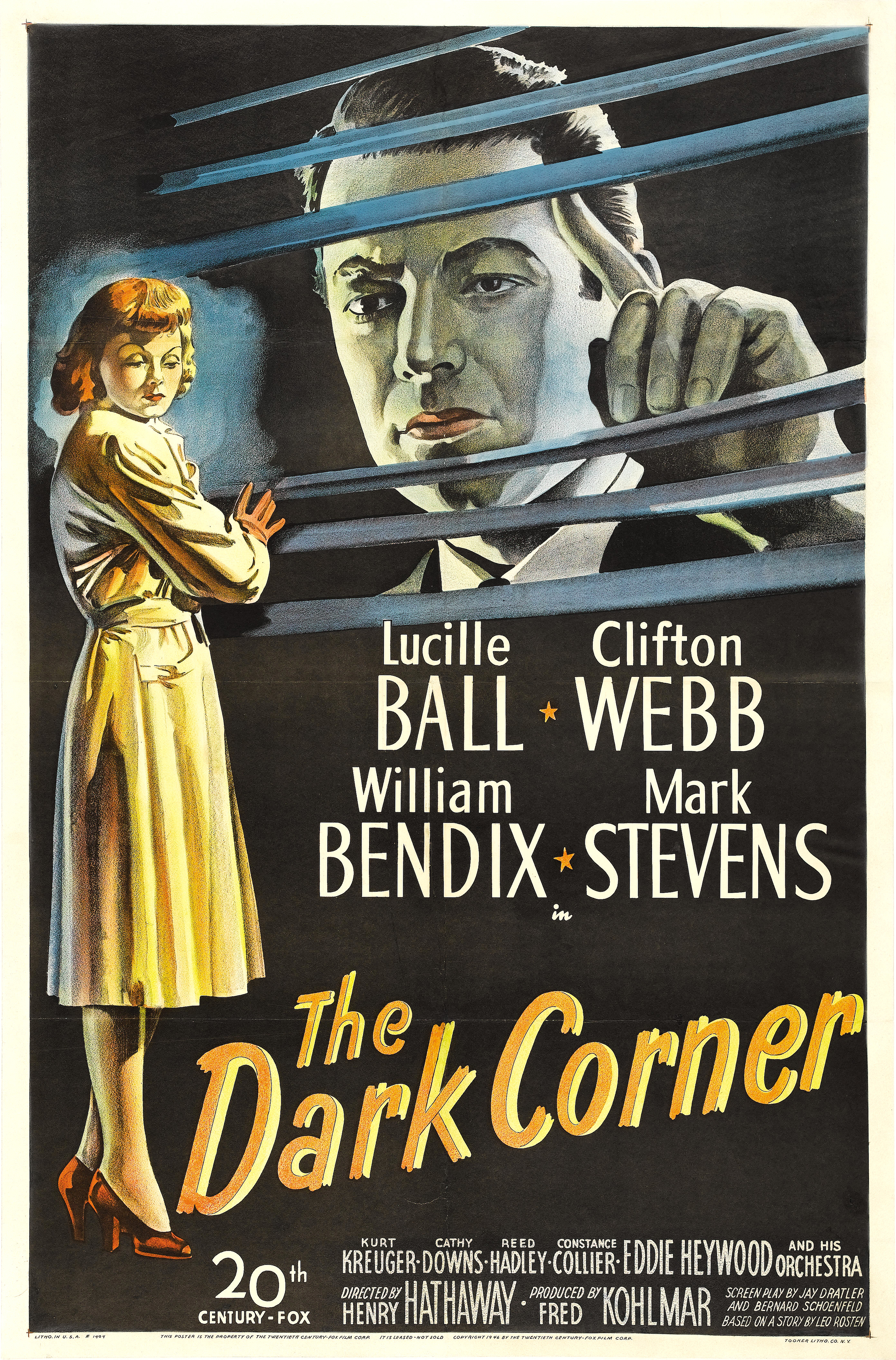
I love me some William Bendix. He’s one of those great character actors that you don’t necessarily notice at first but then he keeps showing up in small parts in all sorts of films and you go, “oh there’s that guy again.” And he’s always good. I probably first noticed him in The Glass Key (1942) where he played a jovial gangster who rather enjoyed beating up on Alan Ladd.

He’s a heavy in The Dark Corner as well, but he’s smarter and more crafty, but not nearly as fun to watch. He’s been hired by the film’s true villain to spy on the hero of our picture, Bradford Galt (Mark Stevens). He intentionally does a bad job of it so that Bradford will know someone’s keeping an eye on him. And then later trying to kill him.

Lucille Ball plays Galt’s secretary, but she doesn’t quite fit. Obviously, she was a gifted comedienne and a true treasure, I just wish they’d done something different with her character. They could have used her comedic talents and made something like The Thin Man where she wisecracks her way through the film. Or they could have made her the smartest person in the room. That’s what all the descriptions indicate she’ll be. I was expecting the Galt character to be rather dim-witted and she’s the smart secretary secretly solving all the crimes. Instead, she’s just a regular secretary and the love interest but is given very little of interest to do.

The story is fine, there are some good twists and it has the look of a good noir. But it never quite did it for me.

This makes yet another Noirvember film this month put into the just OK category. I fully expected this to happen as I intentionally picked relatively obscure films to watch instead of the well-known classics, but I have to admit I’m ready for something really good.

The Friday Night Horror Movie: The House of the Devil (2009)

the house of the devil

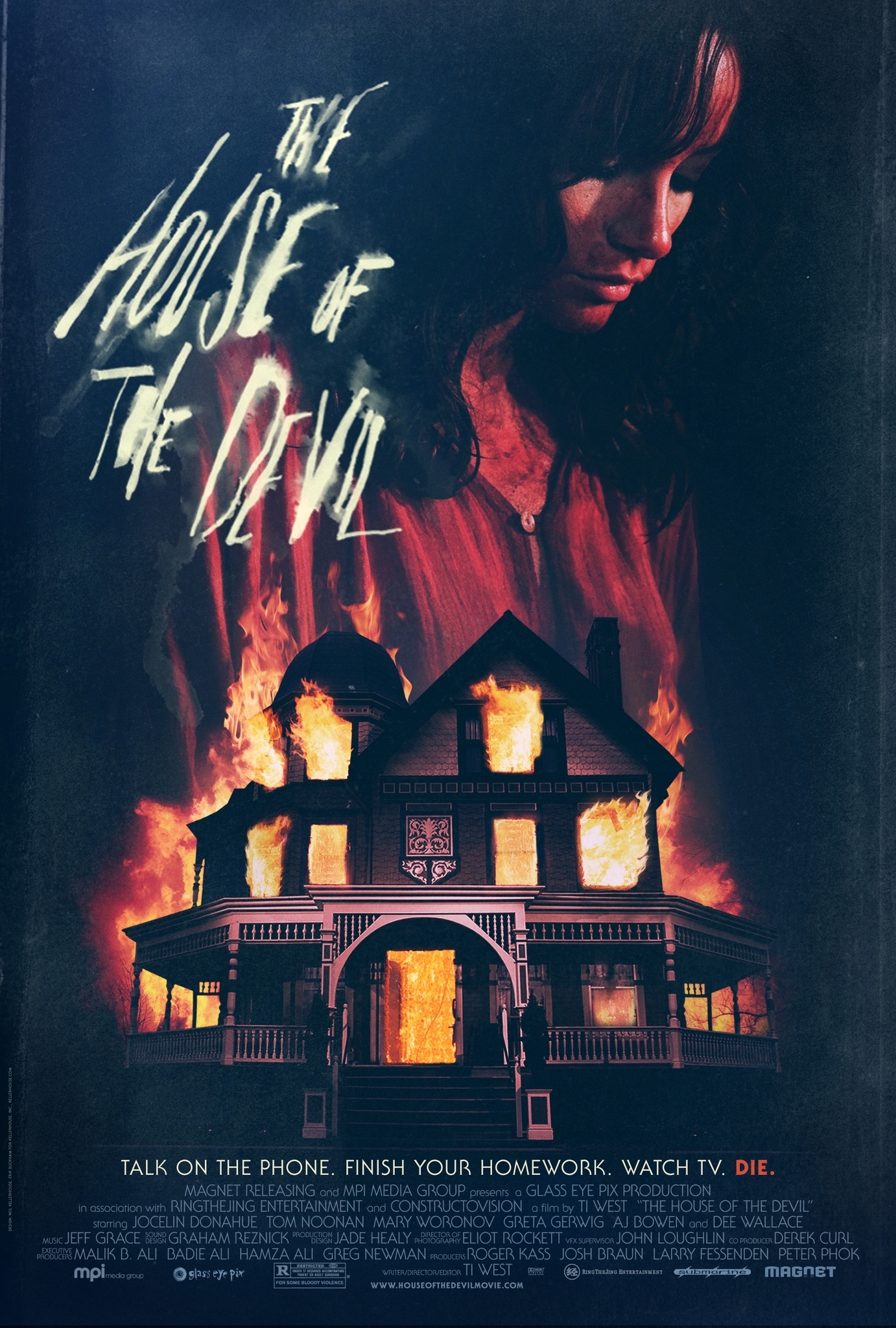
I’ve been hearing good things about Pearl and X, both films that were directed by Ti West and came out this year, and so when I saw that his 2009 film House of the Devil was on The Criterion Channel I decided to give it a shot.

I mostly loved it and I’m gonna try not to spoil anything as this is definitely a film that’s best if you go into it not knowing very much. It is also a film that clearly takes its influences from late 1970s/early 1980s horror. It is definitely a slow burn, that only gets “exciting” in the last twenty minutes. I put exciting in quotes because I found the rest of the film exhilarating, but not a whole lot happens in that build-up.

Joceline Donahue plays Samantha, a college student in need of help. Her roommate is terrible and she desperately wants to move. She’s found a place to rent, but she’s got to come up with the first month’s deposit, and she’s unemployed and broke. When she sees a flyer for someone needing a babysitter she immediately gives it a call. Despite the guy who answers the phone sounding like a creep and standing her up on their first meeting, she takes the job.

She gets her friend (Greta Gerwig) to drive her out to the isolated (and close to a cemetery) house where she meets Mr. Ulman (Tom Noonan). He is strange, and kind of creepy. The house is big, old, and creepy as well. He tells her he lied, that this isn’t a babysitting job, but rather a looking after his elderly mother-in-law job. She is healthy and gets around just fine, so really all Sam has to do is make sure no emergencies happen and it will be smooth sailing. Especially since the mom is a private person and will likely stay in her room.

Despite the creepiness, and the warnings from her friend Sam stays. It should be easy, and besides the guy is offering $400 for one night’s work.

This is a horror movie called The Devil’s House so we are primed for Mr. Ulman to be a serial killer, or the mother-in-law to be a holy terror, or for devil worshipers to try to get into the house. Ti West knows this expectation and plays with it. For most of the film’s run-time literally, nothing happens. Sam sits in the house alone and bored. She watches TV. She orders a pizza. She plays pool while listening to her Walkman. She explores the house. But the way the film is shot. The way the camera lingers in certain places. The way it was shot in 16mm giving it a grainy look. The way the music acts like a creepy horror movie score. The way the house looks with its weird rooms, and deep shadows. The way Sam is perpetually scared. All of these things build up unrelenting tension.

There is one scene, relatively early on, that happens to someone who is not Sam, that lets you know all this tension building isn’t for naught, but mostly it’s just playing with your expectations. I loved it. So much so that I was actually kind of disappointed when things actually started to happen.

I’ll stop myself there. I have a few reservations about the ending, but mostly I really liked this one.

Noirvember #10: Beyond a Reasonable Doubt (1956)

beyond a reasonable doubt

I’m generally not the type of person who complains about plot holes in a movie. I’m a firm believer that cinema is much more than the plot. I can easily overlook holes in a plot or problematic bits of a story when the acting, direction, cinematography, music, etc, are doing it for me.

Fritz Lang is a fantastic director. He came up making silent films in Germany so he knows how to tell a story visually, without a lot of audible or written language. But I almost turned Beyond a Reasonable Doubt off because the story was so ridiculously dumb.

Dana Andrews plays a guy who, along with his soon-to-be father-in-law hatch a plan to expose the inadequacies of the district attorney and the death penalty. The idea is to find a murder case that the police can’t solve, then plant a bunch of evidence making it look like Dana Andrew’s character is guilty. At the same time, they’ll take some photos and stuff proving they planted it. The police will catch him, the DA will prosecute him, and the jury will convict but just before he’s executed the father-in-law will reveal the plan and all will be saved. Also, they’ll expose how easy it is to convict and execute an innocent plan.

Anyone with half a brain can see how terrible this plan is. Nobody in their right mind would intentionally get convicted of a crime they didn’t commit expecting the justice system to correct itself when proof of innocence is procured. Anybody who has ever seen a film before will know that something will inevitably go wrong leading to a panic that our hero will actually face the gas chamber. Everyone will guess he gets saved at the last minute.

What I’m saying is this movie is dumb. Dana Andrews does his best to carry the plot on his shoulders. Fritz Lang does a decent job of adding what tension he can to the story. But I could not get past how stupid it all is.

Did I mention that the two men decide not to tell Andrews’s character’s fiance about this stupid, stupid, plan because they don’t want to worry her? Because apparently letting her believe her fiance is going to be wrongfully executed is no big deal. That’s how dumb this plot is.

Noirvember #9: The Dark Mirror (1946)

the dark mirror

I’ve been slacking in my film noir reviews. I’d apologize, but I can’t imagine any of you actually care.

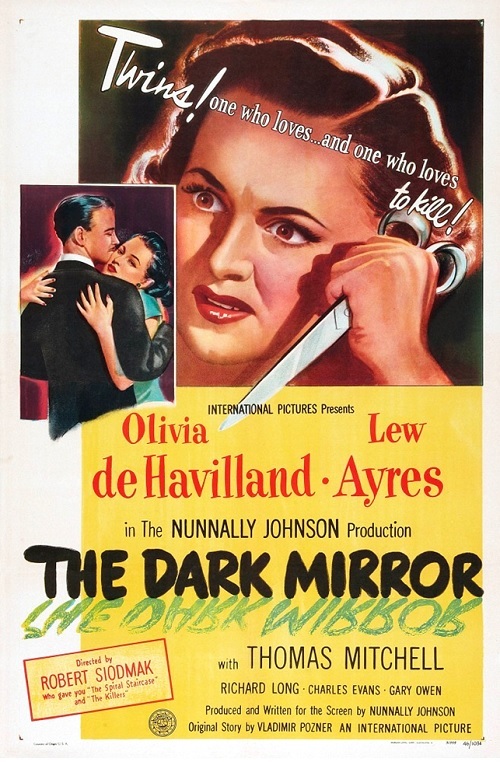
The first fifteen minutes or so of The Dark Mirror are terrific. A man is stabbed to death in his apartment. Several witnesses put the man’s girlfriend Terry Collins (Olivia De Havilland) at the scene. But when Lt. Stevenson (Thomas Mitchell) questions her, she provides several witnesses that can prove she was nowhere near the murdered man at the time of his death.

What the…? How can that be? Twins, that’s how. Terry has an identical twin sister named Ruth (also De Havilland). So, one of them did kill the man but the other has an airtight alibi. Trouble is no one can tell which one did what except the two sisters, and they aren’t saying.

The film has a lot of fun playing with that situation, befuddling the lieutenant at every turn. But then it introduces a psychologist, Dr. Scott (Lew Ayres) who has made a career out of studying twins. He begins seeing the girls individually, running them through a series of tests. Naturally, he also falls in love with one of them.

One of the twins is insane and has been gaslighting the other their entire lives. Naturally, there is a bit of a switcheroo with the twins, because you can’t have a movie about twins without having them pretend to be each other at some point. Once the doctor is introduced I started losing interest. He all but pushes the lieutenant out of the way and the story becomes less about a cop trying to solve a murder and more about a doctor analyzing patients. Boring is the word.

De Haviland is great. She creates two distinct characters out of the sisters while still making them fully believable as twins. Michell is very enjoyable as the lieutenant as well. I wish the film had stuck with him instead of getting all psychobabble with the doctor.

Noirvember #8: Johnny Allegro (1949)

johnny allegro

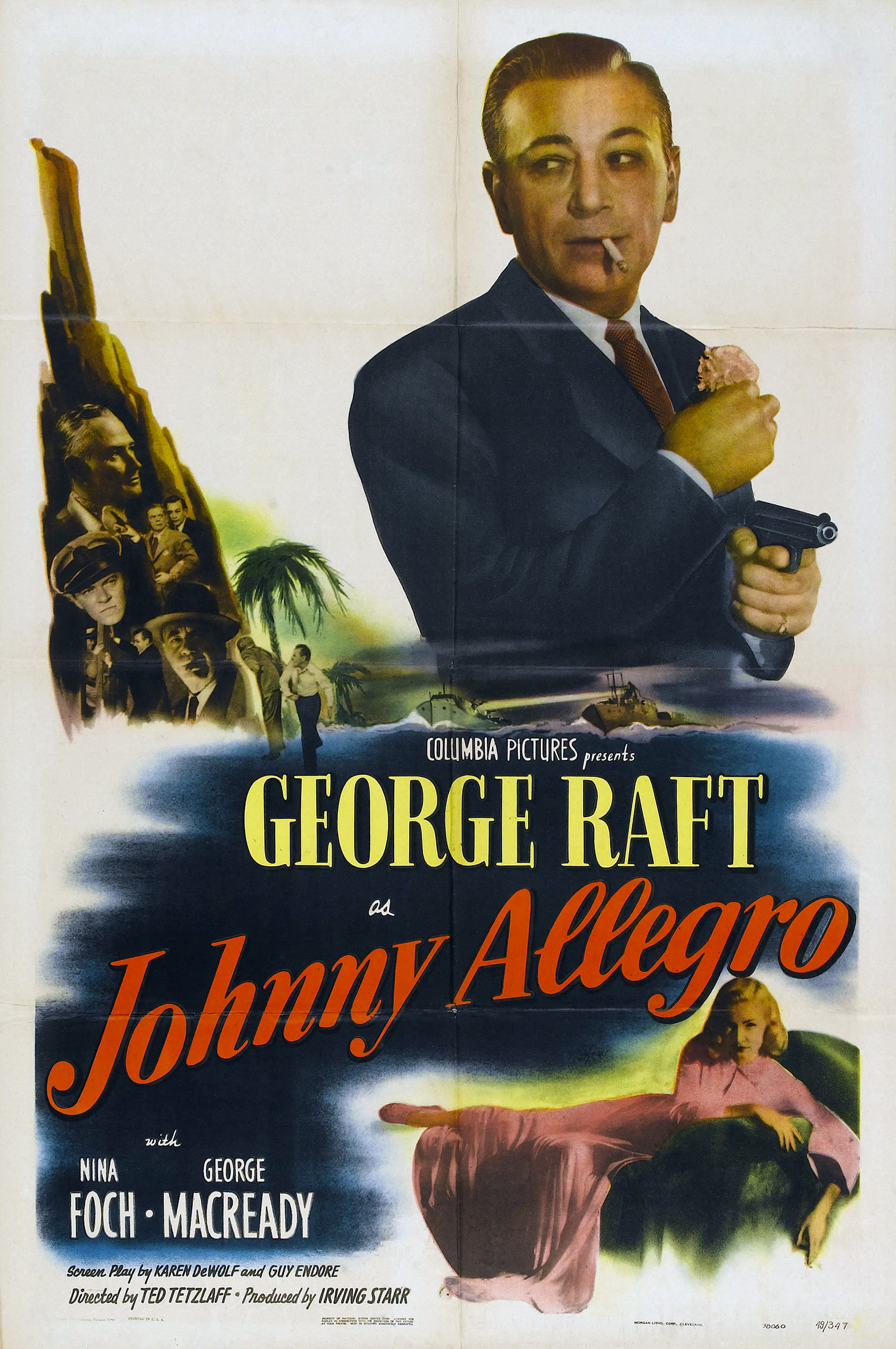
George Raft plays the titular Johnny Allegro, a florist with a secret past. When he starts playing nice with Glenda (Nina Foch) a federal agent takes an interest. It turns out she has a past too and a present. She’s married to Morgan Vallin (George Macready) a shady gangster that the feds are interested in, but have yet to be able to pin anything to. They figure Johnny can use his new connection to Glenda to get to Morgan.

He gets cozier with her and she invites him to meet Morgan on his private island. There is some discussion of Johnny being of service to Morgan’s counterfeiting scheme, but things turn sour pretty quickly. Morgan is a guy who eschews guns but loves playing with his big bow and arrow. Naturally, he uses it a few times and it all winds up a The Most Dangerous Game type situation.

George Raft was not a spectacular actor in the best of situations and here age has crept up on him. He plays Johnny like he’s bored most of the time. Big reveals in the plot barely get a raised eyebrow. George Macready matches his lackadaisical stance and between the two of them the film has a hard time creating any sort of tension.

It is, however, a ton of fun watching Macready fire off his bow and arrow. The actual story and the direction are all pretty good. Good enough to keep me watching anyway.

The Friday Night Horror Movie: Psycho II (1983)

psycho II

Alfred Hitchock’s Psycho is about as close to perfection as horror films come. I love it. I’ve seen it probably half a dozen times over the years. Yet, I’ve never had any desire to see any of the sequels. There was no need to, in my opinion. Psycho said everything that needed to be said about Norman Bates. Hitchock never indicated he wanted to make any other films and all of the sequels came about after he had died. The general consensus of the sequels is that they are pretty bad, and so I never bothered with them.

But then the other day one of my favorite critics, Keith Phipps, wrote a piece about Psycho II and it intrigued me, and so it became my Friday Night Horror Movie.

As it turns out Psycho II is way better than it has any right to be.

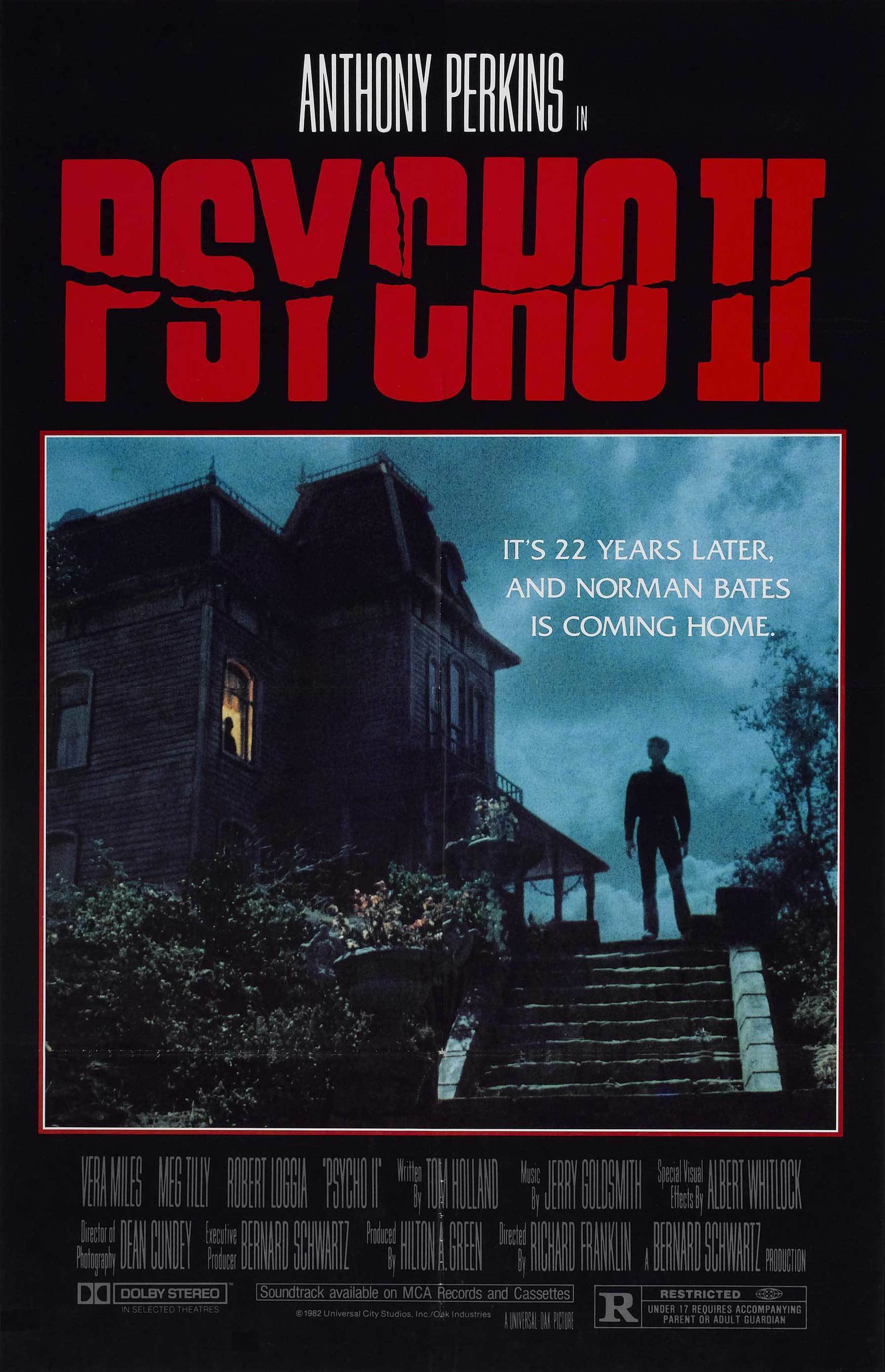
Set 22 years after the events of Psycho, this sequel follows Norman Bates (Anthony Perkins) as he is released from the psychiatric institute he’s lived in since being found guilty of the murders from the original film. He’s been found mentally sound by his psychiatrist (Robert Loggia) and sent back to his (surprisingly still intact) home. The hotel is there too and so is Mr. Toomey (a never-sleazier Dennis Franz), a guy hired by the institute to run the place in Norman’s absence.

The hotel has never been much of a money maker so Norman gets a job as a cook’s assistant at a nearby diner. There he meets Mary (Meg Tilly). They get chummy and when Mary’s boyfriend kicks her out Norman lets her sleep (and shower) at his place. Things go ok until little notes start showing up from Norman’s mother. And somebody keeps calling his house claiming to be his mother, too. Then the bodies start piling up.

Is Norman going crazy once again? Or is somebody else trying to get him locked back up?

What I find interesting about the film is that Norman Bates is a true protagonist. The film takes his side, it makes us like him. Anthony Perkins’s portrayal is sympathetic. It was sympathetic in the original, but here we really like him. Or at least I did. The murders in the first film were due to a deep psychosis. We believe he is cured. That’s a really interesting route to take in this film.

Director Richard Franklin (who had just come off the terrific Australian thriller Road Games) knows what he’s doing. There are lots of visual homages to Hitchcock throughout the film, but he makes it his own. This is a film that didn’t need to be made, but it makes you glad it exists.

Noirvember #7: Fallen Angel (1944)

fallen angel poster

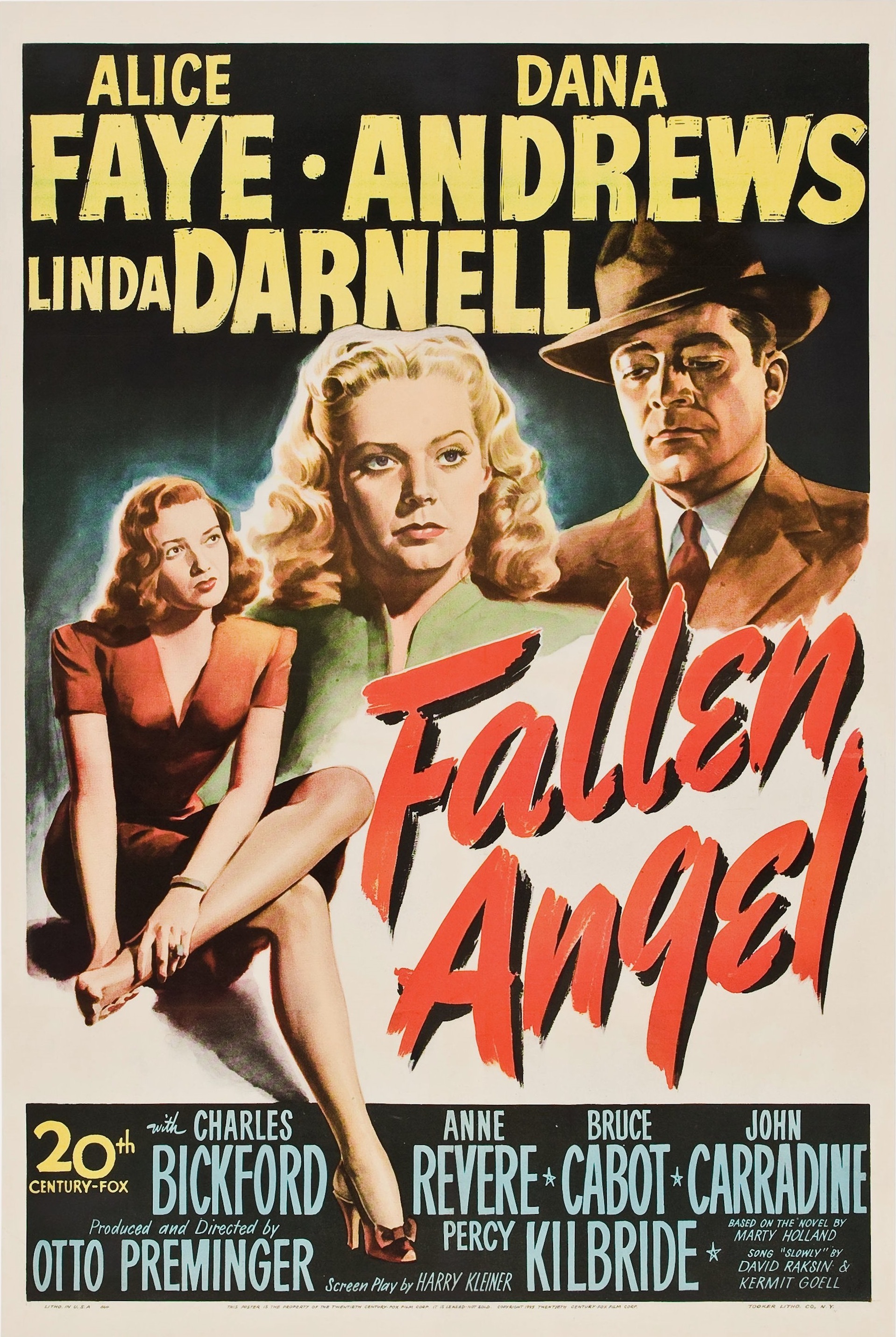
Laura the Otto Preminger film from 1944 is one of the all-time classic film noirs. It was a huge success upon its release and remains one of the genre’s most beloved films. Preminger followed it up with another noir, Fallen Angel, which also stars Dana Andrews. Here, he’s no longer a detective trying to solve a murder, but a drifter, a conman who gets into trouble he may not be able to get himself out of.

His name is Eric Stanton and he drifts into a small town called Walton because he doesn’t have the bus fare to make it to San Francisco and the driver kicks him off at the first stop once he learns Stanton doesn’t have a ticket. There he meets Stella (Linda Darnell) a beautiful, sultry waitress and like any good film noir sap, he falls immediately in love. But like any good dame in a film noir she won’t have him until he’s got some money. He figures he can get it from June (Alice Faye) a pretty, but reserved woman who hasn’t had much luck in love, but does have a lot of money.

Stanton figures she’s an easy mark. He can get lovey-dovey with her, score some cash out of her fat wallet then drop her and head back over to Stella. Naturally, things don’t go as planned and he finds himself on the run from the cops as a murder suspect.

The plot is just as complicated as Laura, but it isn’t nearly as compelling. Linda Darnell is the standout. She is radiant and mysterious. Unfortunately, she doesn’t get a ton of screen time and her character isn’t given much. Dana Andrews is fine. I love morally murky characters, especially men who think they have it all under control but are really quite clueless. Likewise, Alice Faye is perfectly acceptable but she’s missing that certain something to make this film truly great.

Well worth your time, but if you haven’t seen Laura grab that one instead.

Heat 2 by Michael Mann & Meg Gardiner

heat 2

Heat, the Michael Mann film from 1995 is one of my favorite movies. It stars Robert DeNiro as a master criminal who heads a crew of high-end professional thieves (including Val Kilmer, Tom Sizemore, and Danny Trejo) and Al Pacino as the highly-skilled detective out to catch them. It would be a great movie if it was just a cat-and-mouse game between those two forces, but it is so much more.

At its heart, it is really a character study of these two characters who are both very similar though on opposite sides of the law. Both men are highly intelligent, great at their jobs, and extremely dedicated. The DeNiro character swears off all attachments because he says he needs to be able to flee without a second thought, he has to be able to leave everything behind. Pacino’s detective is married, but it is falling apart (and this isn’t the first time that’s happened) because he can’t ever leave the job at the office. Kilmer plays a man kind of in the middle of these two. He is smart and very good, but he’s got a girl and he’s dedicated to her. He’ll get the job done, but he’ll never leave her.

It is a long movie and one that takes its time. It allows the audience to really soak up these characters and live in this world. It is a film I like more and more each time I watch it and one I always enjoy spending time with.

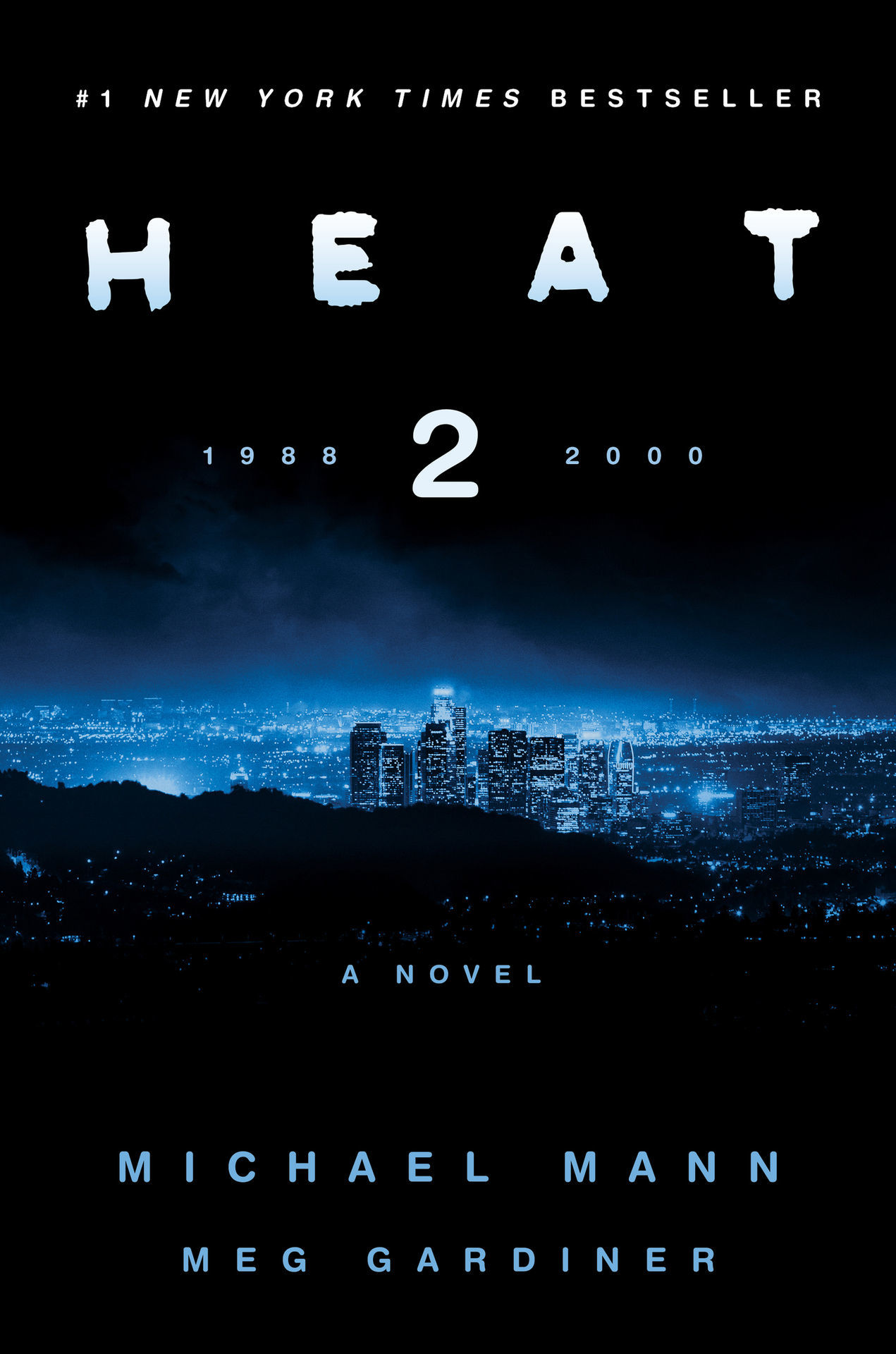
So, I was excited when I learned that Michael Mann (with help from Meg Gardiner) had written a sequel to Heat. As a novel. Which is weird, right? Mann has never written a novel before, and Heat is a movie. Except Mann often talks about how when he writes a movie script he writes long character descriptions giving them background stories and filling in their characters. Apparently, he writes hundreds of pages of background stories that never make it to the actual script. Heat was actually a remake of an earlier film of Mann’s called L.A. Takedown, which was originally intended as a TV pilot but when it wasn’t picked up he converted that into a television movie. What I’m saying is Mann knows and loves these characters so it makes a certain amount of sense that he’d want to revisit them in this format.

Heat 2 is really good, even if it is a little convoluted and relies a little too heavily on coincidence. It follows two timelines that eventually converge. The first follows directly after the events of the film. Chris (that’s the Val Kilmer character) has escaped with his life (barely) and is on the run. He makes it to Paraguay where he begins working for a crime syndicate.

The second timeline follows Vincent (the Al Pacino character) several years prior to the events of the movie as he chases a violent gang of home invaders in Chicago. Neil (the DeNiro character) and Chris and their cohorts are also in Chicago at the same time, involved in an unrelated crime.

The stories converge in interesting ways. At least to me. Your mileage may vary.

Spoilers for the movie: at the end of the film Neil is dead and so he can’t factor into the events of the book that unfold after that moment. It is clear from the film that Neil and Vincent had never met before. In this book, the two characters circle each other without really knowing it and the various coincidences and events that connect them do feel a little contrived and may be a little too much for some readers.

Personally, I didn’t mind. Mann and Gardiner do a great job of bringing us back into this world. The voice of the characters line up so well with the actor’s performances in the film that I do wonder how it would come across to someone who hasn’t watched the movie.

I highly recommend watching the movie then reading the book. Mann has already said he’s interested in adapting the book into a movie or possibly a TV series. I’d vote for a series as there is so much crammed into these pages it would be difficult to fit it all into a movie, even a long one. It will be fascinating to see who they get to play these characters as the original actors are far too old for it now.

Noirvember #6: This Gun For Hire (1942)

this gun for hire

I had forgotten I had seen this before, but once I got started it was too good to turn it off.

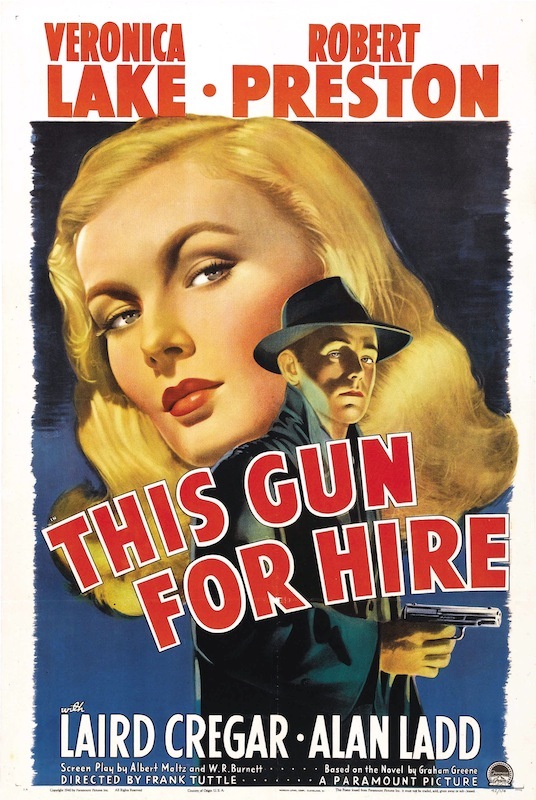
Alan Ladd, in his first real role (he’d been in other films before but they were bit parts, so small he gets an “introducing” credit here) stars as Raven, a sadistic killer-for-hire. But he’s so good in it, he brings such emotional complexity to the role that you can’t help but root for him. He’s hired by Willard Gates (Laird Cregar) to bump off a chemist and steal some papers. Raven doesn’t ask questions, he doesn’t care what’s in the papers. He just does his job and takes his pay.

Gates double-crosses him by paying out in marked bills, ones that he claims to the police were stolen from his company. Detective Michael Crane (Robert Preston) is put on the case. He’s in love with Ellen Graham (Veronica Lake) who was just hired by Gates as a performer in one of his nightclubs. She accidentally winds up on a train next to Raven. Gates sees them sitting next to each other, thinks they are in cahoots, and calls the cops. Raven holds Ellen hostage in order to get away from the cops. Though she isn’t in cahoots with Raven she is working with a local senator who believes Gates is selling secrets to foreign agents.

As you can see, it is a complicated, convoluted plot. Director Frank Tuttle keeps things moving at a quick pace but still manages to more or less keep all the convolutions understandable. Veronica Lake is lovely as usual though she isn’t given much to do. She sings a couple of songs while doing some pretty fun magic tricks and makes googly eyes with Detective Crane. Her scenes with Ladd are good, but mostly she’s just there to look pretty. Preston has even less to do. He’s top-billed but he’s in the fewest scenes out of the three main cast members and when he is on screen it is just to move the plot along.

This is completely Ladd’s film and it is easy to see why he became a star. He really nails the nuances of the role and makes us feel sorry for a guy who kills for a living.

Noirvember #5: Reign of Terror (1949)

reign of terror

The thing about film noir is that nobody really agrees on exactly what makes a film noir a noir. The plots for this genre are all over the place. But the one thing everybody agrees upon is that a film noir has a certain style, a certain look. It is all about the light and the shadows. Noir had a way of lighting a set and a character like nothing else.

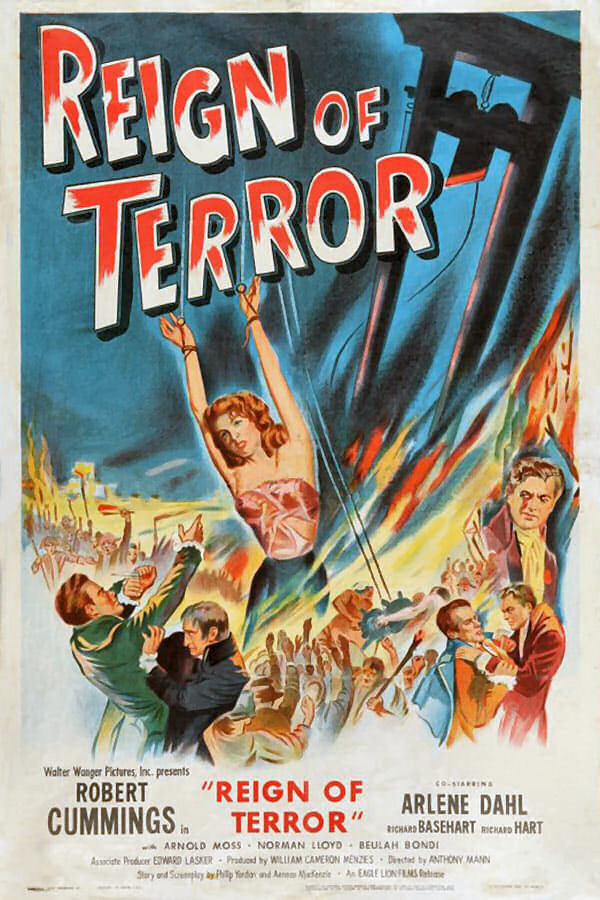
Normally you wouldn’t say a movie about the French Revolution could be a film noir, but director Anthony Mann who was no stranger to the genre having directed He Walked By Night, one of the great noirs, films Reing of Terror just like it was a perfect fit.

In this version of events, Maximilian Robespierre (Richard Baseheart) is not satisfied with having led France into a revolution, overthrowing the King and instilling a reign of terror by beheading anyone who opposes him, he wants to be dictator for life as well. Charles D’Aubigny (Robert Cummings) is tasked with infiltrating the Jacobin Party in order to find a Black Book. In this book written all the names, Robespierre intends to kill at one time or another. Since nobody knows whose name is in the book, everyone is afraid to oppose him. But if the book is opened to the people then the people may decide the time has come for Robespierre to face the guillotine.

Or something. The details of the plot get a bit muddled as it goes along. But it looks fantastic. The sets are brilliant and the lighting is full of bold, dark shadows. It is the sort of film where you can forget what is happening in the actual story because you are so mesmerized by how it looks.

Cummings is good but it is Arnold Moss who steals the show as one of Robespierre’s henchmen who wouldn’t mind seeing him at the wrong end of a guillotine if it helps line his own pockets and gains him a little more power.

Reign of Terror is definitely worth the watching.