The Elephant Man (1980)

the elephant man poster

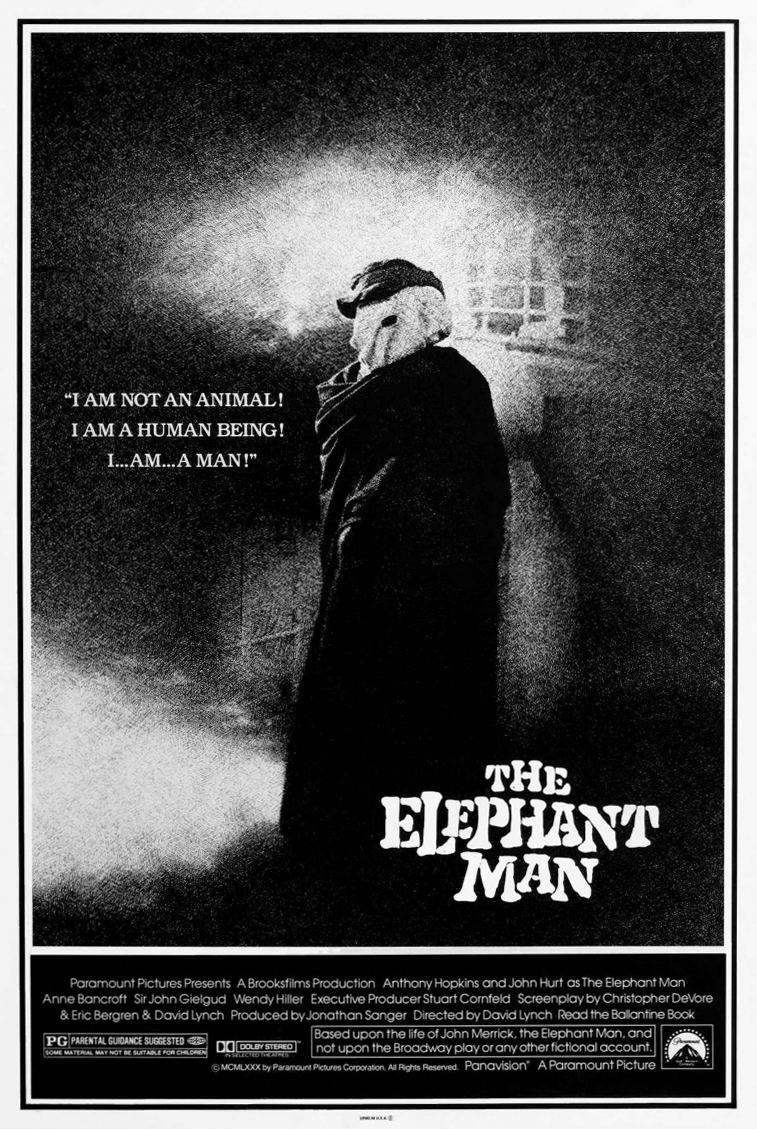
David Lynch’s second full-length film contains the odd assortment of freakish characters we’ve become accustomed to in his films. Yet, despite having one of the more outlandish characters he has ever put on celluloid, it remains his most sentimental film. The Elephant Man is based upon the true story of John Merrick, a 19th-century Englishman with massive deformities throughout his body. He performed in freakshows for many years until he was found by Dr. Treves who cared for him and placed him in Whitechapel hospital. It is his time in this hospital that the film concerns itself with. For here, Merrick is able to live, more or less, as a gentleman. He is well-fed, well-kept, and educated. He can read, write, speak eloquently, and even begins to entertain the well-to-dos of society.

It is filmed beautifully in black and white. It is a very well-made piece of cinema. Lynch, for the most part, stays away from his trademark imagery and symbolism and sticks to more traditional storytelling, although the opening sequence is a straight Lynch nightmare. That the characters come from real life and not Lynch’s twisted imagination only serves to add to the surrealism of the film.

It has been said that Lynch is too sentimental in this movie. That he manipulates the audience too much. Ebert even goes as far as saying Lynch tricks the audience into believing that Merrick is a noble and courageous man. He suggests, that rather than being noble, Merrick is merely doing the best that he can, under poor circumstances. It is true that the film is sentimental. There is hardly a scene that does not prick the audience’s emotions.

How many of us would dare to get out of bed each day with similar difficulties? And here, this man, though physically plagued, manages to keep up his spirits and even write and build card sculptures. It would be a poor director at that who could not produce a tear at such a sight. If we pretend it is not a noble feat for such a creature to retain his humanity and good cheer, while being constantly bombarded with inhumane indecencies are we any better than those who stand outside the carnival and jeer?

Yet there is something in these critiques of sentimentalism. Lynch continues to use his tricks as a director to keep our eyes wet. There is a scene in which Merrick meets Dr. Treve’s wife and breaks down with tears at her simple kind acts. His tears state that no one has been so kind to him as to treat him like a gentleman. Though effective, this is using the craft of filmmaking to do nothing but manipulate emotions. In other films, I would lambaste this type of sentimentalism and chastise the audience for falling for it. Yet the overall sadness throughout the story makes me fall for it here. I cannot commend such use of it in the film anywhere, and yet it works for me in this particular instance.

Overall, The Elephant Man is a fine achievement for a young director. Lynch would go on to make more articulate, less sentimental films. But here we find him assured in his imagery and storytelling. He effectively sweeps the viewer into the emotional turmoil of such a sad, hopeless story.

The Hound of the Baskervilles by Sir Arthur Conan Doyle

the hound of the baskervilles

In my determination to read all of the classic detective fiction I recently picked up Sir Arthur Conan Doyle’s Hound of the Baskervilles. I have a collection of Sherlock Holmes short stories, but those are a little too simplified for my tastes. They consist of a setup for the mystery and then a detailed description of Holmes using his near supernatural ability of observation to determine the culprit. Most of these never develop any real sense of mystery because Holmes is too brilliant for the reader’s good. We are briefly marveled by his powers of observation and deduction, to the point that we begin trying to concentrate our own powers on the mundane tasks of our lives. Upon some contemplation, though, it is easy to realize that paying attention to details will not bring us the answers the super detective seems to collect from the air at will. There are too many possibilities as to why our neighbor has a bit of mud on the cuffs of his pants to be able to surmise the reason out of sheer reasoning.

This being said, I was looking forward to reading a longer-length novel about this super sleuth. With more pages, surely Doyle would prepare a better mystery for his hero to unravel. Still with a mere 174 pages, Doyle managed to create a more well-rounded story and develop enough mystery to satisfy my tastes.

The story revolves around Henry Baskerville and his inherited homestead amongst the moors of England. It seems his family has been haunted by a demon hound for generations. The patriarchs of the family have befallen many a beastly end in this home. Not one for superstition, Henry moves to the homestead from America after he inherited the land when the previous owner, Sir Charles Baskerville, fell dead of fright. After a series of threats and strange circumstances, Dr. Watson travels to the Baskerville home to investigate. Holmes has announced himself too busy in London to be able to make the trip himself.

This point was a brilliant maneuver by Doyle. Allowing the more human Dr. Watson to do much of the investigation himself allows the mystery time to develop rather than be solved immediately by Holmes. Dr. Watson investigates the few residences around Baskerville Hall and finds them all to be rather suspicious in their own way. Suspense is built by the appearance of an escaped convict loose in the area, and the appearance of a mysterious stranger roaming the moors.

When Holmes does appear back on the scene, Doyle allows the action to take the place of Holmes’s usual verbal pomposity. Though, we are told numerous times that this is a most interesting and difficult case by the detective. As if the reader is too dumb to appreciate the difficulties of the case, we need to be reminded by Holmes over and over again. Once the case is solved, the novel is concluded with a meeting between Holmes and Dr. Watson months after the case had occurred. Here Holmes once again must amaze us with his brilliant deductive powers. Once again, a mystery novel must tie up loose ends with a lot of verbiage.

The Hound of the Baskervilles was a light, enjoyable read. It is easy to see why Sherlock Holmes mysteries were so popular. They are easy to read, quickly paced, and pack enough muscle to keep the page turned. Holmes penetrating powers of observation and deduction are fascinating. Like magic tricks, they entrance the reader and make us feel that with a little help and a lot of practice, we could also perform such feats. As serious literature, the book fails to be scrutinized. I will read more of the Holmes mysteries, and these books will hold a place on my bookcase, but they will have to hold a second shelf to the true masters of the genre.

Two Stories

I’ve been meaning to post these for a bit, but haven’t had the time to write them down.

Story #1

A few days back I had to walk home from my French lesson due to the tram workers being on strike. As I walked, I pondered the peculiarity of the way in which French workers strike. In the US the mere talk of a strike can get action. Whenever union workers actually do strike it is often a long, brutal affair. Days, weeks, even months roll by while workers and managers bicker over the terms of an agreement. In France, a group of workers will often strike for one day only. Since I have been here, the Post Office, the university clerks, and now the tram workers have gone on strike for a day. Sometimes there are longer strikes, but it seems it is a normal practice for workers to have these short strikes periodically. It is like a way to show the managers what they are capable of doing. The workers tend to congregate downtown airing their grievances to whomever will listen. I digress. As I was walking home, these were the thoughts I was having.

On a long stretch of road, two college aged girls crossed my path. One of them stopped and spoke directly to me. Being lost in thought I didn’t catch a single word. Something on my face must have registered this fact and the girl repeated what she said. Having spent the last 5 months not understanding a word any stranger spoke to me, I prepared my sentences explaining that I was a foreigner and didn’t understand French. Yet to my astoundment, I actually understood what she was asking. She needed to know where Place de Etoile was located. It was as a light from Heaven broke through the clouds and shone a ray on my head. I could almost hear the angels sing “Hallelujah.” I understood!

I managed to say a couple of words in my excitement and point towards the city square they were looking for a couple of blocks over. They understood my words as well and thanked me for my time.

My elation was held short though. That very evening we received a telephone call. I managed to understand who was calling (the mother of the girl we are sub-letting the apartment from) and why she was calling (to thank us for sending some money we owed her), but she continued to speak with a fast tongue, and I quickly got lost in the shuffle. I tried to ask her to hold on one moment and let me catch my mental breath. But she didn’t understand and kept speaking. Finally, deflated, I gave up and handed the phone to Amy.

Story 2

A different day I was performing the same action as in the previous story: walking home from my French lesson. This time no person stopped to chat, but a car did stop in the middle of the road. He was parking himself a few feet from a rather busy intersection. He was on the busy end of the street, and though it was passed the rush hour, traffic was still quite heavy. I could see the passenger door open and a woman was partially outside the door. At first I thought that there must have been a breakdown of sorts, and they were in the process of looking for its source. As I walked closer I realized this was not the case. The driver was simply dropping off the passenger, and she was reluctant to leave. Instead she was engaging him in conversation, In the middle of a highway, with loads of traffic surrounding them, they were having a chat. I walked slowly in order to see how long they were going to do this. After about 5 minutes of me watching this situation, the car drove away.

To add to this obnoxiousness, there was a pull off but a few feet in front of the car. Instead of parking his car a few feet forward, and remain out of the way of oncoming traffic, this joker decided to stop there, in the middle of the street.

I suppose they chalk this up to libertè. The French fought very hard for their right to ignore laws that don’t suit their taste for the moment. This guy was just using his God given right to thumb his nose at everything and enjoy one last moment with his girl.

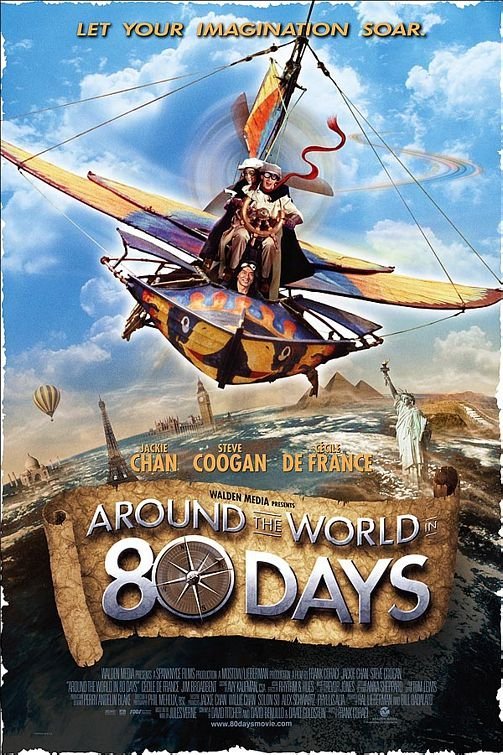
Around The World In 80 Days (2004)

around the world in 80 days movie poster

There are some films that I make no plans to watch, nor have any desire to see. Yet, sometimes, through circumstance, watch them is exactly what I do. Recently, I was invited to dinner at a friend’s house. Another invitee decided to rent this Jackie Chan vehicle. Never to be one to turn down a free movie, I watched.

I am not one of Jackie Chan’s fanboys. The action sequences in his films are generally spectacular, and often hilarious. But his film’s lack of a cohesive narrative, god-awful dialog, and horrid acting turn me off, more than any stunt can save. From time to time, I do manage to catch one of his films, even enough to notice their general degeneration of late. His earlier, non-English films, though containing worse overall production value, had more bang for your buck. His American-made films seem to be bent on adding plot and characterization to the detriment of the action. This might be commendable if the additional plotting was any good. But more often than not, it’s just a glossy version of the same old schlock. Around the World in 80 Days follows this formula.

Waiting thirty minutes into a Jackie Chan film for the first action sequence is an atrocity. When that action sequence is lame, you might as well take up the pooper scooper and walk the dog. The movie followed this pattern. Thirty minutes of mind-numbing story development followed by tame, lame action sequences.

The plot is old and rehashed. Loosely based on the Jules Verne novel of the same name, Chan plays Lau Xing masquerading as Passpartout, servant of snooty inventor Phileas Fogg (Steve Coogan). Through a bet, they impart on a journey around the world in…oh, who cares? Who watches a Jackie Chan film for the plot? And if you don’t know this story by now, stick around and I’m sure they’ll make another TV movie of it shortly.

The film is scattered with high-profile cameos. Most interesting of which is the now California governor, Arnold Schwarzenegger’s turn as a Turkish prince. The others are mostly pointless and unfunny cameos designed to make the audience go “oh that’s Rob Schneider” and miss the fact that he’s amazingly unfunny and his character serves no particular point. The casting of Kathy Bates as the Queen seems most spectacularly ill-placed. Her British accent is appalling. Was it too hard to find a real Brit to play this role? Some of my French friends have better British accents than that.

With the exception of but a few moments, the fight scenes, few that we get, are unspectacular. The joy of Jackie Chan is in his ability to stage acrobatic action sequences while using an odd array of props. Chairs, stools, flags, and culinary devices have all served as weapons in previous pictures, yet here he is mostly intent on using his hands to fight against regular swords and blades. It’s not that the action is terrible per se, but that they pale in comparison with so many of the others he has performed.

There is really nothing to recommend this movie. It is age appropriate enough. There is little to offend the younger sensibilities (besides the acting, plot, and production values)If you have children, I suppose, they might find it silly enough to enjoy. But, with so many other quality films out there appropriate for children, I can’t make myself recommend this one to them either.

Shadows and Fog (1991)

shadows and fog poster

Editors Note: I wrote this long before I knew of the various accusations against Woody Allen. I have no comment to make about those allegations, but as I am reposting this review in 2022 I wanted to note that this is not any sort of endorsement of Allen as a human being, but simply a review of his film.


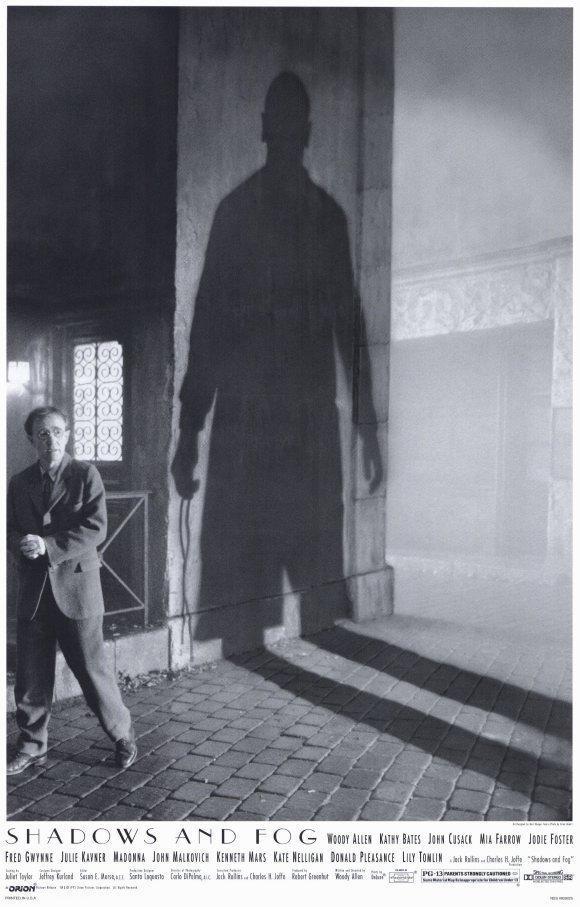
Woody Allen’s tribute to German Expressionism is better than most critics would have you believe. Sure there is very little plot to speak of, it’s more a series of vignettes and gags than a cohesive narrative. Sure, it ends rather abruptly, never solving the mystery, but none of this stopped my thorough enjoyment of this film.

As the title suggests the entire movie is designed in shadows and fog. Shot with beautiful black and white photography, Allen and cinematographer Carlo Di Palma create the look and feel of an unnamed East European city as seen in such films as M and Nosferatu. The lighting is set up so that in nearly every shot underlying shadows engulf the scene. In the exteriors, a vicious fog rolls across the night sky obscuring most details. Through the fog bumbles Kleinman (Allen is his typical neurotic schmuck role) trying to find his role in a vigilante mob’s plan to stop a serial killer roaming the streets. From dark night until dawn, Kleinman wanders from place to place meeting a wide variety of curious characters (played by an even more curious group of celebrities), the most endearing of which is a desperate sword swallower (Mia Farrow)who has wandered into a brothel after fleeing her cheating boyfriend/clown (John Malkovich).

It is a little unsettling to watch Allen do his normal schtick while the characters around him are murdered, subjected to racial prejudice, and beaten by the police while discussing such subjects as love, sex, and meaning. There is a subtext involving the plight of the Jews between the World Wars, foreshadowing the Nazis. Yet the gags remain as solid as any Woody Allen film. Amongst the seriousness of his subtext and the films he is paying homage to, Allen finds a way to bring full-bellied laughter. Though his quirky neurosis isn’t as resolutely hilarious as it is in such films as Annie Hall, it is still enough to fill the film with mirth.

The film ends rather abruptly with Kleinman having never learned his role in the plan, nor the killer having been caught. Yet as the credits role we realize the mystery was not so much the reason behind the story as a method of creating it.

American History X (1998)

american history x poster

There are spoilers. Read at your own risk.

It has been many years since I have seen this film. My memory attested it to be an excellent picture that meaningfully discussed issues as heavy as race relations, prejudice, and hatred. Unfortunately, my memory is a little at fault, and upon viewing it this time I found it a bit disappointing. The film sets its sights on the heavens, and while succeeding in many ways, it could not attain such a lofty height. In trying to cover all the basis in such a thorny issue as race relations it cheats a bit in its storytelling. But we’ll cover more of that in a bit.

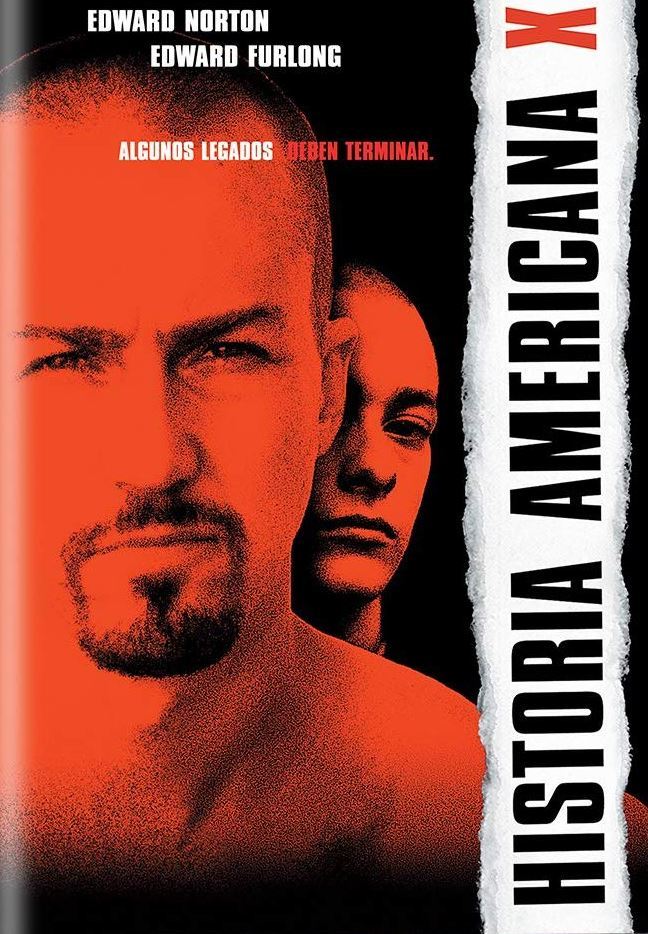
The plot involves a young, white man named Derek Vinyard (Edward Norton) and the tumultuous 24 hours after his release from prison for killing two black men, while they were trying to steal his car. Much of the story is told in a flashbacked black and white. Here we learn that Derek was a Neo-Nazi skinhead leader who had a change of heart after his stint in prison. Post-prison time is being spent trying to keep his brother, Danny (Edward Furlong) from following in his footsteps. A path he is already walking down.

This is a powerful, moving film. Reading the boards on IMDB will attest to lives being changed through watching it. It works best when it shoots for an emotional response, rather than an intellectual one. Scenes such as when Edward Nortan’s skinhead leader rallies the troops to loot a local grocer, the opening scene where we see Norton kill the two aforementioned black men, or a traumatic rape scene in prison, emit a guttural response from its viewers. It is in such scenes that we are rallied into a discourse on the issues presented. Yet when the film gets talky it falls short of its ideals. It presents nothing beyond the general rhetoric you can find just about anywhere. In fact, most of the rhetoric is spewed from the Neo-Nazi skinheads, and this type of discussion can be found every other day on daytime talk shows. There is little in way of discussion from the rational, unprejudiced mind.

There are two powerful performances from Edward Norton and Edward Furlong. At this point Norton was already beginning to take his role as the new Robert DeNiro, who had previously taken his turn as the new Marlon Brando. Let’s hope he escapes the fate of mediocrity that they fell into. Furlong who once made Arnold Schwarzenegger look like Laurence Olivier with such a wooden performance, here has finally made himself worthy of attention. He gives a fine performance here, as a young man struggling with the passionate feelings of youth.

Tackling an issue as heady as racism in America is a worthy, yet difficult cause. It proves to be too much for first-time screenwriter David McKenna and director Tony Kaye. Trying to condense their story into regulation movie time they either skipped over completely or barely touched on some important issues. To give reasons for Derek’s turn as a skinhead we are only allowed one small dinner table conversation with his father who spews some hateful race sentiments. This and his father’s murder at the hands of black addicts in a crackhouse, whom he was trying to save from fire must suffice for an intelligent, middle-class youth to turn into a Nazi. Likewise, his subsequent salvation in prison does give us sufficient reasons for this turn of heart. Yes, the skinheads in prison are hypocrites, and yes the rape scene is brutal enough to turn away from their midst. But, his relationship with his black coworker, Lamont (Guy Torry) is not enough to change the heart of such hatred. Torry gives a fine performance, and does enough to show Derek that all blacks aren’t as vile as the rhetoric made him believe, but are jokes about sex really going to make a skinhead believe in the goodness of the black race?

In searching for a cause behind the Neo-Nazi scene in America the filmmakers seem to point directly towards the intense feelings of anger found in adolescence and the need to fit in with some social group. And rightly, these two issues play powerfully on the minds of many in the skinhead culture. But the issue goes deeper than this, and it is here, again, that this film misses the mark. Just as Derek dismisses issues of poverty, and social position in the plight of the black man this film seems to skim over some of the deeper motivations behind racism.

Don’t get me wrong. This is a powerful, well-made film. There is plenty to chew upon and discuss. It is, in fact, a good film to watch with others and bring to light an important debate. Yet when I watch it I can’t help but think of how it could have been better, how it could have reached the heights it was reaching for.

A Slight Mishap With Chocolate

I have decided my foibles with chocolate milk and the laptop should be combined into one post for posterity. Thus three posts are now one.

Last night I was working diligently on the computer (ok, I was playing games as usual) and drinking a very large glass of chocolate milk. I took one swig too many and the milk went the wrong way and had to eject. My reflexes were not good enough to stop the exploding milk from landing across the keyboard. As quickly as I could I dried the milk. Then I tried my best to clean the keyboard. Everything works properly, thank goodness. However, several of the keys stick, and I have to use great force to get them to type. We are going to a shop Wednesday to have it fixed. Until then I shall be brief in writing since it is a great pain to type. I am unsure how quickly I shall receive the computer back after Wednesday, so I may be completely down for a few days.

Day 2

Besides having the annoyance of sticky keys we now also have a phantom typist. The letter “l” periodically begins typing itself across the screen repeatedly though no one is near it to actually press on the cursed letter. If I am lucky enough to be on a Word document, I quickly receive a page full of “l”s. More likely than not I am elsewhere and thus given more grievance than that. If I am on the internet the mysterious typer causes all other internet functions to shut down so that the “find” function can begin searching the page for “llllllllllllllll….” On other software, the “l” will bring up some unwanted function, or if no function is available, the computer produces an obnoxious repeating error sound.

Kindly enough my French tutor’s husband has offered to take a look at the machine and take it to a local shop to have it fixed.

Day 3

Arriving at my French tutor’s house for my lesson, her husband began promptly looking the sick machine over. After a few minutes, he rushed out of the house and down to the local PC doctor. Back with a frown, he said that not only would he not work on a Dell computer, but that no one in the entire city of Strasbourg would. Not wanting to believe that, we ventured across town to a larger computer shop. Again they said they would not work on Dell computers, because that company does not want to work with them. The kind man behind the counter did relay that Dell had a store in Paris and that they would send someone here for a fee of 78 Euros. Realizing that this was only the fee to get the tech here and that there would be an additional fee for parts and the tech’s time spent working, my heart sank.

We were able to reattach the keys (for they had been pulled off earlier to try to de-stickify them) and keep the phantom typist from typing again. Though the letter “m” no longer works at all. The control keys do not work either so, in order to type “m” I have to copy and paste it using the mouse. Shortly I will go insane of this.

Day 5

After insanely typing using the copy/paste method we have found salvation. Our dear friend, Pamela has let us borrow an extra keyboard that she had. It is a French keyboard so all of the keys are in the wrong place. I was able to configure it to type like an American keyboard, however, all the keys are still labeled like the French version. I am a good typist so I do not need to look at many keys, but a few such as parenthesis, have become a bit of trial and error as I try to remember where they are located. At least we have an “m”.

Midnight Hamburgers

Story # 2 as told to my French tutor, Ann.

The first couple of years at college, I lived in the dormitory, known officially as Burton, but dubbed “the ghetto” by the student body. I lived on the “backside” of the dorm which opened out into a small field on which many an adventure was had.

Once every few months me and the “backside boys” would plan a cookout of magnificent proportions. By the time of this story, we had developed a plan of cooking out that enabled us the greatest amount of grub, with the smallest amount of work and moochers. After cookout #1 we realized that grilled food brings the masses quickly to our lair, with a hand out. So we worked out a plan to have each interested person bring at least one item, and scrounged to find enough grills to cook it all.

Being college boys we typically prowled the evening for other services before our minds were set on food. This particular night the proceedings didn’t start until 9 pm or so. By the time the grills were good and hot and the meat was cooking it was after 10. We had burgers, hot dogs, and shrimp cooking. Lawnchairs were set about and good times were being had by all. Being a private, Christian university, beverages of an alcoholic variety were not present. Though a security guard did stop by to ensure our following of this policy.

Things really got going around 11. Hamburgers were being passed around, the shrimp was cooked, and the pasta was nice and tender. The moochers were present, but we had plenty to go around. James Taylor was rolling through a hot rendition of “Steamroller.” Life was good. There is nothing like spending a warm September night outdoors with plenty of food, drink, and good company.

The party toiled on until late in the evening. Around 2 AM or so a guy from one of the dorm rooms nearby, Jason, came stumbling out. He was in his boxer shorts and a tee shirt.

“Guys, guys, can you keep it down?” he said. “I’ve got to get up in the morning and go to work.”

“Oh sorry, man.” We all said in unison. “Didn’t mean to bug ya.”

“Wanna burger?”

At this question, Jason leaned his face towards the earth, rubbed his hand across the stubble of his head, and said “Yeah.”

A couple of burgers and nearly an hour later he clamored back to his room, mumbling something about keeping it down.

Khartoum (1966)

khartoumt

One of the fun things about going to the library is that you never know what you are going to get. They have a wide selection of DVDs, but very few are available at any given time. I was surprised this last time when I actually had a choice to pick from. Albeit it was a choice between 2 films (the few others available were either foreign films translated into French or straight French films). The choice was between the Gary Cooper version of A Farewell to Arms and an unheard-of by me Charlton Heston/Laurence Olivier adventure called Khartoum. Not in the mood for Hemingway, I decided a Heston/Olivier picture might be a treat.

To say this is a Laurence Olivier picture is to say too much. Though he gets top billing, and his character plays an important part in the picture, his actual screen time is minimal. He plays a part known only as The Mahdi, who is a Muslim that rose out of the desert to claim his place as the chosen one. I believe Olivier is an African Muslim like I believe Heston is a Mexican cop. But we suspend our disbelief and all that for the sake of the story.

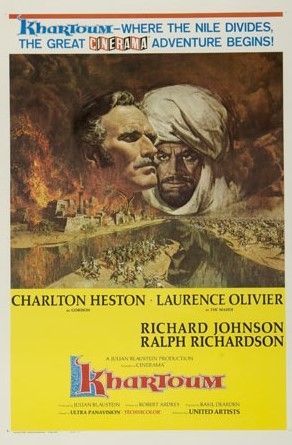
As it is the story is a grand one. Based on historical events, of which, sadly, I’ve never heard a lick of until this film, where the Mahdi attempts to take control of British ran Sudan. The mysterious General Gordan (Charlton Heston) is sent down to help things along. A standoff evolves and it is wit against wit.

It is not a bad film, but neither is it a great one. There are some truly beautiful shots of the scenery. Heston plays Gordan without as much conflict as the character requires, but with enough gusto to make it believable. Olivier is, as always, near perfect. With simple facial expressions, he carries the convictions of a man who believes himself a prophet. The scenes between Olivier and Heston, though historically inaccurate, add a much-needed emotional punch. The direction is a bit plodding, nothing particularly bad, but nothing exceptional either.

When watching historical films such as Khartoum, having some connection with the actual events helps bring meaning to the picture. Films based on the holocaust are often forgiven some of their cinematic sins due to the weight of the history behind the story. Yet, historical films that are not as well known can also entrance the viewer through the weight of their story. Knowing that the events actually happened often stir the viewer to greater emotional depths than a depiction of completely fictional events. It is here that Khartoum failed for me. As I said there was nothing particularly wrong with the production, but it never really captured my emotions. Admittedly I know very little about British history or the struggles of the Mid East beyond the years of my own life. This is a fault of my own, yet a film should be universal in its undertaking. If it fails to move an audience unfamiliar with its history then it will likely fall into obscurity. For those familiar with this particular history, the film may bring more to you than it did me. As for me, it was a mostly entertaining, and an interesting couple of hours in my life, it will be one that will largely be forgotten in time.

Story Number 1

The following is the first story I told to Ann after the lecture and our agreement that storytelling would be the best way for me to improve my language skills. It is first not so much because it is the best, but because is easy to tell with my limited vocabulary.

Several years ago I was driving from Montgomery to Tuscaloosa, Alabama. I was driving my old ’92 Volkswagen Fox (the one with a dent in the fender and an odd-colored driver’s side door.) I was accompanied by my friend, who lay asleep for most of the trip. We had miserable driving weather. It was dark, overcast, and raining. It wasn’t the kind of rain that makes you pull over to the side and wait it out. It was the kind that slows traffic, stiffens your neck, and keeps your windshield wipers in turmoil. I simply hate to have the wipers going faster than they need to be. Too slow and you cannot see, too fast and you get that awful skwelk sound of rubber on dry glass.

The normally quick drive took us an additional hour driving. We entered Tuscaloosa and my heart was glad that the drive was nearly over. We were on a heavily trafficked six-lane highway. I was cruising along nicely in the middle lane. I almost always choose the middle lane when driving in cities. You have none of the break riding action you get in the right lane from people entering and leaving the highway. There is also less tailgating from locals who feel they were meant for the race track.

As I said there was a good deal of traffic out that day and we were traveling somewhere near the 40 MPH mark. Suddenly the car in front of me began to fishtail slightly. I pumped my brakes and checked my mirrors to see if I would be able to pass into another lane. No such luck. The fishtailing worsened and the car before me did a 180-degree turn! I was literally looking the driver and passenger square in the eyes.

Those eyes were like saucers, all white. Panic transferred each car like water over a burst dam. Again I darted my eyes to see if I could get out of the way, and again I was met with traffic on each side. I pumped my brakes some more hoping the wet road would not cause me to slide. After a few terrified moments of staring at the people I might die with, the car turned another 180 degrees to face the correct way.

Control was still not with them. A moment later they skidded into the right lane, barely missing another car before they came to an abrupt stop on the embankment. Traffic had slowed during this and I was able to see that the other car’s passengers were ok.

My friend slept through the entire ordeal.