Agatha Christie’s Poirot: Series 13 Review

image host

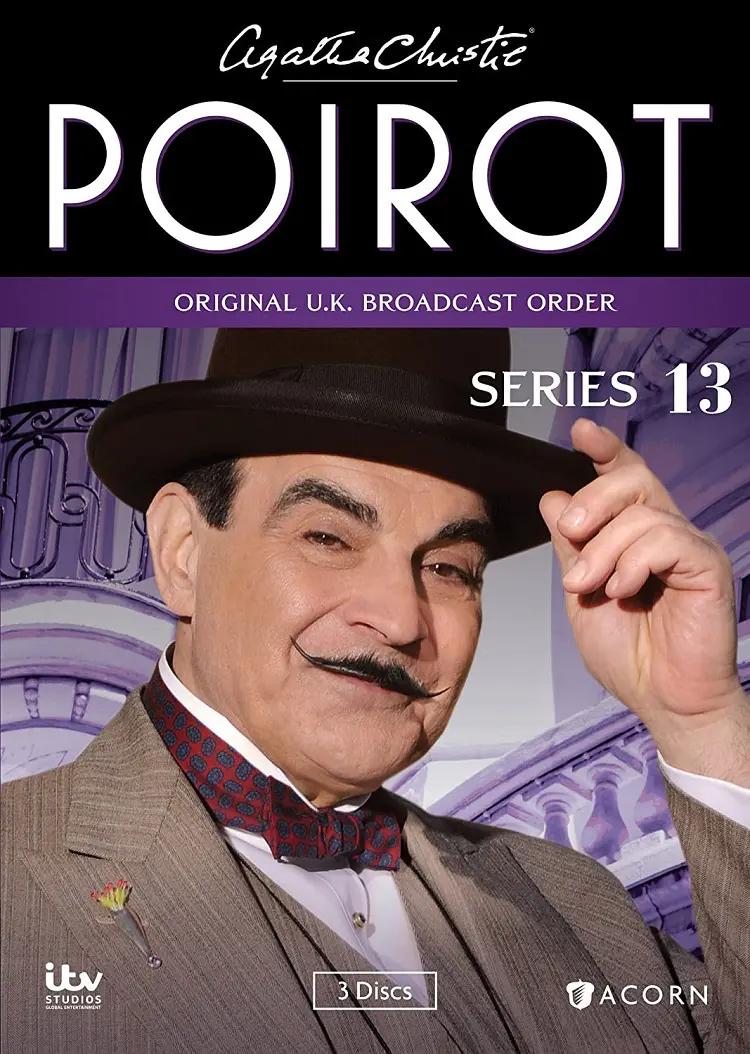
I’ve written about these Poirot movies starring David Suchet before. This is the very last set, containing the very last films with the actor. Nothing went wrong, the actor is very much alive and working (though not as much as he used to – he is 78 after all) nor did the series get cancelled. They simply filmed every Hercule Poirot story Agatha Christie ever wrote. That’s astonishing. You can literally now read every story and then turn on a pretty good adaptation of it.

You can read my full review of this set here.

Murder Mysteries in May: Murder Most Foul (1964)

poster
Margaret Rutherford played Miss Marple, the Agatha Christie crime solver, in four films (well, technically she has an uncredited cameo in The Alphabet Murders, but it’s just a gag). I’ve seen three of them and they are all delightful.

Murder Most Foul is the third film in that series. It finds Miss Marple on the jury in a murder case. One in which everyone thinks the man on trial is guilty. Even the judge pushes for a guilty verdict. But Marple has her doubts. So much so that she hangs the jury.

Naturally, she investigates. Clues lead her to a theatrical troupe (who have just performed a mystery based on an Agatha Christie story, Murder She Said – which was the first film in this series). She suspects the dead girl was blackmailing an actor in the troupe. Naturally, she finds a way to join them.

As always with this type of thing the cast is an eclectic group, each with their own secrets and possible motives for murder. Marple does her best to snoop them out.

Margaret Rutherford plays Marple as an eccentric, dotty old lady, who loves murder mysteries and uses her knowledge of them to solve real-life ones.

I think I liked Murder She Said slightly more than this one, though I’d put it on par with Murder at the Gallop. Though they do tend to get jumbled up in my mind. They are all very slight, but thoroughly enjoyable.

Murder Mysteries in May: The Alphabet Murders (1965)

poster

The challenge for anyone adapting a murder mystery originally written many decades ago is how to make it relevant to modern audiences. All too often there is a need to remove racist, sexist, or homophobic content. Famously Agatha Christie wrote a novel that she originally titled Ten Little N—- (after an old minstrel song that plays an important part in the plot). Even in 1940, Americans knew this title was unacceptable and it was redubbed And Then There Were None for its US release. For a while, it was renamed Ten Little Indians in most markets (and there are at least a couple of movie adaptations with that title), but these days everyone has changed it to And Then There Were None.

But beyond dealing with words and ideas that are no longer acceptable, adaptations must decide if they want to keep the original time period or update it to modern times. Are there language or plot points that now seem archaic? Etc. and so forth.

The Alphabet Murders, based on an Agatha Christie novel from 1936, chose to modernize the story in every conceivable way. The film is so very 1960s it hurts.

It begins with Tony Randall playing Tony Randall an actor who is about to star in the film we are about to watch. He winks at the camera and introduces the film. Then with a flash of editing, he’s changed into Hercule Poirot the famed Belgium detective. But he’s still winking at the camera and telling us to leave him alone. For he is in London and surely no crime will follow him there.

The rest of the film has that same winking, and cuteness to it, though no one else breaks the third wall. There is more than a little Inspector Clouseu to Randall’s portrayal of Poirot and it should be noted that the Pink Panther series was two films into its run by this point, and quite successful.

I’ve never read the book – got a few chapters in and then got distracted, nor seen any of the other adaptations of it (I’ve seen bits and pieces of a couple of them – maybe this story just doesn’t grab me like it should) but from what I do know this is a very loose adaptation of the novel. Here some serial killer is murdering people who have the same letter for both of their initials and is doing so in alphabetical order.

But the mystery takes a back seat to the comedic shenanigans and the comedy just never works. The setting and the look of the film are all swinging in ’60s London which is fun, but strange for a Poirot movie. Robert Morley is Hastings, a recurring character in Christie’s novels. He normally acts as a Dr. Watson-type character to Poirot’s Sherlock Holmes, but here he’s an English copper who does not know Poirot at all.

I suppose if you know nothing about Poirot and are looking for a silly 1960s crime story then this might work for you. But as someone who has seen many Poirot adaptations, this just fell flat for me.

Great British Cinema: Murder She Said (1961)

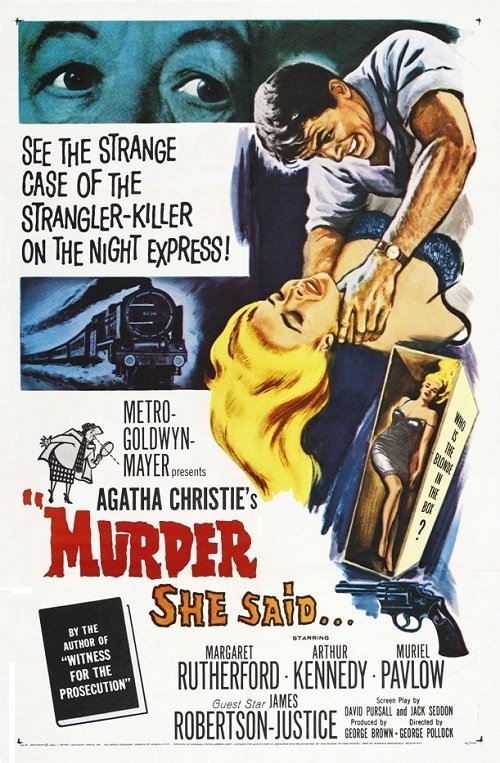
murder she said

I love me a good detective story. Though I write a lot about horror movies the genre I find myself watching more than others is crime stories. There is something pleasurable about watching someone solve a murder.

Officially, I am on the side of Raymond Chandler and the school of the hard-boiled detectives. I like my crime dark and dirty, violent and real. Bloodless murders happening in the parlor rooms of rich and genteel classes are a little bit too silly for my liking. Especially when they conclude with a rounding up of all our suspects into one room while the detective susses out the culprit.

But sometimes, that’s exactly the sort of thing I need.

I’ve only read a few Agatha Christie novels, all of them Poirot, but I’ve seen quite a few cinematic and television adaptations of her stories (most of them Poirot) and I consider myself a fan.

Murder, She Said was the first screen adaptation of a Miss Marple story, and it is delightful.

It begins with Miss Marple (Margaret Rutherford) on a train. Another train crosses on a parallel track. Miss Marple watches the other passengers on the other train – an elderly man embarrassed that she sees him, a young girl who sticks out her tongue, and a woman getting strangled to death.

Miss Marple immediately informs the conductor who, when he spies the mystery novel she’s reading, believes she’s made it up. She makes him notify the police anyway, but they find nothing. They stop the train at the next station and can find no corpse. No body equals no murder and so they drop the matter.

Miss Marple, naturally, investigates.

She grabs a friend, Jim Stringer – a local bookseller and mystery enjoyed – and they walk the tracks around the area where she witnessed the murder. When they see some tracks made by what could be a dead body being dragged across the ground and trace them to Ackenthorpe Hall, Miss Marple finds a job there as a maid.

What follows is your standard Agatha Christie-type investigation. The Ackenthorpes are an odd bunch. She must do her duties as a maid, while still asking discreet questions and wandering around the grounds. There is a cute, clever boy who helps her, and lots of clues to be found.

It is handled very lightly, and often very humorously. Margaret Wutherford is just wonderful. She reminded me a lot of Angela Lansbury in Murder She Wrote. And considering how close that series title is to this film, I expect that is no coincidence. Wutherford is bold and clever, strong but vulnerable.

It works as both a good mystery and a comedy of manners. I loved it.

Poirot: Series 9

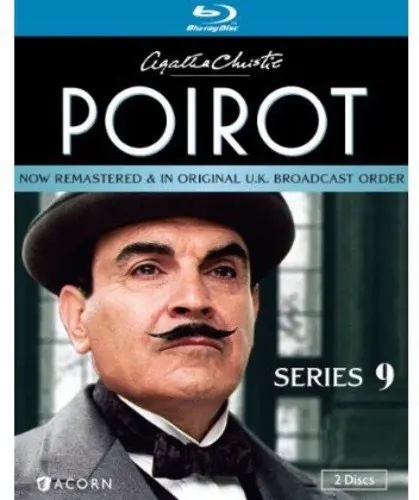
poirot series 9 blu-ray

I love a good cozy television mystery. There is something comforting about sitting down on the couch and watching a smart detective solve a murder week after week, episode after episode.

I’m not actually the biggest Agatha Christie fan, at least not in terms of actually reading her actual books. But I do enjoy many of the films and television series that have been based upon her works, and Poirot, the BBC series starring David Suchet is one of the best.

Suchet so perfectly embodies the Belgian detective I find it difficult watching anybody else play the role now I’m pretty sure Series 9 was the first time I really sat down and watched this series. It was definitely the first time I ever reviewed one (I’ve reviewed a few others since then.)

You can read that review here.

Rambling About Mysteries

Editors Note: The first couple of paragraphs of this post talk about a counter that I no longer have installed on the site. I’m keeping them up because some comments refer to it, and ultimately I want to keep almost everything I’ve written on this site to stay up as a sort-of historical marker to my thoughts.

Made a few changes to the site. Added a permanent link in the sidebar to a posting about the books I have read since coming to France. For the last several years I have meant to start keeping track of the books I read in a given year, but never do a good job of it. I believe this blog will help me do the trick. If I get real good I might actually review/rate them as I go along. If people seem to like it I just might add movies and music to the list as well.

My counter (which is now set to produce random numbers on the actual blog site, but give me real numbers by logging in) from bravenet.com has some sort of referral program with it. It says it is supposed to bring a lot of new hits to my site. It is pretty vague about how it does it and I’m thinking it  probably has to do with pop-up ads. Since my IP address is disallowed from the program I’m gonna need some help. If you are getting pop-ups when you go to my blog please let me know. If that is the method of getting more hits, I’d rather find a better way. Pop ups stink!

Anyway to get along with the subject of this blog. I have been trying to read some of the classics of the mystery genre. Or more literally the detective subgenre of the mystery genre. The three main writers I have been reading in this subgenre are Raymond Chandler, Dashiell Hammett, and Agatha Christie. All three are very good writers in their own right, but whom bring something different to the genre.

I first started reading Dashiell Hammett because I had heard more about him through the film The Maltese Falcon (1941 )and he was purportedly a big influence on the Coen Brothers. I have read all of his novels: The Maltese Falcon, Red Harvest, The Glass Key, The Dain Curse, and the The Thin Man. Each one is original and very different stylistically. It’s as if he intentionally wrote each novel as a different sub-sub genre. Red Harvest uses the unnamed Continental Op (who was the main character in many of his short stories as well as The Dain Curse) as a prototypical hard-boiled private-eye to tell his story. This character uses allegiances in two rival gangs to clean up a small city while trying not to go “blood simple” (excited to the point of amorality by excessive violence). The Coen Brothers were highly influenced by this book using blood simple as the title of their first movie, and many of it’s plot points in their gangster movie, Miller’s Crossing (1990). It also influenced other films such as Akira Kurasawa’s Yojimbo (1961), Sergio Leone’s A Fistful of Dollars (1964), and many more.

Hammett’s The Dain Curse again uses the Continental Op as his story teller but this time he is entwined in an episodic, melodramatic mystery. Its plot is as convoluted as it gets involving stolen jewels, drugs, a religious cult, and murder to name a few things. It’s also my least favorite of Hammett’s novels.

In The Maltese Falcon, Hammett turns things right again. Though everyone remembers Sam Spade as being portrayed by Humphrey Bogart in the 1941 John Huston picture. There were actually two other movies based on the novel (1931’s Dangerous Female and 1936’s Satan Met a Lady) that were lackluster at the box office. Bogarts portrayal of the hardboiled, but sensitive at heart private eye made him a star. That picture is pretty much spot on with the novel. Both are considered classics of the genre. The subgenre for Hammett here is the quest story with a wild assortment of characters. Sam Spade is our detective hero sorting through classic oddballs to find the mysterious, and very valuable bird of the title. For beginners into Hammett’s writings (or for detective stories in general) this is an excellent place to begin.

The Glass Key is a political drama without much of a detective in sight. Oh, it’s still dark and cynical as all get out, but it deals more with the corruption of city officials than any murder mystery. It also was a great influence on Miller’s Crossing and was made into a very good film noir of the same name in 1942.

The Thin Man is a more comic tale than any of his other work. Detectives are back this time in the guise of socialite Nick Charles and his wife Nora. Here Hammett plays up the high society couple as snoopers subgenre. When the Charles aren’t tossing back martinis and hob-nobbing with the rich they are solving murders. Hollywood came calling again with this one and created a whole series of Thin Man pictures starring William Powell and Myrna Loy.

***

Agatha Christie is probably the most well-known of the classic mystery writers. She wrote some 60 stories in her lifetime, most of which starred the eccentric, genius Belgian detective Hercule Poirot (Yes, I am now fully aware Christie wrote many books with other detectives including Miss Marple – Mat). I have only begun reading her novels having just finished Murder on the Orient Express and Death on the Nile. These novels are excellent representations of the “whodunit” version of the detective crime novel.

She masterly develops setting, imaginative characters and then deals in a murder or three. Clues are paced throughout in what has become a cliched manner. Though Christie has been imitated by umpteenth followers, nobody has topped her style. I typically do not enjoy mysteries because they follow a pattern Christie seems to have invented. The genre has gone stagnant with so many plots following the same pattern.

Odd-ball characters gather in a stylish setting. A murder is committed and then the reader is led down a path (often the wrong one) following a series of clues leading to the final scene where everyone is brought together and the mystery is explained. Christie follows this almost to a tea in both the Orient Express and Murder on the Nile. Yet, somehow she makes it all seem fresh. Her characters are inventive and thoroughly interesting. Hercule Poirot is the perfect detective. Smart, sensitive, and eccentric. And the following of clues is never too clever or too dull to drive me crazy. There are films based on both the books I’ve mentioned here as well as many of her other novels.

****

Raymond Chandler deserves a genre of his own. All of his novels feature the same main character, Phillip Marlowe. Marlowe is as hardboiled as they come. Dark, cynical, sarcastic, tough, and funny in a sick sort of way. There is almost always a murder (sometimes several), and plenty of drinking, smoking, and sometimes sex. Yet his stories are not so much about solving a crime as it is an insight into a certain time, in a certain place with certain characters. He dwells in the seedier, darker places of the American cities, and the human soul. His stories are never pretty, but often beautiful. I would hold up any of his novels high in the canon of literature.

My favorite novel of Chandler’s that I have read was also made into an excellent Humphrey Bogart picture, The Big Sleep. Other novels of his that I have read include The High Window, The Lady in the Lake, and Farewell, My Lovely. All of them are well excellent and an excellent introduction into the detective mystery genre.

“”Tall, aren’t you?” she said.
“I didn’t mean to be.”
Her eyes rounded. She was puzzled. She was thinking. I could see, even on that short acquaintance, that thinking was always going to be a bother to her.”
—The Big Sleep (Chapter 1)

“I’m an occasional drinker, the kind of guy who goes out for a beer and wakes up in Singapore with a full beard.”
–The King in Yellow

Anybody who can write dialogue like that is well worth a read in my book.