
The Friday Night Horror Movie: Frankenstein (2025)

frankenstein

I don’t believe I’ve ever read Mary Shelley’s novel Frankenstein; or, The Modern Prometheus, but I have seen several different cinematic adaptations of it. I’ve seen the 1931 film with Boris Karloff, of course, and all the sequels from Universal. I’ve seen several of the Hammer Studio versions and that one from the 1990s with Robert DeNiro. I guess it is safe to say I like the story, or perhaps I just like the monster.

Guillermo del Toro is a director whom I like but don’t really love. He’s an incredibly creative creator, and his films have an amazing visual style, but his stories rarely do it for me.

I don’t know why I tell you these things except that I guess when a beloved director takes on a beloved story, it feels like I should begin by expressing my feelings toward both things before I tackle how I feel about their collaboration.

For del Toro’s part, he’s apparently loved the story for decades and dreamed of making his own adaptation of it. I am reminded of Martin Scorsese’s The Gangs of New York, which was likewise a film the director had wanted to make for decades, yet when he finally got to do it, the film was compromised and became far less than his greatest film and presumably fell far from his aspirations.  I don’t know if del Toro’s film was compromised by Netflix or anyone else, but the end result is overlong and overstuffed, and if it were to be given a subtitle like the novel, it might go something like this: Frankenstein; or, Be Careful What You Wish For.

The good news is the film looks absolutely amazing, even via streaming. Del Toro’s visual sensibilities have never been stronger. Frankenstein’s castle is a maze of gothic sensibilities and steampunk technology. The exteriors exist with beautiful mountain-strewn landscapes that made me want to grab my passport and head for the mountains of Eastern Europe. The acting is good across the board, especially Oscar Isaac as Victor Frankenstein and Jacob Elordi as the monster. And I always love to see Mia Goth in anything.

The problem, then, lies in the story. As I mentioned, I have not read the book, so I have no idea if this version is more faithful than the films I’ve seen, or less. It begins with a prelude. On an ice strewn sea somewhere,  a ship full of Russian sailors is desperately trying to break through the ice and make it to the North Pole.  They hear a noise and see flames rise somewhere toward the horizon. They run in that direction and find Victor Frankenstein badly wounded, near death.

Then the monster comes.  It is fierce and dangerous and apparently impervious to bullets. It kills many men and screams Victor’s name. The sailors manage to get Victor aboard the ship and blow up the ice around the monster, sinking him into the frozen abyss. 

Victor then tells the captain his tale, which makes up Part 1 of the film. It is more or less the story we all know. We do get a little more backstory on Victor. We see him as a child being taught by a demanding father (a wonderful Charles Dance) and being doted on by his mother.  Then one by one her parents die, and he becomes estranged from his brother. 

He becomes a doctor with wild ideas about life and death and is shunned by the community. He meets Henrich Harlande (Christoph Waltz), who is intrigued by his ideas. He gives him all the funding and supplies he needs and sets him up in an isolated castle. 

He makes the monster but is disappointed when he doesn’t seem intelligent. The estranged brother comes back, and with him his fiancée, Lady Elizabeth Harlander (Mia Goth,) whom Victor falls in love with. It is Elizabeth that sparks the humanity inside the monster. Still, Victor tries to destroy him.

Part II picks up from there and tells the monster’s side of the story. He survives Victor’s murder attempt and flees to the forest. There he is taken in by a kindly, blind, old man (David Bradley) and learns to read and about friendship. Eventually he must leave, for he knows he cannot die, and he desires a companion. A companion only Victor Frankenstein can create. Slowly we’ll be brought back around to the prelude, and finally the film’s end.

It isn’t that the story is bad, but perhaps that it has been told too many times before, so it can no longer be made interesting. Del Tor does try. He keeps some things familiar but adds many other things, and even the familiar ones he plays with. But at 2 and a half hours, it is far too long and has far too many parts that just drag. 

One wonders if del Toro is too big of a name now that no one was willing to tell him “no.” With pet projects like this, sometimes that’s exactly what you need.  It is well worth watching for the acting and the stunning visuals. I just wish the story they are telling was more worthy of the artistry behind it.

The Friday Night Horror Movie: Frankenstein Created Woman (1967)

cover

Hammer Studios made a name for themselves in the 1960s and 1970s by remaking and updating the classic Universal Horror Monster Movies. They were stylish and full of wonderful sets. They were more violent and sexy than those classic films, though they come out looking fairly tame by today’s standards.

They made numerous Dracula, Frankenstein, and Mummy films (I don’t believe they ever made an Invisible Man or Creature from the Black Lagoon film), most of which starred Christopher Lee and/or Peter Cushing. I’ve talked about a few of them in these pages. I have a great fondness for them all.

Frankenstein Created Woman was the fourth film in Hammer’s Frankenstein series (there would be seven in total.) It is a bit of a strange one in that it doesn’t seem to have much of a connection to the other films other than Peter Cushing playing Victor Frankenstein, and him continuing to be a mad scientist.

Here he isn’t so much reanimating freshly dead corpses, but capturing the souls of the recently deceased and placing them in fresh bodies. It is also strangely, almost accidentally progressive.

It opens with Frankenstein lying dead in a sort of deep-freeze coffin. He’s been dead for exactly one hour and at that precise moment, his assistant Dr. Hertz (Thorley Walters) resuscitates (or resurrects?) him. This proves to Frankenstein that a person’s soul does not immediately leave the body at death. Something he surely must experiment with.

Meanwhile, his other assistant, Hans (Robert Morris) is having a love affair with Christina Kleve (Susan Denberg) a woman who is disfigured and whose body is partially paralyzed.

Soon enough he’ll find himself being guillotined for a crime he didn’t commit and she’ll commit suicide shortly thereafter.

Naturally, Frankenstein takes this as an opportunity to capture the soul of Hans and put it into Christina’s body. This is where the film gets accidentally progressive. It apparently doesn’t occur to our friend Baron Victor Frankenstein that putting a male soul inside a female body might be considered strange (I mean stranger than reuniting a dead person). He doesn’t seem to consider it at all. For a brief moment, Hertz raises the question but it shuts down with a singular word from Frankenstein.

The film doesn’t really do anything with the concept after that either. There aren’t any moments where Hans’ soul is questioned about what it is like inhabiting a woman’s body or anything of the sort. No one ever mentions the fact that he could have simply resurrected Christina without Hans’ soul and his experiment would have still been a success.

Frankenstein also fixes all of Christina’s ailments (well, technically Hertz does the actual surgeries as Frankenstein’s hands no longer work – something I think that happened when he was frozen). She can now walk properly and her face is beautiful. No one questions why he didn’t do this while she was properly alive. That would have actually been something the entire community could get behind.

Anyway…

The two souls seem to exist simultaneously. Christina is more or less in control, but she hears Hans talking to her – he mostly screams at her to kill the people who committed the crime that got him executed.

It is a strange entry into the Frankenstein universe. There isn’t really a monster, just a nice girl who gets her dead lover’s soul implanted inside her body. Even after she (or they) start a murder spree the film is on their side. It seems to justify their crimes since the people getting killed were jerks in the first place.

So she’s not really a monster. There aren’t any townspeople with pitchforks, and Frankenstein isn’t all that involved in his own movie. We spend more time with others, developing relationships than with Frankenstein in his lab.

But it kind of worked for me. I am a great fan of these Hammer Horror films. They are often rather slow and meandering, but there is something I just love about them. This is no exception.

You can stream the film for free on the Internet Archive.

31 Days of Horror: Frankenstein (1931)

frankenstein

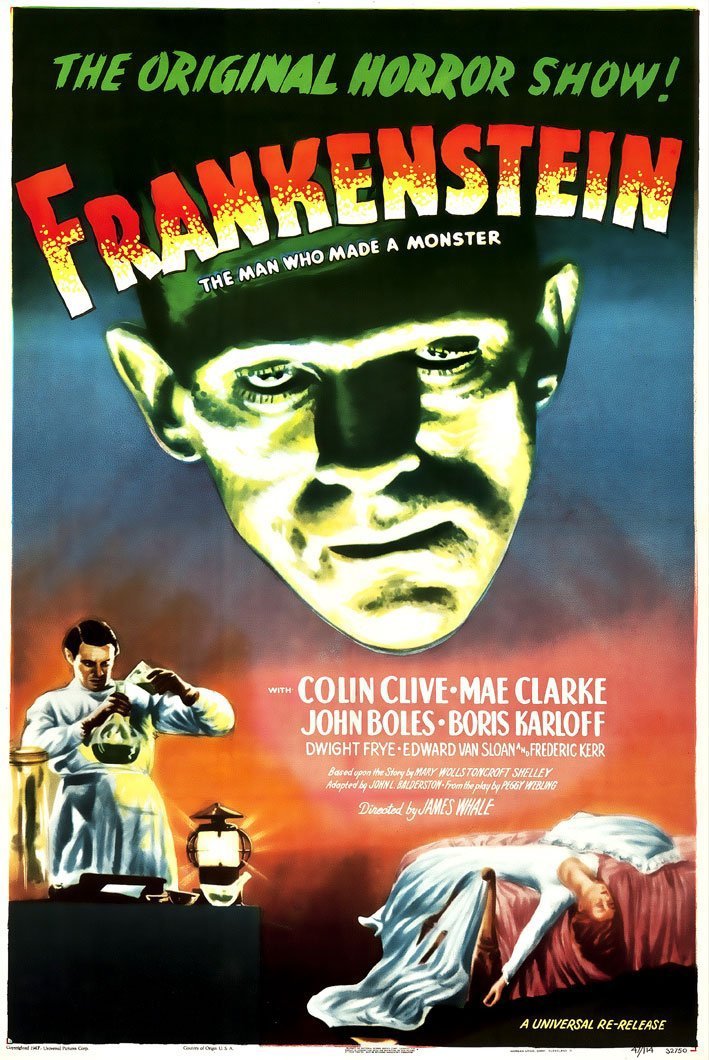
My wife is not a fan of horror movies, at least not the blood-soaked, gore-filled variety and so every once in a while I throw on an older film and we watch them together. I can’t remember the first time I watched Frankenstein. It is such a part of the culture I probably saw parodies of it before I ever actually watched the film. I’m pretty sure I watched Young Frankenstein (1974) before I watched the original.

Whenever I watched it first, I have seen it many times since. It is a genuine classic. Frankenstein (or technically Frankenstein’s Monster) is my favorite of the Universal Horror Monsters. I actually prefer the sequel, Bride of Frankenstein (1935), slightly more than this one, but they are both terrific.

Young Frankenstein is one of my all-time favorite comedies and I’ve probably watched it more than any of the original films. So much so that it is a little difficult to watch the original because my mind always goes back to the comedy. I find myself muttering the jokes to myself and anticipating certain sight gags. When the Monster meets the young girl, for example, I’m confused when they don’t play on a teeter-totter.

But really, this is a great film and if you haven’t seen it I highly recommend it, even if you don’t like horror.

Frankenstein Meets The Wolfman (1943)

frankenstein meets the wolfman poster

I’d like to say that I grew up going to the Midnight Movies and staying up to watch the old Universal horror movies on television. I’d like to say that, but I can’t because, well, because it simply isn’t true. I grew up watching movies from my generation, the 80’s, and that means the Goonies, Gremlins, Ghoulies, and others that don’t start with the letter “G.’ It has only been recently that I have dipped into the classics of horror and began watching them.

There has been a recent spat of high-quality DVD releases of the mainstays of the franchise – Dracula, Frankenstein, and the Wolfman – and I’ve filled my till with the magic, the brilliance that is those films. So, it was with pleasure that I recently found a VHS copy of Frankenstein Meets the Wolfman.

To say this is a great movie would be missing the point and make me think you were delusional. It’s far from anything anyone ought to call great, but it’s still a pretty fun bit of horror history.

The title is a little misleading – well not technically so since Frankenstein does in fact meet the Wolfman – but a picture like this makes one think they will either be locked in mortal combat for the entirety of the picture or team up to destroy some other force, like Dracula for instance.

More to the point it is something of a character study for the Wolfman as he is awakened from his grave and has to come to terms with his moonlight alter-ego. It is late in the film when he manages to come across Frankenstein’s castle and a frozen monster inside. The monster is awakened and wreaks havoc before coming to a not all too engrossing close.

The film has a good atmosphere and the sets are marvelous, but it never gets fully off the ground. There just doesn’t seem to be enough plot to keep the story moving, as it often plunges into a dulldrom.

Definitely worth checking out for classic horror fans, but not the first place to stop.