The Friday Night Horror Movie: Frankenstein (2025)

frankenstein

I don’t believe I’ve ever read Mary Shelley’s novel Frankenstein; or, The Modern Prometheus, but I have seen several different cinematic adaptations of it. I’ve seen the 1931 film with Boris Karloff, of course, and all the sequels from Universal. I’ve seen several of the Hammer Studio versions and that one from the 1990s with Robert DeNiro. I guess it is safe to say I like the story, or perhaps I just like the monster.

Guillermo del Toro is a director whom I like but don’t really love. He’s an incredibly creative creator, and his films have an amazing visual style, but his stories rarely do it for me.

I don’t know why I tell you these things except that I guess when a beloved director takes on a beloved story, it feels like I should begin by expressing my feelings toward both things before I tackle how I feel about their collaboration.

For del Toro’s part, he’s apparently loved the story for decades and dreamed of making his own adaptation of it. I am reminded of Martin Scorsese’s The Gangs of New York, which was likewise a film the director had wanted to make for decades, yet when he finally got to do it, the film was compromised and became far less than his greatest film and presumably fell far from his aspirations.  I don’t know if del Toro’s film was compromised by Netflix or anyone else, but the end result is overlong and overstuffed, and if it were to be given a subtitle like the novel, it might go something like this: Frankenstein; or, Be Careful What You Wish For.

The good news is the film looks absolutely amazing, even via streaming. Del Toro’s visual sensibilities have never been stronger. Frankenstein’s castle is a maze of gothic sensibilities and steampunk technology. The exteriors exist with beautiful mountain-strewn landscapes that made me want to grab my passport and head for the mountains of Eastern Europe. The acting is good across the board, especially Oscar Isaac as Victor Frankenstein and Jacob Elordi as the monster. And I always love to see Mia Goth in anything.

The problem, then, lies in the story. As I mentioned, I have not read the book, so I have no idea if this version is more faithful than the films I’ve seen, or less. It begins with a prelude. On an ice strewn sea somewhere,  a ship full of Russian sailors is desperately trying to break through the ice and make it to the North Pole.  They hear a noise and see flames rise somewhere toward the horizon. They run in that direction and find Victor Frankenstein badly wounded, near death.

Then the monster comes.  It is fierce and dangerous and apparently impervious to bullets. It kills many men and screams Victor’s name. The sailors manage to get Victor aboard the ship and blow up the ice around the monster, sinking him into the frozen abyss. 

Victor then tells the captain his tale, which makes up Part 1 of the film. It is more or less the story we all know. We do get a little more backstory on Victor. We see him as a child being taught by a demanding father (a wonderful Charles Dance) and being doted on by his mother.  Then one by one her parents die, and he becomes estranged from his brother. 

He becomes a doctor with wild ideas about life and death and is shunned by the community. He meets Henrich Harlande (Christoph Waltz), who is intrigued by his ideas. He gives him all the funding and supplies he needs and sets him up in an isolated castle. 

He makes the monster but is disappointed when he doesn’t seem intelligent. The estranged brother comes back, and with him his fiancée, Lady Elizabeth Harlander (Mia Goth,) whom Victor falls in love with. It is Elizabeth that sparks the humanity inside the monster. Still, Victor tries to destroy him.

Part II picks up from there and tells the monster’s side of the story. He survives Victor’s murder attempt and flees to the forest. There he is taken in by a kindly, blind, old man (David Bradley) and learns to read and about friendship. Eventually he must leave, for he knows he cannot die, and he desires a companion. A companion only Victor Frankenstein can create. Slowly we’ll be brought back around to the prelude, and finally the film’s end.

It isn’t that the story is bad, but perhaps that it has been told too many times before, so it can no longer be made interesting. Del Tor does try. He keeps some things familiar but adds many other things, and even the familiar ones he plays with. But at 2 and a half hours, it is far too long and has far too many parts that just drag. 

One wonders if del Toro is too big of a name now that no one was willing to tell him “no.” With pet projects like this, sometimes that’s exactly what you need.  It is well worth watching for the acting and the stunning visuals. I just wish the story they are telling was more worthy of the artistry behind it.

31 Days of Horror: Castle of Blood (1964)

castle of blood

Alan Foster (Georges Rivière), a journalist meets Edgar Alan Poe (Silvano Tranquilli) at a pub. In the film’s reality, Poe is not a writer of fictions, but a documentarian of actual supernatural occurrences. He tells Foster this, but the journalist is a skeptic. Poe makes him a bet that he cannot spend the night in a haunted castle. Foster agrees.

Once there he is accosted by the usual haunted house trappings – spooky noises, candles getting blown out, strange sounds, and paintings that seem to stare back at him.

Then the ghosts come.

Luckily two out of the three ghosts are beautiful women (Barbara Steele and Margarete Robsahm), the other is a handsome, musclebound man. They were each murdered on the premises sometime in the past and now, once a year they must take the soul of a living human in order to remain in existence.

Ah, but Barbara Steele’s character falls in love with our hero and decides to help him survive the night, even though that will mean her own destruction.

Castle of Blood is pretty light on plot, but oh is it heavy on atmosphere. The camera investigates and lingers on every gothic inch of the castle. It is cobweb-filled, shadow-dense, and incredibly creepy. It longingly gazes at Barbara Steele who has a face custom-built for films like this. She is both incredibly beautiful and eerily terrifying.

This is the type of horror film my squeamish wife can watch with me. It is exactly the type of film I love.

The Friday Night Horror Movie: House of Usher (1960)

house of usher poster

As a producer, Roger Corman helped launch the careers of Francis Ford Coppola, Martin Scorsese, Jack Nicholson, Peter Bogdanovich, and Jonathan Demme. His films were very low-budget, often exploitive, but they almost always made money. He famously developed a strategy as a producer and distributor that allowed directors to have full creative control (within budget, of course) as long as they had a scene of violence and/or sex every fifteen minutes.

He’s produced an astonishing 512 films in his life (and at the age of 96 IMDB lists at least one upcoming project with his name on it). And though with a few exceptions, he stopped directing in the early 1970s he managed to helm over fifty films.

The most famous of those films are a series of eight films (very) loosely based on the writings of Edgar Allan Poe. House of the Usher was the first of those adaptations. It is a good one.

Phillip Winthrop (Mark Damon) travels to the titular House of Usher, a grand, decaying, gothic old mansion, to visit his fiance Madeline Usher (Myrna Fahey). He is told by the family butler, Bristol (Harry Ellerby) that she is very ill and bedridden. When he demands to see her anyway he is taken to see her brother Roderick (Vincent Price)

Roderick is afflicted with an illness that enhances all of his senses so that the slightest noise, or light, or rough surface drives him to near madness (well, as we’ll see later to total madness). He says his sister is afflicted with the same illness and tells a tale of their entire bloodline being infected with madness so intense it has affected the house itself.

He begs, no he demands that Phillip leave the house but he refuses. This only serves to drive Roderick further into madness and in turn, he drives Madeline to the very edge. Roderick is so intent in his belief that Madeline should not leave the house, nor marry, nor have children that he is prepared to murder her himself.

Corman makes great use of his sets. The mansion is sprawling with a seemingly endless set of rooms, hallways, and secret corridors. As Roderick’s insanity grows the house begins to crumble.

I’m used to watching gothic horror films being shot in stark black and white with great shadows overcoming the scenes, so it is surprising to see this in full, glorious color. It looks magnificent. There is a dream sequence toward the end that is saturated in color and even a bit psychedelic.

Mark Damon is a bit stiff, and Myrna Fahey is just ok, but good golly is Vincent Price great in this. I’m a huge fan of the actor and he’s full-throttling the role as only he can but it works oh-so-well here.

It is a bit slow to get going as these types of gothic melodramas can be, but once it gets into gear it’s a great deal of fun to watch.

The Friday Night Horror Movie: The Whip and the Body (1963)

the whip and the body

At an isolated castle in the 19th Century, on some isolated European coast, Kurt (Christopher Lee), the prodigal son returns. There is no fatted calf for this son though, as his father (Gustavo De Nardo) is unwilling to forgive his many trespasses. The most treacherous of which was seducing the maid’s daughter and then leaving her, causing her to commit suicide in his wake.

The maid, Giorgia (Harriet Medin) has vowed her revenge a hundred times over, and there is no lost blood between him and his younger brother Cristiano (Tony Kendall). Thus when Kurt turns up murdered, there are plenty of suspects.

Nevenka (Daliah Lavi) who had been engaged to Kurt before the whole maid’s daughter incident occurred, and is now married to Cristiano, begins seeing visions of Kurt whenever she turns. When more bodies start to drop the rest of the family begins to wonder if he hasn’t returned from the grave to seek his revenge.

Mario Bava was one of the great Italian horror directors. He was a pioneer of gothic horror and his film Blood and Black Lace (1964) is often credited as the first Giallo film ever made. Bava began his career in special effects, working his way into cinematography before finally directing. His films are noted for their visual beauty and style. When not shooting in stark black and white he made bold use of color.

The Whip and the Body makes great use of its gothic setting and tropes. The design of the castle in which most of the film takes place is as haunting as it is beautiful. The film is simply bathed in purples. It makes use of greens and reds, but bold purple permeates every shot.

As the title implies the sex gets a bit kinky, surprisingly so for a film made in 1963. Nevenka, who in most aspects of her life has to be subservient to the men in her life, takes control of her own sexuality. She hands Kurt a whip more than once and writhes in passion as he uses it on her. She married Christiano, because that’s what she was suppossed to do, but it is Kurt she truly loves. It is Kurt she continues to long for and envision even after his death (Or did he fake that? Or has his ghost returned from the dead? The film has fun toying with those ideas).

I’m making it sound more exciting than it is. The Whip and the Body is more of a gothic romance/drama than a horror. There is a lot of talking and passionate declarations. Too much for my taste, if I’m being honest. But it is so beautiful to look at, I never much minded.

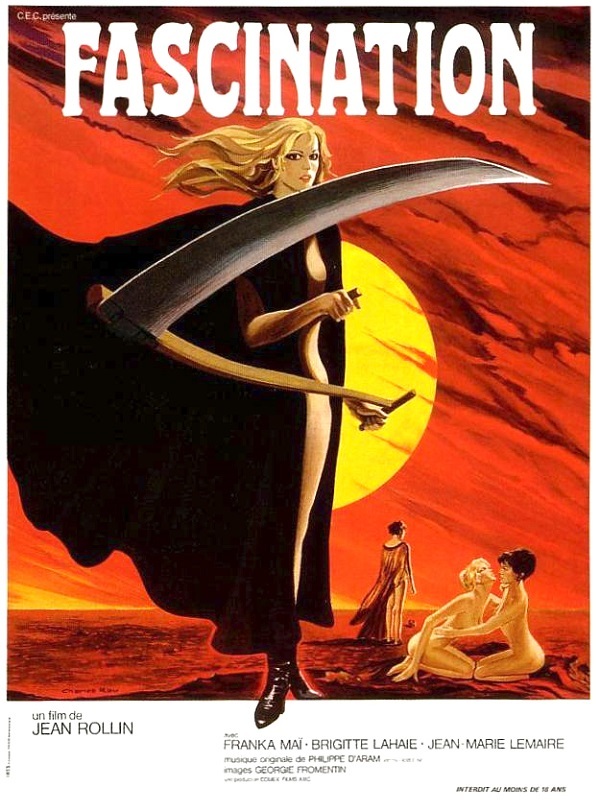
31 Days of Horror: Fascination (1979)

fascination movie poster

French director Jean Rollin is somebody whose name I’ve known for years, but whose films I had never sat down and watched until today. He made a lot of movies in his career but is probably best known for a series of erotic vampire films he made in the 1970s. Fascination is probably his best-known movie.

It is about a man who flees from his fellow villainous compatriots with a bag full of stolen gold. He winds up in a creaky, old, castle where he plans to hide out until the cover of darkness. There he meets two beautiful women clad in flowing white gowns.

Though he has a gun and speaks as if he’s willing to use it the women do not seem afraid. They taunt him and speak elliptically about further friends coming that evening and something sinister happening at midnight. The man doesn’t understand but is attracted to them and so he stays.

More women in flowing gowns arrive and they too play games with the man. I’ve already noted that Rollin is known for his erotic vampire films so you can probably guess where this film is going, though it may actually surprise you.

The film uses the castle, and those flowing gowns, to great effects. This is more a mood piece than a particularly violent horror film. It takes its time getting to where it’s going but it is mesmerizing just the same. Well worth a watch if you enjoy gothic horror and beautiful vampires.

31 Days of Horror: The Blancheville Monster (1963)

blanceville monster poster

This is film #2 of Arrow Videos Italian Gothic Horror boxed set. I’ll be reviewing the entire thing soon so I won’t say much about it here. The Italians were great at taking successful American genres and making them their own. When Roger Corman found success with several Edgar Alan Poe adaptations the Italians started adapting his stories. The Blancheville Monster (also known simply as Horror as seen from the poster) basically rips Corman’s adaptation of The Fall of the House of Usher. The story, about a woman who returns home to her family castle, discovers that everything has changed and that someone (possibly a ghost) is trying to kill her before her 21st birthday, is pretty standard gothic horror story stuff.

But it looks great and contains everything you want – a spooky old castle, creepy shadows, flowing white gowns, and a monster in the attic – from this sort of thing. It isn’t a great film, its own director essentially disowned it calling it “a little film of no importance” but I found it quite enjoyable.

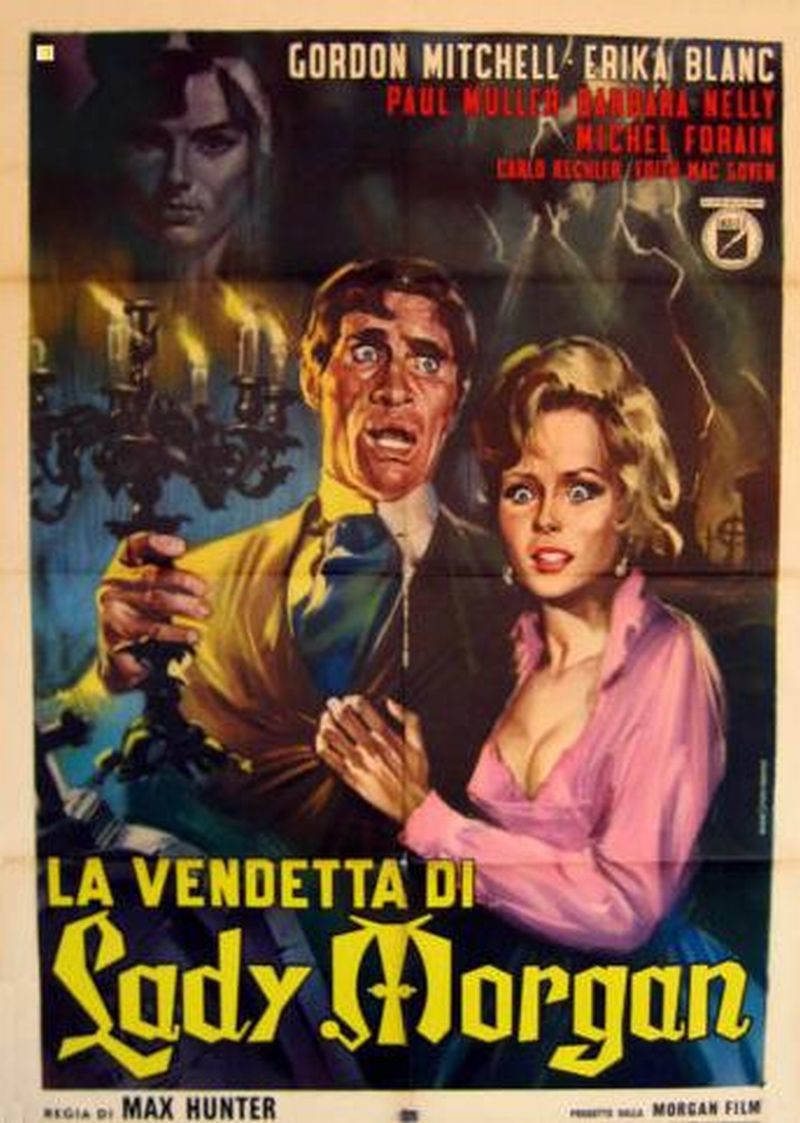
31 Days of Horror: Lady Morgan’s Vengeance (1965)

Lady Morgans Vengeance Poster

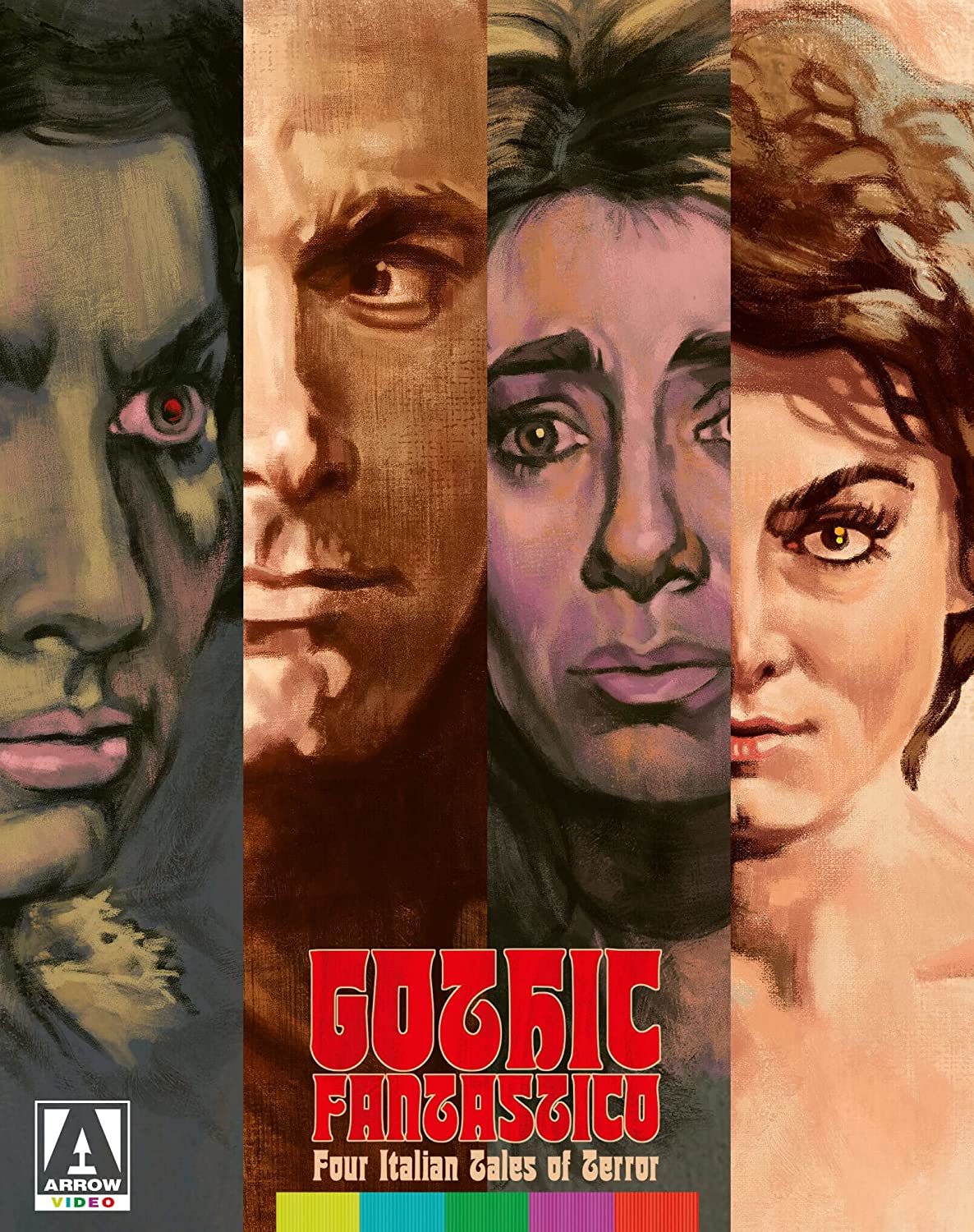
If you paid any attention to my last post then you might have noticed that this film does not appear on my list of horror films to watch this month. That’s because it is part of a four-film boxed set from Arrow Video entitled Gothic Fantastico: Four Italian Tales of Terror which appeared in my mailbox today. I’ll be reviewing the entire set for Cinema Sentries in a few days or so, thus I’ll not say much about it here.

It is a surprisingly good film about a woman who marries a man she doesn’t love and finds herself in an old Scottish castle. Her husband and her staff begin gaslighting her, and she starts seeing spooky things and hearing spooky noises, and then she’s killed. Her ghost seeks some pretty fun revenge on those responsible for her death. I’d say that was a spoiler but those details you’ll find on the back of the box so it isn’t really a surprise.

I love a good gothic horror story and this has plenty of creeping sets, shadowy lighting, and billowy gowns. It is definitely worth checking out if you are into that sort of thing.