31 Days of Horror: The Killer Reserved Nine Seats (1974)

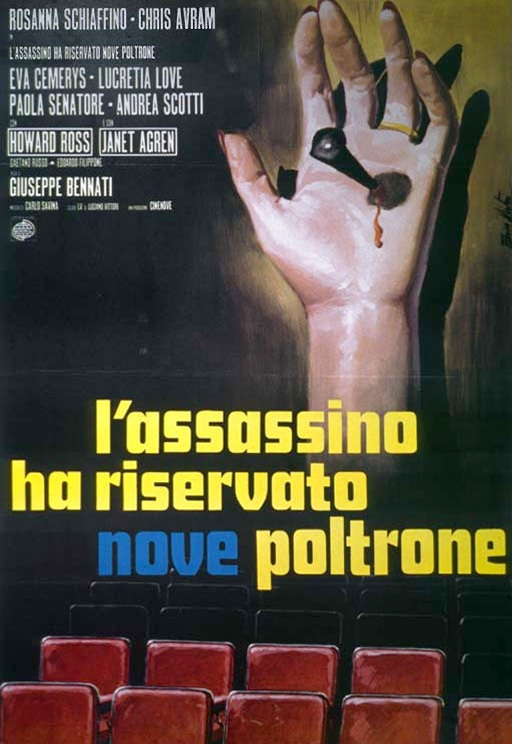
the killer reserved nine seats

A rich man, Patrick Davenant (Chris Avram) invites a group of friends to an old abandoned theater that he owns. Once there they get locked inside and someone starts killing them one by one. Who is the killer? Why is he or she killing these nine people?

The Killer Reserved Nine Seats is an Italian Giallo by way of Agatha Christie.

All of the guests are financially connected to Davenant, in that he mostly supports them through various means. His death will benefit them all in various ways. It is his life that is almost taken first. I say almost because he is saved at the last minute. A large beam is cut free from its holding rope and it drops down on top of him, but just seconds before someone calls the man’s name, he moves and is saved.

Others are not so lucky. As the bodies pile up so do the accusations as to who could be the killer.

But first, there is a lot of silliness. Because this is a 1970s Italian Giallo and not some actual Christie adaptation by the BBC or some old 1940s movie, the characters spend a lot of their time taking off their clothes and getting horny with one another. What I love about that stuff is they are getting naked with one another even after the bodies start piling up.

There is one scene in which one of the women is attacked by the killer (he’s in a mask so she can’t tell who it is). She screams and shouts for help. A man comes in and fights off the killer. The woman escapes and runs to the others. None of them believe her. They say she is hysterical and hallucinating. When they return to the room where she was attacked and find the man who helped her dead by hanging. They decide he was the real killer and guilt drove him to suicide.

I couldn’t help but watch this scene and think of the #metoo movement. About all the statistics showing that when women cry for help, when they report harassment and sexual assault they all so often aren’t believed. I have no idea if the filmmakers were thinking about such things when they created this scene, but it feels very modern.

The script is mostly nonsense. At least the parts I could understand. There were several moments in which the characters inexplicably started speaking Italian and there were no subtitles. Italian films from this era often had the actors speak in whatever language was native to them, and then they would dub in the proper languages in post-production. Presumably, these sections were moments when the English dub has been lost.

What works in the film is its vibe. The theater setting gives us several different locations with different feels. The stage has working sets for the characters to play with. Curtains rise and fall. The auditorium and lobby are beautiful and ornate. The backstage area is filled with props and costumes. Upstairs the attic is dusty and filled with cobwebs. There is even an old crypt filled with candles downstairs. All of this gives the film atmosphere. The women are dressed in fabulous gowns, and the men are in nice suits. The camera moves about, and the lighting is filled with shadows.

I love that stuff. I can put up with all sorts of bewildering things in a script if the filmmaking is interesting.
Billy Strings

My Twitter feed has been going crazy over Billy Strings for a while now and I finally checked him out. Gotta say I’m fast becoming a fan. I guess you’d put his genre as bluegrass or maybe newgrass, but he plays a lot of rock and roll covers (including regularly playing the good ole’ Grateful Dead). Dude is a great performer. He’s got a bunch of shows on the Archive, and I just listened to this one and I highly recommend it. Check out “Dust In a Baggy” for a taste of what he’s capable of.

Planet of the Vampires (1965)

planet of the vampires bluray

Mario Bava is one of the all-time great horror directors. He basically created the Giallo subgenre and was a master visualist. He also directed lots of other genres, including sword and sandals movies and science fiction. Planet of the Vampires is a bit of a genre blend including both sci-fi and horror. Kino Lorber recently released a nice copy of it on Blu-ray and I wrote a review which you can read here.

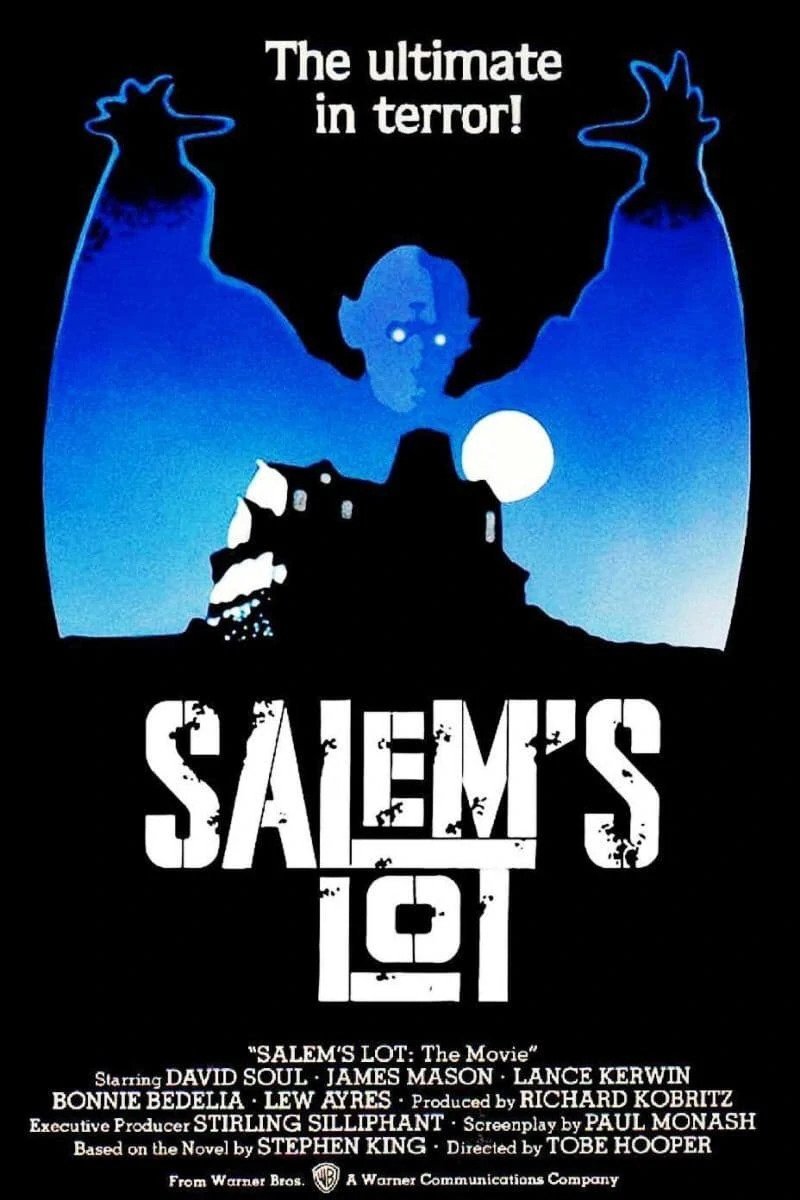
Salem’s Lot (1979)

salems lot poster

I was slow coming ’round to Stephen King. Growing up I was more of a Dean Koontz man. I read the short story The Langoliers when I was in high school and loved it, but for some reason didn’t even bother finishing the other short stories in the book, much less read any other King. In college, I read Dolores Claiborne and loved it, and then didn’t get around to reading any other King books until a few years later. And so it went for a long time. I’d read a King book, love it, and then not pick one up again for many months or years. And then four or five years ago I got a copy of the Mr. Mercedes audiobook from the library and really dug it, then picked up the sequel, Finder’s Keepers, and I was off to the races. I’ve been reading him steadily ever since.

I read ‘Salem’s Lot about 12 years ago and absolutely loved it. I’m a sucker for vampire stories, and King tells a really good one. It remains one of my favorite novels of his. Tobe Hooper directed a two-part TV miniseries back in 1979, and I decided to rewatch it this week. It is surprisingly good.

The story concerns Ben Mears (David Soul), a writer (the first of many times the protagonist in a King story would have that occupation) who grew up in the small town of Salem’s Lot but moved away as a boy. He comes back to write about a spooky old house up on a hill that has a sordid history and is rumored to be haunted. He plans on renting it, but as it turns out, the house has just been purchased by the mysterious Richard Straker (James Mason, completely enjoying himself) and his absent partner Kurt Barlow.

Turns out Barlow is an ancient vampire, and Straker is his familiar. But the movie takes its time getting to that part. First, Ben has to meet Susan (Bonnie Bedelia), the romantic interest, plus other assortments of characters. It isn’t until the second part of the movie, more than 90 minutes into its three-hour runtime, that we actually see the vampire. Mysterious things do happen—people get sick, a kid dies, a dog is murdered, etc., but Hooper keeps the pace slow and the eeriness high.

There is quite a lot of padding, as one would expect from a TV movie made in 1979. And the production values fit within that genre as well. But Hooper gives some good jump scares and several truly spooky scenes. There’s one in which a vampire kid floats into another kid’s room, which is an all-timer. The look of the main vampire is very Nosferatu-esque and pretty darn terrific.

It is a film that, if you consider the budget and its limitations, comes across as surprisingly great and well worth watching.

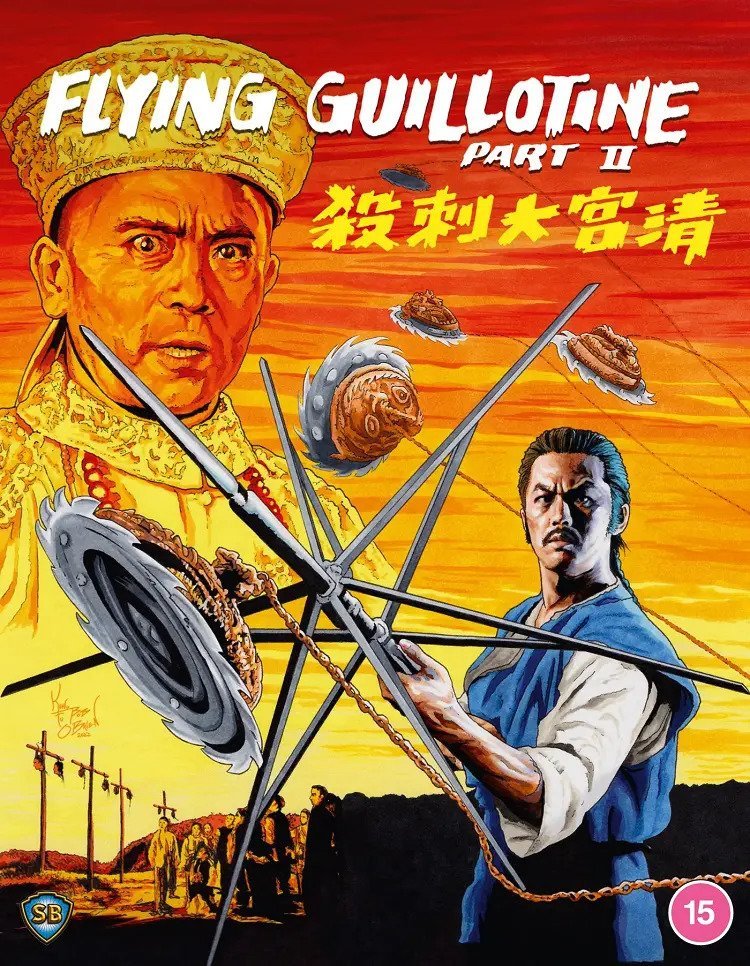
Flying Guillotine Part II (1978)

image host

I’ve recently started getting into old kung fu movies again. I loved them as a kid, but then grew out of the genre for a while. But boutique Blu-ray labels such as Arrow Video and 88 Films have been releasing some really terrific sets of all the Shaw Brothers films and I am here for it. I reviewed Flying Guillotine II (also known as Palace Carnage) over at Cinema Sentries. You can read it here if you like.

Phil Lesh & Wilco – Bridgeview, IL (08/26/22)

Philco (Phil Lesh and Friends with Jeff Tweedy and Nels Cline)
2022-08-26
Sacred Rose Festival, Canopy Stage
Bridgeview, Il

Set I

  1. Intro
  2. Dire wolf
  3. Doing that rag
  4. Mr Charlie
  5. Jack straw
  6. Airline to heaven
  7. US Blues
  8. Not Fade Away

Set II

  1. Intro
  2. Shakedown
  3. Viola Lee Blues
  4. Pride of Cucamonga
  5. New Speedway Boogie
  6. Franklin’s tower
  7. Via Chicago
  8. Ripple

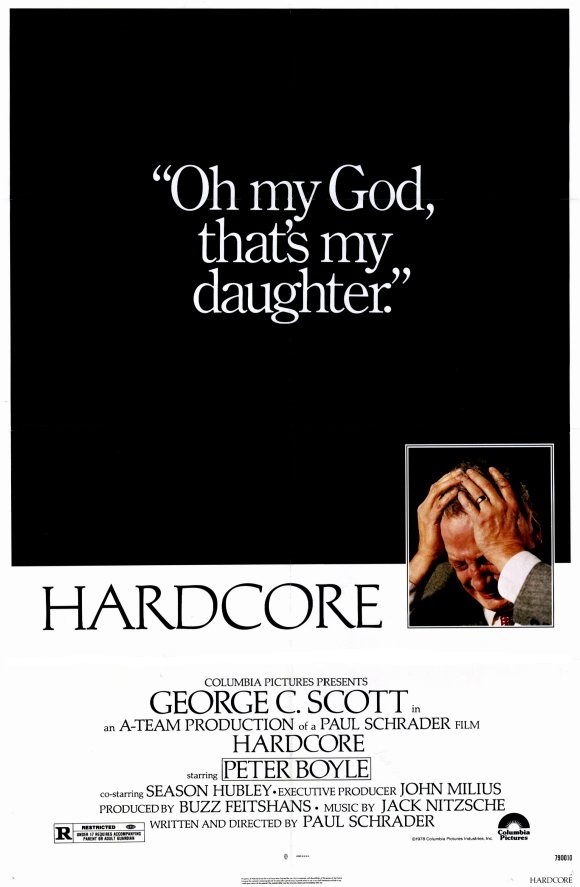
Hardcore (1979)

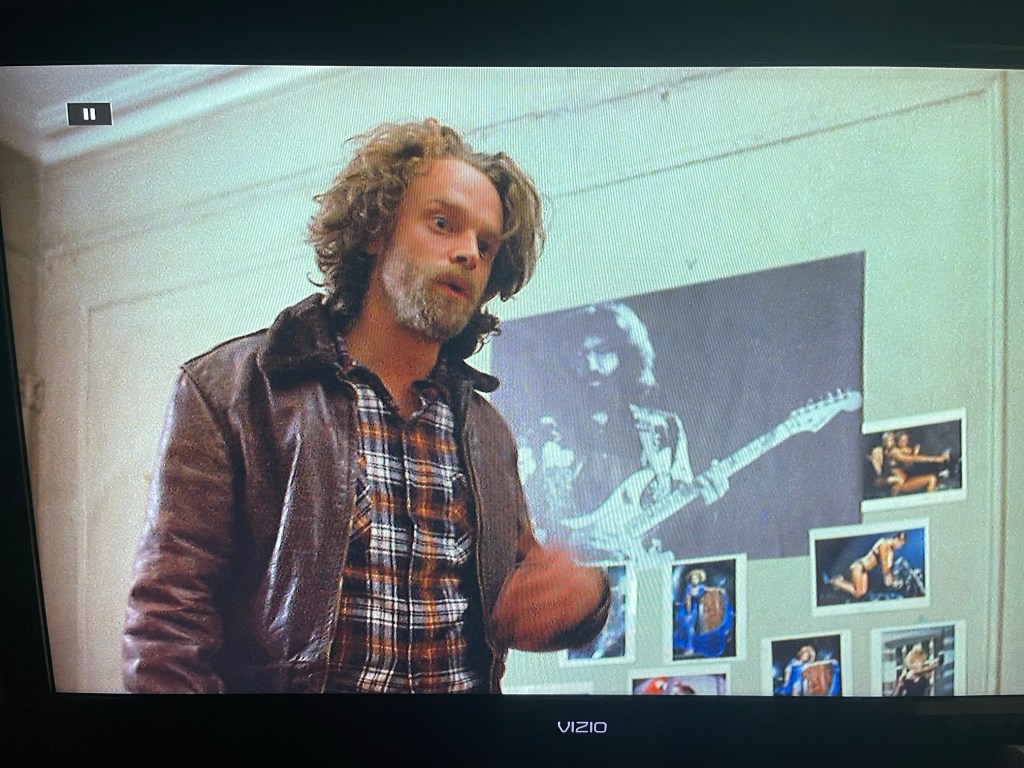
Hardcore (1979) stars George C. Scott as Jake VanDorn a conservative, Calvinist, businessman from Grand Rapids, Michigan. When his teenage daughter goes missing while on a trip to California he hires a sleazy private detective (Peter Doyle) to find her. The detective turns up a short pornographic reel with the daughter in it, but when he is unable to locate her Jake flies to Los Angeles to do the job himself. Once there he journeys through the seedy underbelly of the city talking to strippers, prostitutes, and porno hustlers.

It covers similar territory as the Martin Scorsese-directed Taxi Driver (1976) which Schrader also wrote. Except in that film, Travis Bickle lived in the dark spaces and seemed to thrive there. Jake VanDorn is from the midwest. He is a moral man. A good churchgoer. He is unmoved by all the sex and unseemliness. He is propositioned several times throughout the movie but only offers back a scoff. As if sex doesn’t interest him. His disgust and anger come out only when dealing with his daughter – while watching her perform sex acts on camera or dealing with someone who put her in that position.

Schrader himself was from Grand Rapids and was raised as a Calvinist. He’s on record saying that the Jake VanDorn character was modeled after his father and it is hard not to see the daughter as a symbol for himself. He did leave Grand Rapids for Los Angeles after all to make a living making movies, something his father no doubt would have abhorred. Yet it is interesting to see how the film is from the father’s perspective. We rarely see the daughter at all, nor do we get her side of the story. Make of that what you will.

Jake wanders around the seedier sections of Los Angeles. He walks into porno shops asking the clerk if he’s seen his daughter. He wanders into makeshift brothels where one can wrestle nude with a pretty young woman and negotiate with her for anything else he wants. He pays these women but all he wants is answers. He doesn’t get very many. While pornography has become essentially legalized, this world is still full of secrets, it lives by a code and Jake is clearly not part of it.

He changes tactics. He puts a classified ad in a local newspaper stating that he is a porno producer looking for male studs. He’s hoping to find the young man who was in that porno clip with his daughter. He dons a cheap wig, a cheaper mustache, and clothes that make him look like a narc with no clue as to how to blend in.

He finds the guy but only plunges deeper into this world which includes underage prostitution and snuff films. In parts, it reminded me of several Brian DePalma films. Movies like Dressed to Kill and Body Double also delve into these unseemly sides of a city, but DePalma fetishized them whereas here Schrader looks at them with a detachment. Jake digs deep into this world that he only ever feared existed but he is not part of it. He is a watcher.

George C. Scott is a fascinating choice for Jake. He’s such a square. I mean I don’t know what the actor was like in real life, but his characters are often very straight-laced, or at least unsentimental. While diving into the underside of Los Angeles and San Francisco, he walks through it as if a robot, almost emotionless. He does break down a few times, but each time it is only due to his feelings for his daughter. He meets a young hustler who says she started hooking up when she was very young. Jake is happy to take care of her while she’s helping him find his daughter, but unlike Travis Bickle, he never seems all that bothered that she’s been abused her entire life. It is almost like this is a completely different world to him, to his world back in Grand Rapids, and he’d just assume it doesn’t exist once he gets his daughter out of it.

Schrader is a director whose work I’ve almost always enjoyed. This was the second film he ever directed and the sixth film that he had written. Hardcore isn’t his best work, but it is an interesting film, and it makes for a very interesting companion piece to Taxi Driver.