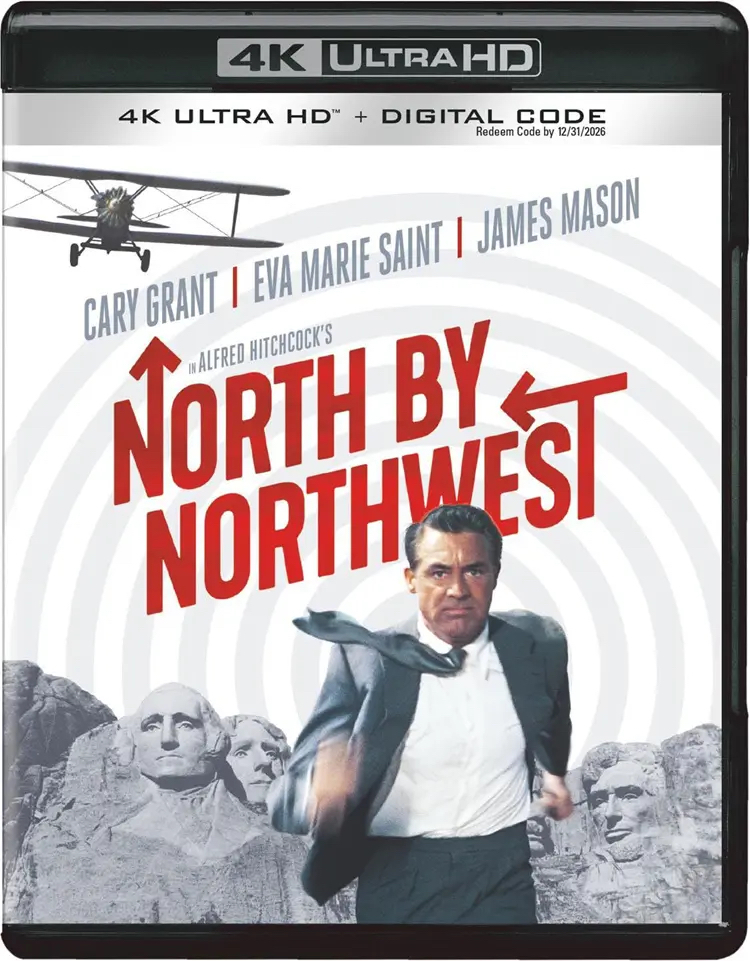
North by Northwest (1959) 4K UHD Review

image host

In my most recent movie journal, I rated North by Northwest with one star. Reader CleJackson noted this and said he was looking forward to reading my one-star review.

Of course, that rating was an accident. North by Northwest is one of my favorite movies. It is the perfect entertainment. It is Alfred Hitchcock at the height of his powers directing Cary Grant at the height of his charm.

I love it so much. I did review the new 4K UHD release of the movie and I definitely did not give it a one-star rating. You can read my thoughts over at Cinema Sentries.

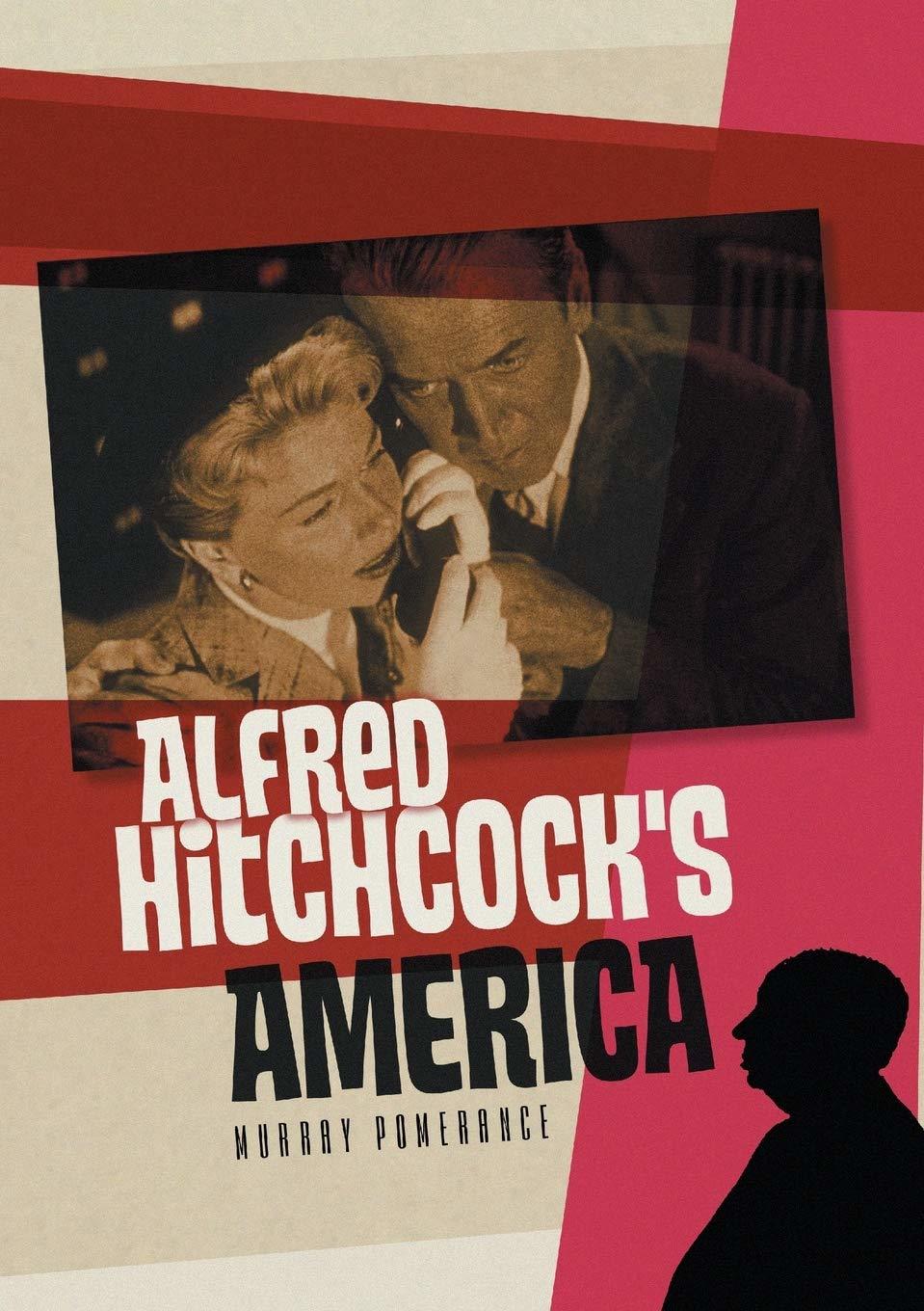
Alfred Hitchcock’s America by Murray Pomerance

cover

Alfred Hitchcock is one of my favorite directors. His movies are immensely entertaining, and utterly rewatchable, but also incredibly crafted and full of deep themes and meaning.

His best films were made in America (though there are still plenty of good ones made during his British period) and this book digs deep into how America influenced the great director and how he influenced American culture.

As much as I love movies I don’t actually read a lot of books about them. I do read a lot of articles online, but my library is definitely lacking in good books about cinema.

I read and reviewed this one for Cinema Sentries. Judging by the shortness of my review I don’t think I really loved it, or at least I didn’t have much to say about it. Books like this are hard to review because they are well-researched and informative, but also quite dull. Anyway, my review is here.

Links of the Day: August 28, 2023

Nancy Pelosi on Dylan, the Grateful Dead, a wild night in Argentina — and the healing power of music: LA Times

Every cameo that Alfred Hitchcock made in his films: Yardbarker

Grateful Dead releases live track from upcoming ‘Wake of the Flood’ 50th anniversary edition: KSIX

NH filmmaker commemorates 1973 rock concert: NHBR

Revisiting Wilco & Bob Weir’s Masterful ‘Dark California Stars’ Performances: Jambase

Hanky Panky (1982)

hanky panky poster

About thirty minutes into Hanky Panky a film that stars Gene Wilder and Gilda Radner, I turned to my wife and said, “I thought this movie would be a lot wackier.” Up until that point, it is a fairly straightforward thriller. It does get a little bit zany once Gilda shows up, but it never quite figures out how to balance the thriller aspects of the film with its comedy.

Wilder plays Michael Jordon, a guy-next-door architect who jumps into a cab that is already occupied by Janet Dunn (Kathleen Quinlin. Despite her obviously being distraught Michael aggressively flirts with her. As an audience, we know that she is being chased by unknown assailants for unknown reasons. Looking about, not knowing if she’s managed to lose her attackers, she puts something into a package and addresses it. Michael, trying to be chivalrous I guess, takes the package and drops it in the mailbox.

The bad guys witness this and figure Michael knows what’s going on. They kill her and attack him asking him where she mailed the package to. He escapes and we’re treated to a cross-country chase. Along the way, he meets Kate Hellman (Radner) who may not be what she claims to be.

There is a lot of North By Northwest DNA living inside Hanky Panky what with an average man getting caught up in incredible events, and being chased by assailants across the USA (this film begins in New York City and concludes at the Grand Canyon). But though I do love both Wilder and Radner they are not Cary Grant and Eva Marie Saint, and Sidney Poitier (who directed) is not even close to Alfred Hitchcock (at least when it comes to directing.)

Which brings me to the comedy. For a film like this to work the comedy has to come naturally from the characters and the situation. It needs to come organically out of the story. While the movie doesn’t necessarily have to be completely realistic, it needs to at least have the facade of realism. The comedy in Hanky Panky is too farcical, it feels like it comes straight out of vaudeville.

Two examples

Michael and Kate have to rush out of his apartment during one scene. He is still in his bathrobe so they slip into a theater and steal a magician’s tuxedo. Later they get onto a bus. When the driver asks for exact change Michael pulls out some coins from the tuxedo pocket only to have them explode in his hand. He then tries to exchange a dollar bill for some coins and when he jerks his hand forward a bouquet of flowers pops out. This causes a sneezing fit to which Kate tries to hand him a handkerchief from his chest pocket. It is a never-ending handkerchief.

Later Michael and Kate are on a small helicopter. The pilot (Pat Corley) mentions he’s not feeling well and then proceeds to belch. A lot. He belches for several minutes, over and over. It is as if Mr. Corley decided to see how long he could let the gag continue until they made him stop. Wilder and Radner are clearly enjoying it as they keep breaking character and cracking up. I suspect Sidney Poitier also thought it was hilarious and just couldn’t help but keep the entire thing in the movie.

Both of these scenes are actually funny, more or less. I chuckled. My wife just guffawed when I was talking about it. But they don’t fit in with the rest of the movie. That scene with the helicopter – Michael and Kate are running for their lives. As the pilot is belching he’s flying is erratic and they nearly crash. So much of the film is very serious, and then there are these random moments of utter silliness. Those two tones crash into each other in incredibly distracting ways.

The serious thriller aspects of the film worked better for me than the comedy. They are still second-rate Hitchcock, but still relatively enjoyable. Wilder and Radner were incredibly talented comedic talents and I’ve enjoyed them both in other things, but they are utterly wasted in this film.

My Week in Movies March 19-25, 2033

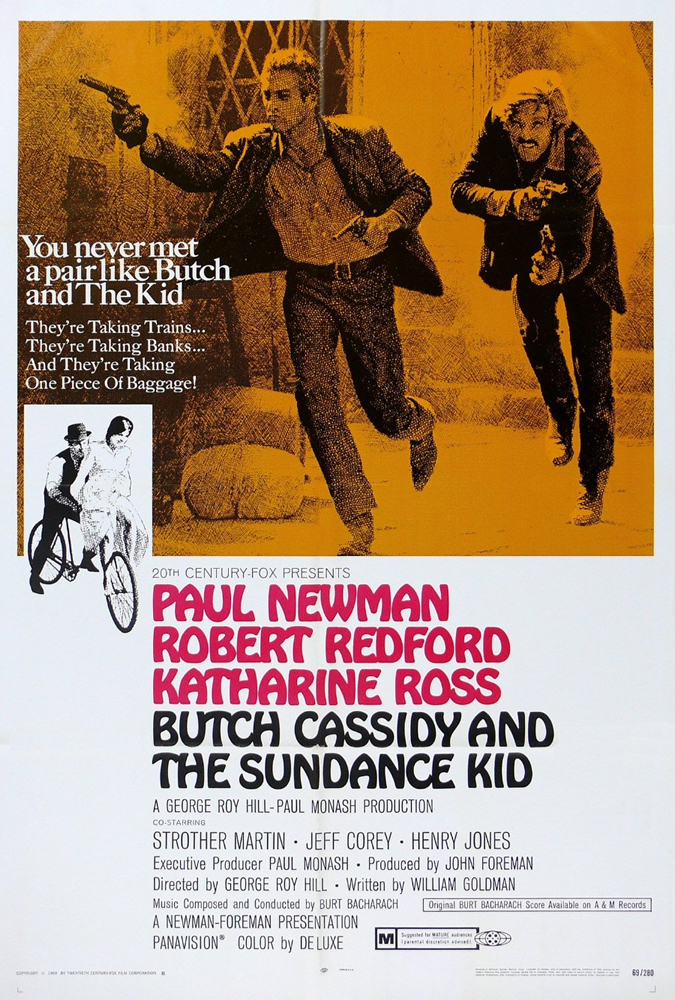
butch cassidy and the sundance kid poster

I watched ten movies last week, seven of which were new to me. Two of which were westerns that I will talk about later this week in more depth.

The Wild Bunch (1969): Sam Peckinpah made several westerns before this one, but this is his masterpiece, the culmination of his thoughts on the genre. It is brutally violent, dark, cynical, and pretty fantastic. I’ll have more thoughts on it when I write my full review.

Small Town Crime (2017): A small, twisty, noir-tinged thriller starring John Hawkes as a disgraced, alcoholic former cop who discovers a body on the side of the road. He convinces the girl’s father (Robert Forster) to let him work the case as a private detective. The case gives him a new lease on life to actually do something besides drink himself into an early grave. The plot is pretty standard stuff, but it is done well and Hawkes is great as usual. I’d love to see him in an HBO-type series where he solves crimes every week.

Double Indemnity (1973): A television remake of the classic film noir with Richard Crenna in the Fred MacMurray role, Samantha Eggar taking over the Barbara Stanwyck part, and Lee J. Cobb as Edward G. Robinson. It follows the original script pretty closely (though it does edit parts out to cut down on the total time), but pales in comparison.

But it isn’t as bad as it’s been made out to be. It is a perfectly serviceable TV movie. If the original didn’t exist this would be, well it would be completely forgotten as it isn’t good enough to really be remembered, but if you picked it up in the $2 DVD bin you wouldn’t think it was a waste of your money.

But since the original does exist there is no real reason to watch it other than to make you realize how perfect the original is in every way. I watched it because it came as an extra on my Blu-ray of the original and I was curious about it.

Butch Cassidy and the Sundance Kid (1969): One of my favorite westerns. It feels like the opposite side of the same coin The Wild Bunch comes from. This is a lot more fun to watch and Paul Newman and Robert Redford have never been more charming.

The Lodger: A Story of the London Fog (1927): Alfred Hitchcock’s first big hit and his first truly Hitchcockian film has been a gaping hole in my cinematic knowledge for far too long. I remedied this week and I can’t really fathom why it took me so long.

The plot follows a London family after they have taken in a mysterious lodger who might just be a Jack the Ripper-style killer. It is full of creeping dread and suspense while utilizing what would become many of the director’s trademark styles. Even without sound, he proves himself a master of camera placement and movement, and editing.

Barbarian (2022): A pretty terrific little horror film that I talked about in my Friday Night Horror piece.

Sabotage (1939): The Lodger got me into the mood for another early Hitchcock film. I’d seen this one before but it is so worth watching again. It is about a man who is enlisted by foreign agents to commit acts of sabotage in London. It follows his wife and a young police detective as they try to determine whether or not that’s actually true.

Strangely, this one doesn’t seem all that beloved by Hitchcock fans and classic movie nerds, but I love it. It is full of that classic Hitchcock suspense and it makes great use of its setting (the family runs an old movie theater.)

Excalibur (1981): I have this distinct little memory of my mother renting this movie when I was a kid. I was very excited to watch it because it had knights in shining armor and wizards and it looked really cool. But Mom watched it before me and decided that the nudity, sex, and violence were not appropriate for little old me. I was so disappointed.

That memory has stayed with me, but I somehow only got around to watching the film now. What a strange, long, freaky movie it is. The plot is a retelling of the King Arthur myth. It looks great, the set design is wondrous and the lighting and camera placement are all really interesting. But the story just plods along and the action is clumsy at best.

John Boorman directed it. He made Zardoz a few years earlier. It is just as weird and stylish but its actually good.

Gold Diggers of 1933 (1933): Joan Blondell and Dick Powell star in this wonderful little musical with choreography from Busby Berkeley. The film opens with Blondell, Ginger Rogers and a host of chorus girls decked out in dresses made of gold coins singing “We’re in the Money” and it just gets better from there.

Every Secret Thing (2014): Two very young girls are convicted of kidnapping and then murdering a baby. Years later, just after they are released from juvenile correction another little girl goes missing. The story moves from the first crime to the next connecting how what we did in our past influences who we are and what we can do in our present and future.

Did you all watch anything interesting this week?

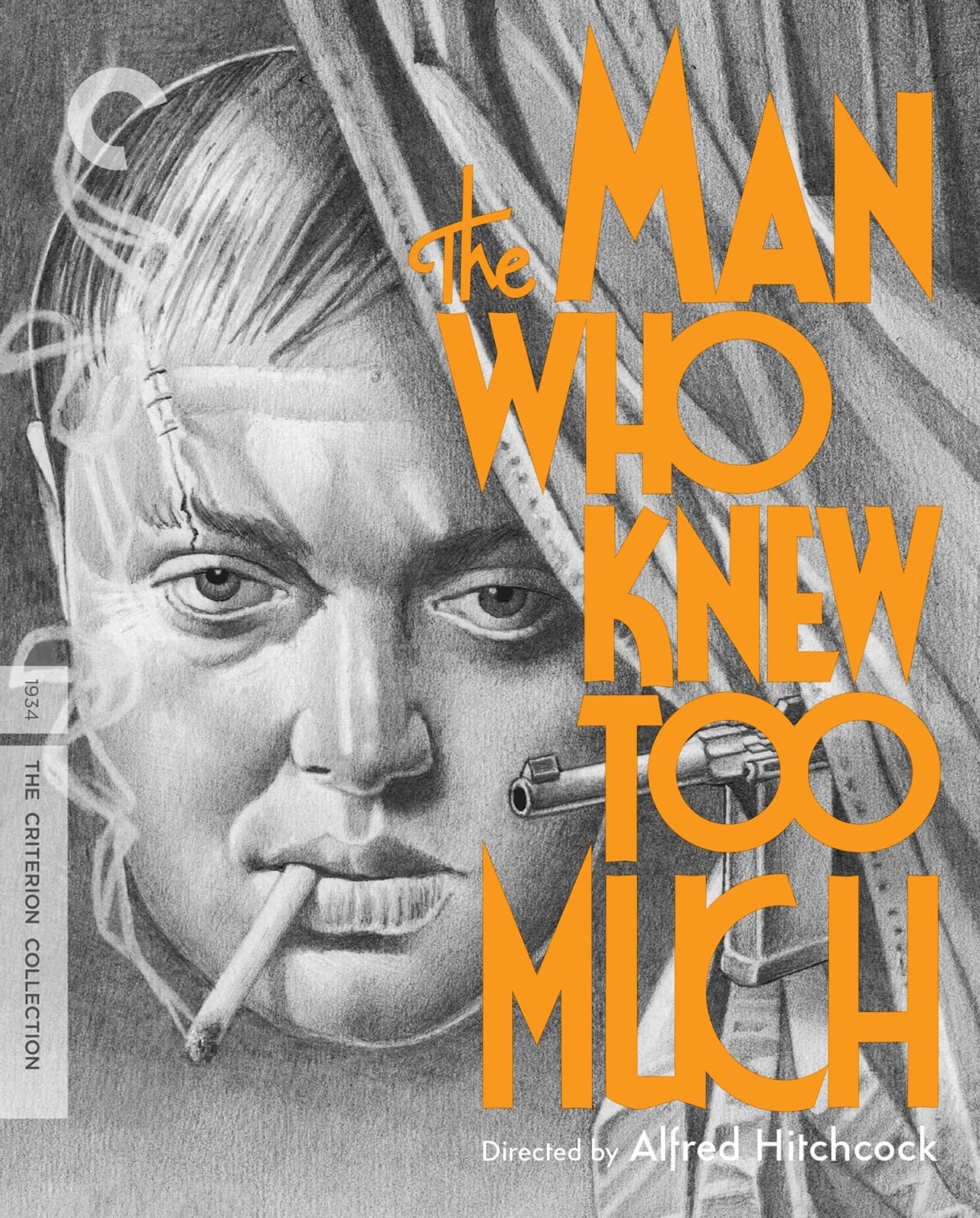
The Man Who Knew Too Much (1934)

the man who knew too much

I suppose for those who are not Alfred Hitchcock aficionados the version of The Man Who Knew Too Much they know is the one with James Stewart and Doris Day. That’s a fine film in its own right, but most people don’t realize it is a remake of a film from 1934. Both films were directed by Hitchock making him one of the few directors to ever remake themselves.

The earlier film was from the director’s British period and stars Peter Lorre in his first English language movie. It is an excellent film and a few years ago Criterion gave it a humdinger of a Blu-ray release. I reviewed it for Cinema Sentries and you can read that review here.

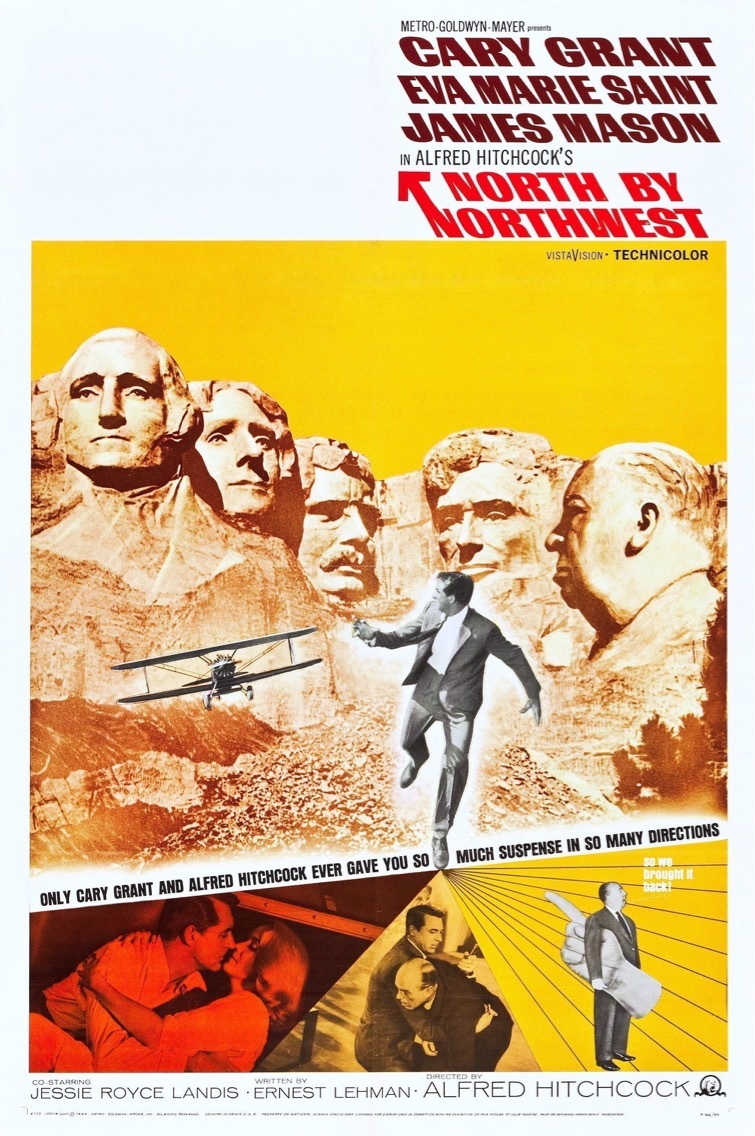
Calendar Movies: North by Northwest (1959)

north by northwest movie poster

This was originally written and posted on April 27, 2006.

Recently, I had lunch with the human resources director at my place of employment. Both she and the chief operations officer were down to my office for the day and I invited them out to Cracker Barrel (it was a cheap maneuver as my boss was out of town, and I knew they’d pay for the food.) I needed the COO as a buffer between me and HR because last time I had lunch with Human Resources I got drilled on my opinion on everything from our company values to how the janitorial staff is doing.

It worked perfectly, I got a good meal paid for, and the COO kept us distracted by trying to win that little triangle peg game all Cracker Barrels leave on the table. It’s quite a thing to see your boss’s boss’s boss cursing at a children’s game because it says he’s an “ignoramous.”

The toughest question I had to field from HR was about my favorite movie. I chose Casablanca much to the surprise of my questioner. Now, at 30, I’m not anywhere near a young whippersnapper, but I guess I’m still pretty far removed from an ancient classic like that.

The thing is, I really dig the old movies. I’m the kind of guy who goes to Blockbuster and heads for the center rows, not the outside aisles with new releases. I suppose this is a strange thing, where kids today haven’t even seen Star Wars much less The Third Man.

Seriously, the first time I found out someone at work had never seen Star Wars I nearly fell out of my comfy office chair. It is as bewildering to realize that a film that means so much to me and my generation could be a relic to a new generation.

But maybe this is just me. I prefer Turner Classic Movies to HBO. I’d rather watch Humphrey Bogart than Tom Cruise. Black and white is much sexier then high definition super color.

Watching a movie like this month’s Calendar Movie, North by Northwest I’m struck by the notion that it’s not so different from your summer Hollywood blockbuster these days.

You’ve got one of the biggest stars working at the time, Cary Grant, working with an A-list director, Alfred Hitchcock; that’s like Tom Hanks and Steven Spielberg working together. The story is full of big action, lots of laughs and brimming with sexuality. It would play perfectly in today’s multiplexes

It’s the sex that struck me in this viewing. No, there isn’t any nudity, or hard core action. There isn’t even any soft core action, or anything more than some kissing. But the dialogue is boiling over with innuendo and double entendres. And if you’re going to have double entendres, who better than Cary Grant and Eva Marie Saint to do it?

Beyond the sex there is more action and twists than a porno staring Gumby and Pokey. The famous crop duster scene still excites beyond what most CGI adventures can muster in an entire film.

So I ask myself again, why do brilliant, solid pieces of filmmaking like this get left on dusty shelves to be replaced by boring, repetitive, unimaginative showcases of mediocrity? Is the movie going public so stuck on adrenaline pumping, computer generated eye candy, that the classics are above their threshold of understanding?

Partially I think that it is part of our cultural existence to get the newest, freshest product. We buy the new models of cars even though our old one rides just fine. We purchase the top of the line, brand new computer products because our 6 month old lap top is “outdated.”

No one stands around the water cooler talking about Hitchcock or Billy Wilder. We talk about box office receipts, and the new weekend releases. Hollywood asks us to. They can’t afford for an audience to sit around watching worn out VHS copies of Ninotchka when they just spend 100 million dollars on the new Vin Diesel picture.

Kids don’t get hip credibility by wearing t-shirts with Peter Lorre on them. That’s not the kids fault, for if they had the chance to watch Lorre in M his picture would be right out there like Al Pacino in Scarface.

I can’t help but think if more people were exposed to classics like North by Northwest there would be no surprise when a young man stated his favorite movie was Casablanca.

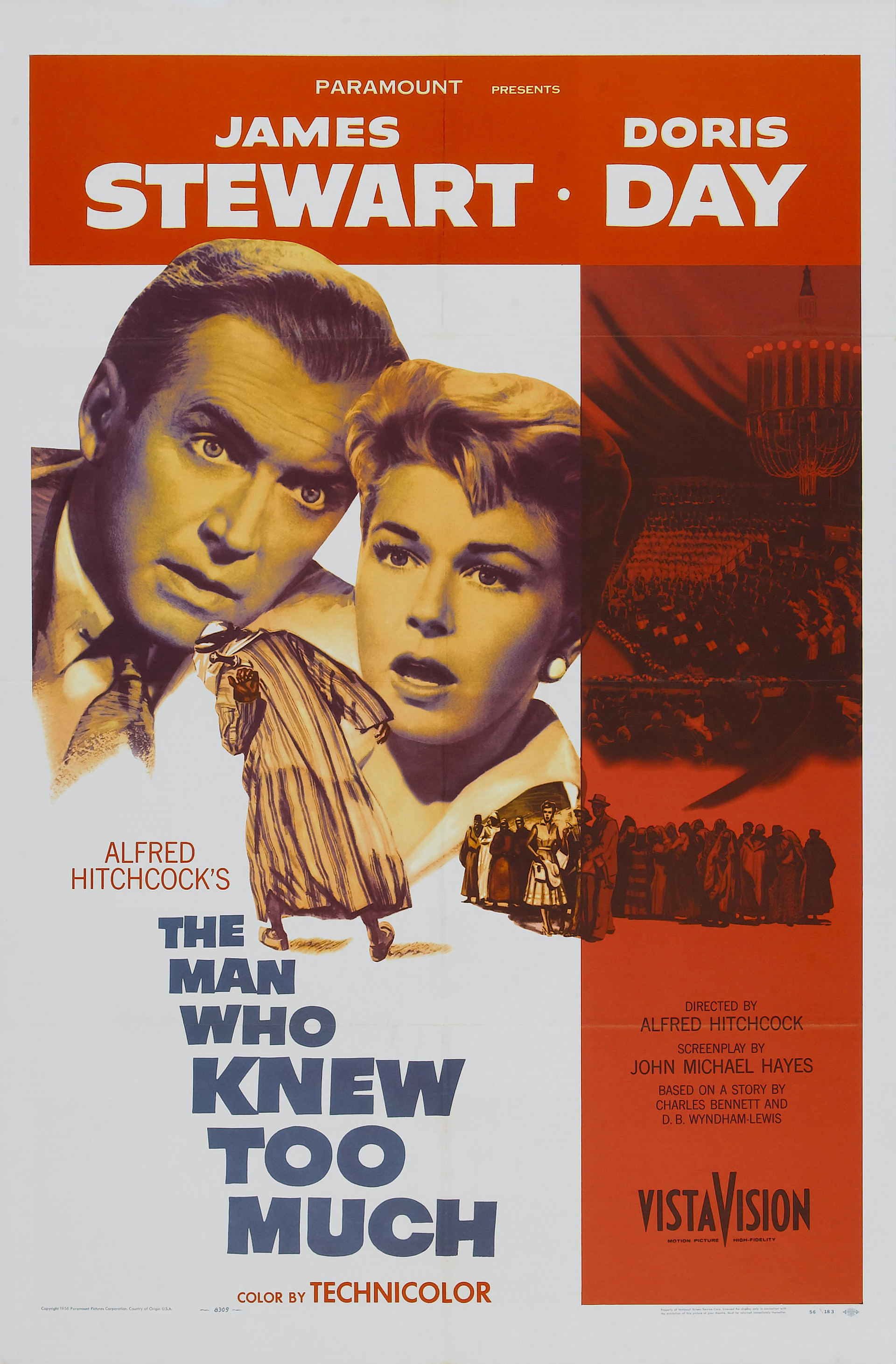
The Man Who Knew Too Much (1956)

the man who knew too much poster

I suppose if you were to pick anyone to remake the classic Alfred Hitchcock film The Man Who Knew Too Much (1934), Hitchock himself would not a bad choice. And that is just what the master of suspense did in 1956. In fact, this version feels more like an extended, director’s cut than a remake. The story is essentially the same. Ben (James Stewart) and Jo MacKenna (Doris Day) are vacationing in French Morocco with their son (Christopher Olson). They are quickly caught up in international intrigue and must try to stop an unknown diplomat’s assassination to keep their son from being harmed.

While the original stays mainly indoors keeping its action to a few set pieces. In this new version Hitchcock thrills in taking his characters and the audience, to wild, colorful places around the world. It begins in Northern Africa and here we see many lovely shots of the countryside. The action moves to London where there are numerous shots inside enormous, gorgeous buildings like the Royal Albert Hall.

The opening credit sequence is beautifully done. Hitchcock shoots a half orchestra playing the opening music. It takes a few moments to realize that the typical orchestrated number you are hearing over the credits is visibly being played by real people in the picture. This inventive bit is promptly ruined by an uninteresting title card played over the cymbalist.

I own the original 1934 version and recently watched it. Many debates are raging over the internet on which version is superior. Frankly, I find both versions to be lacking. The original was paced quicker but suffered from several jolts in the plot which created some confusion and no sympathy for the protagonists. The newer version tries to help this out by giving us long and unmoving scenes in which the protagonists try to stretch out their characters.

Jimmy Stewart does a marvelous job as usual, but Dorris Day is annoying in nearly every scene. She is pretty and plays the part of a normal, cheerful American girl, but she grits my teeth while she’s on the screen. Maybe I’m just not a fan. In a scene towards the end she sings “Que Sera Sera” and to my ears, it sounds like she’s howling the number. One could argue that she is singing loudly for a plot purpose, but I would say it would serve the movie better if it was pretty and not harsh. In an interesting bit of trivia, Ms. Day apparently didn’t like the song to the point of nearly refusing to record it. It turned out to be her biggest hit, and won the Oscar that year.

There is an ingenious bit of filmmaking in the latter 3/4ths of the movie filmed in the Royal Albert Hall. There are some 12 minutes when not a word of dialogue is spoken and the only sound heard is the music played by the orchestra. It is a beautifully crafted scene that builds tension like a bullet.

Several plot elements make me ill at ease. The Scotland Yard seems terribly inept. We are made to believe that these detectives are willing to allow the MacKennas to run around the streets of London trying to solve the crime by themselves even though Mr. MacKenna knows important details about the assassination of an important diplomat. Why would an assassin use a small pistol to kill the diplomat from a long distance? After the assassination attempt, why is everyone allowed to run free? There are other questions and inaptitude that go unanswered except to allow a movie to tie up loose ends quickly and move the plot along.

Hitchcock was a master at manipulating audiences. He is in fine form throughout this movie quickly moving the viewer through the scenery with a good bit of humor and suspense. This is not a bad movie by any stretch. There is a great deal to enjoy as a carefree audience member and for anyone interested in the craft and art of film. However, it is far from Hitchcock’s greatest film, and I find its flaws to be more disappointing considering the masterful hands that created it.

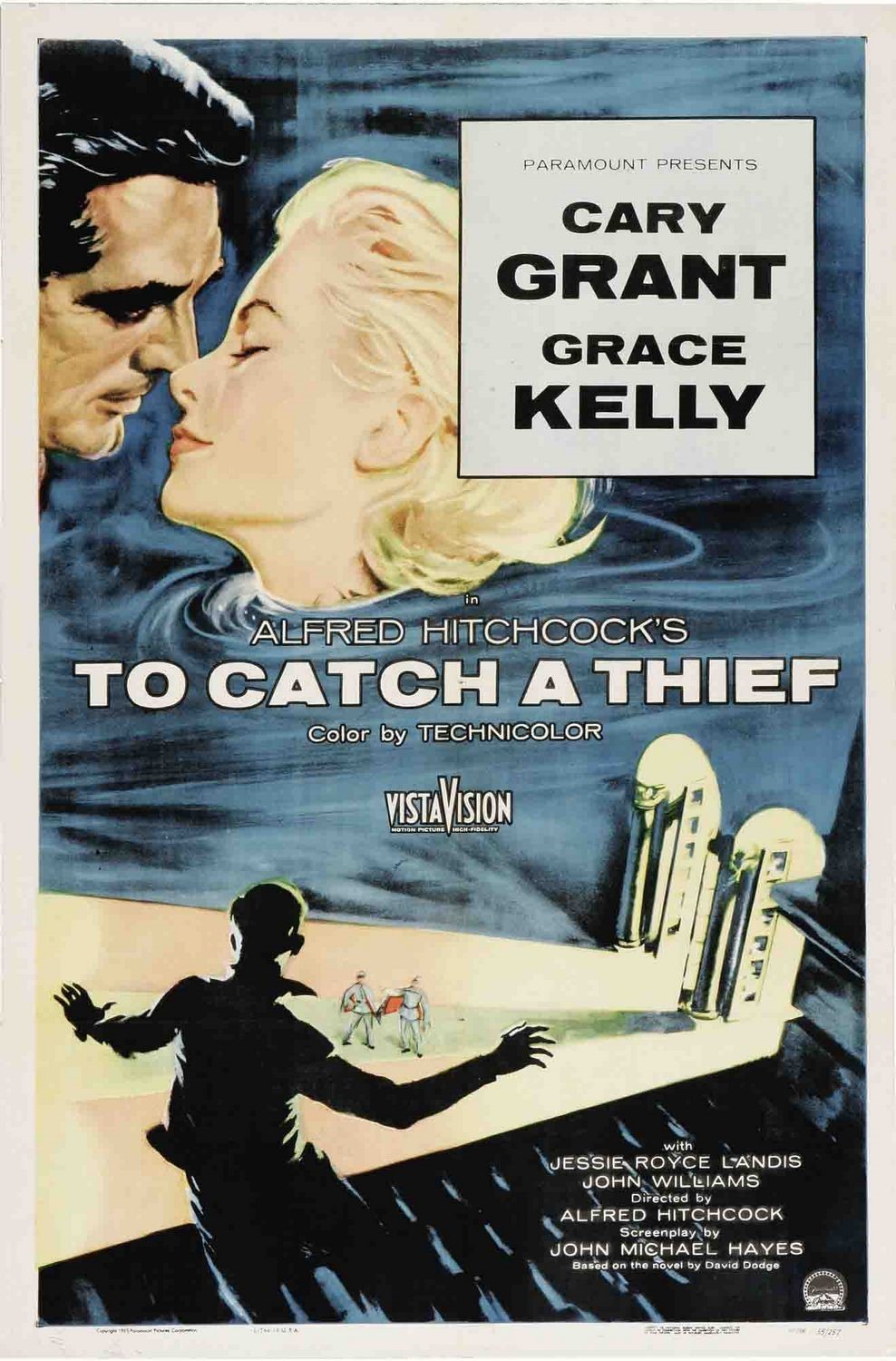
To Catch a Thief (1955)

to catch a thief poster

Alfred Hitchcock’s 1955 film To Catch a Thief is a light, fluffy picture that differs in content from much of the suspense masters’ other pictures. Cary Grant stars as a former thief, and patriot of the French Resistance, who is currently suspected of a new series of crimes. Grace Kelly plays the beautiful daughter of a rich American woman who is high on the list of possible victims of the new cat burglar.

The plot is all cotton candy. Shot in the French Riviera, Hitchcock allows his camera to take all of the beauty in. There are lots of lovely traveling shots of the location. Hitchcock follows cars driving the streets in high crane shots, simmers through the sea on a boat ride, and stops to take in the view of Cary Grant and Grace Kelly at a picnic overlooking a stunning valley.

Cary Grant is playing Cary Grant at this point, but that’s perfectly fine since there are few actors I enjoy more. Grace Kelly is simply gorgeous. Hitchcock’s camera is as admiring as a new suitor. Their interplay is fun, witty, and sensuous. A famous scene between them intercuts their developing romance with fireworks and is pure sizzle.

If you are looking to write a thesis on the genius of suspense then you should look elsewhere. But for a beautifully shot, light-hearted romance for a Saturday night, it would be difficult to find a better picture.