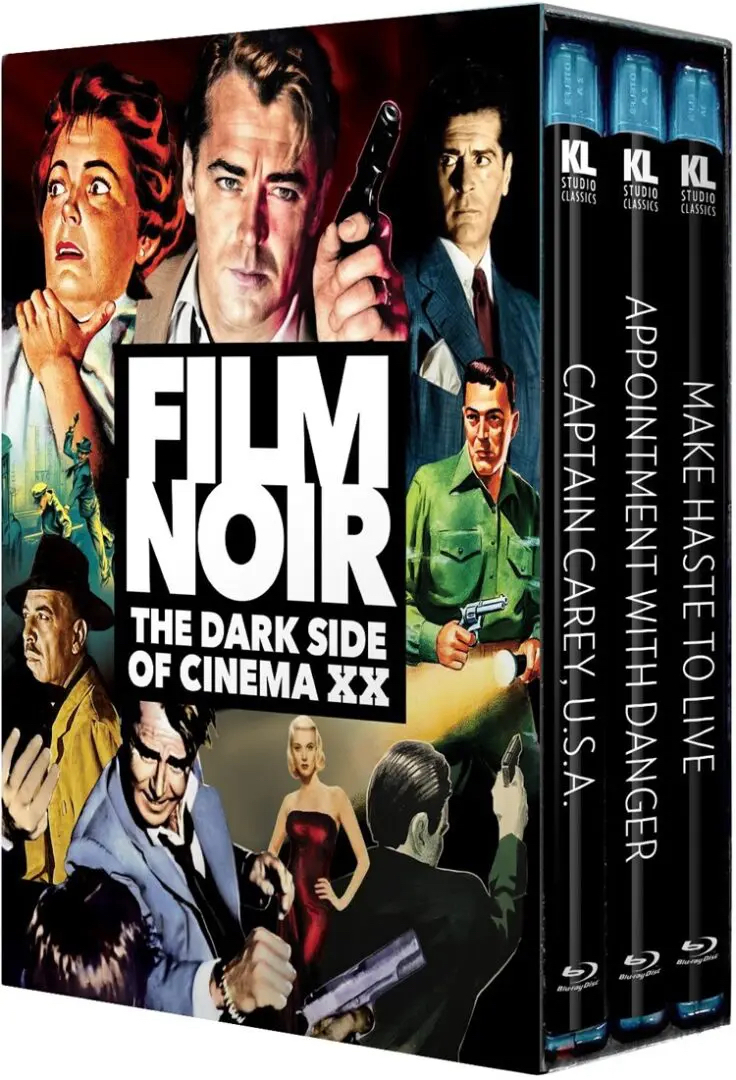
Film Noir: The Dark Side of Cinema XX

cover

Alan Ladd was one of the great film noir actors. He had a star-making turn as a contract killer in This Gun For Hire alongside Veronica Lake. He made three more noirs with her and continued to star in various noirs throughout his career. Kino Lorber presents two of those films in this set (Captain Carey, USA & Appointment with Danger) and then there is one film without him (Make Haste to Live).

The two films with Ladd are pretty good and the other – not so much. But I continue to love this noir sets from Kino. You can read my full review here.

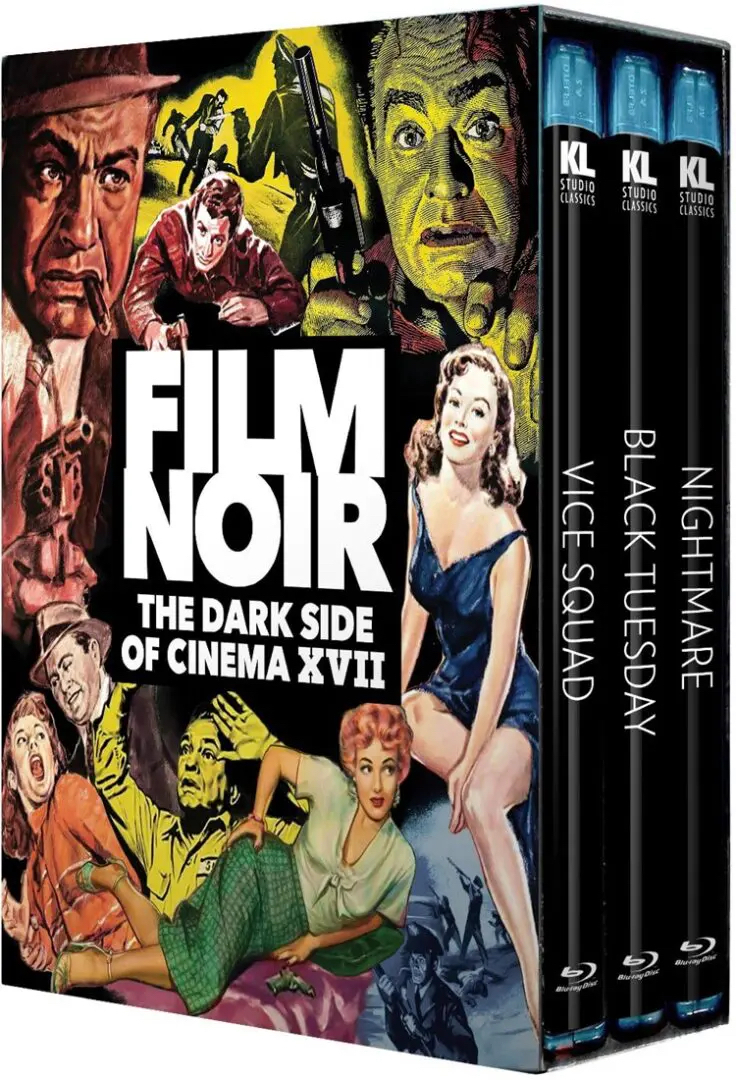
Film Noir: The Dark Side of Cinema XVII

Edward G. Robinson is one of my favorite actors. He became famous for portraying snarling, and deadly gangsters, and he’s great in that type of role in films like Little Ceasar and Key Largo (1948). But he made all types of other films from film noirs to comedies to heartfelt dramas. One of my favorite roles of his was his very last, the bookish best friend of Charlton Heston in Soylent Green (1973).

This edition of Kino Lorber’s long-running noir series stars Robinson during a dark period of his career. He’d been blacklisted by HUAC and could only find jobs with poverty row studios in low-budget b-pictures. These are certainly not his best films, but I just love that they are getting the Blu-ray treatment. You can read my full review here.

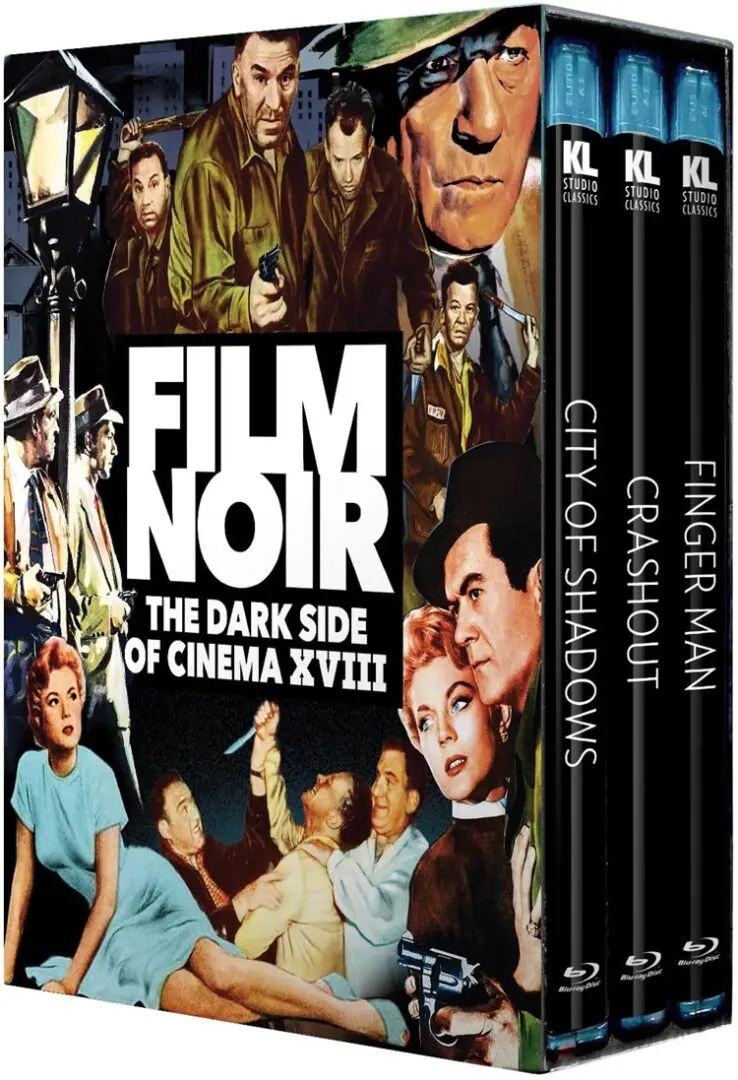
Film Noir: The Dark Side of Cinema XVIII

cover

Kino Lorber has been putting out these film noir sets for a few years now. I love them. I’ve watched most of them and reviewed more than a few. The thing with them is that they are collecting the b-sides of film noir. The best films in the genre get their own single releases. They get special editions. These films get packaged together in a set of three.

Naturally, not all of them are going to be good. In fact, I only liked one film in this entire set – Crashout (1955). But the other thing about these sets is that I love that they keep putting them out. I love that these mostly forgotten films are getting nice little Blu-ray releases even if they don’t get a lot of special features and come in sets of three.

You can read my full review of this set here.

They Drive By Night (1940)

bluray

Humphrey Bogart is my all-time favorite actor. He was one of the biggest stars of Hollywood’s golden age. But he didn’t start out that way. He actually languished for over a decade before becoming a star. He spent most of that time being billed third or fourth in gangster pictures. They Drive By Night helped push him into the spotlight. It was not a gangster picture, and while he was still third-billed the movie was a big hit and it showed off his range. A year later he’d star in The Maltese Falcon and the rest is history.

George Raft is the star of the picture. And Ida Lupino. The film is a mix between a social message movie and film noir. It’s pretty good.

You can read my full review here.

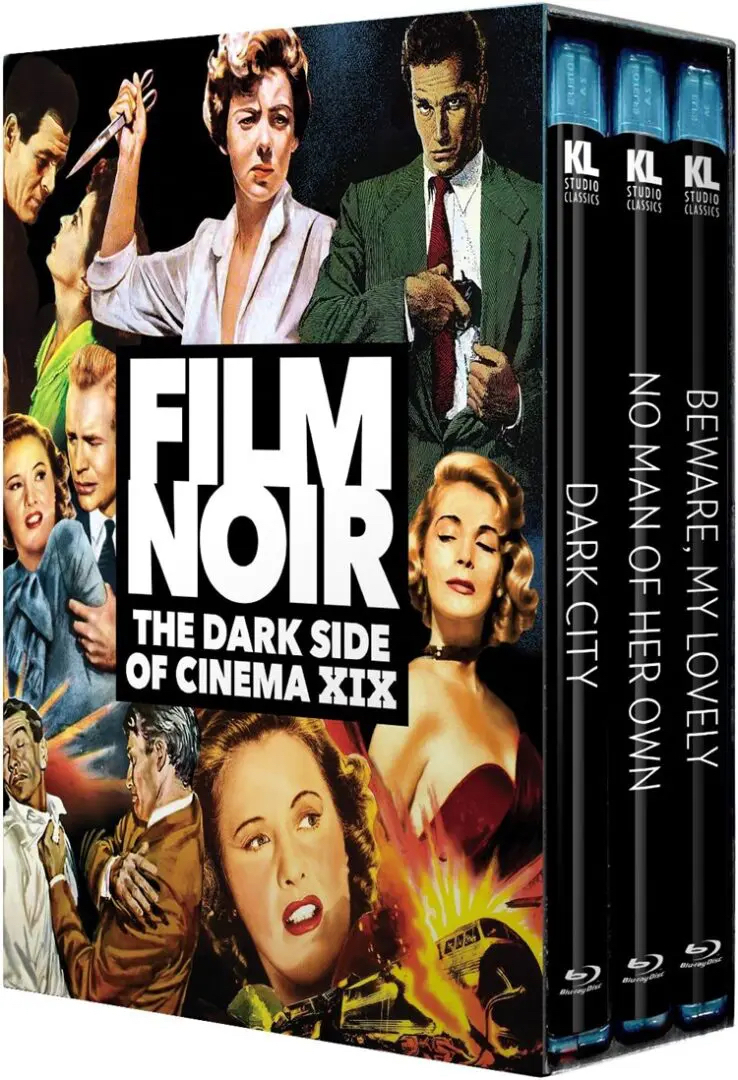
Film Noir: The Dark Side of Cinema XIX

cover

I’ve reviewed a bunch of these film noir sets from Kino Lorber over the last few years. Not all of the films are great, some of them are pretty lousy if I’m being honest, but I love that these films are getting released in HD.

This set features stars such as Charlton Heston, Barbara Stanwyck, Lizabeth Scott, Robert Ryan, and Ida Lupino (those last two are in Beware, My Lovely a film I reviewed last Noirvember).

All three films are pretty good if not exactly true classics. You can read my full review here.

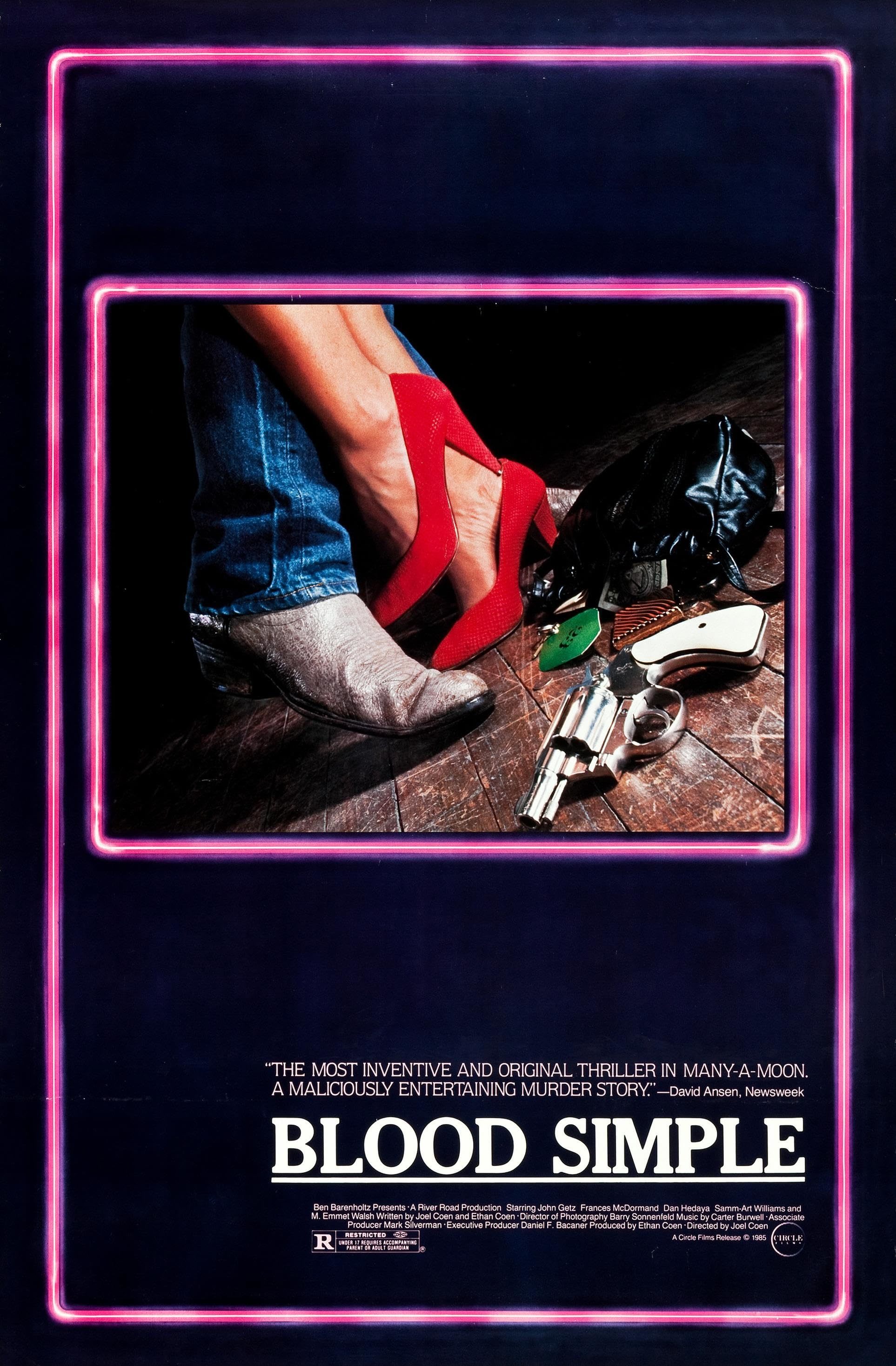
Murder Mysteries In May: Blood Simple (1984)

poster

Rare has a debut film been so self-assured, so completely full of what would become the filmmaker’s regular themes and style than the Coen Brothers’ Blood Simple. It isn’t their best film, but it is a great one, and it is absolutely through and through a Coen Brothers movie.

The title comes from a line in Dashiell Hammett’s novel Red Harvest in which a character starts getting a little punchy after being involved in a series of murders. The plot is original, but it was clearly influenced by another hard-boiled crime writer – James M. Cain, with bits of Jim Thompson thrown in for good measure.

The Coens would return to the hard-boiled film noir well many times in their careers. Their third film, Miller’s Crossing stole plot points from two Hammett novels – Red Harvest and The Glass Key. The Big Lebowski is a modern, stoner retelling of Raymond Chandler’s The Big Sleep. Neither Fargo, No Country For Old Men, nor The Man Who Wasn’t There seem directly influenced by any hard-boiled novel that I know of, but they fit right into that milieu.

But let’s get back to Blood Simple. The plot finds a sleazy bar owner named Julien (Dan Hedaya) hiring Loren Visser (M. Emmett Walsh) an even sleazier private detective to kill his wife Abby (Frances McDormand in her first film role) who is cheating on him with his barkeep Ray (John Getz).

One of the many joys of the film is following its labyrinth plot so I don’t want to spoil anything, but I will say things do not go as planned. Like so many noirs none of the characters are particularly bright, and rarely do they actually understand what’s going on. I don’t think either Abby or Ray ever realized that Loren even exists.

All of the Coen’s style is here, even if it is in a slightly rougher form. There are a couple of bravura shots that feel like first-time directors trying to show off what they can do, but they are pretty impressive all the same.

The entire cast is fantastic. Frances McDormand immediately shows herself to be one of the greatest actors of a generation. But the movie belongs to M. Emmett Walsh. He’s great in everything, but he’s particularly slimy here (and wonderful).

It is a terrific film, one that keeps getting better everytime I watch it and an absolutely smashing debut for some of my favorite directors.

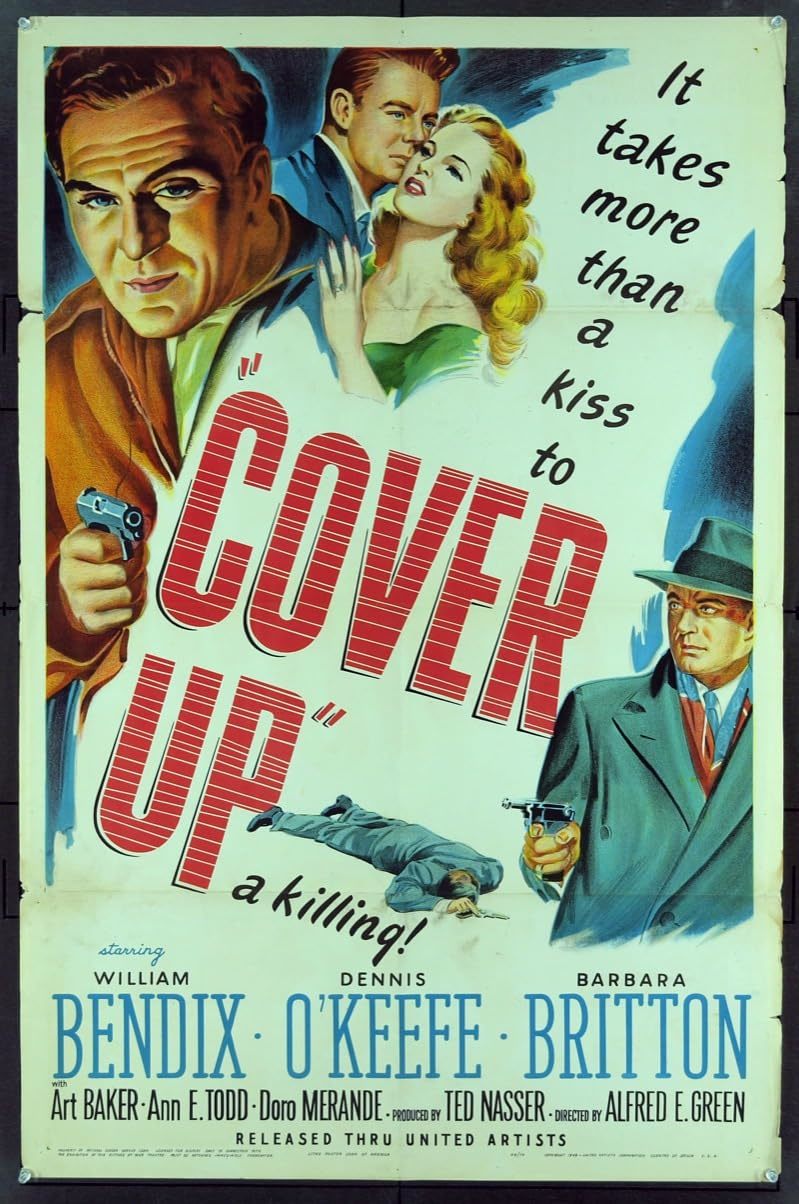
Murder Mysteries In May: Cover Up (1949)

poster

In my review of the 1935 adaptation of The Glass Key, I mentioned a scene in the 1942 remake that starred William Bendix. In that scene, Bendix plays a thug who gets to slap around Alan Ladd’s character. He does so with such gusto that he nearly steals the movie. It made me an instant fan.

I’ve since watched 11 films starring the actor where he’s mostly played tough guys, loveable lugs, and the like. He was a bigger man physically, and not exactly handsome so he fits the role of the heavy, but there is a goofy warmth to him, which makes him interesting.

In Cover Up he plays Larry Best the sheriff of a small, Midwestern town investigating a murder. Except he doesn’t seem all that interested in investigating it at all.

It is actually an insurance investigator, Sam Donovan (Dennis O’Keefe) who does most of the investigating. The dead man was shot and the sheriff ruled it a suicide. The trouble is the gun is nowhere to be found, and there are no powder burns on the body which would indicate being shot at close range. When Sam pushes Larry for answers he just shrugs it off. In fact, no one in the town seems all that interested.

Turns out the dead man was good and hated by pretty much everyone. Clearly, he was murdered and clearly, it is being covered up. Almost everyone in town is helping with the cover-up because whoever killed him is well-liked and the dead man deserves to be dead. To a normal investigator, this would be enough. Suicide prevents an insurance pay out and that’s that.

But Sam is no normal investigator. He pursues the matter strongly even if murder means a double indemnity payout. The film owes a clear debt to Double Indemnity but it is nowhere near as good.

Naturally, there is a girl. Anita Weatherby (Barbara Britton) becomes the love interest. She’s also the daughter of one of the prime suspects. But there is little heat between her and Sam and almost no cleverness to their dialogue. Even my beloved William Bendix doesn’t add much. He’s fine, but rather more reserved than usual.

The mystery is serviceable and it is set at Christmastime which adds a nice holiday theme to what is really a rather cozy film noir. That’s the thing, it isn’t a bad film, it is exactly the kind of movie you might throw on during the holidays while you are at your in-laws, full of ham and good cheer.

Murder Mysteries In May: The Glass Key (1935)

poster

It is easy to declare nowadays that Hollywood has run out of ideas, that all they do is remake older movies, or create endless sequels. But the truth is Hollywood has always bastardized itself. This is certainly true with the crime genre. There were actually two adaptations of The Maltese Falcon made before the famous one with Humprey Bogart.

Another Dashiel Hammet novel, The Glass Key was made into two films. The superior one, starring Alan Ladd, Vernonica Lake, and Brian Donlevy was made in 1942. This one was made just four years after the book was published. It isn’t bad, but if you are going to watch just one version of the book, watch the 1942 film. Actually watch the Coen Brothers Miller’s Crossing, which isn’t a direct adaptation, but it was certainly inspired by it.

Anyway, this one stars George Raft as Ed Beaumont the right hand mand of Paul Madvig (Edward Arnold) a gangster who controls pretty much everything is a smallish unnamed city. Pauls in love with Janet Henry (Claire Dodd) whose father is running for state senate. Beaumont thinks Janet is a grifter, using Paul in order to use his political sway to win her father the election. This causes tension between Paul and Beaumont.

When Janet’s brother gets murdered things get even more tense. Paul and Beaumont have it out and Beaumont seems to leave Paul for his rival.

The story is classic (like I said it greatly infuenced the Coen Brothers but it also inspired Akira Kurosawa’s Yojimbo, which was then remade as the Clint Eastwood Western A Fistful of Dollars).

This adaptation feels more brutish than the 1942 remake. It also feels like a proto film noir. Some of the pieces of that genre are here, but not quite polished (the remake is one of the classics of the genre).

I generally like George Raft, but he’s not exactly a world class actor. He tends to be a little wooden, which works okay in his gangster pictures, but Ed Beaumont is a guy who knows all the angles and holds his cards close to his chest. Raft just doesnt’ have the nuance to pull it off.

Claire Dodd is nice, but she’s not in the same league as Veronica Lake. There is a scene in both films where Beaumont is worked over by a gangster’s goons. In the remake one of them is played by William Bendix and he’s just terrific. That scene is one of my all-time favorites. Here its pretty much forgettable.

I’d say this is worth watching if you like the Hammett story or the 1942 film. But the remake is by far the superior film so if you haven’t seen that I’d head that way immediately.

Awesome ’80s in April: Breathless (1983)

poster

I have a lousy memory. I can’t remember the details of things. I deal in impressions and feelings. This is especially true with movies, music, and books – all art really. There are songs I’ve heard a million times, that I’ve sung along to since I was a little boy, but if you were to ask me right now – if you were to put a gun to my head and force me to recite a lyric or tell you what the song was about you’d have a lot of cleaning up to do and be no less the wiser.

There are movies I’ve seen multiple times, that I absolutely love, but that I could not describe the plot to you any more than I can speak French to my wife. There are lots of other films that I know I’ve seen, that I remember enjoying, but the details of what and why are completely lost to me. I can remember it being joyous, or devastating. Sometimes I’ll remember images or specific scenes. I might quote a line of dialogue, but the details just disappear.

I’ve seen Jean Luc Godard’s Breathless at least twice. it is a great movie. An important one. I know it was an early entry into the French New Wave and endlessly influential. I can see Jean-Paul Belmondo and Jean Seberg in that little bedroom and walking down that Parisian street. That imagery is iconic. I know they have great chemistry. But I really don’t remember what happens.

All of which is to say I came to Jim McBrides’ remake of Breathless with Richard Gere and Valérie Kaprisky with a relatively clean slate. Since I can’t remember the details of the Godard film, I wasn’t constantly comparing the two.

The setting was moved to Los Angeles (versus Paris in the original) and the character’s nationalities were reversed (the man is American here, the woman French). I think the basic plot points – the story if you will – are more or less the same but I really couldn’t tell you what details were changed. Honestly, I watched this film about a week ago and I had to read the Wikipedia summary to remember much of what happened in this one.

Jesse Lujack (Richard Gere) is a Jerry Lee Lewis-loving drifter. He steals fast cars and likes to ride. He reads Silver Surfer comic books. He steals a Porche in Las Vegas and drives to Los Angeles in hopes of finding Monica Poiccard (Valérie Kaprisky) an architecture student he had a torrid affair with one weekend while she was visiting Vegas.

On his way, he zips around a traffic blockade, and accidentally (more or less) shoots a cop when he makes chase. On the run from the law he still comes to UCLA, finds Monica, and tries to convince her to come to Mexico with him.

At first, she rebuffs his advances. That weekend was fun but she has work to do. But he’s so charming, so much fun, she eventually gives in. Much of the movie is spent watching them wander around LA, goofing around. He tries to get some money owed to him, and she spends some time with her professor whom she’s also having an affair with.

I don’t remember a lot about the Godard film, but I do remember it is infused with this sense of carefree joy. Godard felt that the French films of his time lacked a certain something that could be found in the cheap American gangster films of the 1930s and 1940s. He made his own version of those films, with modern cuts, music, and filmmaking. His film went on to influence countless American movies.

McBride’s film gained modest critical praise and made a little money, but slipped into obscurity pretty quickly. Godard’s film feels very 1960s even though it mimics film noirs from two decades prior. In the same way, McBride’s film feels very 1980s and has the sheen of neo-noir on it.

I’ve been watching a lot of Richard Gere films from this period and geez that guy was a star. It simply exudes charm and sexiness even when he’s playing a creep like he is here. There is a long scene early in the film where he’s just driving down the road, talking to himself and singing along to Jerry Lee on the radio. I could watch him doing that forever. It’s no wonder Monica drops everything to run away with him.

I can’t begin to argue which film is “better” as if that designation would mean anything anyways. Both films are wonderful, even if I won’t remember any of the details in a couple of weeks.

Westerns in March: Blood on the Moon (1948)

blood on the moon

On a surface level Westerns and Film Noirs have very little in common. Noirs tend to take place inside the big city. Westerns are all about the wide open spaces of the American West. Noirs usually occur in the present, whereas westerns (almost by definition) occur in a specific past. Noirs are filmed in black and white. They revel in shadows and light. They take place in smoky little bars and grubby flats. Westerns make great use of the widescreen format and technicolor. Classic Westerns are about good versus evil; the differences are plain. Noirs live in the grey, the morally ambiguous, the dark nights of the soul.

It is that last bit that sometimes allows the two genres that seem so far apart to grow a little closer. While Classic Westerns often do present moral absolutes with clear good guys and bad guys, as the genre grew older it began to change. Their heroes were sometimes morally grey. They wrestled with complex questions. Dealt with complex characters. Etc. They started to feel a little more like noirs. Not always, of course, the vast majority of westerns stuck to their lane, but some of them, some of the best of them, allowed themselves into murkier territory.

Blood on the Moon is a Western Noir. It is set in the Old West, its characters are old cowboys, and its plot involves cattle and Indians, but its hero is flawed and its cinematography is pure noir.

Robert Mitchum plays Jim Garrey, a man down on his luck. When his old pal Tate Riling (Robert Preston) offers him a job he takes it, no questions asked. He soon learns he should have asked questions because Riling is up to some shenanigans.

The plot (or I should say Riling’s plot) is convoluted and too complicated to get into here. Basically, he’s setting some homesteaders against a rancher in hopes of making himself rich. He needs Garrey as a mediator to arrange a deal over some cattle.

That part of the plot doesn’t really matter. It boils down to Riley using Garrey for some pretty shading dealings. Garrey is basically a good man, but he’s done some bad things which makes him feel like a scoundrel. He’s left with a decision on whether to do the right thing and go against an old friend, or stay the course and get rich in the process.

Honestly, I got a bit lost in the machinations of the plot but Mitchum is great as usual and cinematographer Nicholas Musuraca gets some great noir visuals out of his scraggly western landscape (and no wonder he shot a lot of great film noirs including Out of the Past and The Spiral Staircase). Preston seems a bit miscast to me. He’s great when he’s playing rascally con men, but he doesn’t quite exude the menace his character needs in this film.

Overall a decent example of both the Western and the film noir but there are better films in both genres.