Awesome ’80s in April: Purple Rain (1984)

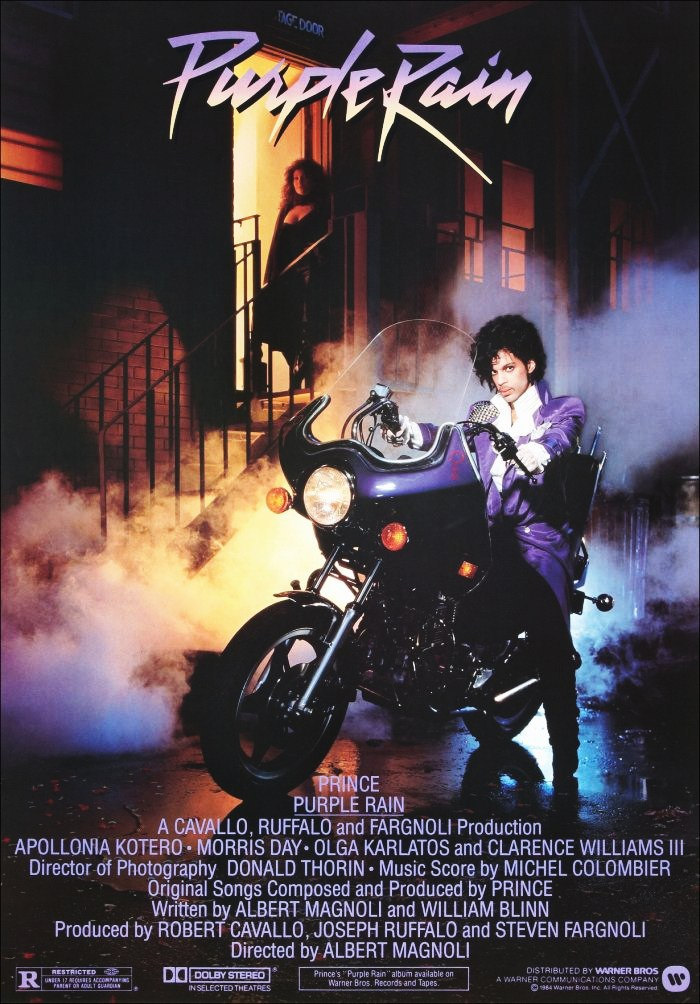
purple rain poster

In my review of Desperately Seeking Susan, I talked a little about how Madonna and Michael Jackson were the biggest stars of the 1980s. One could argue that Prince was up there, too. He had numerous hit songs and his style was very much a part of that decade.

I liked some of his songs, but if I’m behind honest, I wasn’t really that into him. I’ve never really ventured beyond his hits and it was decades after its release before I had even heard the song “Purple Rain” much less seen the movie.

I’ve learned to appreciate more of his music over the last few years and was happy to use the Awesome ’80s in April as an excuse to finally watch this film.

As a piece of cinema, as a narrative story, Purple Rain is not great. As a time capsule, as a snapshot of Prince in this particular stage of his career it is pretty fascinating. As a music video, it is freaking fantastic.

They say the story is more or less autobiographical with Prince pretty much playing himself. Here he’s called The Kid and he’s an up-and-coming musician in Minneapolis along with his band The Revolution. They have a regular gig at the First Avenue nightclub (an actual Prince haunt) but the headliners are Morris Day and The Time. The two groups have a less-than-friendly rivalry.

The Kid has a lot of talent, but his personal life is a mess. His father (Clarence Williams III) was a musician as well, but he never made it big and is now an alcoholic and abusive husband. Two of the women in The Revolution hand him the music to “Purple Rain” a song that they wrote, but he refuses to listen to it. He wants to be the star.

He starts a relationship with Apollonia (Apollonia Kotero) but when her own musical career starts to take off the Kid suddenly makes those lyrics from “When Doves Cry” become reality (“Maybe I’m just too demanding/Maybe I’m just like my father, too bold”). He becomes jealous and abusive. He also plays a brutal rendition of “Darling Nikki” at the club while staring directly at her.

If this movie is autobiographical then Prince does not come off as a good guy. The weird thing is the film doesn’t really give him much of a redemption arc. He does come to realize that he’s becoming more like his father, but he doesn’t really apologize to Apollonia or the band. His only real action is to finally perform “Purple Rain” and even then he doesn’t acknowledge that it was written by his bandmates.

It is, however, a brilliant performance of that song and at that moment I can forgive him, too. All the songs and performances are terrific. They really are the reason to watch the film. And for that, it is well worth watching. Just don’t come expecting a great story or any real insight into Prince, the character, or the person.
The Friday Night Horror Movie: Evils of the Night (1985)

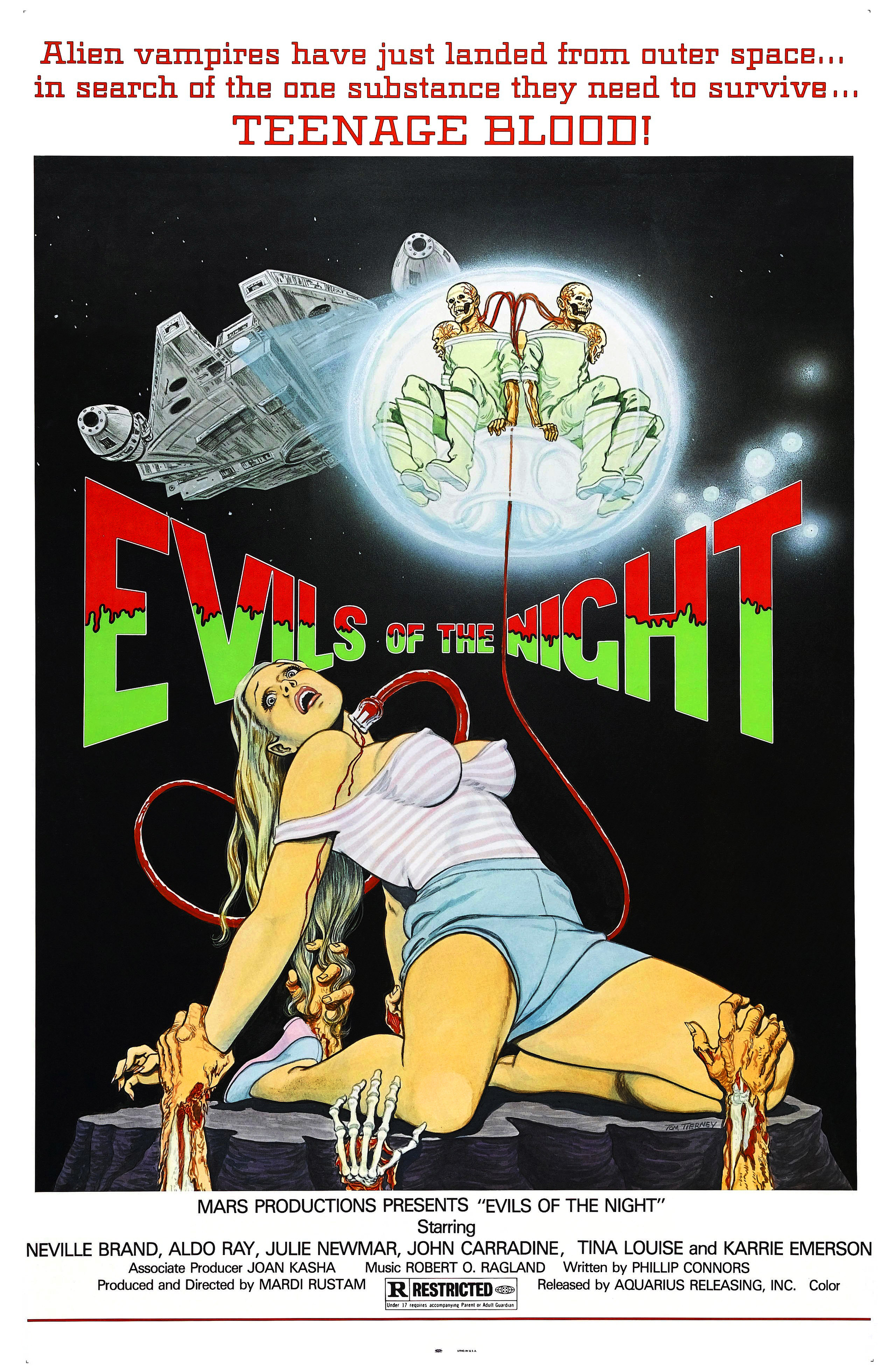
evils of the night poster

I’m fascinated by the careers of classic film stars late in their lives. Every now and again an aging star will land a wonderfully juicy film role, but mostly they found themselves in cheesy television shows as guest stars, or in low-budget horror films, slumming.

Julie Newmar, Neville Brand, Aldo Ray, John Carradine, and Tina Louise weren’t exactly the biggest stars of their day, but they made some good movies and starred in some enjoyable TV shows in their prime. They deserve better than this.

I watched Evils of the Night primarily based on that cast list and the basic plot description that involves vampire aliens kidnapping attractive young people for their blood.

I should have just gone to bed early.

I’m a fan of bad movies. I love the so-bad-its-good genre of cinema. This film doesn’t deserve to be called bad. It’s terrible.

The first twenty minutes find a bunch of sexy teens frolicking at a lake and sexing on the beach. Some dudes in ski masks (Neville Brand and Also Ray) snatch some of them and take them back to a hospital where Tina Louise, John Carradine, and Julie Newmar attempt to extract their blood, but not actually kill them.

It is never quite clear what they need the blood for, only that it has to come from healthy young people (but not too young) and that they can’t have any bruising (which is a problem for them because the guys is ski masks keep beating the kids up before they bring them in.) There is some business about the bosses screwing up by landing them in this small town where there aren’t enough healthy youngsters or intelligent minions to make their plan work. But nothing is really explained.

It is a weird mix of ’80s boner comedy and slasher horror with a bit of sci-fi alien story mixed in. But it feels completely thrown together with very little thought or effort put into it. For example during the numerous sex scenes, everybody keeps their shoes on and the guys never even unbutton their pants (the girls, including porn stars Crystal Breeze and Amber Lynn, naturally, get completely naked). The masked dudes wear masks to conceal their identities, but also overalls with their names on them. The spaceships come from clips stolen from the original Battlestar Galactica series (the poster includes a slightly modified Millenium Falcon).

One imagines they blew their entire budget on the stars and then just slapped something together fast and cheap hoping to recoup their money based on name recognition alone.

Please, do everyone a favor and don’t watch this film. It is bad enough that I had to.

Awesome ’80s in April: Slave Girls From Beyond Infinity (1987)

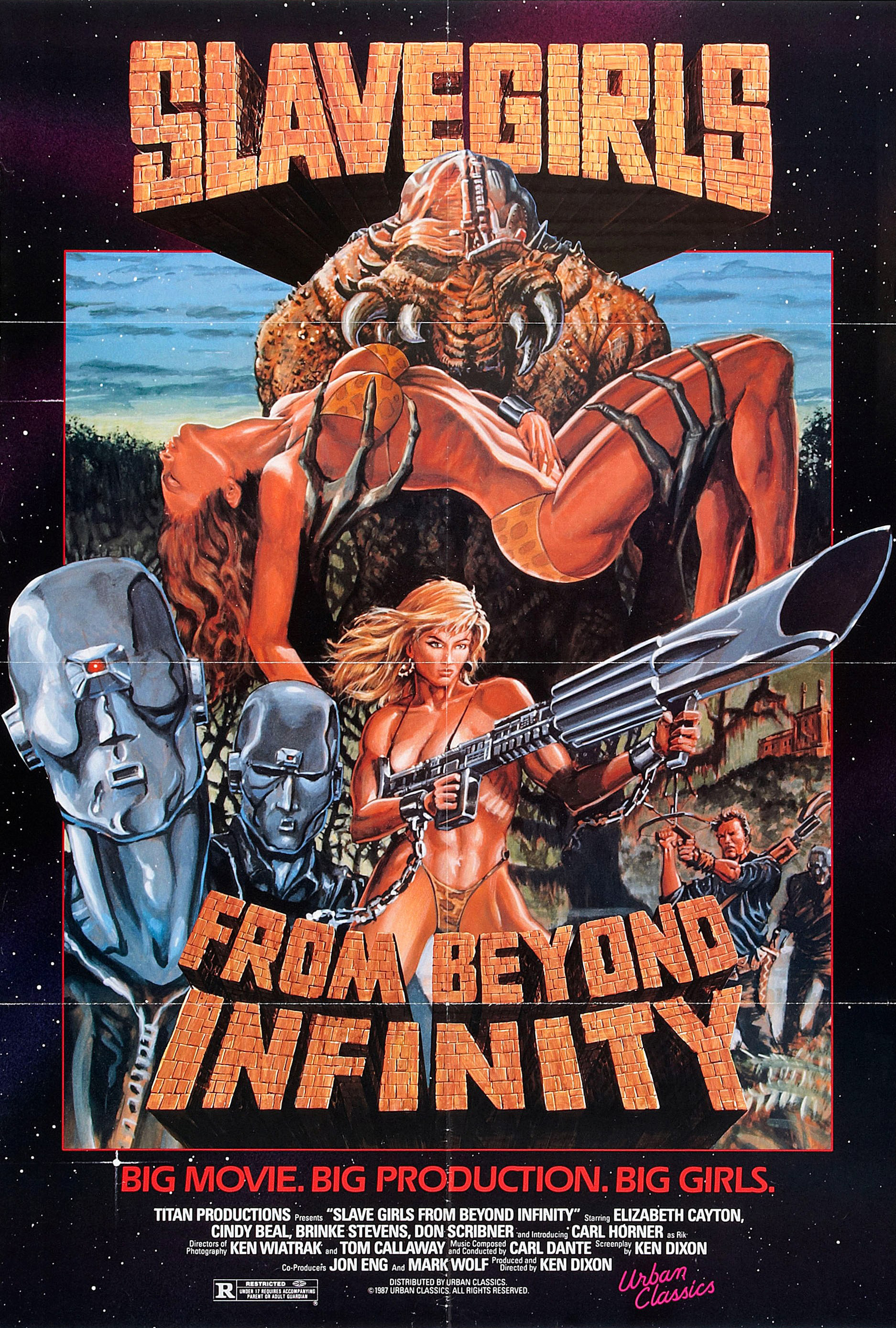
slave girls beyond infinity poster

The 1980s brought unto us the Video Cassette Recorder, also known as the VCR, and the Video Home System, also known as the VHS tape. Well, technically, these things were available way before the 1980s, but that decade made them popular, and it was then most people experienced home video. And technically Betamax came before the VCR, but it lost the Video Format War and so most people only ever had a VCR.

They say it was the porn industry that won the war for the VCR but that’s another story for another time.

My family was early adapters of the home video industry. We actually had a Betamax for a little while but eventually switched to VCR and never looked back.

Once the VCR took off it exploded onto the scene. Almost everybody had one. Video stores seemed to spring up almost overnight. The big sellers (or renters I should say for it would be many years before you could really buy a movie – I still remember seeing a price sheet once and the cheapest tapes were over $100, clearly they were meant to be purchased by stores and rented out) had a lot of shelf space to fill and while the big blockbusters and new releases were the reason most folks came into the store, they needed to fill those shelves to give the customers at least some semblance of major choices. Loads of small studios and big dreamers (or big pockets and a good sense that the home video market was a boon) started churning out low-budget movies to help fill those shelves.

Naturally, if you didn’t have a budget to make your movie then you had even less to market it, so you needed some reason for folks to buy your films and rent them. Exploitation cinema was nothing new, people had been making exploitative films for nearly as long as film existed. But the 1980s saw an explosion in the market. Sex sells, of course, as do naked boobs, blood-soaked violence, and big action. If you can make your audience laugh on top of that, then all the better.

I love that stuff. I especially loved it in the 1980s and early 1990s when I was coming of age as they say. There used to be a late-night cable show called USA Up All Night. It was hosted by Gilbert Godfried on Saturday nights and Rhonda Shear on Fridays. Godfried was very funny but it was Shear who always got my attention. She played a bubbly, innuendo-laden, hot blonde type and this pubescent boy watched her every weekend. Both introduced a series of films and then did various skits during the commercial breaks. The films were the types of films I’ve been talking about. My love for bad cinema can be traced back to watching Up All Night.

This (finally) brings us to Slave Girls From Beyond. I don’t remember if that film aired on Up All Night, but it could have. I felt I would be remiss if I didn’t have at least one film of this nature in my Awesome ’80s in April feature and here we are.

Slave Girls From Beyond is basically a retelling of The Most Dangerous Game, but in space with scantily clad babes. Daria (Elizabeth Kaitan) and Tisa (Cindy Beal) are captured by some mutant-looking dudes. Clad in rabbit-skin bikinis they escape their prison and flee in a rocket ship. Before long a mysterious force causes them to crash land on a jungle planet and they soon find themselves in the fortress of a strange man named Zed (Dan Scribner). He seems to be the only sentient inhabitant of the planet, though he has two robot guards.

A couple of other folks also recently crash-landed on the planet. The dude (Carl Horner) warns the girls that there were more of them, but one by one they’ve all disappeared. Soon enough he disappears and, yeah, I mentioned this is based on The Most Dangerous Game, so soon enough the three girls find themselves being hunted by Zed.

Before that though there is some naked frolicking, lots of running about the castle in their underwear, and a bit of comedy. Later, they will run into some mutants, zombies, and a hunch-backed alien with a laser rifle for an arm.

It is all very ridiculous and silly and kind of fun. There is nobody, and I mean absolutely no one who thinks this is a good movie, not even the people who made it. I do appreciate that the two leads aren’t the typical dumb bimbos. They are both rather intelligent and one of them often rambles off a bunch of technical mumbo jumbo to indicate she knows what she’s doing. They are both quite able to get out of scrapes as well.

If you can get into silly, low-budget, girls in outer space flicks, then you might find this one to be enjoyable.

Awesome ’80s in April: 2010: The Year We Make Contact (1983)

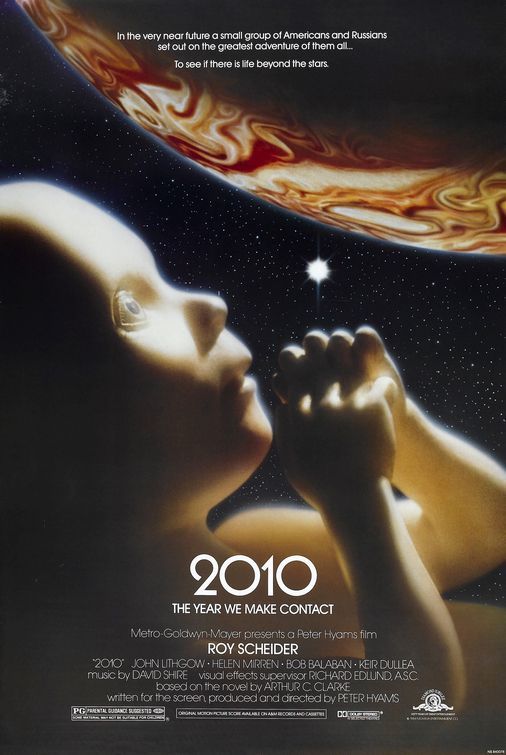
2010 the year we make contact poster

2001: A Space Odyssey is arguably one of the greatest movies ever made. Certainly, it is one of the greatest science fiction films ever put on celluloid. It was made by the visionary auteur Stanley Kubrick. One of the many astounding things about the film is that it is almost entirely told through visual language. Great swaths of the movie contain no dialogue whatsoever. This is also one of the reasons the film is endlessly discussed – it never tells you what’s happening, it shows you.

A sequel was made in 1984. Directed by Peter Hyams 2010: The Year We Make Contact is a pale imitation of the original. As a sequel, it is not great. Where Kubrick’s film is mysterious, asking big questions and giving no answers, 2010 is all answers.

But if you can separate it from the original, and take it on by itself, it’s actually pretty good. Admittedly, that is a difficult task, as this film is basically an answer to the questions asked by the original. Its plot takes place right after 2001 ended and its characters spend their time hunting down what happened in that movie. But if you can get the original out of your mind and just let this one do what it’s doing, then I think you can find it enjoyable.

I said it begins right after the events of 2001, but really it begins 9 years after that movie (hence 2010 in the title.) At the end of the first film, the crew from the Discovery One spaceship which was on a mission to Jupiter are lost. The HAL-9000 computer, which controlled pretty much everything on board went a little crazy and killed most of the crew. Dave (Keir Dullea) the only survivor disappeared. As an audience, we know that he discovered a giant black monolith orbiting Jupiter and was sucked inside it. A long, psychedelic trip then turns him into a cosmic space baby. But in-film, the people of Earth have no idea what happened to him.

The Americans and the Russians are both planning missions to Jupiter to find out. There is a time rush as the Discovery One is slowly losing orbit and will soon crash. The Russians will have their ship ready faster than the Americans, but it is the Americans who have knowledge of the Discovery One and are the only ones who can reboot HAL. So, three Americans Heywood Floyd (Roy Scheider) who feels responsible for the entire Discovery One mishap, Walter Curnow (John Lithgow) who designed the Discovery One, and R. Chandra (Bob Babalan) who created the HAL-9000 computer, jump aboard the Russian ship.

All of this occurs during the height of the Cold War. During the mission relations between the two countries deteriorate with a Cuban Missile Crisis-type situation pulling them toward the brink of war.

The astronauts try to ignore the ongoing politics back home and instead concentrate on the mission. The film does explain what happened to HAL in 2001, but I won’t spoil that here. It explains further what the monolith is and what the aliens want, but again no spoilers. None of that is particularly thrilling or all that interesting. And if you want it to it can destroy all the mystery of 2001.

However, the design of everything is really quite good. I especially enjoyed the matte paintings and the various images of space, Jupiter and its moons and the placements of the ships within all of that. All of the space stuff is really interesting. I also enjoyed the relationships that develop between the various scientists (Helen Mirren plays one of the Russians and she’s always fun to watch, especially when attempting a Russian accent).

If this movie existed on its own, if 2001 had never been made I think 2010 would have been well-regarded. It might not be a classic, but It would definitely have a good following. I’d argue it should definitely be reconsidered, despite the Kubrick film always overshadowing it.

I wrote a different review of this film back in 2004. You can click here and read it if you like (spoiler alert, I hated it).

Listen To Bob Dylan Covering “Truckin'” In Tokyo (04/11/23)

Bob Dylan’s setlists have remained pretty static for years now, especially so on his recent Rough and Rowdy Ways tours. Last night he changed things up and covered the Grateful Dead’s “Truckin'” for the first time ever.

I haven’t seen the bootlegs yet, but Ray Padget has a stream up of this song over on his wonderful Flaggin’ Down the Double Es Substack (I highly recommend subscribing to it, for it is full of wonderful Dylan thoughts.)

It is a nice recording and a pretty great version of the classic.

Awesome ’80s in April: Monkey Shines (1988)

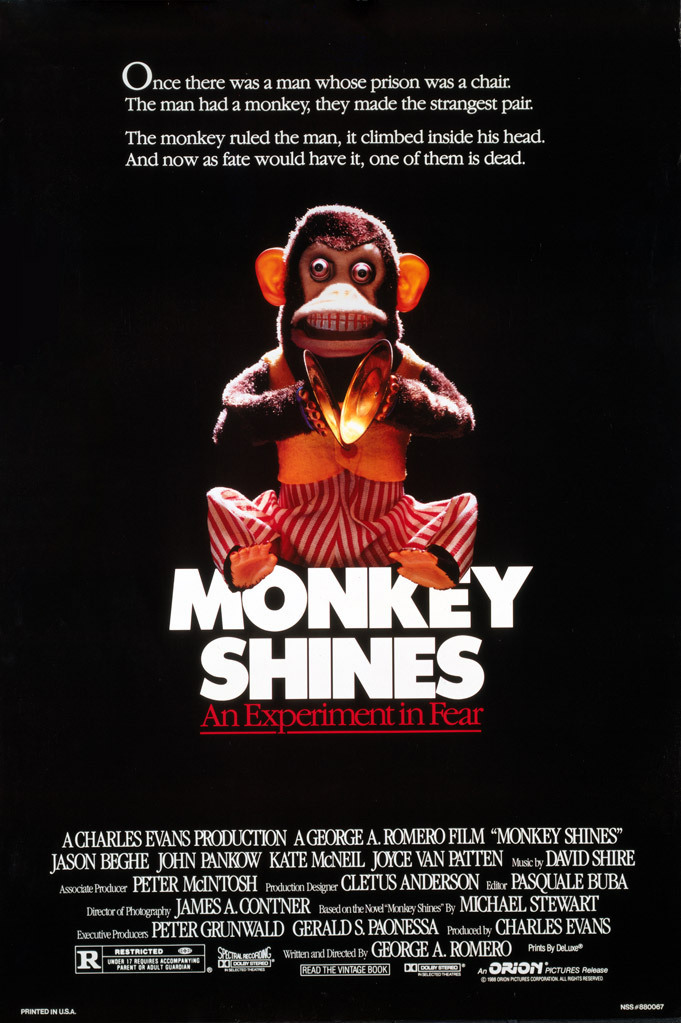
monkey shines poster

For some reason, I assumed this movie was based on a Stephen King novel. I think that was because the poster features one of those toy monkeys with cymbals in its hands. King wrote a short story featuring the same toy (which I’ve read part of, but didn’t finish because the audiobook had to be returned to the library). It is based upon a book, but not anything by King, but rather a British author named Michael Stewart. The film has nothing to do with a toy monkey either. But its plot does run into Stephen King territory.

At the beginning of the film we know something is going to happen to law student Allan Mann (Jason Beghe) because he is out running on a beautiful morning and all seems to be right with the world (and films don’t begin that way unless something bad is going to happen.) Since it features him running athletically and focuses on his muscular legs, he’s naturally hit by a truck which renders him a paraplegic.

He has a tough go of it in the beginning and tries to kill himself. But fails. His kooky scientist friend, Geoffrey (John Pankow) hooks him up with a helper monkey. Geoffrey doesn’t tell Allan that he’s been secretly injecting the monkey, named Ella, with a human brain cell-laden serum.

At first, things seem great. Ella is super helpful and seems to anticipate Allan’s every need. But because this is a horror movie, one directed by George A. Romero no less, things go sideways quickly. Actually, quickly isn’t the right word here, because the film takes its time to get to the psychotic monkey killing people. But they do eventually get there.

Basically, the monkey forms a psychic connection with Allan and it especially attaches to Allan’s anger, and unlike people who might think they’d like to kill someone in a fit of anger, the monkey translates things literally and does some bad, bad things.

There are a few too many side plots involving, among other things, Geoffrey’s boss (who doesn’t like his experiments, and is played by Stephen Root in his first film role), Allan’s Nurse Ratched-like healthcare worker, and Allan’s wife having an affair with his surgeon (Stanley Tucci in his third film role – the wife is played by Janine Turner). There is also a romance with the monkey’s trainer that includes a very interesting sex scene (one of the few on-screen sex scenes involving a paraplegic.)

Romero handles the material well, but this is definitely one of his lesser films. It isn’t exactly boring, but I was very much ready for the monkey to turn psycho much earlier than it did.