A Change Around the Corner

Welcome those of you coming from Blogcritics! I’ve apparently been choosing critic of the day on that site. I have no idea if this is chosen randomly or if some kind soul actually picked me out. I suspect the former, but I’ll still allow myself to be honored.

It seems I have been pretty busy lately, at least if you judge by the number of reviews I have written. I have been giving some serious thought about changing the content of my blog. Originally it was created to keep a journal on my year abroad, in Strasbourg. Eventually, even the excitement of living in a foreign country that speaks an unknown tongue wore off. Oh, I’m still enjoying myself, and am having quite the adventure, but there is a definite groove that I have worn myself into. This does not make an interesting blog.

Anyone that might be interested in the regular goings on of my day, I e-mail anyway, so it seems redundant to maintain that aspect of my blog. This does not mean that I plan to give up posting about my experiences. I simply hope to be a better editor of the information. I am proud of my grocery shopping story from the other day, and I would like to continue to post similar expieriences. Also, when we do any traveling or have any real adventures, I will be sure to post them. This is not a declaration of fact or a change of rules as of yet. These are just things I have been considering and will eventually, probably, move in that direction.

It has been snowing. Strasbourg snow seems like its rain: it comes in slow, continual drizzles. Essentially it has been snowing for the last week, but we barely have an inch sitting on the ground. And that’s only because we got what I would call a proper snowing for about an hour last night.

We went to see The Aviator (2004) a couple of nights ago. I will have a review posted in a day or two. Strasbourg movie houses are set up differently than their American counterparts. They actually do have a large multi-plex, but I haven’t been to it. The ones we frequent (if once a month can be considered frequently)are smaller and more interesting.

This particular one had a little cafe connected to it, where presumably, people could wait before their movie started. We arrived twenty minutes early and were informed we could not yet enter the theatre. Being Americans, the whole cafe idea seems peculiar to us and so we simply waited outside the door.

While we waited I realized I needed to use the restroom. None were visible. I went downstairs, into the lobby, to look. Amy reassured me on my question “Ou son la toilette?” Yet when I arrived in the lobby and found no visible toilet, I froze up. The usher was looking at me as I passed down the steps ready to help me in any way. But I looked away and walked towards the door, pretending that I was waiting for someone. I looked at my watch and generally looked impatient. I cursed myself for being such a chicken and paced about hoping that some sign would show me the way. I had no such luck and returned to Amy feeling no relief.

Why can I not ask a simple question? I know the words, and the pronunciation is easy. Perhaps I was afraid I would not understand the answer. But it is a question of where, and this was a small building. Surely the answer would incorporate hand gestures that would help me along. There have been no recorded incidents of movie ushers suddenly devouring unintelligent tourists. The man’s job was to help, surely he would be willing to repeat himself slowly if I could not understand. Yet there I sat through a 2-hour movie without the ability to relieve myself.

To add insult to my stupidity I got another lecture from my French tutor.  I have not been a particularly good student. My brain has just drawn blanks on the simplest of things. Ann chastised me for not talking with Amy or doing internet work on my own. I feel really bad because she seems to take it personally. As if she is not a good teacher, because I am a terrible student. Not talking to the cinema usher and not talking to Amy are tied together. I am extremely embarrassed when I speak in French. I am afraid of getting the pronunciation wrong, of misusing grammar, of not knowing what words to say. So I simply don’t say anything. Which, of course, does not improve my language skills. I have vowed again to speak more and work more on my own. We’ll see how it goes.

Serenade by James M Cain

serenade book cover

James M. Cain wrote in the first person, from the criminal’s perspective. His storytellers are not usually hardened criminals, yet through circumstances commit the most atrocious of crimes. He writes about downtrodden, out-of-luck schmucks, who fall for the wrong kind of girl. Interestingly, it is usually his women who are tough, manipulative, and full of lust for the crime. The men tend to be suckered in by their seductive charms.

Serenade centers around a down-and-out opera singer, John Howard Sharp. He is so down on his luck that he’s been singing in a small club in Mexico, before, even they, kick him out. His luck seems to change when he meets a cheap whore, whom he falls with. His love for her causes his once faltering voice, to come back. What follows is a transcontinental series of adventures cataloging John’s skyrocketing rise in both movies and the New York opera, and his subsequent fall.

There is plenty to like about Serenade. Cain’s terse, cynical prose moves across the page like a song. He accurately portrays John’s love and hatred for his lover. There are plenty of nice character moments. Moments that give just the right details that give meaning to ordinary events. Much of the “action” of the story revolves around the little moments of life: sitting in a room talking to friends, stroking the hair of a girl, and listening to music. Cain understands that much of life is filled with these types of moments and that great changes and meaning can be found in them.

Before Cain became a writer, he was trained as a singer. In part, this novel seems to be an attempt for him to allow his musical knowledge and training to come to some use. Throughout the book, John converses about or describes internally the music he likes and hates, musicians, and his own singing. Some of this is vitally important to the story, for he is a professional singer, and the plot concerns his successes as such. Yet it is so infused with information that it, at times, feels more like a trade magazine than a proper story. At only 136 pages, it is superfluous to fill so many with discussions on Puccini and Mozart.

There is a revealing moment about John’s character in the last third of the book. Even while reading this in 2005 it seemed shocking. Yet it is treated with aplomb, handled with an expert hand. The feelings that arise out of the character seem true if not entirely kind. It is also interesting to see how that particular issue was handled at that time.

Overall, Serenade is an interesting read. It is well written and the characters are well drawn. However, if you have never read anything by James M. Cain, I would recommend picking up The Postman Always Rings Twice and then Double Indemnity before I began reading this.

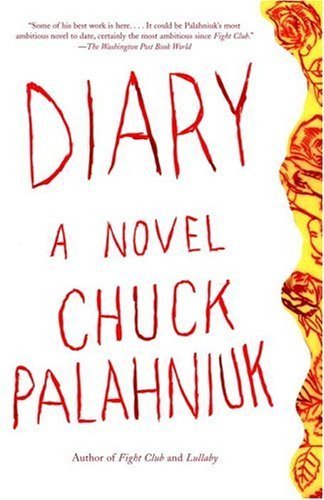
Diary by Chuck Palahniuk

diary chuck palahniuk

Chuck Palahniuk’s first novel was the bitter, cynical, diatribe called Fight Club. It is the story of young males who are so disenfranchised by materialistic American culture that they must beat themselves silly to feel anything. It is a scathing review of a society that numbs its members with consumerism. The characters become nihilistic in their views and begin destroying all that society deems worthy, including themselves. It spoke directly to a generation of males (and many females) including myself. It is a theme that permeates his following novels.

After seeing the excellent 1999 movie based on Fight Club and reading the book, I planted myself firmly in the fandom of its writer. I began reading his subsequent books in no particular order (other than what I could find at the library.) I made it through Survivor, Invisible Monsters, Choke, Lullaby, and most recently Diary. Each of these stories follows the same basic guidelines. An assortment of odd and often disturbed characters move through an increasingly absurd amount of crazed plot lines. There is the former cult member on a plane to his death (Survivor) the faceless ex-model on the road with a trans woman (Invisible Monsters). You get a man who intentionally chokes on food in crowded restaurants so he can bilk his saviors out of cash (Choke) and an involuntary killer who can summon a culling song of death at will. And finally a coma Diary “written” by the wife of an attempted suicide. Each of the novels is filled with jabs and slashes at societal norms. All of the characters go through extreme changes and end with a shocking twist. Unfortunately, they wind up being mostly the same.

Diary tells the story of Misty Wilmont, a once-promising art student, who now waits tables at a seaside resort while she writes a coma diary to her husband. It seems her husband, Peter, whisked the young artist to the resort tourist island of Waytansea. Throughout the story, Peter is in a coma from an apparent suicide attempt. All is not well on the once quaint Waytansea island and Misty quickly finds herself being locked in a hotel room by her mother-in-law and daughter, being forced to paint picture after picture blindfolded. I won’t give any more of the story away, because it is filled with the usual Palahniuk twists. Once again this book is filled with, mostly true factoids, and a biting cynicism towards all things culturally held dear. The problem, here, is that we’ve heard it all before.

Try as he might, Mr. Palahniuk has been writing the same story novel after novel. Oh, he gives us different characters and more outlandish scenarios, but his central themes remain the same. I read this one just waiting for the new twists to occur. But even the twists seem more of the same. I wasn’t expecting the actual twists to occur as they did, but I was expecting the twists, and that knocked half the shock out of them. The characters seem less real, and more like a cheap device to rattle off more nihilistic castigation.

Palahniuk is a talented writer. I just wish he’d get off his philosophy and get to writing something new, something fresh, something that Fight Club was when it first arrived in bookstores.

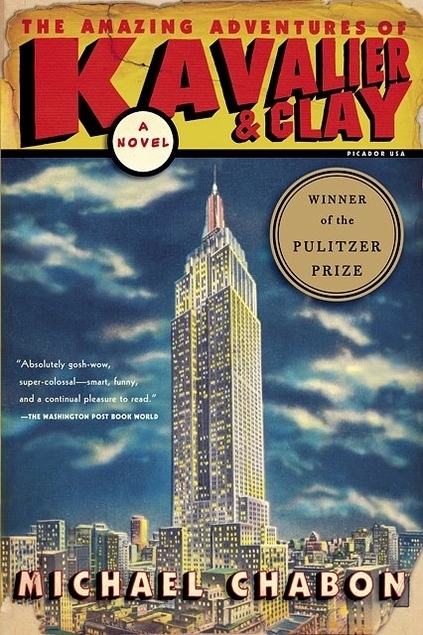
The Amazing Adventures of Kavalier and Clay by Michael Chabon

Amazong Adventures of Kavlier and Clay

I finally tried my hat at doing a full book review with Michael Chabon’s 2001 Pulitzer prize-winning book. I’ve never reviewed a book before, so let me know how I do.

I started reading this book in February or March of 2003. For one reason or another, I was only a couple of hundred pages into it when it was due back to the library. As is usual with me, I decided to give up reading it and turn it in, rather than recheck it. This is not a comment on the quality of the read, but rather a quirk in my own existence. I was fairly busy at the time and I figured that if I only made it through 200 pages in the first three weeks, another three weeks wouldn’t get me to the end of this 636 paged tome. Finding it in the library here, I decided to pick it back up. I’m glad I did and grateful I managed to finish it this time.

Chabon has created a magical book. It is slightly based on the history of comic books and is partly a fictional account of a small group of Jews during the atrocities of Hitler. Though, as Chabon admits, he chooses to ignore facts and history as it suits his story. It is the story of the friendship between Joe Kavalier and Sam Clay. The story begins with Joe having fled Nazi-run Prague for the comforts of his cousin Sam’s apartment in Brooklyn. They quickly become great friends and enter the burgeoning comic book world.

Chabon writes beautifully crafted sentences.  The plot courses forward and backward through time to tell a multi-faceted story. His pen pauses in moments of time during the present and pulls the reader into a back story of Prague, the Kavaliers, and comic books. Joe Kavalier’s story is beautifully told, encompassing a stint as a magician and escape artist before traveling from Prague to New York by way of Asia and California. The story of how Joe traveled to New York by way of a golem-filled box is hilarious, frightening, and poignant. For the first 2/3s of the book, Chabon’s pen doesn’t let the reader down from its magnificent beginning.

Yet it is about 2/3s of the way in, that the story begins to falter. In an effort to tell a grand, epic story, Chabon treads beyond the beautifully told past, and magnificent present, into a less-than-glorious future. Seeing his characters rise from humble, troubled beginnings to a stellar, triumphant present, only to have them fall again was a mistake.

It’s not so much the fall that hurts the story but the rushed way it is told. The novel moves at a slow pace, giving many sumptuous details and never minding slipping into the past for a revealing story. Yet, when it moves to the future it seems to force things along. You can feel the writer telling his story to point towards his final concluding point, rather than just allowing the story to unfold. To really flesh out the future section he would have needed another few hundred pages. I would have preferred him to wrap up the story by leaving out the future scenes. He does manage to salvage the conclusion and bring his characters into fully realized beings.

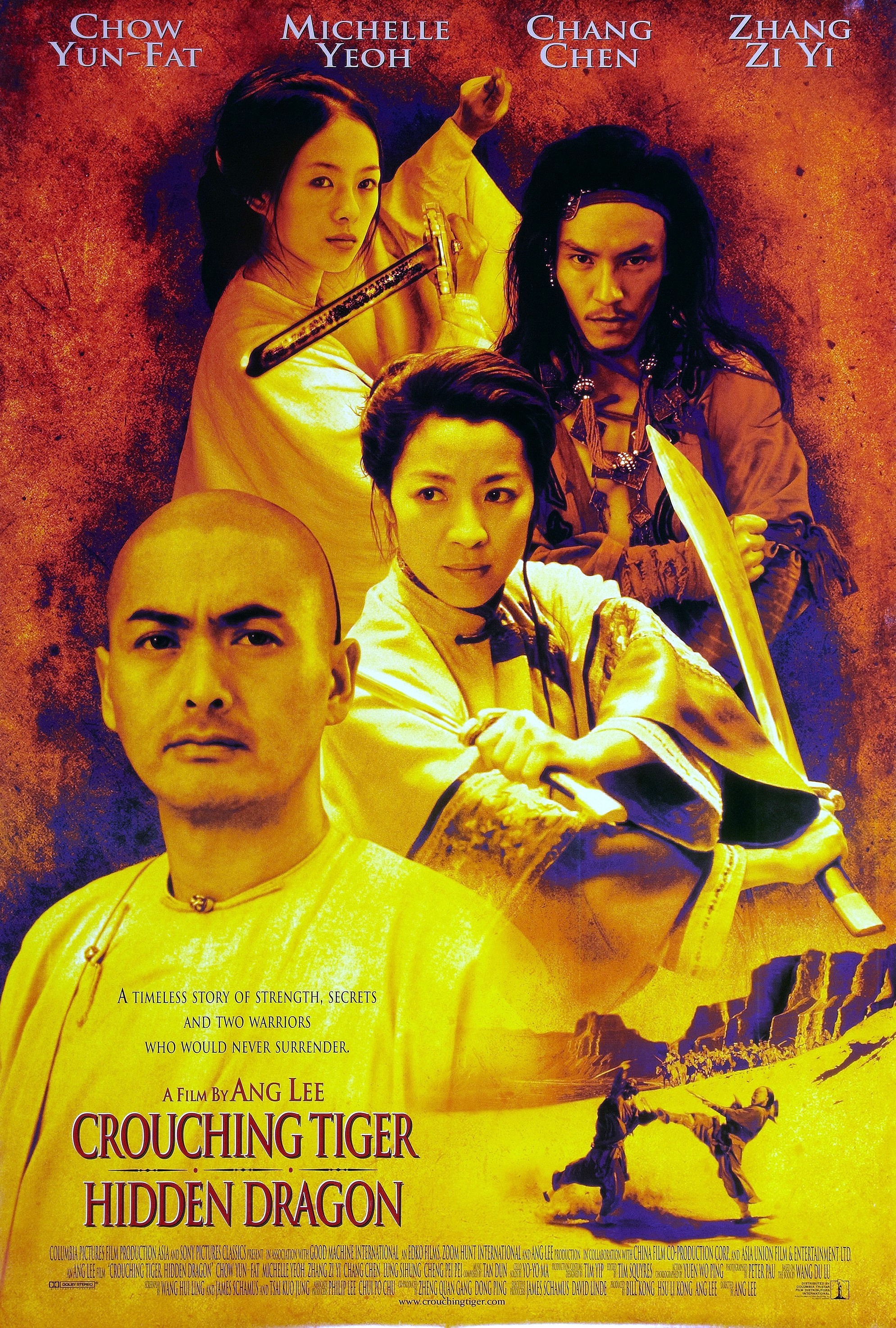
Crouching Tiger, Hidden Dragon (2000)

crouching tiger hidden dragon poster

Now that wire work is pretty standard in American film, it is hard to remember how impressive the effects were in The Matrix. Though The Matrix was hardly the first to use that type of effect, Asian cinema had been doing it for a while, it was the first time I had seen anything like it. I remember being completely awed by the look and movement of the film. Though much of the style and effects quickly became vamped by many films, shows, and commercials, it remained perfect in its visual effects. Crouching Tiger, Hidden Dragon came out a few months later and pushed the Matrix visual envelope even farther. For my dollar, Ang Lee created a smarter, more beautiful use for the effects than the Wachowskis ever dreamed of creating.

The story is a bit tricky. A master martial artist, Li Mu Bai (Chow Yun Fat), decides to give up his heroism and settle down. Proving his seriousness in this new direction he gives up his famed sword, the Green Destiny, to a friend. The sword is quickly stolen throwing Li Mu Bai and another friend, Yu Shu Lien (Michelle Yeoh) into detective work to reclaim it. Added to the plot is a noblewoman, Jen Yu (Ziyi Zhang), about to be married against her wishes, and Li’s old nemesis Jade Fox (Pei-Pei Chang). To add a little more to the plot (I told you it was tricky) Li Mu Bai and Yu Shu Lien are lovers destined to never have their loved fulfilled.

Ang Lee manages to sort out this complicated plot rather smoothly. The film is sumptuously shot on location in China. The renowned action sequences are poetic and beautiful. It feels more like watching ballet than a sword-fighting action movie. The more skilled fighters can climb up walls, jump great heights, and seemingly fly through the sky. Though the film never explains how they are able to manage such incredible feats, they do it with such agility and grace, that you never think to question it. There is a scene fought out amongst tall whisp trees that is pure poetry. Yet the action sequences never stand in the way of the story. This is not a film designed to wow the audience with nothing but visual tricks, the action serves the story alone and is not there to give cheap thrills.

As the film unfolds a theme develops. Li Mu Bai and Yu Shu Lin never express their love for each other out of honor and loyalty. They hold to strict codes that must be obeyed over all of their own desires. Jen Yu is also bound by codes of conduct, but she chooses to disobey them and strives to live her own life. This serves as the central conflict between the characters. I will not give too much more of the plot away but will say that film concludes this conflict in a manner not seen often in cinema.

It is difficult for me to judge the acting of a foreign film. I choose only to watch the original language, with subtitles. This allows me to hear the nuances of the actor’s voices, but since I must rely on the subtitles to tell me what they are saying it is difficult to really judge a performance. That being said all of the actors do a fine job. Chow Yun Fat does a remarkable job as a master fighter. In each action scene he is in he fills the screen with a knowing presence. He fights with great poise as if he knows he will be the victor, but does not want to show his true ability. Michelle Yeoh and Ziyi Zhang are also standouts.

My only complaint has to do with one of the subplots. In the middle of the picture, we get a long back story on part of Jen Yu’s life. After watching the film again I can see that the back story is essential to the overall theme of the film, but it is still too long in the telling. It also serves to slow the film down just as the plot was finally moving along. I believe the essentials of the back story could have been told at a quicker pace allowing us to understand what is needed without slowing the pace of the film down or lengthening it too much.

This is a small complaint with a truly wonderful film. I have been a fan of Ang Lee for many years, and this film stands as his finest achievement. He is known for his smaller, character-driven family films. Here he manages to achieve something on a grander scale, yet maintains a beautifully portrayed character drama.

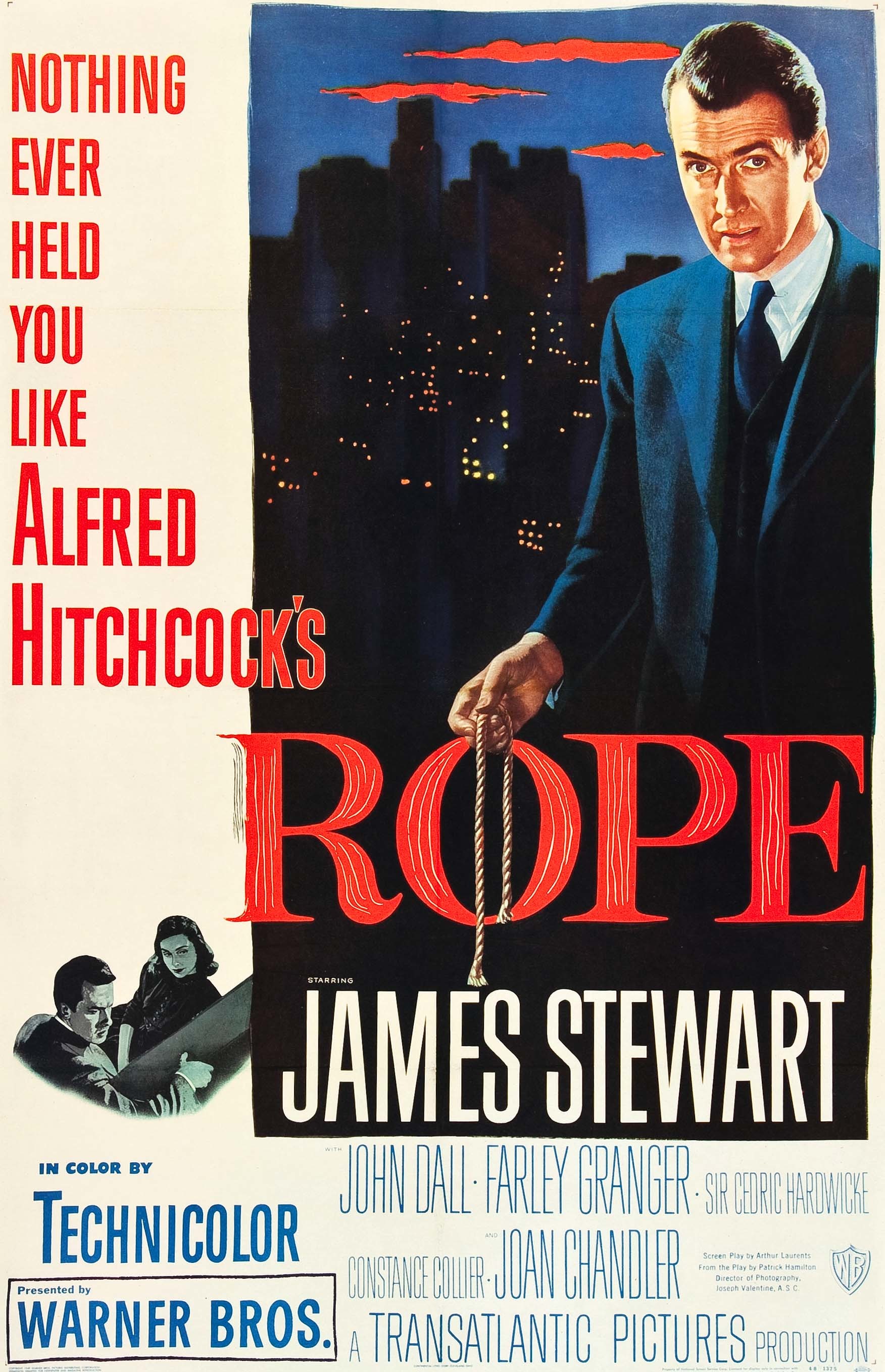
Rope (1948)

image host

This 1948 Hitchcock film is mostly noted for its technical achievements. Hitchcock filmed this story, about two well-to-do rich kids who decide to commit a murder for the fun of it, as a play. Which, in fact, originally was, though based in London and not New York. Technical limitations did not enable his original vision of making the entire picture one continuous long shot. Instead, it is made up of several 8-minute continuous shots. This was the length of film that fit into one reel. Using some very inventive cutting techniques the film appears as if it was filmed all in one take.

This is more impressive when you see the actual size that color film cameras during this time period. They were absolutely enormous, bigger than a man standing. To move the camera in and around the small stage space, many of the set pieces were set on casters and rolled about to keep out of the way of the camera. Some of the actors were noted saying that they worried every time they sat down, that there might not be a chair for them to fall into. Another achievement of the film is in terms of lighting. The apartment that the entire film is set in has several large windows overlooking the city. As the movie is more or less uninterrupted from start to finish we see the lighting change as the sun begins to set and night falls. It is a testament to this achievement that upon first viewing you don’t really notice the effect. Yet, the filmmakers took great pains to get it to look realistic, staging numerous re-stock for the final few scenes.

Though the technical achievements are quite wonderful, it is a shame that they have overshadowed what is really a very good bit of suspense. It seems the two high society murderers have planned a dinner party just after the murder. They store the corpse in a wood box that is featured prominently in the midst of the dinner. This creates an excellent mix of suspense and macabre. Throughout the party, the murderers become more unraveled even as they are enjoying their little game.

All of the acting is quite good. The two murderers (John Dall and Farley Granger) do a fine job of playing intellectual, society playboys, with a desire for excitement. It is slightly annoying watching their excited, nervous mannerisms (especially some stuttering by Jon Dall) but it is fitting with the characters. Their former instructor, Rupert Cadell, is played magnificently by the impeccable James Stewart. This is a bit of a departure from Stewart’s typical roles. Here he is a tough, cynical intellectual. This was the first of four collaborations between Stewart and Hitchock and it is hard to imagine his role as Scottie in Vertigo without this movie.

The story unravels in typical Hitchock fashion. The suspense is built, then lessened by some well-timed comedy, and then built again to a final crescendo. Hitchcock was excellent as a technical director and allowed his actors the breathing room they needed for fine performances. In the end, I left the picture feeling more excited about the superb storytelling than any particular technical achievement. It is a testament to his craft, that Hitchock allows you to leave a picture being enamored with his story over his technical achievements. Some of the greatest effects are those you don’t notice because they seem so natural and real.

Alfred Hitchock manages a triumph of technical brilliance and suspense in Rope. Its influence in the technical realm of cinema far outshines any effect the story has on future movies. This is a shame, for the story being told is one of suspense, macabre, and excitement.

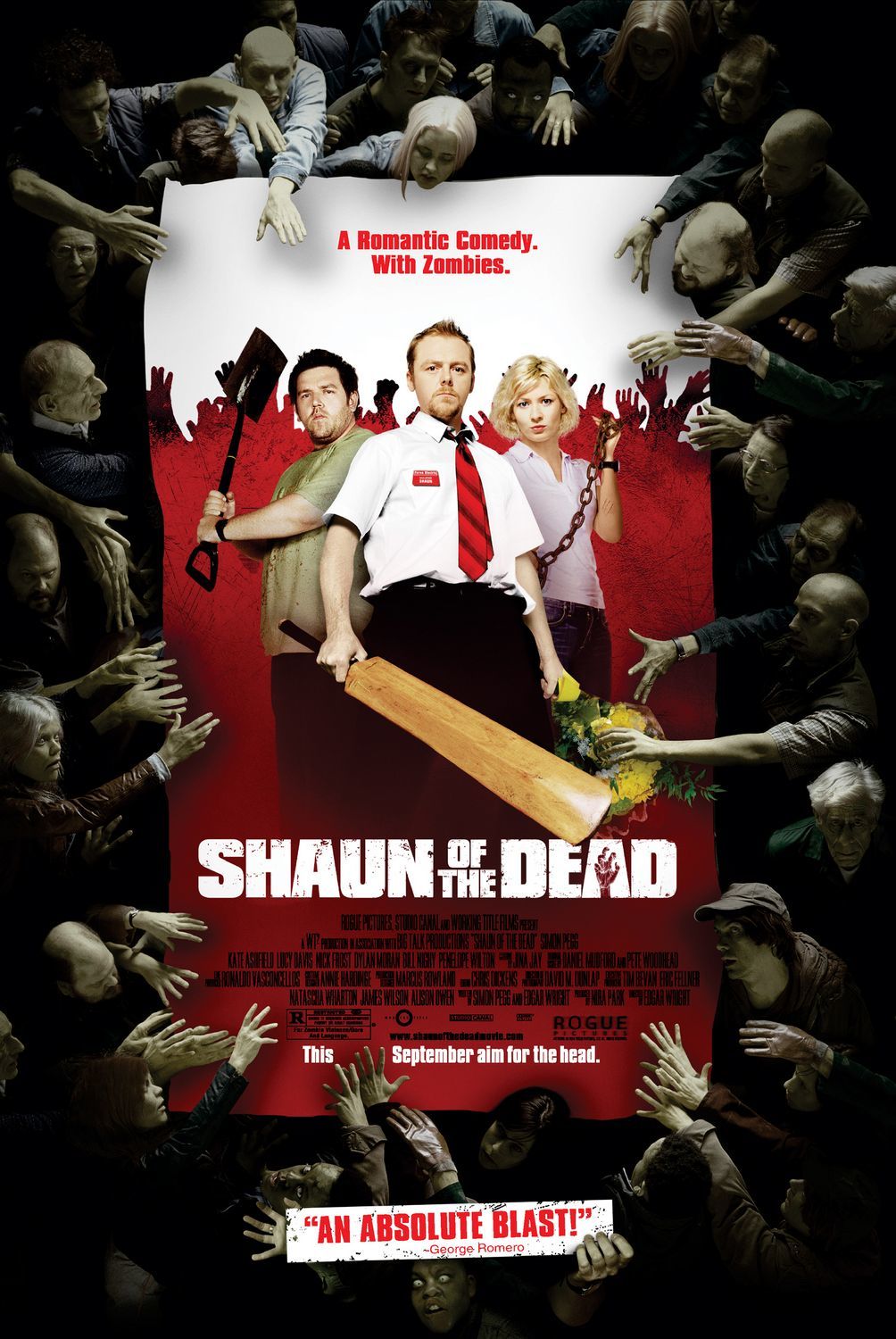
Shaun of the Dead (2004)

shaun of the dead poster

Editors Note:   I don’t know what I was thinking with this review.  I’ve since watched Shaun of the Dead many, many times and I absolutely love it.  I don’t know why I didn’t find this movie funny the first time, I now think it is hilarious.  Oh well, you live you learn.

I’m the type of person who doesn’t read movie reviews before I watch the film. I don’t seek out trailers online or read the latest dish on upcoming releases. I prefer to go into a film with a clean slate, knowing as little as possible about the film before I see it. I find the moviegoing experience more enjoyable when I have fewer preconceived conceptions about the movie I’m about to watch. That being said, I love to read reviews and seek out trivia about movies that I have already seen. I enjoy reading other people’s thoughts and ideas about a movie and comparing them to my own.

Since living in France I have completely been out of the entertainment loop. We don’t have a TV and it is rare that we go to a new movie. I do visit a few websites to keep up with the news and hear bits and pieces of the movies that are coming and out and generating some buzz. Shaun of the Dead is a film that I have been hearing buzz about for several months. I refused to read any reviews or really research any aspect of the movie, but I couldn’t help but hear bits and pieces of good things about it. Primarily that it was a funny zombie spoof. Being a fan of the zombie genre, when the chance came up to borrow the DVD, I didn’t hesitate to take it.

The plot is the pretty standard zombie plot. Some type of radiation/virus wreaks havoc on the earth re-animating the dead into brainless, homicidal maniacs. The movie does a good job of spoofing many of the conventions of the genre. The title character, Shaun, (Simon Pegg) is so stuck in his humdrum existence it takes him a couple of days to realize that his city has been attacked by zombies. He has a dead-end job, his girlfriend just broke up with him, and his flatmates are constantly fighting. Despite there being several zombies eating human flesh around him and the constant media blitz,  it literally takes a zombie in his backyard for Shaun to notice. There are a number of truly funny scenes that mimic many of the classic zombie cliches.

Here, the zombies walk in the classic, slow-motion, brain-dead way. They are mockingly slow. In one scene Sean and his friend, Ed (Nick Frost), throw a large crate full of junk at two zombies, then have time to run for a crate of records and argue which records are crappy enough to launch. The entire time the zombies are slowly walking toward them to devour Shaun and his friend. Other scenes have one zombie being beaten with pool sticks repeatedly to little or no effect. Time and time again there are little digs at the genre conventions while still lovingly following them.

A quick perusal of IMDB’s list of trivia for this film will show plenty of references to nearly every zombie film imaginable. I consider myself a fan of zombie films, but these guys must be nuts about them. They’ve set up multiple scenes that are an exact homage to older films. They’ve lifted lines right out of the classics of the genre. I must say that while reading the list I became more impressed with what the filmmakers created with this picture, but while watching it most of the references went over my head. As I said, I like zombie movies. They’re gory, violent, bloody, and often hilarious (intentional or otherwise). I have seen more than my fair share of good and awful zombie flicks. Yet here, most of the references were naught caught by me. I can’t exactly fault a film for referencing so many other films, yet I have to wonder who but the diehard zombie fanatic caught them.

My biggest complaint about the film is that it is too comedic, without being funny enough. What I mean by that is that the production is made like a comedy. The actors play their parts as if they are in a comedy and not the horrible zombie-addled situation that is scripted. Sure, there are a few moments of anguished screaming and fear, but those are over acted and far between. The story is truly frightening, the dead came to life and are devouring the city. This is not a light-hearted romp. Though often quite funny, zombie films play the situation straight. I felt let down that everyone was playing the situation for gags and not allowing the comedy to be more organic, or to flow out of the conventions of the genre itself. In the end, I didn’t find the movie funny enough for all that.

It was played for humor all the way through, yet I wasn’t laughing nearly enough. Some of this comes from not getting all the “in” jokes. Some of this is also, likely enough, because it is a British comedy at heart. There are a number of bits that seem to play better for the British sensibilities than my American in France’s heart. There were several moments that I could see the joke play out and “get” it, but it wasn’t enough to really make me laugh. This is not to say the movie isn’t funny. Because it is, often hilarious even. It’s just that the tone of the film was of great comedy, and the buzz I had heard matched this. Yet while watching it, I didn’t find it as funny as expected.

While thinking about this review I began to wonder how I would make a zombie spoof better. It wouldn’t be right to go the Zucker brother’s way. I got over that type of comedy in junior high, and the genre (well the horror genre which zombie movies are a sub-genre of) has been spoofed in this way enough (see Scary Movie). Slap stick spoofs were perfected by Sam Raimi in the Evil Dead series. In the end I decided that what the filmmakers were trying to do with this film is exactly the way to do it. I just think they missed the mark a little. I think I was partially disappointed because the genre itself has produced enough unintentional humor. Zombie movies are so often insanely bad, they are great fun. It is difficult to spoof a convention when the convention itself is so awful it seems a spoof unto itself. Likewise, some of the conventions such as the ineptness and slow walk of the zombies have been revamped by the likes of Danny Boyle. Instead, here, I would have preferred a darker, bloodier movie. I don’t believe this would have hurt the comedy. The references and homages could have stayed in tact and comedy could come out of horrific situations.

Shaun of the Dead is a fine movie. It spoofs a genre of film that is dear to my heart, yet remains firmly a fan of the genre. It references so many of the classics and non-classics of the genre that you’ll need an encyclopedic knowledge of zombies to catch them all. It is truly funny and makes a great party movie. Where it fails, it fails as a zombie movie. It is made for jokes and not scares, and there it falls a little flat for a good spoof. But certainly worth the price of the rental.

Roma

Leaving on a Jet Plane

The end of the French University semester is at the end of January. Unofficially this is about a two-week break for the professors and lecturers. It was a little bit shorter for Amy because she had to finish grading her student’s presentations. She recorded them using the video feature of our digital camera. We had the joy of watching third-year English students give an oral presentation on such illustrious topics as “American Politics” and “British Immigration. Once she finished grading she had to present some research to her advisor back in Indiana. Basically, they wanted her to show that she had been doing some research during her year abroad. Even with all of this work we still managed to have a few days free. We discussed going to London, Dublin, bits of Scotland, and even Barcelona before finally settling on Rome.

Ryan Air is an ultra-cheap airline in Europe. Unfortunately, they no longer fly out of Strasbourg but have an airport about 30 minutes away in Baden Baden, Germany. Even with the added travel time we purchased tickets that were cheaper than taking a train or bus. Daniel agreed to drive us to Baden Baden. Tammy and Fabianne decided to make a trip out of it because there is a Wal-Mart in Baden Baden. If it seems strange to travel to another country for a Wal-Mart so let me explain the reasoning.

There is no Wal-Mart in Strasbourg. As I have mentioned before shopping in this city is a bit of an adventure. No store carries all the items you will need. It usually takes 2 stores for all of our grocery needs. Buying any household item will generally take a visit to 3 or more stores before we find the items we were looking to purchase. Auchan comes closest. They have a good variety of both groceries and general goods, but even they do not have everything your average Wal-Mart will have. Prices in Germany are generally much cheaper than in France because they have less taxes. Add that to Wal-Marts general low price and you have quite a bargain. Since we were already headed to Baden Baden riding along for convenience and low prices was an easy choice for the ladies.

We planned to meet at the girls apartment at 9:30 Tuesday morning for our ride out to the airport. Daniel and company arrived about half an hour late, but no matter because we still arrived at the airport over an hour early. Ryan Air has a habit of flying out of smaller airports, often taking space in old Air Force bases. Baden Bade was no exception and we got our boarding passes quickly. The flight was quick (about an hour and a half) and smooth going. We flew over some beautiful, snow-covered mountains, and then landed in Rome.

The Ryan Air Roman airport is located next to a military base. We were greeted off the plane by camouflaged men with machine guns! Inside the airport proper were roaming guards equipped with Uzis. As with most airports, it was located outside the city. We went outside where there was a bus waiting and purchased our tickets to the train station. Quite a few other people were doing this as well. Amy and I were the last two people aboard, and it was PACKED. I pushed my way onto the steps of the bus and could go no further. Driving down the road I had to lean against the door of the bus. I prayed the door wouldn’t suddenly open and send me flying into the streets. Standing on the steps of a crowded bus, leaning against the door is never the ideal travel circumstance, and in Rome, it was a nightmare.

There has seemingly never been a good city planner in the city in its 2,000+ years of existence. The roads wind, twist, and curve every which way. The bus driver apparently learned his job from a blind man. He drove fast, rarely hit the brakes, choosing rather to take wide curves nearly smashing the parked cars on the side of the road instead. My view was one of panic. The bus took us to the metro station which we took to the train station.

Our hostel was located just a block down from the train station. This is in the middle of the city. My first impression of Rome was that it is dirty. There in downtown Rome, the building are high and allow little sunlight to penetrate the streets. All sorts of people were milling about and the sidewalks were full of merchants selling magazines, sunglasses, purses, pants, and just about anything else you can imagine. I got the impression that most of it was bootlegging, but I didn’t stick around to ask.

Using our printed directions we walked the two blocks to our hostel. It was essentially a flat in a big apartment building. There was no sign outside suggesting there was a hostel inside. Luckily there was a number on the building and someone coming out of it as we approached. Two men left the building and I caught the door to let us in. As I did so one of the men in English said, “Can I help you?” I stood there a moment wondering if he was talking to me, but he continued to walk on so I figured it was part of the conversation with the other man. An odd thing to hear in downtown Rome, when in fact, I needed help. Inside we wandered about looking for some sign that would indicate a hostel. After searching the mailboxes for a sign we noticed a door with a small plaque labeled “Eden.” This was the name of the hostel so we knocked. A pleasant young man answered the door and agreed this was the hostel.

He spoke rather good English and began welcoming us with way too much enthusiasm. He brought out maps and began to describe the places we would want to see and the correct paths to see them. He brought out the keys and explained where our room was and how everything worked. I kept wishing he would shut up and let us go sit down a moment and rest. Eventually, he got to money and I whipped out my credit card. “No,” he said, “that won’t work. The credit card machine is broken.” When I asked when it would be working again he shrugged and mentioned that he had called about it, but that in Italy nothing gets fixed quickly. Having no choice I took out cash and paid the man. This was quite discouraging because we had planned to put a good deal of the trip on our credit card and only pay for a few things in cash. The hostel took nearly 1/3 of the money I had set aside to spend in Rome.

Hostel

As I said the hostel was a converted apartment. The main room had a couple of tables, chairs, and a radio. There was a real kitchen with a stove, fridge, and cabinets. The two bedrooms were fitted with four bunk beds a piece, giving a total of 16 places to sleep. There was a narrow hallway that led to the one toilet. In the hall were two cubicle-sized showers. The room we slept in (Amy on the bottom bunk, me on the top) was never completely full. There were always at least two males and two women in the room, with a couple of beds remaining empty. The other room remained mostly full with a group of college-aged girls. No privacy was the norm. Showering was quite an experience. Since there was no lock on the hall door to the showers I generally hung my change of clothes over the shower door. Squeezing into the small shower I would undress shower, and then dress while trying to not lean against the wet walls.

I Go Out Walking

After getting settled in our room we decided to go for a walk. We stopped off at a little cafe and had some supper. We, of course, ordered Italian (pizza for me, calzone for Amy). We quickly realized that recognizing the proper sights was going to be a difficult task. Many of the modern buildings are designed to look like the ancient Roman Forum. There were columns and marble steps everywhere. However, we managed to see the beautiful Ministry of Agriculture building and the Trevi fountain.

The Trevi fountain was built in 1735 as a monument to clean water being brought to Rome via the aqueduct. Legend has it that anyone who drinks the water or throws a coin into the fountain will assuredly return to Rome in the future. It was quite beautiful to behold just as the night began to take hold. Unfortunately, there were numerous gypsies hounding all the tourists to purchase toys or pay to have their pictures taken.

One man came to Amy with a rose saying it was hers for free because of her beauty. Now I believe my wife is truly beautiful, but strange men don’t offer her roses for no reason. She refused the flower numerous times but he kept shoving it into her hands and expressly claiming he wanted no money for it. Eventually, she cracked and took the rose. No sooner was it out of her hands but the man whipped out a camera asking to take her picture for a small fee. Again she repeated no, and I stepped in with a much louder NO! and the man finally accepted the rose back and left us alone.

We were there for maybe 15 minutes and were approached at least four times by people this way. We returned back to the hostel around 8:30. We found a young lady completely wrapped up in covers and sound asleep. We went to the main room and began playing cards. Soon several other ladies came in saying “hello” to us and then speaking to each other in Italian or Spanish. All of this was very disorienting. We were at the end of a long and exhausting day to find ourselves not in the comfort of our own home, but surrounded by strangers in a peculiar little home. As we prepared for bed two other Italian girls came into the room and spoke to each other quite loudly despite the sleeping girl. As the ladies left, another young man climbed into a top bunk and began preparing for sleep. There was an odd moment of me wondering whether I could turn the light off. After the young man was laying under the covers I decided if I was to sleep at all it was to be lights out. I chose the top bunk and dreamed of falling off.

The Roman Forum and Colosseum

We awoke early the next morning prepared for a full day of sightseeing. I found that someone had occupied shower number 1. The second shower was open but I couldn’t seem to make myself enter into it. You see I knew that the occupants of my room were not up yet, and that left only 1 of the girls in the other room to occupy the shower. Though the hostel left little privacy, the actual showers would not permit any indecencies themselves. But still, I felt too awkward to be showing next to some strange woman. I chose instead to sit in the main room. There I was in my pajamas with my towel and a fresh change of clothes. I caught several odd looks from the other residences.

Showered and refreshed we headed out for the Colosseum. We quickly found ourselves lost, and not for the last time. Italian streets tend to wind and curve aimlessly. We had a map, but it was for tourists and didn’t have the details of every road. Luckily there is plenty to see in Rome and we quickly found ourselves staring at the first of many Egyptian obelisks. Unknown to me Rome carries a good many obelisks. We stared in awe of the ancient wonder, turned a corner, and found ourselves in front of St John’s church.

Dating from the 17th century St. John in the Lateran is the Cathedral of Rome, the mother of all churches in Rome. It is also, quite beautiful. The structure is quite enormous, I had to stand a good 200 yards away to get a good picture.

Inside the church is ornate, intricate, and absolutely gorgeous. It is continually amazing to me to see such beauty inside a church. My own faith maintains very simple church buildings. Though I understand the purpose and intent of keeping the buildings simple and the heart beautiful, when I enter into these buildings I can see some truth in the ability of a building to bring you closer to God.

From there we found our bearings and made our way to the Colosseum. Like most people, I suppose, when I think of Rome I think of the Colosseum, and had been looking forward to viewing it since we began planning the trip. I was not disappointed. The Colosseum is located next to several preserved areas of the ancient Roman city. It was quite a feeling to realize that I was walking in pathways that men have walked for over 2,000 years. Some of the first Christians walked those very steps, stayed in those very ruins, and were killed on that very ground. The apostles Paul and Peter walked, talked, and preached where I was walking and talking. You seem to only see the Colosseum photographed from one side, but it is just as unique and interesting the whole way around.

We stopped to eat at a little stand next to the Colosseum. My advice to my readers is that if you ever go to Rome, eat before you visit this structure. One small cheese sandwich, one pastrami sandwich, and two Cokes cost us 17 Euros! And for this, we had to stand in line for 15 minutes! After walking around the structure a couple of times we debated about whether to actually go inside. Our desire was to go in and see where the fighting occurred, however, there was a long line to get in and we knew there was much more to see that day.

After talking it over and deciding not to go in we noticed that the line had actually shrunk a great deal during our debate. We paid our money and ventured inside. Again, you usually only see the inside of the Colosseum photographed from one angle. I had only seen the floor taken from above. That shot doesn’t really give a good perspective, because what you see in real life is much more interesting. Underneath what was once the floor is about three levels of pathways. It is amazing how deep the trenches go. But then there is much more to see in terms of the walls and what is left of the stadium seating. To stand where thousands of others stood and watched countless bloodbaths was quite an experience. My tour book states that contrary to popular belief the Colosseum was not a place of martyrdom for thousands of the early Christians. Apparently, this rumor started from a permanent cross set up there by Benedict XIV. He did this so the structure would be considered holy and not destroyed any further. However, there is little evidence that Christians were killed in as great a number as popularly believed. My other tour book stated that there probably were Christians killed in the arena, but not in great numbers.

From the Colosseum, we ventured to the Roman Forum and then up to Palantino. The Roman Forum consists of the ruins of various temples and governmental buildings. Palantino is, according to legend, the site of the first Roman settlements. It also later held the homes of the nobles and emperors. What remains now is the ruins of their palaces. It was very interesting to see these ruins.

A few buildings remained pretty much intact, but many were but traces of their former grandeur. While I was there I couldn’t compare this section of Rome with our trip to Paris. In Paris all of the old buildings are in pretty good shape and, of course, date back to the Renaissance and not before Christ, and thus are very beautiful. Rome, through all its history, is not nearly as pretty. The Louvre will never compare to the Colosseum in terms of history, but it wins hands down in terms of beauty and grandeur. Nevertheless, the forum and Palantino were quite spectacular in their own way. In the middle of the forum, with little fanfare, lies Julius Ceasar’s grave. Apparently, he was burned and buried in a little spot that only later received any type of monument. Now there is a bit of rock ruins built over a lump of dirt. Not too impressive for a renowned emperor. Though, I suppose, one could say the entirety of the ruins is a testament to him. Palantino is built on top of a hill and gives a wonderful view of the forum and most of Rome.

From there we headed to the Pantheon. It is pretty much like the pictures you see in guidebooks. It has big Greek columns and looks about a million years old. Inside, they were working on the dome, cleaning it inch by inch. There are a few graves inside, my favorite being of the famed painter, Raphael. Outside was another Egyptian obelisk. We grabbed a quick sandwich from a couple of nice old Italians and followed a British tour group onto the Piazza Navona. After a brief rest, we headed home for the day.

Traffic

On numerous occasions, I have complained about the traffic in Strasbourg. Well, I have been to Rome and I take it all back. The roads must have been laid out by a drunken, blind man. Rome has been sacked, burned, and remade on several occasions. The typical way to rebuild the city seems to have been to build right on top of the old city. I don’t think they ever had a good city planner working for them. What remains is a series of roads that are overpopulated, not well spaced, and wind all over creation.

In America when two roads intersect they normally do so at right angles. At the intersection, one places a stop sign or a traffic light and everything runs smoothly. In Strasbourg intersections usually become roundabouts. Each road intersects a circular road which the driver pulls into, and drives around the circle until he meets with the road needed. In Rome, roads just seem to run into each other allowing God and insane drivers to sort it out. I saw 5 or 6 major roads run into each other, twist and turn into and around each other. Creating some sort of massive highway for a brief moment before each road finds its own way, sometimes at very odd angles. The problem for a pedestrian tourist is that there are very few crosswalks with any kind of signal allowing you to safely cross a road.

In Strasbourg, this is also true, but usually you only have to wait about a minute before a nice driver will stop allowing you to cross. In Rome, no such drivers exist. We found out that to get across the street you had to just walk out in front of a car and pray it stopped, which they always did. I decided the reason the city is so religious is because everyone is praying not to get run over.

The Vatican

On our last day, we rose very early to reach the Vatican before the other tourist. Our illustrious hostel keeper had noted that if you make it later than 9 am you should plan on spending the day in line. We arrived at about 8:30 to a steadily growing crowd. Not knowing which way to go in we wound up in line to climb up the steps to the dome of St Peter’s church. The initial steps slowly sloped in circles around the elevator. By the time we reached the top of the first level, we were out of breath and knew it was going to be a long climb to the dome. We rested and managed a nice view of the famous plaza. Some more steeper, circular steps took us about midway up the dome. Here we could climb inside and look down into the church.

Unfortunately, there was a large fence designed to keep jumpers from leaping to their death. It also kept me from getting a good picture. From there the steps became much steeper. The stairwell was very small, allowing you to climb one at a time, and that only if you were relatively thin. Eventually, they began to lean to the side as well and became so steep they hung a rope down so that you could keep your balance. We finally escaped to the outside and the top of the dome.

After joining the small crowd of out-of-breath travelers we were rewarded with a truly spectacular view. You can walk around the entire dome getting a panoramic view of Rome and the Vatican City. Unfortunately, it was a little cloudy that day and my photographs didn’t come out as well as I would have liked. A trip back down the stairs led us into the church itself. Like St John’s it is absolutely gorgeous. But unlike the National Cathedral, it is much larger on the inside. There are several side areas. Many of the Popes commissioned a statue to remember them after their death. These became more and more spectacular. I managed to slip into an English tour group for about the last half of the tour, while Amy listened to her own audio guide.

My favorite part of the church was the underground. There they have a burial room where many of the popes (plus several bishops, a king, two queens, and an emperor)have their final resting place. In this area is where the Apostle Peter’s bones are supposed to lie as well.

After lunch, we headed out of the city to the catacombs. Just outside the old city walls lie thousands of underground tombs. Many of the 3rd Century Christians are buried there. According to law the Christians and other groups could not be buried within the city limits and were thus buried in several catacombs. We visited the catacombs underneath St. Sylvester’s church. It is essentially a series of underground tunnels where thousands of people were buried practically on top of each other. There still remain markings and drawings of the early Christians. We saw the Christian fish symbol etched in a stone as well as some drawings of Jonah and Noah’s Ark.

From there we walked past the Colosseum again and visited the other side of Palantino where lies the Circus Maximus. This was the sign of the old chariot races as seen in the movie Ben Hur. We finished up our sightseeing with a stop-off at the Mouth of Truth. Unfortunately, the church had closed by that time so I was unable to stick my hand inside the mouth to see if it would bite off my hand for being a liar.

The Long Road Home

Our flight was scheduled for 10:50 Friday morning. We left the hostel just after 8 am. We were assured Ryan Air had a shuttle bus from the train station to the airport. After searching all over the train station we finally gave up and decided to take the city transportation. With still over 2 hours to reach our destination we figured we were doing fine. We plotted our path and boarded the metro to the end of the line. From there we went top side and looked for a bus. After spending a few minutes trying to determine which bus would take us to the right place, we spotted numerous suitcase-holding travelers and decided they were probably going our way.

Actually, there were a lot of suitcase-holding travelers and I found myself once again smashed against the door of a crowded bus. This time there were even more travelers trying to get on. Two British tourists began screaming at a couple of Italian ladies trying to squeeze in. This went back and forth until finally, the bus driver said he had to go and made the Italians get out.

The bus made a couple of stops and each time there was another argument with passengers trying to board. Finally, after more than an hour and a half the bus reached the airport. We rushed inside only to see that our flight had been taken off the board. Being 35 minutes before our departure we were sure that we would be allowed to board. We were wrong. The Ryan Air lady said they had a policy to stop boarding 40 minutes before departure time. Saddened and irritated we were given the option of flying to Baden Baden the next day or Frankfurt at 9 that night.

A call to Tammy confirmed that Daniel would not be able to pick us up in Frankfurt and that Baden Baden might be difficult for him. She assured us that there was a bus that ran from Frankfurt to Strasbourg and that we could catch it. We bought our ticket to Frankfurt and decided to spend our time at the airport. It would be a nearly 3-hour trip to and from Rome again and we worried we might miss another flight.

Nearly 9 hours we spend sitting in that small, military airport. We read, we ate, we sighed, but we did not sleep. Finally, the time came and we boarded the plane to Frankfurt. We reached the airport only to find out it was well outside Frankfurt proper. But they kindly offered to sell us tickets to a shuttle bus. An hour and a half bus ride later and we were in Frankfurt.

At 3 am armed guards at the train station informed us that we were not allowed into the station without a ticket. We would not be able to buy a ticket until 6 am. It was cold, it was raining and we were in the seedy part of town. We began walking down the street to get away from the screaming drunks out at that hour. After passing a couple of bars and motel lobbies we finally stopped at an all-night kebob shop, right next to all the sex shops.

We nursed our one kebob and two glasses of water for 2 1/2 hours. All the while trying to ignore the loud-mouthed drunks, bums, and drinking games going on around us. Finally, at around 5:30 we had had enough and walked back to the station. To our surprise, the guards had left and we found ourselves inside. To get to Strasbourg it would take us 2 trains and about 3 hours. I couldn’t pay fast enough. After an hour wait to change trains in some other city, we were on the train home. Finally, at around 11 AM and 28 odd hours of travel we had made it home.

Meditations on the Grateful Dead circa 10/09/77

1977 is not the greatest year for Grateful Dead concerts. 10/09/77 is not the Dead’s finest night, it is not even their best from 1977 or their best night from October. “The Music Never Stopped” is a good song. It is not a Great Song.

But what the band does to it this night is what the Dead could do to just about any song. They make it Great. It begins no better than any number of versions they played throughout the years. All cylinders are popping right on time. Bob sings with his usual gusto.

The verses and chorus sound good, but it is after the last chorus that things really get going. At 3:24 the music begins to break down. The song’s structure is shed. Garcia plays like two snakes intertwined, dancing through each other. Bob follows his trail, throwing loopy, curved rhythms. Lesh hops along behind on bass like a kid on a pogo stick. The drummers keep their pace. Garcia speeds up the race moving his fingers like a jackrabbit on acid.

The pace quickens, and all melody and structure are thrown away, for a moment there is no longer a song, hardly what anyone would call music, but it is magic. An exciting pulsing beast. Garcia’s snakes eat each other and explode into something new. Phil thump thump thumps into the highest reaches of the atmosphere. Bob is no longer playing anything like rhythm unless it is the rhythm of some cosmic god. This lasts for two or three minutes, then without warning every musician, as if on cue, bangs back into the beat. I, wearing my headset at full volume, tense up as if a bomb has been dropped.

I begin to open my mouth half expecting to sing along with the next verse or the chorus. The boys seem to expect this too, playing the melody outright for a moment before realizing there is nothing left to sing. There are no more verses, the chorus has been sung. Garcia takes that cue to soar to the heavens again. The rest of the band continues to hammer out what remains of the song. The melody is there in the backbeat. Phil has it in his bass, the drummers pound it out on the skins, and even Bob is back into the rhythm. But Garcia, sensing the cosmos around him wants nothing to do with the conventions of song. He skates, dances, and weaves through a new song.

Something the audience, as cosmically charged as Dead audiences get, must understand. It is Garcia taking us along for the ride, headed to outer space and salvation, held back only by the melody and rhythm of that song. No longer dancing, Garcia charges ahead to break free. Faster, faster, louder he plays. Like a rocket flaring to break through the atmosphere, but at last, the gravity of the song still being played pulls him down. The band senses their victory and as if toying with Garcia breaks out of the mold of the song and begins the fast beat of the end. A crescendo of noise followed by the crash of a song ended.

No, 1977 was not the greatest year for live Dead. December was not the greatest month in 1977 and October 9 was not the Dead’s greatest night of October. “The Music Never Stopped” is not the Dead’s finest song. Yet in this year, this night, and on this song the Grateful Dead created magic. Just like they did for 30 years over different years, different months, and different songs.

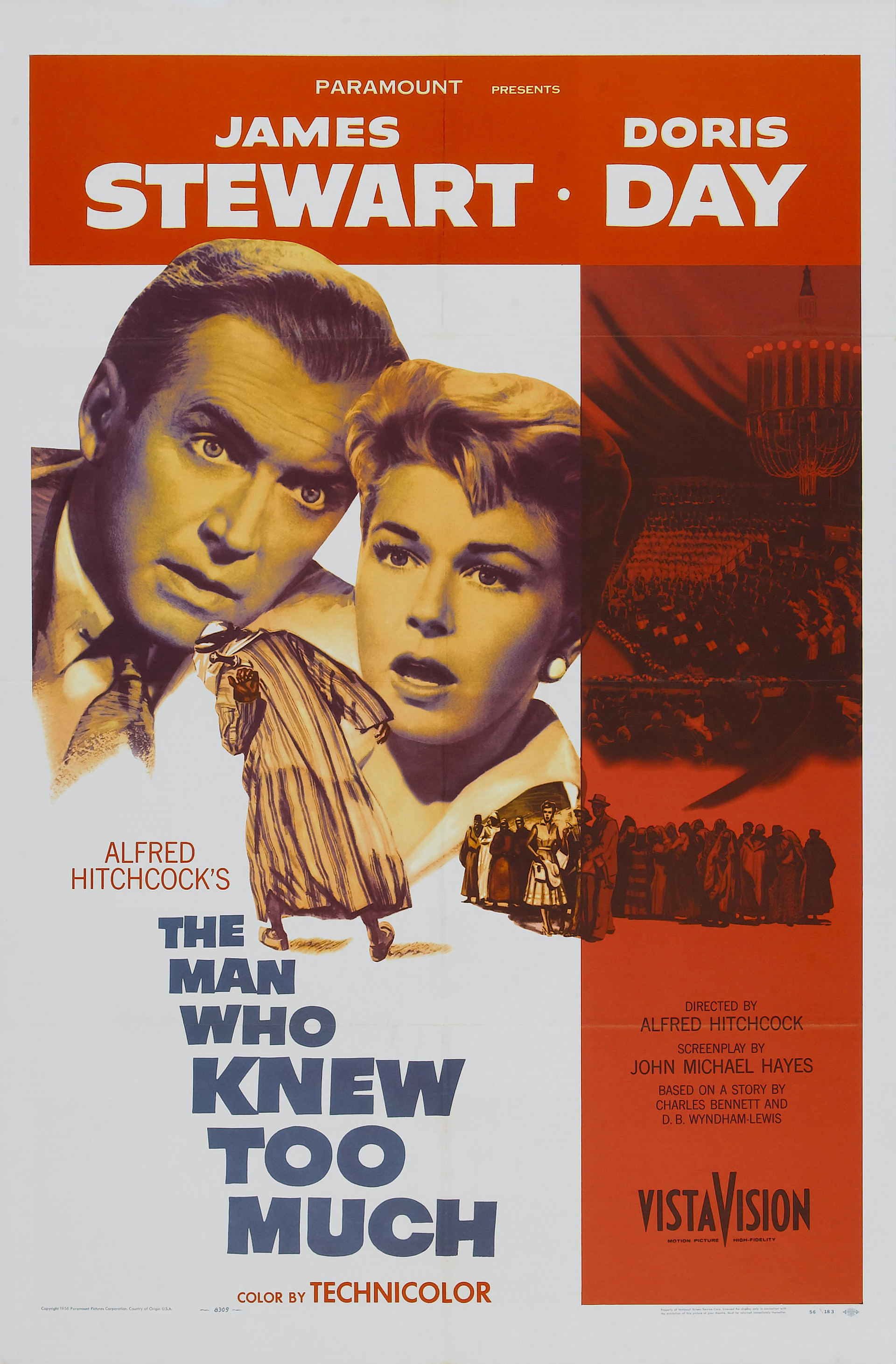
The Man Who Knew Too Much (1956)

the man who knew too much poster

I suppose if you were to pick anyone to remake the classic Alfred Hitchcock film The Man Who Knew Too Much (1934), Hitchock himself would not a bad choice. And that is just what the master of suspense did in 1956. In fact, this version feels more like an extended, director’s cut than a remake. The story is essentially the same. Ben (James Stewart) and Jo MacKenna (Doris Day) are vacationing in French Morocco with their son (Christopher Olson). They are quickly caught up in international intrigue and must try to stop an unknown diplomat’s assassination to keep their son from being harmed.

While the original stays mainly indoors keeping its action to a few set pieces. In this new version Hitchcock thrills in taking his characters and the audience, to wild, colorful places around the world. It begins in Northern Africa and here we see many lovely shots of the countryside. The action moves to London where there are numerous shots inside enormous, gorgeous buildings like the Royal Albert Hall.

The opening credit sequence is beautifully done. Hitchcock shoots a half orchestra playing the opening music. It takes a few moments to realize that the typical orchestrated number you are hearing over the credits is visibly being played by real people in the picture. This inventive bit is promptly ruined by an uninteresting title card played over the cymbalist.

I own the original 1934 version and recently watched it. Many debates are raging over the internet on which version is superior. Frankly, I find both versions to be lacking. The original was paced quicker but suffered from several jolts in the plot which created some confusion and no sympathy for the protagonists. The newer version tries to help this out by giving us long and unmoving scenes in which the protagonists try to stretch out their characters.

Jimmy Stewart does a marvelous job as usual, but Dorris Day is annoying in nearly every scene. She is pretty and plays the part of a normal, cheerful American girl, but she grits my teeth while she’s on the screen. Maybe I’m just not a fan. In a scene towards the end she sings “Que Sera Sera” and to my ears, it sounds like she’s howling the number. One could argue that she is singing loudly for a plot purpose, but I would say it would serve the movie better if it was pretty and not harsh. In an interesting bit of trivia, Ms. Day apparently didn’t like the song to the point of nearly refusing to record it. It turned out to be her biggest hit, and won the Oscar that year.

There is an ingenious bit of filmmaking in the latter 3/4ths of the movie filmed in the Royal Albert Hall. There are some 12 minutes when not a word of dialogue is spoken and the only sound heard is the music played by the orchestra. It is a beautifully crafted scene that builds tension like a bullet.

Several plot elements make me ill at ease. The Scotland Yard seems terribly inept. We are made to believe that these detectives are willing to allow the MacKennas to run around the streets of London trying to solve the crime by themselves even though Mr. MacKenna knows important details about the assassination of an important diplomat. Why would an assassin use a small pistol to kill the diplomat from a long distance? After the assassination attempt, why is everyone allowed to run free? There are other questions and inaptitude that go unanswered except to allow a movie to tie up loose ends quickly and move the plot along.

Hitchcock was a master at manipulating audiences. He is in fine form throughout this movie quickly moving the viewer through the scenery with a good bit of humor and suspense. This is not a bad movie by any stretch. There is a great deal to enjoy as a carefree audience member and for anyone interested in the craft and art of film. However, it is far from Hitchcock’s greatest film, and I find its flaws to be more disappointing considering the masterful hands that created it.