Blackboard Jungle (1955)

blackboard jungle poster

Ten years ago Larry Clark released his controversial film, Kids (1995), about teens having sex, doing drugs, and generally acting like delinquents. The world was shocked (SHOCKED, I tell you) that a film would depict teenagers behaving so badly. Surely, it was an exaggeration. There were exposes on the national news shows, and lines formed outside the theatres picketing and boycotting the pictures.

I had just graduated from high school a few months before I saw the film, and while I found the picture to be a good one the only shock I felt was that of disbelief that parents were so unaware by their children’s behavior. Those kids seemed a lot like the ones I went to high school with. Of course, kids were, and are, having sex and doing drugs. The quarterback of our football team bragged about having sex on the 50-yard line. Another used to tell us about having sex underneath the soundboard in the light booth of the auditorium (sorry Mrs. Patton). The headbangers used to make bongs out of stolen beakers from the chemistry lab.

They say similar reactions came from screenings of the 1955 classic Blackboard Jungle, and its depictions of juvenile behavior in an inner-city high school. After watching the film all I can say is that parents seem to be as unaware of their children then as they are now.

It’s not that the film is a bad one, in fact, it is rather good, it just seems strange that anything appearing in the film was controversial at one time. It feels tame by today’s standard.

It’s like Rock Around the Clock, the Bill Haley song that opens and closes the film, apparently caused quite a stir amongst moviegoers and critics alike. With songs by shock rockers like Marilyn Manson and Trent Reznor filling up the airwaves and movie soundtrack it’s hard to imagine how such a tame “oldie” could ever create the smallest wave of shock.

What we get from the actual film is a story about a high school teacher who takes his first job in an inner city school filled with all kinds of hoodlums. The teachers and staff that have been there for years are all content with simply maintaining some type of order. Of doing little more than surviving, and certainly not trying to do any actual teaching.

The new teacher, Richard Dadier (played superbly by Glenn Ford) actually cares about his students and wants them to succeed both academically and as fellow humans. Though he takes more than one beating (both philosophically and literally) he never gives up his task of being a teacher, of being a guide to those students.

The always impeccable Sidney Poitier, in one of his earlier roles, plays Greg Miller, an obviously intelligent student who acts as a leader for one of the school gangs. Dadier sees in Miller a chink in the student’s resistance and attempts to pull him into his side. Miller resists at first, but in a move that must be obvious to even the most half-hearted filmgoer, he eventually proves a powerful ally to the teacher.

It is here that my biggest complaint about the film lies. Much of the plot turns are telegraphed to the viewer way in advance. There is no doubt about how the film is going to end, nor even much of how it is going to get there. The film could use some real surprises, or at least bring to the table something deeper, or more original in terms of story.

That being said it is still an interesting ride to ride out, by the means in which the story is told. The acting is filled with fine, nuanced performances highlighted by Ford and Poitier’s scenes together. Director Richard Brooks adds some real tension to scenes in which we already know the outcome.

It is interesting to see films seeking to enlighten an audience by turning a blind eye to juvenile delinquency. It becomes preachy at times even beginning the film with a card noting the problem of the unruliness of the nation’s teenagers and that this must be stopped. That, along with some of the more trite plot points, it can sometimes feel like you’re attending a sermon, not watching a movie. It is to the director’s credit and the fine performances that the film mostly rises above the material and presents a solid piece of filmmaking.
The Apartment (1960)

the apartment poster

I came to this film expecting a light-hearted romantic comedy. Watching the trailer did nothing to eliminate this idea. The actual film is hardly light-hearted and is really rather sad, and dramatic.

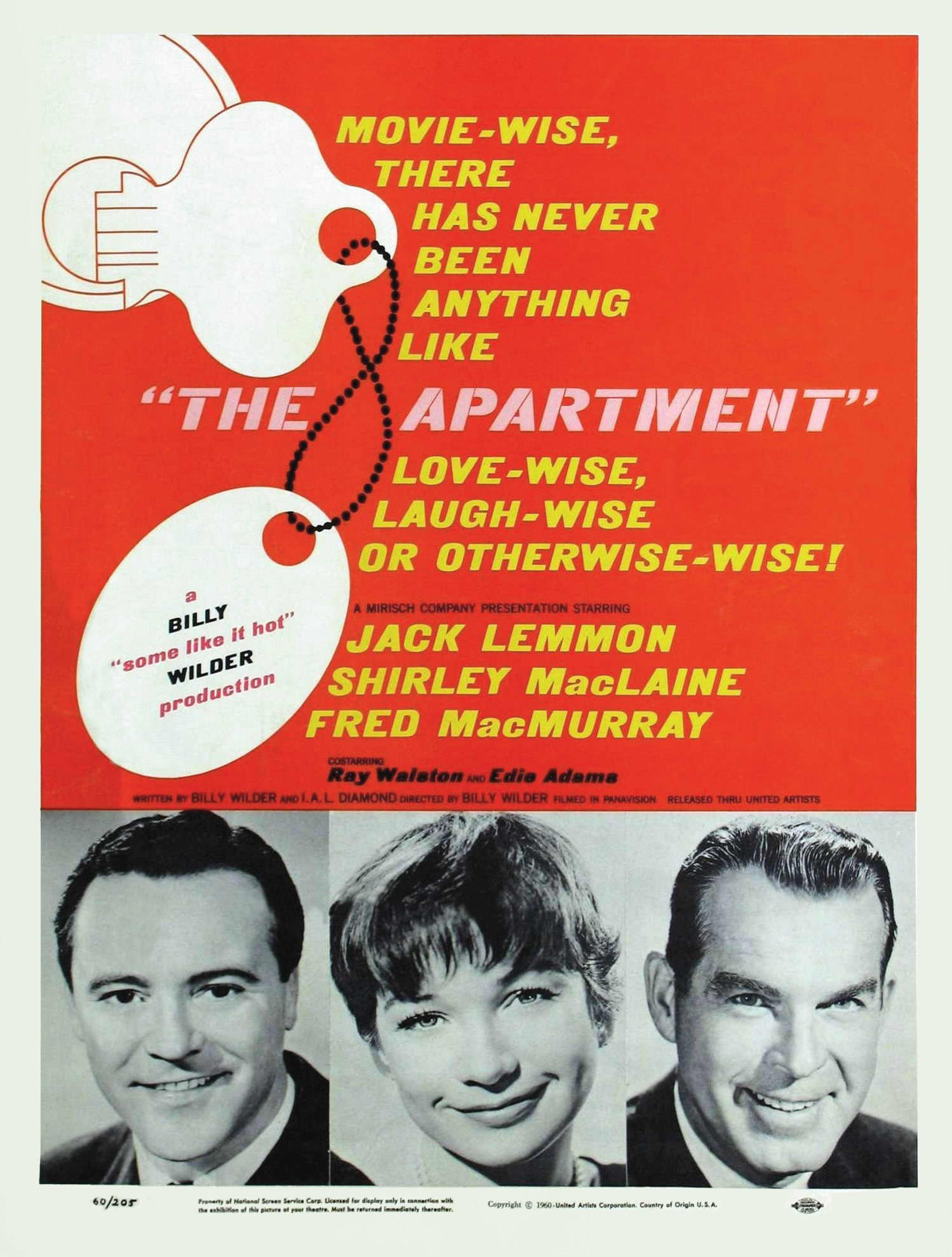
The setup is fairly antiquated and somewhat sexist. Jack Lemmon plays CC Baxter, a quiet gentleman working as a small cog in a very big insurance company. He also happens to have a very spacious apartment to himself. Word gets around the office about the apartment and Baxter’s agreement to not be home on certain nights. Soon enough every male executive in the office is hitting him for use of the apartment for evening trysts.

Though modern audiences probably grimace at such a concept, it is pulled off quite well. For the most part, the comedy remains intact. When I said that it isn’t a comedy, I don’t mean that there isn’t lots of humor to be found. It’s just that the drama is more involved than what we typically consider to be a comedy. There are some truly funny scenes one of which has Baxter getting out his apartment planner, and rescheduling several visits from the office men. In my favorite scene, he cooks pasta with a tennis racket.

The conflict of the film involves one of the top executives of the office, Mr. Sheldrake (Fred MacMurray), and a fun-loving elevator operator Fran Kubelik (Shirley MacLain). When Sheldrake begins using the apartment to rekindle his affair with Kubelik, he promotes Baxter at the office. Not knowing that Kubelik is Sheldrake’s love interest, Baxter begins courting her himself.

Tension builds up within the love triangle. Kubelik is not the fun-loving gal she at first seemed. As Baxter gets to know her better we find that she harbors some deep secrets and her actions take a downward spiral. The film becomes rather dark, rather grim. It turns even bleaker when the principal joke wears thin. It seems the only thing holding back every married man from having an extra-marital affair is a nice place in which to have it. There isn’t a man in the cast, except Baxter, who has the slightest moral aptitude.

Billy Wilder is one of the great directors of American cinema, and it certainly shows here. Instead of going for a more slapstick approach, and the material certainly could have been handled that way, he turns it into a more touching drama.

The three characters involved in the love triangle are all superbly acted. Lemmon and MacMurray are both at the top of their game. And MacLain reminds us that she was not always the kooky old lady waxing nutty about past lives. Here she is a beautiful screen presence and holds her own against the two male leads.

What I thought was going to be a light-hearted, fast-paced romp in the vein of Some Like It Hot, turned out to be a rather poignant, sad tale of the complexities of life. This was a little disappointing while watching the film, but after letting it sit inside the recesses of my mind, it has become one of the great films I have seen. This is not to say there isn’t a comedy, but instead of jokes, the comedy comes from within the characters themselves. As in life.

Talk To Her (2002)

talk to her poster

A friend of mine recently lent me her Chinese bootlegged copy of Talk to Her. I have seen a few other Pedro Almodóvar films and expected another tale filled with bizarre violence and kinky sex. What I wasn’t expecting was a rather moving tale of unrequited love.

Talk to Her reminded me quite a bit of the films of Todd Solondz. Like his movies, this film manages to make characters who commit rather heinous acts quite sympathetic. Equally alike, Talk to Her deals with the immense loneliness of its characters.

The story begins with a chance meeting between Marco (Dario Grandinetti) and Benigno (Javier Cámara) at a dance recital. Neither man knows the other, but they happen to have seats that are side by side. They later meet again at a private hospital, where Benigno is the caregiver to a beautiful dancer, Alicia, who has been comatose for several months. Marco is there visiting his girlfriend, a bullfighter who was recently gorged by a bull and is likewise comatose. A friendship builds between the two men, as they care for the women they love, though they cannot be loved back.

The film’s title comes from Benigno’s insistence that Marco speaks to the women as though they could hear him. He urges Marco to open up and tell his lady the intimate details of his life. Benigno is deeply in love with Alicia and treats her as if she was his lifelong lover, though she cannot respond in any way.

The film is very subtle and nuanced in meaning. Both men, though apparently quite heterosexual, spend most of the film in more standard feminine roles. They are the caregivers: washing, cleansing, and taking care of the women. Benigno is a male nurse. They become very good friends, and indeed seem to love each other deeply, yet they are hopelessly devoted to women who are deemed hopeless, doomed to never awaken from their coma.

Neither Benigno or Marco really knew these women in their waking lives. Benigno watched Alicia in her dance classes, from across the street, through his window. Marco had just recently met Lydia, interviewing her for a magazine, and finding the beginnings of romance. It is really only through their caring for these women while they are asleep that they begin to feel love for them.

Almodovar is careful to portray the characters as sympathetic while still tainting their devotions with something sinister, something perverse. As the stories conclude, one character’s actions become slightly horrific, and yet we still feel sympathy for him. Almodovar understands life’s complications and that it is too easy to broadly label people as one thing when reality goes much deeper.

In keeping with the kinkiness of his prior films, Almodovar throws in a sequence with Benigno retelling a silent film he watched recently. It rivals the bathtub scene in Tie Me Up, Tie Me Down, and inside the cheerleader’s pants scene in the USA Up All Night classic, Getting Lucky. Let’s just say for lovers of perverse, whacked-out cinema, it is a must-see.

Ultimately, Talk to Her is a bizarre, but moving portrait of unrequited love, friendship, and the complexity of human life. It is undoubtedly a difficult film emotionally, but one definitely worth sitting through and contemplating.

Sweet Smell of Success (1957)

the sweet smell of success poster

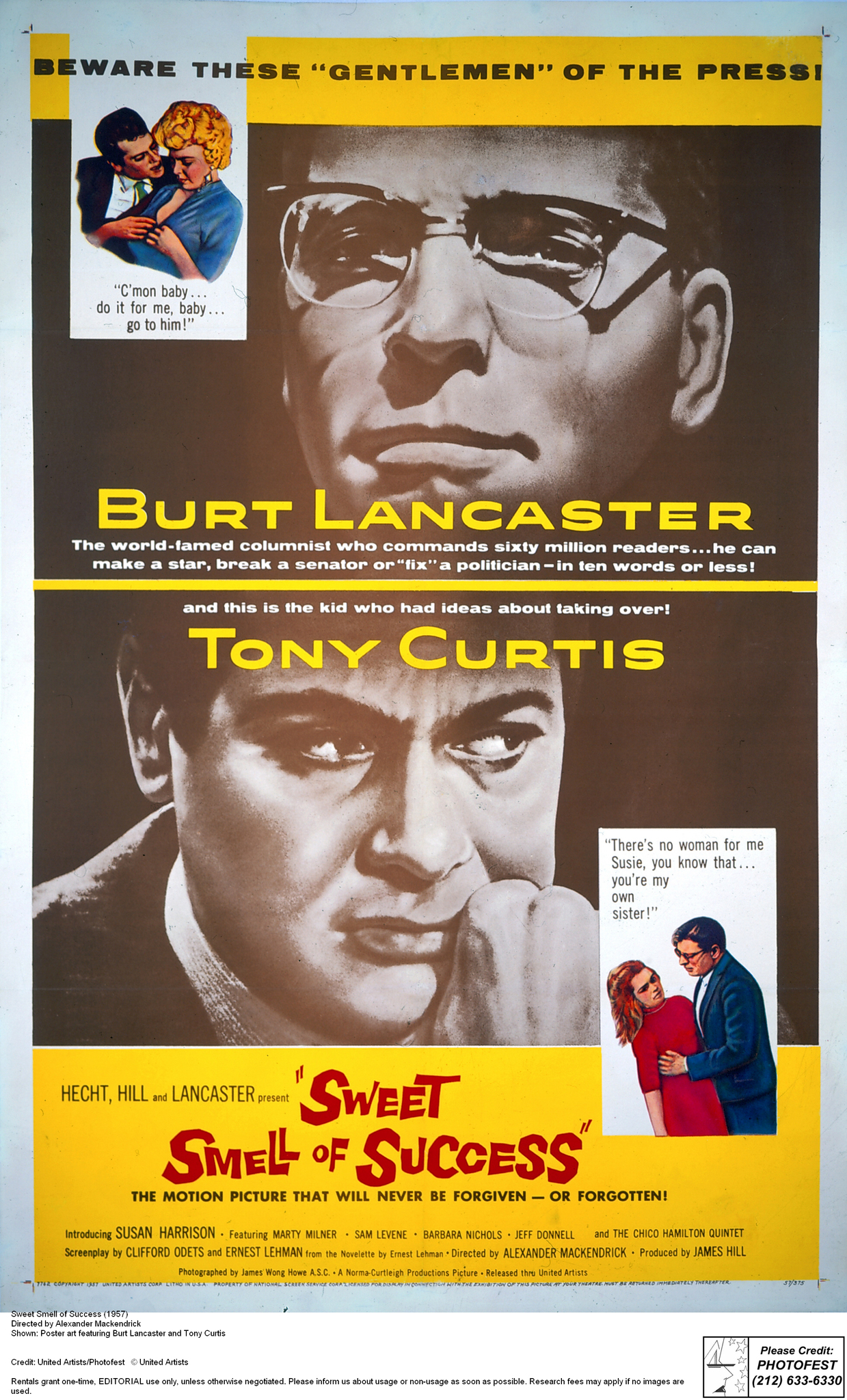
This is the kind of film that could coin an expression like “They don’t make ‘em like that anymore,” except that people have been using that line for every piece of crap that was made more than two years ago. Go ahead and say it to yourself, and I’ll say that David Mamet’s Glengarry, Glen Ross comes close. Both feature snarling and biting dialog. Both have irredeemable characters that will do anything for success. Mamet’s characters are mostly down-and-outers who are scrapping at each other to find some sampling of their former successes. In Sweet Smell of Success, there are successful characters and losers, both of which need each other to survive. It is a tale of a successful columnist and his need for a low-life press agent. It is a bitter, bleak story of power, success, and the desire to have more.

Burt Lancaster plays JJ Hunsecker, a powerful columnist who is at the top of his game. He gets what he wants when he wants it with no questions asked. He can make or break celebrities with a quick blurb in his column. He dines with politicians and gets any girl he wants. Tony Curtis is Sidney Falco, a low-rent press agent who needs Lancaster’s blurbs for his clients to keep in business. The problem is, Hunsecker has cut Falco out of his columns because Falco hasn’t delivered on a deal they made. Though Hunsecker can garner the love and admiration of anyone he chooses, the one woman he cannot win over is his own sister. As he repeatedly says throughout the film, she’s all he has. The problem is she is in love with a jazz singer, and they plan to marry. Hunsecker can’t bear the thought of losing his sister, so he forces Falco to get rid of the boy by any means necessary.

The film is relentless. From beginning to end it never stops its pounding. There is never a breath of kindness. The two characters with some redeeming characteristics Hunsecker’s sister, Susan (Susan Harrison), and her boyfriend, Steve Dallas (Martin Milner), are so overshadowed by the continual foul play by Hunsecker and Falco that they come away with a foul stench.

Tony Curtis pulls a performance that reminded me of his turn as the Boston Strangler. It is not difficult to see his Falco turning to murder if it helped him succeed. Though as the strangler, he seems to have found some remorse for his actions, whereas Falco is irredeemable to the very end.

There is a scene in the middle of the picture where Falco pulls a trick to convince a mid level performer to make Falco his press agent. At this point, Falco needs all the clients he can get. Later the performer comes to Falco, ready to sign him as his agent. Falco, now feeling some signs of success brushes the performer off without a second thought. It is a telling scene of just how heartless and uncaring Falco has become.

Where has Burt Lancaster been all my life? Sadly enough, the only film I can remember watching him in is the 1986 toss-off comedy Tough Guys. His performance here is nothing short of astonishing. He is the king of his castle, never stepping off his high throne, treating everyone as servants. Even his shows of affection for Susan are grotesque and menacing.

This is a story that is hard to watch. It is brutal, and menacing with nary a redeeming aspect. But it is a film that must be watched. The craftsmanship of the filmmakers and the performances of the actors elevate it above so many others. It is nearly a morality tale of the horrors that befall humanities greed.

The Elephant Man (1980)

the elephant man poster

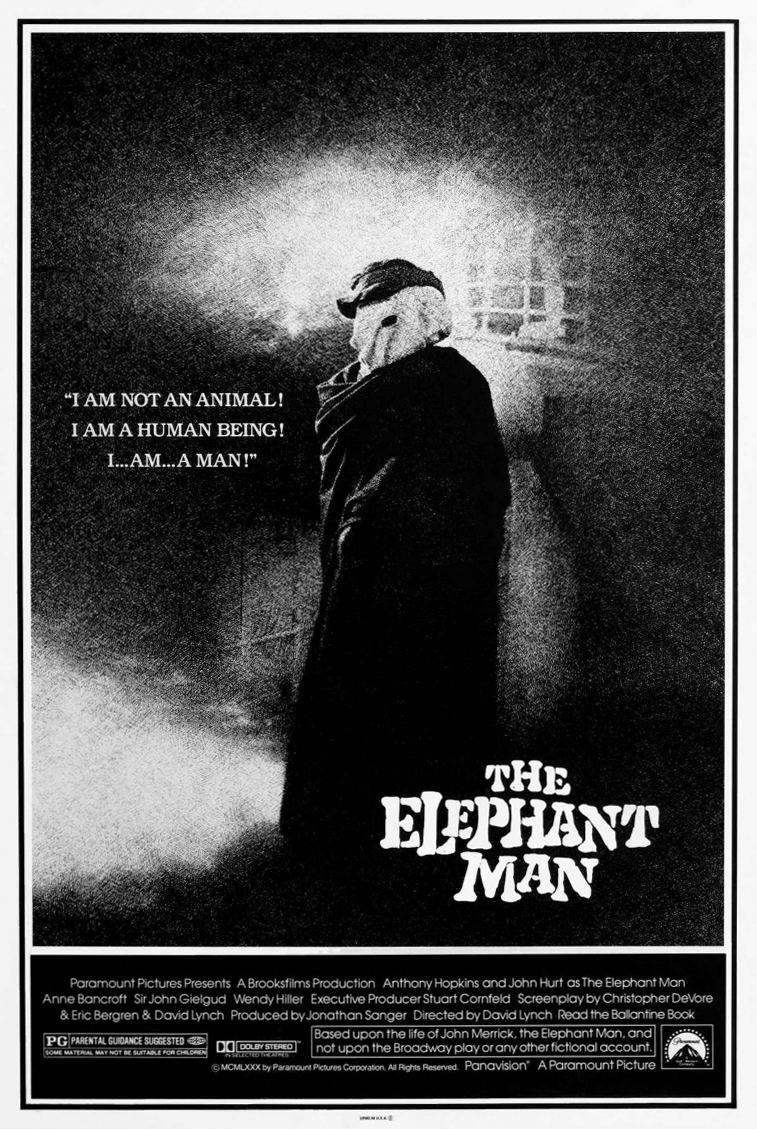
David Lynch’s second full-length film contains the odd assortment of freakish characters we’ve become accustomed to in his films. Yet, despite having one of the more outlandish characters he has ever put on celluloid, it remains his most sentimental film. The Elephant Man is based upon the true story of John Merrick, a 19th-century Englishman with massive deformities throughout his body. He performed in freakshows for many years until he was found by Dr. Treves who cared for him and placed him in Whitechapel hospital. It is his time in this hospital that the film concerns itself with. For here, Merrick is able to live, more or less, as a gentleman. He is well-fed, well-kept, and educated. He can read, write, speak eloquently, and even begins to entertain the well-to-dos of society.

It is filmed beautifully in black and white. It is a very well-made piece of cinema. Lynch, for the most part, stays away from his trademark imagery and symbolism and sticks to more traditional storytelling, although the opening sequence is a straight Lynch nightmare. That the characters come from real life and not Lynch’s twisted imagination only serves to add to the surrealism of the film.

It has been said that Lynch is too sentimental in this movie. That he manipulates the audience too much. Ebert even goes as far as saying Lynch tricks the audience into believing that Merrick is a noble and courageous man. He suggests, that rather than being noble, Merrick is merely doing the best that he can, under poor circumstances. It is true that the film is sentimental. There is hardly a scene that does not prick the audience’s emotions.

How many of us would dare to get out of bed each day with similar difficulties? And here, this man, though physically plagued, manages to keep up his spirits and even write and build card sculptures. It would be a poor director at that who could not produce a tear at such a sight. If we pretend it is not a noble feat for such a creature to retain his humanity and good cheer, while being constantly bombarded with inhumane indecencies are we any better than those who stand outside the carnival and jeer?

Yet there is something in these critiques of sentimentalism. Lynch continues to use his tricks as a director to keep our eyes wet. There is a scene in which Merrick meets Dr. Treve’s wife and breaks down with tears at her simple kind acts. His tears state that no one has been so kind to him as to treat him like a gentleman. Though effective, this is using the craft of filmmaking to do nothing but manipulate emotions. In other films, I would lambaste this type of sentimentalism and chastise the audience for falling for it. Yet the overall sadness throughout the story makes me fall for it here. I cannot commend such use of it in the film anywhere, and yet it works for me in this particular instance.

Overall, The Elephant Man is a fine achievement for a young director. Lynch would go on to make more articulate, less sentimental films. But here we find him assured in his imagery and storytelling. He effectively sweeps the viewer into the emotional turmoil of such a sad, hopeless story.

Shadows and Fog (1991)

shadows and fog poster

Editors Note: I wrote this long before I knew of the various accusations against Woody Allen. I have no comment to make about those allegations, but as I am reposting this review in 2022 I wanted to note that this is not any sort of endorsement of Allen as a human being, but simply a review of his film.


Woody Allen’s tribute to German Expressionism is better than most critics would have you believe. Sure there is very little plot to speak of, it’s more a series of vignettes and gags than a cohesive narrative. Sure, it ends rather abruptly, never solving the mystery, but none of this stopped my thorough enjoyment of this film.

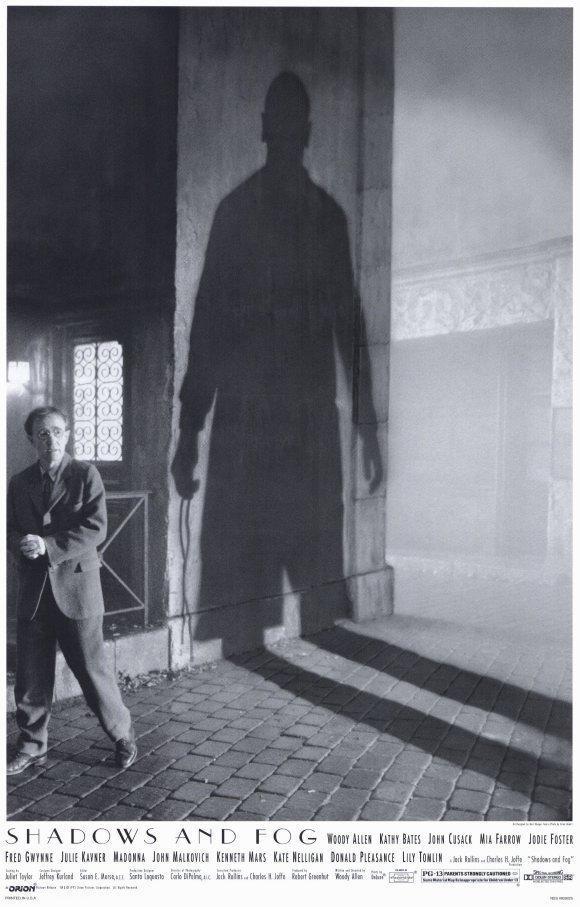
As the title suggests the entire movie is designed in shadows and fog. Shot with beautiful black and white photography, Allen and cinematographer Carlo Di Palma create the look and feel of an unnamed East European city as seen in such films as M and Nosferatu. The lighting is set up so that in nearly every shot underlying shadows engulf the scene. In the exteriors, a vicious fog rolls across the night sky obscuring most details. Through the fog bumbles Kleinman (Allen is his typical neurotic schmuck role) trying to find his role in a vigilante mob’s plan to stop a serial killer roaming the streets. From dark night until dawn, Kleinman wanders from place to place meeting a wide variety of curious characters (played by an even more curious group of celebrities), the most endearing of which is a desperate sword swallower (Mia Farrow)who has wandered into a brothel after fleeing her cheating boyfriend/clown (John Malkovich).

It is a little unsettling to watch Allen do his normal schtick while the characters around him are murdered, subjected to racial prejudice, and beaten by the police while discussing such subjects as love, sex, and meaning. There is a subtext involving the plight of the Jews between the World Wars, foreshadowing the Nazis. Yet the gags remain as solid as any Woody Allen film. Amongst the seriousness of his subtext and the films he is paying homage to, Allen finds a way to bring full-bellied laughter. Though his quirky neurosis isn’t as resolutely hilarious as it is in such films as Annie Hall, it is still enough to fill the film with mirth.

The film ends rather abruptly with Kleinman having never learned his role in the plan, nor the killer having been caught. Yet as the credits role we realize the mystery was not so much the reason behind the story as a method of creating it.

American History X (1998)

american history x poster

There are spoilers. Read at your own risk.

It has been many years since I have seen this film. My memory attested it to be an excellent picture that meaningfully discussed issues as heavy as race relations, prejudice, and hatred. Unfortunately, my memory is a little at fault, and upon viewing it this time I found it a bit disappointing. The film sets its sights on the heavens, and while succeeding in many ways, it could not attain such a lofty height. In trying to cover all the basis in such a thorny issue as race relations it cheats a bit in its storytelling. But we’ll cover more of that in a bit.

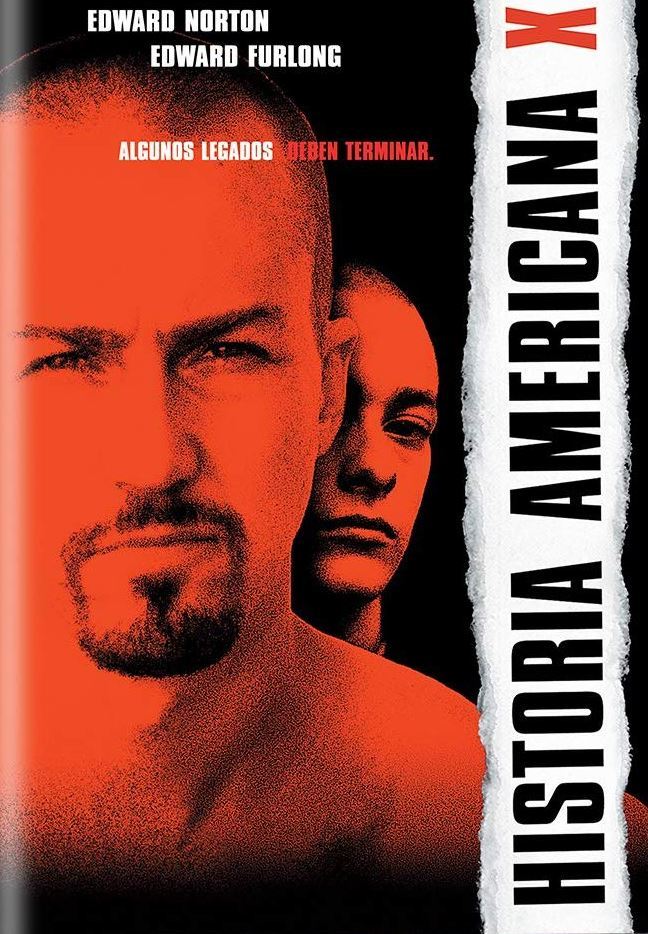
The plot involves a young, white man named Derek Vinyard (Edward Norton) and the tumultuous 24 hours after his release from prison for killing two black men, while they were trying to steal his car. Much of the story is told in a flashbacked black and white. Here we learn that Derek was a Neo-Nazi skinhead leader who had a change of heart after his stint in prison. Post-prison time is being spent trying to keep his brother, Danny (Edward Furlong) from following in his footsteps. A path he is already walking down.

This is a powerful, moving film. Reading the boards on IMDB will attest to lives being changed through watching it. It works best when it shoots for an emotional response, rather than an intellectual one. Scenes such as when Edward Nortan’s skinhead leader rallies the troops to loot a local grocer, the opening scene where we see Norton kill the two aforementioned black men, or a traumatic rape scene in prison, emit a guttural response from its viewers. It is in such scenes that we are rallied into a discourse on the issues presented. Yet when the film gets talky it falls short of its ideals. It presents nothing beyond the general rhetoric you can find just about anywhere. In fact, most of the rhetoric is spewed from the Neo-Nazi skinheads, and this type of discussion can be found every other day on daytime talk shows. There is little in way of discussion from the rational, unprejudiced mind.

There are two powerful performances from Edward Norton and Edward Furlong. At this point Norton was already beginning to take his role as the new Robert DeNiro, who had previously taken his turn as the new Marlon Brando. Let’s hope he escapes the fate of mediocrity that they fell into. Furlong who once made Arnold Schwarzenegger look like Laurence Olivier with such a wooden performance, here has finally made himself worthy of attention. He gives a fine performance here, as a young man struggling with the passionate feelings of youth.

Tackling an issue as heady as racism in America is a worthy, yet difficult cause. It proves to be too much for first-time screenwriter David McKenna and director Tony Kaye. Trying to condense their story into regulation movie time they either skipped over completely or barely touched on some important issues. To give reasons for Derek’s turn as a skinhead we are only allowed one small dinner table conversation with his father who spews some hateful race sentiments. This and his father’s murder at the hands of black addicts in a crackhouse, whom he was trying to save from fire must suffice for an intelligent, middle-class youth to turn into a Nazi. Likewise, his subsequent salvation in prison does give us sufficient reasons for this turn of heart. Yes, the skinheads in prison are hypocrites, and yes the rape scene is brutal enough to turn away from their midst. But, his relationship with his black coworker, Lamont (Guy Torry) is not enough to change the heart of such hatred. Torry gives a fine performance, and does enough to show Derek that all blacks aren’t as vile as the rhetoric made him believe, but are jokes about sex really going to make a skinhead believe in the goodness of the black race?

In searching for a cause behind the Neo-Nazi scene in America the filmmakers seem to point directly towards the intense feelings of anger found in adolescence and the need to fit in with some social group. And rightly, these two issues play powerfully on the minds of many in the skinhead culture. But the issue goes deeper than this, and it is here, again, that this film misses the mark. Just as Derek dismisses issues of poverty, and social position in the plight of the black man this film seems to skim over some of the deeper motivations behind racism.

Don’t get me wrong. This is a powerful, well-made film. There is plenty to chew upon and discuss. It is, in fact, a good film to watch with others and bring to light an important debate. Yet when I watch it I can’t help but think of how it could have been better, how it could have reached the heights it was reaching for.

Khartoum (1966)

khartoumt

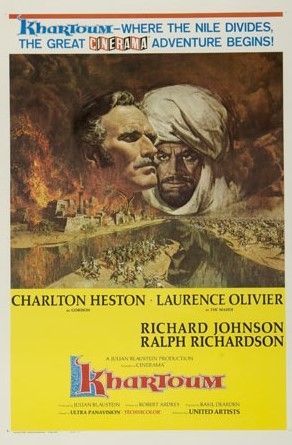
One of the fun things about going to the library is that you never know what you are going to get. They have a wide selection of DVDs, but very few are available at any given time. I was surprised this last time when I actually had a choice to pick from. Albeit it was a choice between 2 films (the few others available were either foreign films translated into French or straight French films). The choice was between the Gary Cooper version of A Farewell to Arms and an unheard-of by me Charlton Heston/Laurence Olivier adventure called Khartoum. Not in the mood for Hemingway, I decided a Heston/Olivier picture might be a treat.

To say this is a Laurence Olivier picture is to say too much. Though he gets top billing, and his character plays an important part in the picture, his actual screen time is minimal. He plays a part known only as The Mahdi, who is a Muslim that rose out of the desert to claim his place as the chosen one. I believe Olivier is an African Muslim like I believe Heston is a Mexican cop. But we suspend our disbelief and all that for the sake of the story.

As it is the story is a grand one. Based on historical events, of which, sadly, I’ve never heard a lick of until this film, where the Mahdi attempts to take control of British ran Sudan. The mysterious General Gordan (Charlton Heston) is sent down to help things along. A standoff evolves and it is wit against wit.

It is not a bad film, but neither is it a great one. There are some truly beautiful shots of the scenery. Heston plays Gordan without as much conflict as the character requires, but with enough gusto to make it believable. Olivier is, as always, near perfect. With simple facial expressions, he carries the convictions of a man who believes himself a prophet. The scenes between Olivier and Heston, though historically inaccurate, add a much-needed emotional punch. The direction is a bit plodding, nothing particularly bad, but nothing exceptional either.

When watching historical films such as Khartoum, having some connection with the actual events helps bring meaning to the picture. Films based on the holocaust are often forgiven some of their cinematic sins due to the weight of the history behind the story. Yet, historical films that are not as well known can also entrance the viewer through the weight of their story. Knowing that the events actually happened often stir the viewer to greater emotional depths than a depiction of completely fictional events. It is here that Khartoum failed for me. As I said there was nothing particularly wrong with the production, but it never really captured my emotions. Admittedly I know very little about British history or the struggles of the Mid East beyond the years of my own life. This is a fault of my own, yet a film should be universal in its undertaking. If it fails to move an audience unfamiliar with its history then it will likely fall into obscurity. For those familiar with this particular history, the film may bring more to you than it did me. As for me, it was a mostly entertaining, and an interesting couple of hours in my life, it will be one that will largely be forgotten in time.

Out of Sight (1998)

out os sight poster

When I purchased my DVD player, I wanted to only own the old classics and excellent new, indie films. The first DVD I purchased was Steven Soderbergh’s Out of Sight. It had the indie cred I desired, plus it was by a director I admired. And I am the type of person to admire directors over actors, and genres. Plus it didn’t do well at the box office so I could feel justified in my ability to overlook the big blockbusters and snuggle into something small and arty.

I have since realized that trying to impress some film buff that will never show himself at my house is both immature and not very practical. After a few additional classics (2001, Taxi Driver, and Evil Dead II) I came to realize that there are some extremely popular DVDs that are must-haves. It’s hard to claim indy cred when you’re picking up Jaws and Animal House. Plus my DVD player came with free copies of crap like Michael and Basic Instinct. Add that to the odd assortment of movies I keep picking up as gifts and swiping from my brother via Mom and you have a whole heap of DVDs not worth bragging about.

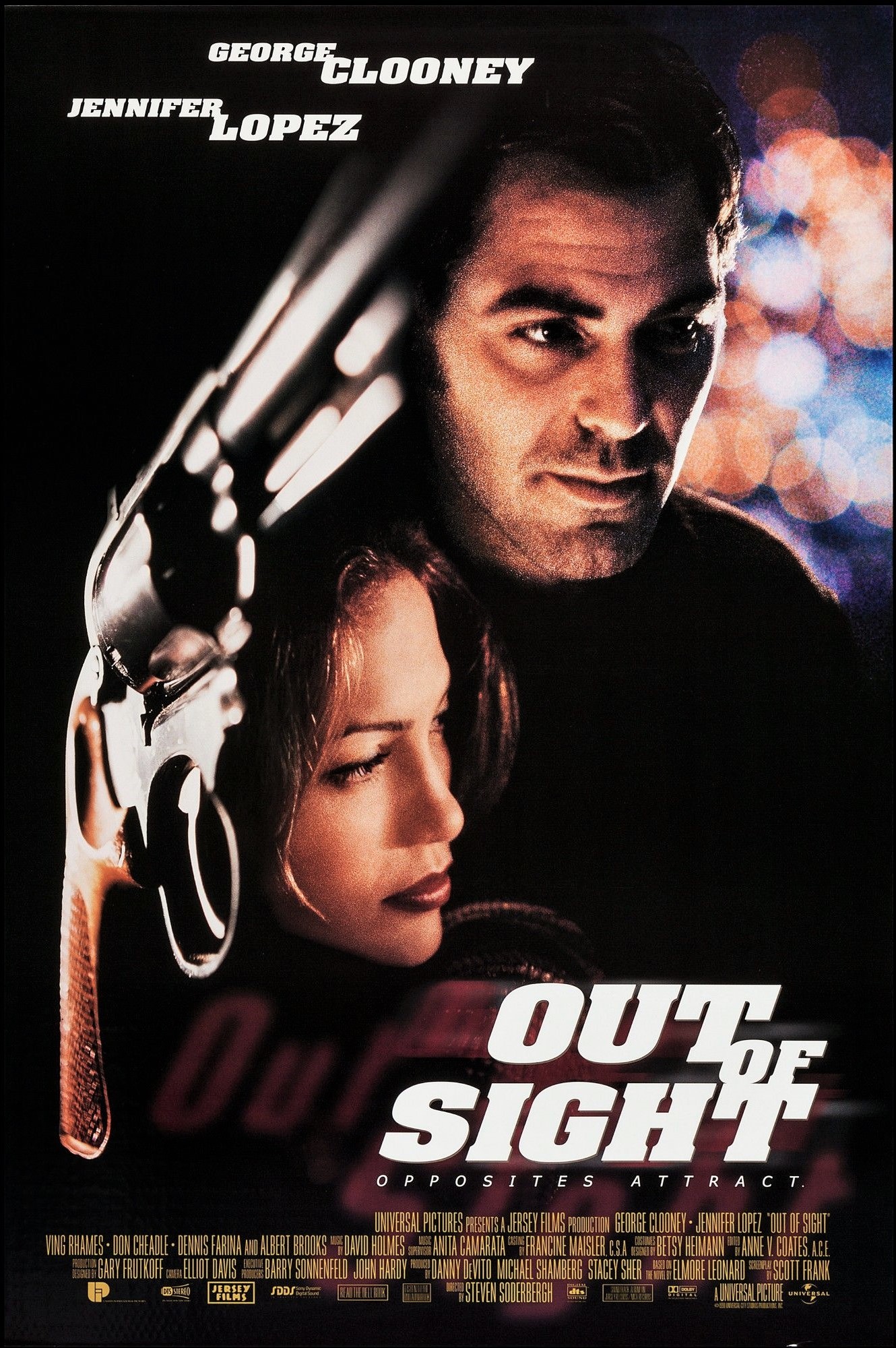
All of this is simply to say I like Out of Sight a great deal. I have watched it every six months or so since I bought it 5 years ago and have never been disappointed. It is a crime story more interested in characters than crime. Though some of the plot points are on the implausible side, the film is so overwhelmingly enjoyable it is easy to forgive such faults.

Soderbergh is a talented artist, though as a director he is a bit of a mixed bag. He has created some truly brilliant films (Traffic, the Limey) but also a few bombs, artistically speaking (Full Frontal, Oceans 11). After starting the indie revolution with Sex, Lies, and Videotape he created the first of several experimental films, Kafka. Thus developing a theme for his films: smart, original films followed by artistic experiments that mostly fail. With Out of Sight, he began what I would call his attempt at being mainstream. It is based on an Elmore Leonard novel, produced by Danny DeVito and Barry Sonnefeld, and stars a couple of up-and-commers looking for a hit. For those of you that scoffed at my labeling, this movie “indie” do understand that this movie was pre-Erin Brokovich, Traffic, or the Oceans series for Soderbergh.

George Clooney was a television star from ER but had yet to have a successful movie. And Jennifer Lopez was still Jennifer Lopez rather than J.Lo, Jenny from the Block, or Bennifer. In 1992 it was, well, not exactly an indie movie, but it definitely was not a sure-fired blockbuster. Point of fact, it rather bombed at the box office.

Soderbergh tends to be his own director of photography in his pictures. By his own admission, this is more because of his method of producing pictures quickly, than of his own expertise at this skill. Though he does do a good job at it. In fact, one of the first things I noticed about the picture, was its use of light. There are two prisons seen in the picture, and both are given a different enough look that you can easily tell them apart. During the scenes in Miami, the lighting is very bright and sunny. Soderburg intentionally over-lighted the windows for interior shots to give the outside a particularly sunny look. Detroit is shot in a lot of blues that give an added feel of cold and separation.

Each character is given a chance to shine. There are no flat characters designed to move the plot along. Rather they are fleshed out and appear real. Clooney and Lopez show real chemistry on screen and you begin to believe that a US Marshall could actually fall for an escaped bank robber. I have never seen an episode of ER and my buddies and I used to make fun of Clooney for his charming good looks and general star quality. This is the film that began to change my mind and understand him for the fine actor he has become. This film also made me believe that Jennifer Lopez was a fine actress and someone to look out for. But, of course, she quickly became a caricature of herself and has not done anything since then to make me a believer.

I love this film. It is a crime drama that pays more attention to the character than the crime. It is romantic, without being schmaltzy. It is funny, without shooting for gags. It is a well-made, competent movie that holds up on repeated viewings. I can still brag that it holds a place on my DVD shelf.

Ride With The Devil (1999)

ride with the devil poster

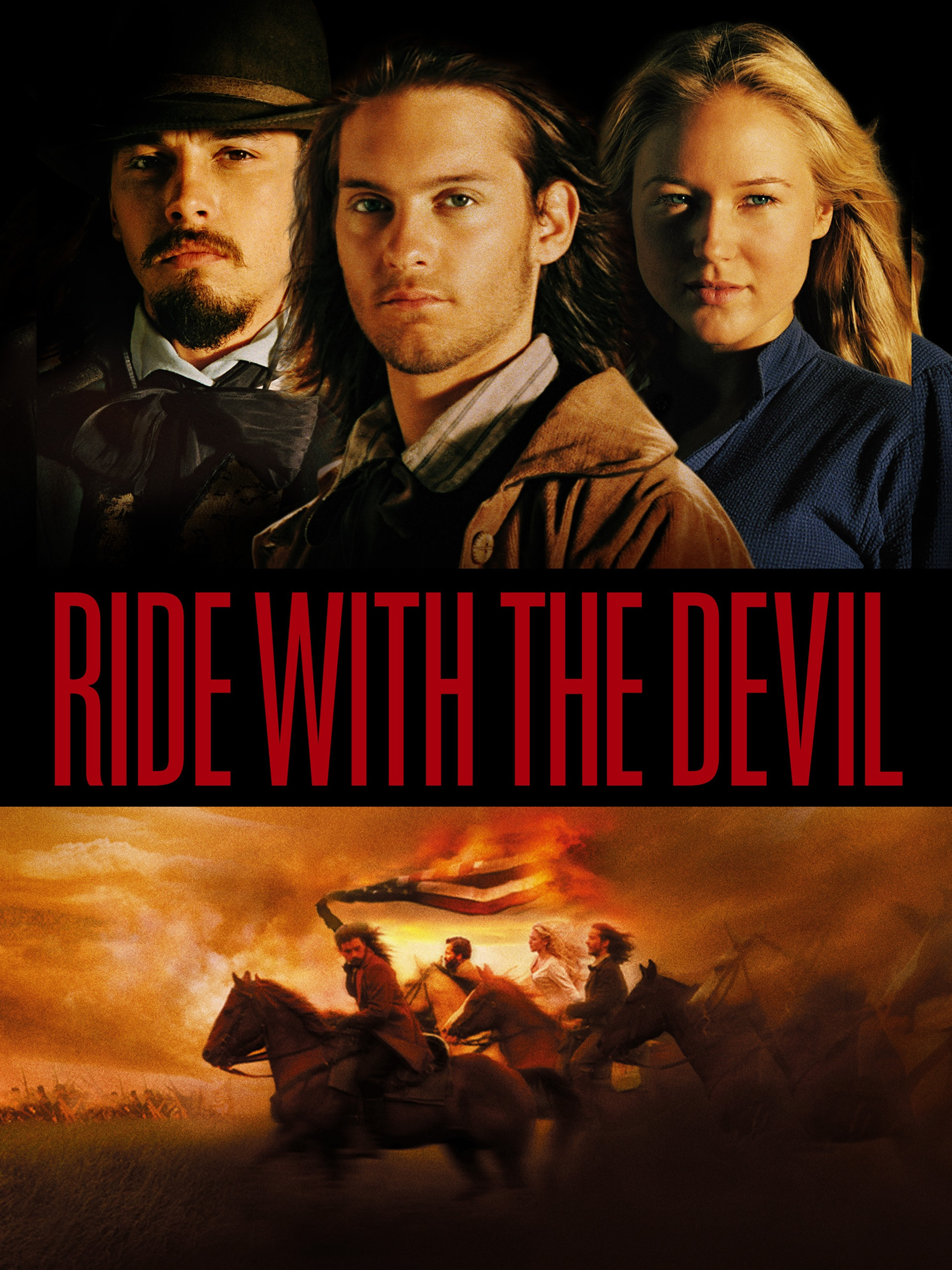
Director Ang Lee chose to follow up the excellent drama, The Ice Storm (1997), with an epic Civil War film. The filmmakers put in much work to ensure that it was as historically accurate as possible. And on this end, they did a wonderful job. Yet as a viewer of the film, with limited knowledge of Civil War history, many of the details seem false. Yes, there were black men who fought on the side of the South. It is true that there were many, intelligent, courageous, and even good men who fought for the South as well. However, true as these things may be, my 21st-century mind had difficulties believing them.

It goes against the grain of traditional Hollywood war, or even action, pictures. Our main characters are fighting on the losing, and wrong side. (Yes, there were many other factors contributing to the Civil War besides slavery, but this film does not get into them, and so neither shall my review.) We watch these characters commit many atrocities, including the murder of innocent people. Yet it also shows soldiers from the North committing similar atrocities. It seems more like a film depicting the horrendous actions of coming-of-age men than any real declaration on the themes of the war itself.

There have been great movies made from the perspective of the wrong. These films show how even soldiers fighting on the wrong side of war are still human. They have families, loved ones, hopes and dreams. If done well this type of film can show us the humanity in each person, and the atrocities of war. Yet in Ride with the Devil, I never learned to care about any character. With few exceptions, the men we watch in this movie, are not sympathetic. Even the few with redeemable qualities are not given the space for us to care about their lives.

The story centers on a small community within the grand scale of the war. It takes place in Missouri, where literally brother fought against brother on both sides of the battle. Jake Roedel (Tobey Maguire) and Jack Bull Chiles (Skeet Ulrich) play friends who run off to join a gang of outlaws fighting on the side of the South. Here they meet George Clyde (Simon Baker) and a black man named Daniel Holt (Jeffrey Wright). Holt’s reasons for fighting for the slave minded are only slightly revealed toward the end. Yet it is his relationship with the other three men that make up the central theme of the film. As each of these characters learns to trust and care for Holt, they must question the sense of fighting a war bent on keeping his fellow brothers enslaved. It is to Ang Lee’s credit that he uses subtle hints to follow this theme rather than pounding it in with a sledgehammer. The characters change and evolve, but in slow, slight movements that resembles real life rather than movie life. Even at the end of the pictures no one has made new resolutions with life or changed their beliefs drastically.

The action sequences, though well directed, still fall flat. Lee is unable to stir any real emotion out of the war’s central motives or the intensity of its loss. It is when Lee focuses his attention on the relationships between his characters that this film succeeds. This is not surpassing when considering Lee’s earlier films were small films focused on familial relationships. The bonds that grow between Roedel and Holt are moving. The love story between Sue Lee Shelley (a surprisingly good Jewel) and her suitors (to give names would be to give too much plot away) is also a treat. In Lee’s next picture, Crouching Tiger, Hidden Dragon (2000), he found a way to entwine both beautiful action sequences and smaller, meaningful exchanges of love. Here, he seems to be still growing into this ability.

For Civil War buffs this film offers a reliable package of history. For the rest of us, it is a well-made film that ultimately doesn’t generate enough interest to really care.